Omar Abdullah Meets Amit Shah Over Statehood, Reservation Reforms & Pending J&K Files
By: Javid Amin | 11 May 2026
High-Stakes Delhi Meeting: Omar Abdullah Pushes Pending J&K Files Before Amit Shah
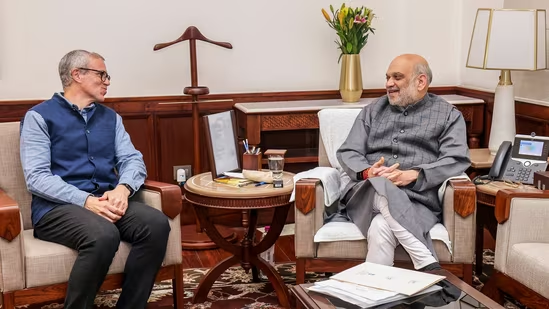
A politically significant meeting between Omar Abdullah and Union Home Minister Amit Shah has drawn national attention as several crucial governance and policy files concerning Jammu and Kashmir remain pending with the Centre.
The discussions, held on May 11, 2026, come at a critical moment when the Union Territory continues to grapple with unresolved questions surrounding statehood restoration, administrative powers, reservation reforms, and governance restructuring.
The meeting also unfolded against a backdrop of mounting political pressure from opposition parties, rising public frustration, and increasing debate over the balance of authority between the elected government and the Lieutenant Governor’s administration.
Key Files Awaiting Centre’s Approval
Several major proposals from the J&K government are reportedly stalled pending clearance from New Delhi.
These files are not merely administrative matters — they carry deep political, constitutional, and social implications.
1️⃣ Statehood Restoration: Omar’s Core Political Demand
The most politically sensitive issue remains the restoration of full statehood to Jammu and Kashmir.
What Omar Abdullah Said
Omar Abdullah reportedly reiterated that:
- Restoration of statehood remains his government’s top priority
- The issue cannot be resolved in a single meeting
- The process requires sustained political engagement with the Centre
However, indications from New Delhi suggest the Centre continues to view statehood as a gradual and phased process rather than an immediate decision.
2️⃣ Business Rules Notification: The Governance Deadlock
One of the most crucial pending files concerns the Transaction of Business Rules, which define the powers and responsibilities of:
- The Chief Minister
- The elected Cabinet
- The Lieutenant Governor (LG)
Though reportedly finalized, the rules have not yet been officially notified.
Why This Matters
Without clear business rules:
- Administrative authority remains ambiguous
- Decision-making slows down
- Governance overlaps emerge between the CM and LG
Political observers say this uncertainty has weakened the functioning capacity of the elected government.
3️⃣ Reservation Reforms: A Highly Sensitive Issue
Another politically explosive file concerns proposed reservation policy changes.
What the Proposal Includes
A government subcommittee reportedly recommended:
- Increasing “open merit” seats from 30% to 50%
The proposal has now been referred to Delhi for legal and constitutional review.
Why It Is Sensitive
The issue directly affects:
- General category aspirants
- Reserved category representation
- Competitive examination dynamics
- Youth employment opportunities
The delay has triggered frustration among students and job seekers across Jammu & Kashmir.
4️⃣ Advocate General Appointment Still Pending
The position of Advocate General in Jammu and Kashmir has reportedly remained vacant since 2024.
The appointment file awaits approval from the Centre, highlighting how even routine constitutional appointments continue to require Delhi’s clearance under the current administrative structure.
5️⃣ Liquor Ban Debate Adds Political Heat
The politically charged debate over prohibition has also become part of the wider governance discussion.
Competing Political Positions
- Ravinder Raina has advocated stricter prohibition measures
- Iltija Mufti has criticized Omar Abdullah’s position on the issue
The Centre’s eventual stance could significantly influence future policy direction.
For the NC government, the liquor ban debate has become more than a moral issue — it is increasingly turning into a political test of cultural positioning and governance priorities.
6️⃣ Telecom Powers Remain with LG
Interestingly, Omar Abdullah reportedly supported the Centre’s decision to keep telecom powers under Lieutenant Governor Manoj Sinha.
He cited:
- Security concerns
- Law-and-order sensitivities
- Strategic communication oversight
This reflects the continuing dominance of security considerations in governance decisions concerning Jammu & Kashmir.
Understanding the Approval Process: Why Files Get Delayed
The governance structure in post-2019 Jammu & Kashmir has created a layered approval system.
How the Process Works
1. J&K Cabinet Approval
The elected government drafts and clears proposals.
2. Lieutenant Governor Review
The LG reviews files for constitutional and administrative compliance.
3. Home Ministry Scrutiny
Sensitive proposals are examined by the Union Home Ministry, particularly those linked to:
- Security
- Statehood
- Administrative powers
- Telecom and law enforcement
4. Inter-Ministerial Consultation
Files may be circulated among ministries including:
- Law Ministry
- Finance Ministry
- Telecom Ministry
- Social Justice Ministry
5. PMO Oversight
Highly sensitive matters such as statehood restoration may eventually require political approval at the Prime Minister’s Office level.
6. Final Notification
Only after clearance can proposals be formally implemented.
Why the Delays Matter Politically
The delays are no longer viewed as technical administrative issues alone.
They have evolved into symbols of:
- Limited autonomy of the elected government
- Centralized decision-making
- Governance bottlenecks
For Omar Abdullah
The meeting with Amit Shah allows him to:
- Demonstrate proactive leadership
- Show engagement with Delhi
- Reassert the statehood narrative
For the Opposition
Parties like the Peoples Democratic Party and Bharatiya Janata Party continue using pending issues to pressure the NC government from different ideological directions.
Public Mood: Growing Frustration Over Delayed Decisions
Among ordinary citizens, especially youth, the repeated delays have contributed to rising uncertainty.
Key Areas of Public Concern
- Reservation policy clarity
- Employment opportunities
- Administrative efficiency
- Restoration of democratic powers
- Delayed institutional appointments
For many residents, governance today appears fragmented between elected representatives and central administrative control.
The Bigger Political Picture
The Omar-Shah meeting reflects the complex political reality of post-Article 370 Jammu & Kashmir.
While the elected government seeks:
- Greater operational authority
- Statehood restoration
- Faster policy implementation
the Centre appears cautious, prioritizing:
- Security stability
- Administrative oversight
- Gradual institutional transition
This tension continues to define governance in the Union Territory.
Editorial Analysis
Omar Abdullah’s meeting with Amit Shah was not just another routine political interaction — it was a reminder of how deeply centralized governance in Jammu & Kashmir has become after the 2019 reorganization.
The growing pile of pending files reflects more than bureaucratic delay. It reveals the structural reality that major policy decisions in J&K still depend heavily on New Delhi’s political approval.
For Omar Abdullah, the challenge is twofold:
- Convince the Centre to move on critical files
- Convince the public that his government still possesses meaningful authority
Whether the Centre clears these proposals — especially statehood restoration, business rules, and reservation reforms — will shape the next phase of politics and governance in Jammu & Kashmir.
Until then, uncertainty remains the defining feature of the region’s administrative landscape.
Key Highlights
| Issue | Status |
|---|---|
| Statehood Restoration | Pending phased decision |
| Business Rules Notification | Finalized but not notified |
| Reservation Reforms | Awaiting Centre’s clearance |
| Advocate General Appointment | Pending approval |
| Liquor Ban Debate | Politically contested |
| Telecom Powers | Retained with LG |