Omar Abdullah’s resolution seeks immediate restoration of full statehood; BJP walks out after opposing autonomy references
By: News Desk | 28 September 2026
Srinagar: The Jammu and Kashmir Legislative Assembly on Monday passed a resolution calling for the immediate and urgent restoration of full statehood to Jammu and Kashmir, bringing the elected House’s latest demand directly before the Government of India.
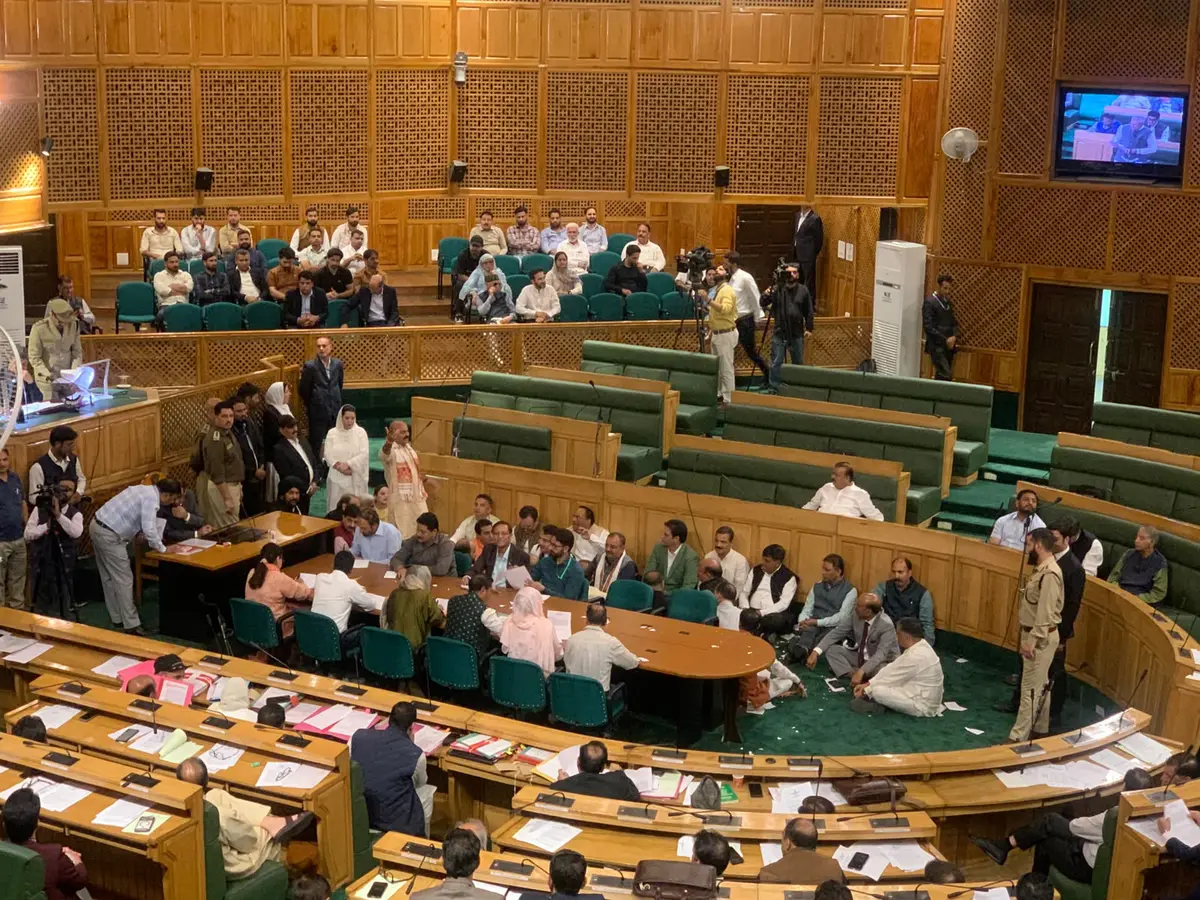
The resolution, moved by Chief Minister Omar Abdullah, was adopted by voice vote after several hours of heated debate, protests and disruptions. BJP legislators, who had opposed the resolution from the beginning of the proceedings, staged a walkout before the vote.
The passage marks the latest formal intervention by the J&K Assembly on the question of statehood and comes nearly two years after the present elected government took office.
But the vote also exposed a sharp political divide over what should accompany the statehood demand.
While the ruling National Conference and its allies argued that the resolution primarily seeks restoration of full statehood, the BJP objected to its references to earlier Assembly resolutions concerning autonomy and special constitutional arrangements.
Resolution Calls for Immediate Restoration of Statehood
The resolution calls upon the Government of India for the “immediate and urgent restoration of full statehood to Jammu and Kashmir” and provides that the resolution be forwarded to the Centre.
The final text specifically states that the demand comes in addition to resolutions passed by the House on June 26, 2000, and November 6, 2024.
That wording became one of the principal sources of disagreement inside the Assembly.
The 2000 resolution concerned restoration of greater autonomy to Jammu and Kashmir, while the November 2024 resolution adopted by the newly elected Assembly dealt with restoration of the region’s special constitutional status and guarantees.
By retaining the reference to both earlier resolutions, the latest resolution places the current statehood demand within the broader political record of the Assembly.
BJP Objects to Autonomy and Special-Status References
The BJP strongly opposed the resolution, particularly its reference to the 2000 autonomy resolution.
BJP legislators maintained that they support restoration of statehood but do not support bringing the pre-2019 constitutional framework, Article 370 or autonomy into the present discussion.
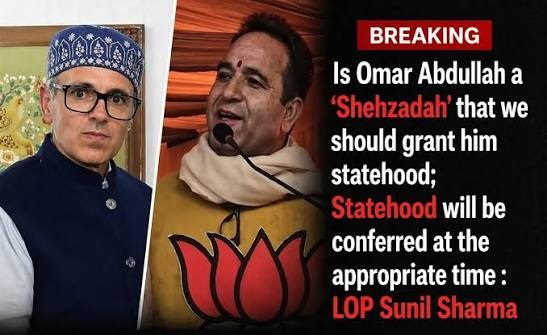
Leader of Opposition Sunil Sharma and other BJP members argued that statehood and restoration of the earlier constitutional arrangement were separate questions. The party characterised the references as an attempt to expand the scope of the resolution beyond statehood.
The BJP’s position, as reflected in the Assembly debate, was therefore not an outright rejection of statehood as a concept.
Its objection was directed at the language and political context of the resolution.
That distinction became central to the confrontation.
BJP Legislators Enter Well, Raise Slogans
The dispute turned into a prolonged confrontation inside the House.
BJP legislators protested from the Well of the Assembly, raised slogans and objected to the Speaker’s decision to allow the resolution to proceed. Reports also said papers were torn during the disruption.
The protests were not confined to the contents of the resolution.
The BJP had also challenged Speaker Abdul Rahim Rather’s decision to admit the resolution for discussion and had moved a motion seeking his removal.
Rather maintained that the Speaker-removal process could not be taken up immediately because the applicable law requires 14 days’ notice.
The procedural dispute added another layer to an already contentious debate.
Speaker Removal Row Adds to Assembly Crisis
The BJP’s motion against Speaker Rather was linked directly to its objections over the handling of the statehood resolution.
The party argued that the Speaker had permitted the Chief Minister’s resolution to be taken up despite objections over its admissibility and procedure.
Rather rejected the demand to immediately leave the Chair, citing the prescribed notice period.
Under Section 19 of the Jammu and Kashmir Reorganisation Act, 2019, a resolution seeking removal of the Speaker requires at least 14 days’ notice and must ultimately be passed by a majority of all the then members of the Assembly.
The motion therefore did not automatically remove Rather from office.
The procedural dispute continued while the Assembly proceeded with the statehood debate.
Omar Abdullah Says Statehood Is the Core Issue
Defending the resolution, Omar Abdullah repeatedly argued that the immediate issue before the House was the restoration of statehood.
He urged members who had submitted amendments seeking explicit references to Article 370, Article 35A, the state flag, special status and the pre-1953 constitutional position not to press those amendments.
According to reports, several legislators had proposed such amendments, including members of the ruling National Conference and the People’s Democratic Party.
Abdullah argued that adding such provisions could provide an opening for opponents to portray the resolution as something other than a demand for statehood.
The proposed amendments were ultimately not pressed.
That allowed the House to proceed with the original resolution, while retaining its references to the earlier 2000 and 2024 resolutions.
Why the 2000 Resolution Became So Contentious
The reference to June 26, 2000, is particularly significant because that Assembly resolution sought greater autonomy for Jammu and Kashmir.
It was adopted during the government of Farooq Abdullah, Omar Abdullah’s father.
The BJP’s objection is that incorporating the earlier resolution into the present statehood demand could be interpreted as keeping the autonomy question politically alive.
The National Conference’s position is that the Assembly cannot simply erase its previous resolutions from its political record.
The current resolution does not itself restore the 2000 autonomy framework.
Instead, it records that the new statehood demand is being made in addition to earlier resolutions adopted by the House.
This distinction became important during the debate.
The 2024 Resolution Also Returns to the Spotlight
The second reference is to the resolution passed by the present Assembly on November 6, 2024.
That resolution called for restoration of special status and constitutional guarantees for Jammu and Kashmir.
The current statehood resolution therefore places the 2026 demand alongside two earlier positions of the elected House.
The BJP objected to this broader framing, while members of the ruling side defended the references as part of the Assembly’s existing record.
The disagreement illustrates why a resolution formally centred on statehood became a much wider political confrontation over Jammu and Kashmir’s constitutional history.
Omar Questions Delay in Restoring Statehood
During his response to the debate, Omar Abdullah questioned the continued delay in restoring statehood.
He referred to the Supreme Court’s December 2023 judgment, which directed that elections to the J&K Assembly be held by September 2024 and statehood be restored at the earliest.
The Assembly elections were subsequently held in September-October 2024, with the elected government taking office later that year.
Abdullah’s argument was that the electoral stage referred to in the earlier sequence had been completed and that the Centre’s commitment to restore statehood should now be acted upon.
He also questioned what “at the earliest” or “as soon as possible” meant if the process could continue for years.
The Chief Minister has repeatedly used this argument to press New Delhi for a clearer timeline.
‘We Are Not Beggars’: Omar’s Sharpest Message
The Chief Minister also used unusually direct language while defending the demand.
Omar said Jammu and Kashmir was not seeking statehood as a favour or charity from the Centre.
He described statehood as a right of the people of Jammu and Kashmir and argued that the Centre had itself made commitments regarding its restoration.
The statement was among the most politically prominent moments of the debate.
It also echoed language Omar had used in earlier political contexts while arguing that democratic rights should not be treated as concessions.
In the present Assembly debate, however, the phrase was directly linked to the demand for restoration of full statehood.
Omar Raises Question of Security and Statehood
Another important part of Abdullah’s intervention concerned the possibility of statehood being linked to the security situation.
He questioned whether restoration of statehood was being made conditional on the complete elimination of militancy.
Abdullah argued that if restoration of statehood depended on the disappearance of militancy, then forces outside India’s constitutional system could indirectly influence when J&K regained statehood.
The Chief Minister’s remarks reflected his broader argument that the status of Jammu and Kashmir should be determined by constitutional and political decisions in India rather than by changes in the security environment.
The issue was raised during an already tense debate and further sharpened the differences between the government benches and the BJP.
BJP Walks Out Before the Vote
After the debate and continued disruptions, BJP legislators staged a walkout.
The resolution was subsequently put to a voice vote.
With the BJP members no longer participating in the vote, the House adopted the resolution without a recorded vote against it. The New Indian Express reported that it was passed by voice vote after the BJP walkout.
This procedural detail matters.
The passage does not mean that every member of the Assembly supported every aspect of the political argument surrounding the resolution.
The BJP had left the House before the vote, while some members who had initially sought amendments to the resolution did not press them.
The final adopted text therefore reflected the government’s statehood demand while retaining the references to the 2000 and 2024 resolutions.
What the Assembly Resolution Actually Does
The resolution is politically significant, but it does not itself restore statehood.
The Assembly’s action formally communicates the elected legislature’s demand to the Government of India.
The wording specifically calls for the resolution to be forwarded to the Centre.
The legal status of Jammu and Kashmir therefore remains unchanged by the Assembly vote alone.
Jammu and Kashmir continues to be a Union Territory with a legislature.
Restoration of statehood would require action at the Union level.
The Assembly resolution is consequently a political demand and institutional expression of the House’s position, rather than an order that independently changes J&K’s constitutional status.
J&K Has Remained a Union Territory Since 2019
Jammu and Kashmir became a Union Territory with a legislature under the Jammu and Kashmir Reorganisation Act, 2019, while Ladakh became a separate Union Territory without a legislature.
The changes followed the Union government’s constitutional measures of August 2019.
The current Assembly was elected in 2024, restoring an elected legislature after several years of direct Union Territory administration.
Restoration of statehood has remained one of the principal political demands of the National Conference-led government.
The BJP, meanwhile, has also stated that it supports restoration of statehood, while maintaining a different position on the constitutional issues that the NC seeks to associate with the demand.
A Second Statehood Resolution From the Present Assembly
Monday’s resolution is also notable because it is the second statehood-related resolution adopted by the present Assembly.
On November 6, 2024, shortly after the formation of the elected government, the Assembly passed a resolution calling for restoration of J&K’s special status and constitutional guarantees.
The latest resolution specifically refers to that earlier decision.
The inclusion shows how the present Assembly is building a continuing legislative record on J&K’s post-2019 political status.
At the same time, the BJP’s opposition shows that there is no uniformity across the House over the constitutional framing of those demands.
Statehood Debate Now Goes Beyond the Assembly
With the resolution passed, the next stage moves beyond the Assembly chamber.
The document is to be forwarded to the Government of India.
The political question now is how the Centre responds to the elected legislature’s renewed demand for immediate restoration of statehood.
The Assembly has made its position formally known.
But the Centre retains the authority to determine the next steps concerning the constitutional status of the Union Territory.
This means the passage of the resolution is the conclusion of one legislative process but potentially the beginning of another political phase between Srinagar and New Delhi.
BJP-NC Divide Sharpens
The episode has also widened the political distance between the National Conference-led government and the BJP inside the Assembly.
For the NC, the resolution is primarily about restoring statehood and addressing what it regards as the incomplete transition from Union Territory status to full statehood.
For the BJP, the statehood demand can be supported while rejecting references that it says reopen questions settled after August 2019.
The disagreement is therefore not simply statehood versus no statehood.
It is a disagreement over what restoration of statehood should mean politically and what issues should accompany that demand.
That distinction is likely to remain central to future Assembly debates.
A Resolution Passed, But the Political Battle Continues
The Jammu and Kashmir Assembly has now formally called for immediate restoration of full statehood.
The resolution passed despite BJP protests and a walkout, and it will be forwarded to the Government of India.
But Monday’s proceedings also demonstrated that the statehood question remains inseparable from the larger political debate over Jammu and Kashmir’s constitutional history.
The BJP’s objections to the 2000 and 2024 references, the Speaker-removal controversy and the proposed amendments on Article 370 and Article 35A all exposed the competing interpretations of what the statehood demand should represent.
For Omar Abdullah and the National Conference, the immediate objective is clear: restore full statehood without further delay.
For the BJP, the stated position is that statehood can be supported while rejecting any attempt to connect it with the pre-2019 constitutional framework.
The Assembly has now recorded its demand.
The next response will come from outside the House—from the Government of India, which will have to decide how and when to act on the resolution passed by Jammu and Kashmir’s elected legislature.