Kashmir Parents’ School Fee Worry: Annual Charges, Fee Hikes and Curriculum Confusion Explained
By: News Desk | 02 October 2026
As another academic session approaches, parents across Kashmir are again facing the same questions: Why is there an annual fee? How much can the school increase it? Which books can it prescribe? Is it following JKBOSE or adding its own material? And if rules already exist, who is checking compliance?
Srinagar, October 3, 2026: For thousands of families in Kashmir, the end of one academic session and the beginning of another no longer means simply buying new books and uniforms.
It means opening the school fee circular and asking:
How much more this year?
Then comes the next question:
What exactly are we paying for?
Tuition fee.
Annual fee.
Transport.
Books.
Workbooks.
Activities.
Technology.
Uniform.
Examination charges.
Sometimes several other heads.
For many parents, the feeling is that a 12-month year has somehow acquired a 13th or even 14th financial month.
But there is an important difference between the perception on the ground and what the law actually permits.
Jammu and Kashmir already has a statutory Fee Fixation and Regulation Committee (FFRC) and detailed rules governing private-school fees.
The problem, therefore, is not simply the absence of a rule.
The bigger questions are:
Are parents being shown the approved fee structure clearly?
Are all schools charging only what has been approved?
How often are fees actually being revised?
What exactly does the annual fee pay for?
And perhaps most importantly:
Why do the same questions return every academic year despite an established regulatory system?
First correction: Private schools are not legally free to decide any fee they want
This is where the public debate needs some clarification.
Under the Jammu and Kashmir Private Schools (Fixation, Determination and Regulation of Fee) Rules, 2022, the FFRC has the statutory power to fix, determine and regulate fees charged by private schools.
The committee is required to examine the proposed fee structure, seek supporting documents and accounts from schools, and determine whether the proposed fee is justified or amounts to profiteering or commercialisation of education.
It can approve the proposed structure or determine another fee.
The rules also require the committee to indicate the different heads under which fees can be levied.
So, legally, the system is not:
School decides → parent pays.
It is supposed to be:
School proposes → FFRC examines → fee is approved/determined → school collects according to that approved structure.
The rules further state that the fee fixed by the committee is binding on the private school.
That is a very important distinction.
Then why do parents feel that fees increase every year?
Because an approved fee structure and the fee notice received by a parent are not the same thing.
A parent may receive a new demand every academic session containing a higher overall amount.
But that does not automatically mean that the school has legally increased its approved tuition fee every year.
Under Rule 6 of the 2022 regulations, the fee fixed and determined by the FFRC is ordinarily valid for three years.
A school seeking modification during that period has to approach the committee for it.
That means the law does not establish a simple system under which a school can automatically increase its approved fee by whatever percentage it wants every year.
This is perhaps one of the most important facts parents need to know.
The question should therefore change from:
“Why did my school increase the fee this year?”
to:
“Show me the FFRC approval under which this particular increase is being collected.”
That is a much more precise question.
What exactly is this mysterious “annual fee”?
This is perhaps the biggest source of confusion for parents.
The law recognises annual fee as a category of fee.
But that does not mean that a school can simply invent an annual charge and give it any name it wants.
The FFRC is supposed to determine the fee structure and specify the heads under which fees can be collected.
The underlying law also restricts the kinds of charges private schools may impose, while permitting tuition fee, annual fee, transport fee and certain voluntary special-purpose charges, along with other fees specifically approved through the prescribed process.
This means an “annual charge” is not inherently illegal.
But the important question is:
What has the FFRC actually approved for that school?
If the answer is not readily available to parents, the transparency problem begins.
Annual fee does not automatically mean another month of tuition
Parents often make a simple calculation:
Monthly tuition × 12 + annual fee = 13th month.
That is understandable from the household-budget perspective.
But legally and financially, the annual fee is a separate component of the approved fee structure.
The FFRC is required to examine the school’s expenditure, infrastructure, maintenance, performance, student strength, classes, results, technology and other factors while determining the fee.
Therefore, the existence of an annual fee alone does not establish that a school is charging illegally.
The real issue is whether:
- the annual fee has been approved;
- the amount is reasonable under the approved structure;
- the school is collecting it under the correct head;
- the same charge is not being disguised under another name;
- the school is not simultaneously collecting unapproved additional charges.
That is where parents need transparency.
The government itself has acknowledged the problem
The strongest evidence that this is not merely a social-media complaint is that the government has repeatedly had to intervene.
In January 2026, the J&K Government constituted a committee to examine private-school fee structures, including the cost of:
- books,
- uniforms,
- shoes,
- other items supplied to students,
and whether these charges were based on verifiable and justifiable criteria.
The committee was also asked to examine the legal basis for transportation charges during the winter vacation in Kashmir.
That is significant.
It means the administration itself recognised that the question is broader than tuition fee.
The real household bill includes everything parents are required to purchase or pay for.
660 schools were warned, and 781 later faced suspension of fee collection
The regulatory record also shows that enforcement has not been absent.
In March 2026, the FFRC issued a final notice to 660 private schools in Kashmir division for failing to submit mandatory documents relating to their fee structures.
Later, in October 2025, the FFRC had issued a notice concerning 781 private schools in Kashmir division that had failed to submit the required files for regulation and determination of tuition and annual fees.
The committee warned that schools failing to comply could be restrained from collecting fees until approval was obtained.
So the claim that “there is no authority” would not be accurate.
There is an authority.
There are rules.
There are powers of inspection.
There are complaint mechanisms.
There are penalties.
The more difficult question is whether this machinery is sufficiently visible and effective from a parent’s point of view.
The regulator can actually order a refund
This is another provision many parents may not know.
Under the 2022 rules, if a school is found to have collected more than the fee determined by the committee, the Chairperson can order the school to refund the excess amount to the student or parent within 30 days.
Repeated non-compliance can attract progressively higher fines, and continued violations can lead to the school being placed in a non-admission category or other action.
Parents can also file complaints concerning excessive or exorbitant fees, with the rules providing that such complaints should preferably be disposed of within 45 days.
So parents are not without a legal route.
The problem may instead be one of awareness, accessibility, enforcement and visibility.
The most important document parents should ask for
Every parent preparing for the new session should ask the school for one simple document:
The current FFRC-approved fee structure.
Not a WhatsApp message.
Not a verbal explanation.
Not:
“This is what everyone is paying.”
Not:
“This is our standard fee.”
Ask for the approved structure.
It should allow a parent to see separately:
- tuition fee,
- annual fee,
- transport fee,
- approved special charges,
- applicable class,
- validity period,
- and any permitted revision.
The 2022 rules require the committee’s fee determination to identify the different heads under which fees are levied.
That should make the annual school bill much easier to understand.
So how much can the fee increase this year?
There is no single universal percentage that can responsibly be applied to every private school in J&K.
This is another area where social-media discussions can be misleading.
The FFRC determines fees school by school after considering factors including:
- location,
- infrastructure,
- administration and maintenance expenditure,
- reasonable surplus,
- school performance,
- student strength,
- classes,
- results,
- laboratories,
- library,
- sanitation,
- technology and other facilities.
Therefore, one school’s approved fee cannot automatically become another school’s entitlement.
The committee has also published individual school fee orders showing that proposed increases can differ substantially between schools and between tuition and annual-fee components.
That is precisely why a blanket “10% every year” or “20% every year” claim should not be treated as a universal legal rule.
The correct question is:
What did FFRC approve for this particular school?
The “10% every year” idea is not the same as the law
Private-school associations have previously sought permission for annual fee enhancement linked to inflation.
But that is a demand or proposal from the school sector, not automatically a legal entitlement.
For example, the J&K Private Schools Association has in the past asked the government to permit annual fee enhancement of 10% to account for inflation and changing costs.
That should not be confused with a government rule allowing every private school to increase fees by 10% automatically.
This distinction matters enormously for parents.
Now comes the other big question: What exactly is my child studying?
Fee is only half the problem.
The other half is curriculum.
A parent may reasonably ask:
“Is my child studying the JKBOSE curriculum, CBSE curriculum or something designed by the school?”
The answer depends first on the school’s affiliating board.
And this is where Kashmir’s school landscape becomes complicated.
There are schools affiliated with:
- JKBOSE,
- CBSE,
- and other recognised examination bodies.
The 2022 fee rules themselves recognise JKBOSE, CBSE and other examination bodies as possible affiliating bodies.
So there is no single curriculum for every private school in J&K.
JKBOSE school does not mean the school can create its own board syllabus
This is where the current situation becomes particularly important.
In 2025, JKBOSE took action against private schools found prescribing private publications instead of Board-approved books.
The Board said four private schools were losing affiliation and eight others were fined for violations relating to textbook norms.
That is not a minor development.
It establishes that the question of textbooks is being actively enforced.
And in June 2026, the J&K and Ladakh High Court upheld JKBOSE’s authority to prescribe textbooks for affiliated schools.
The court rejected an appeal by a private-schools body and affirmed the Board’s power to prescribe courses, curricula, syllabi and textbooks for affiliated institutions.
So the idea that:
“It is a private school, therefore it can teach whatever syllabus and books it wants”
is not an accurate description of the JKBOSE framework.
Then why do parents see so many different books?
This is where the distinction between curriculum, textbook and supplementary material becomes important.
A school may have its own teaching methodology.
It may conduct additional activities.
It may provide enrichment material.
It may use worksheets or other learning resources where permitted.
But a JKBOSE-affiliated school cannot simply replace the Board’s prescribed curriculum or textbooks with a private publisher’s books and continue as though nothing has changed.
JKBOSE has specifically warned private schools about such practices.
In March 2026, the Board directed affiliated private schools in the Jammu division to strictly implement the prescribed curriculum and textbooks, with inspection teams tasked with checking compliance.
The Board has also taken disciplinary action in actual cases.
That is an important ground-level indicator.
So how many Kashmir schools follow JKBOSE and how many have “their own syllabus”?
This is where the public needs to be careful.
There is currently no single publicly accessible, up-to-date official dataset that I could verify which categorises every private school in Kashmir into “JKBOSE syllabus” versus “school’s own syllabus.”
And that itself is a finding.
The authorities publish affiliation and regulatory information through different systems, but there is no simple public dashboard saying:
Total private schools in Kashmir: X
JKBOSE curriculum: X
CBSE curriculum: X
ICSE curriculum: X
Independent/supplementary curriculum: X
Therefore, publishing a precise percentage without such a consolidated official database would create false precision.
What can be established is more useful:
JKBOSE-affiliated schools
They are required to follow the curriculum and textbook requirements prescribed by JKBOSE.
CBSE-affiliated schools
They follow the CBSE curriculum applicable to their affiliation.
CBSE’s own affiliation framework describes affiliation as being for the Board’s secondary and senior-secondary examinations and requires affiliated schools to operate within CBSE norms and curriculum.
Schools using private books in place of prescribed JKBOSE books
They can face action.
The 2025 cases prove that this is not merely a theoretical rule.
So the more important question is not simply:
“Does the school have its own curriculum?”
It is:
“Is the school following the curriculum and textbooks required by the board with which it is affiliated, and are any additional materials being used lawfully and transparently?”
The CBSE picture is also changing
There is another reason parents need to look at the affiliation certificate rather than relying on a school’s name or marketing.
The official CBSE SARAS directory lists individual J&K schools and their affiliation status.
For example, Delhi Public School Srinagar is listed as a CBSE-affiliated independent senior-secondary school, as is Minto Circle English Medium High School. Other schools in J&K are affiliated with CBSE under government, Kendriya Vidyalaya, Navodaya or independent-school categories.
This means parents should not assume that every English-medium private school in Kashmir follows JKBOSE.
English-medium is a teaching medium.
JKBOSE or CBSE is an affiliating board.
Curriculum is the academic framework.
These are three different things.
The real curriculum confusion begins when marketing becomes bigger than affiliation
Parents sometimes hear phrases such as:
- “CBSE pattern”
- “NCERT pattern”
- “international curriculum”
- “advanced curriculum”
- “smart curriculum”
- “competitive curriculum”
But these phrases do not necessarily tell a parent which board the school is actually affiliated with.
That is why the school should clearly display its affiliating authority.
JKBOSE itself issued directions requiring affiliated private schools to prominently display the Board’s name and school code after concerns that some institutions were creating confusion about their actual affiliation.
For parents, this is a simple rule:
Do not judge a school by the words on its brochure.
Check the affiliation.
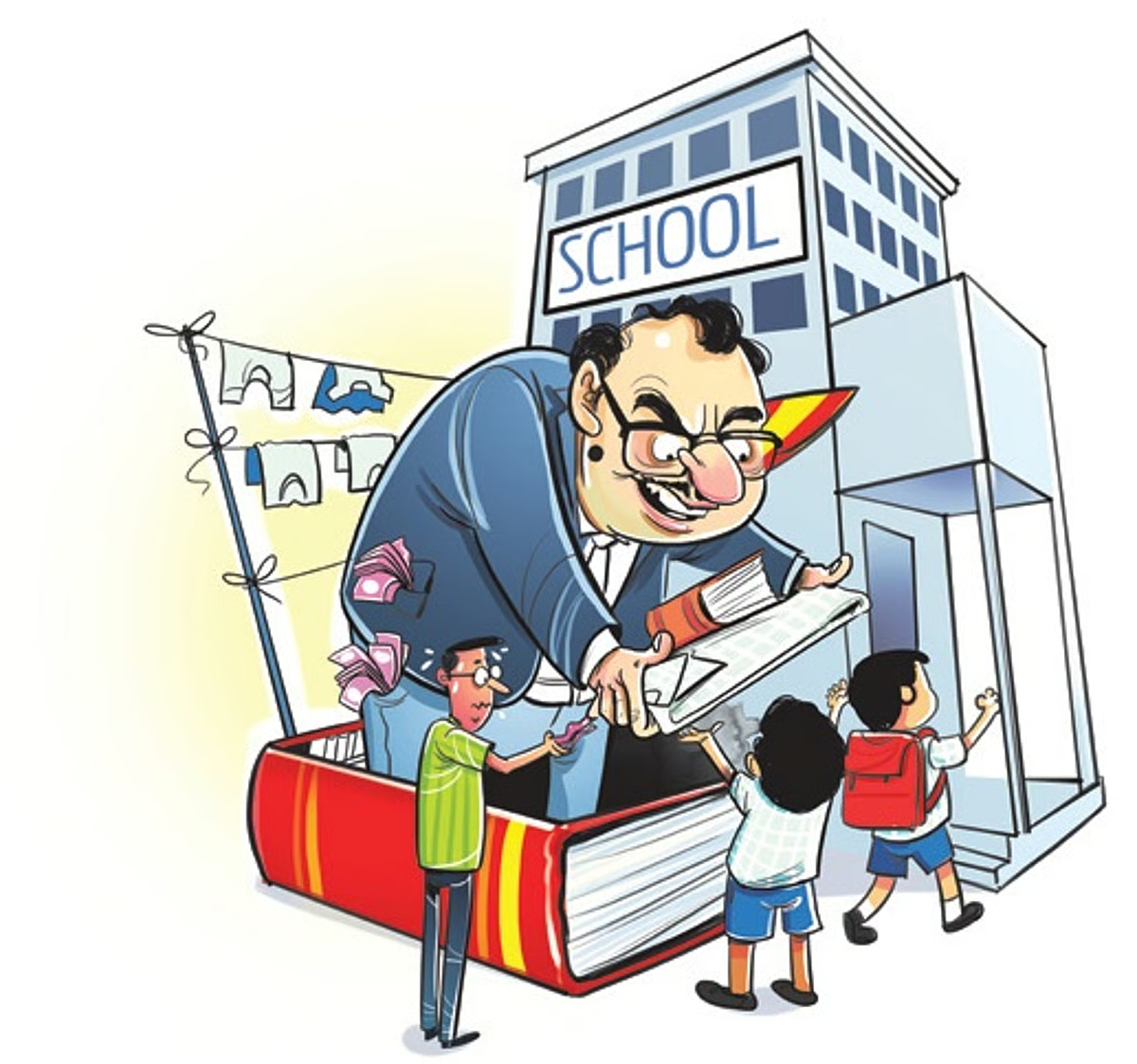
What about books? That is where the bill gets bigger
A parent may initially worry about a ₹2,000 increase in annual charges.
But the larger expense may come from the books.
Suppose a child is required to purchase:
- Board textbooks,
- private publisher textbooks,
- workbooks,
- activity books,
- practice books,
- grammar books,
- handwriting books,
- general knowledge books,
- computer books,
- special worksheets.
Individually, each may look inexpensive.
Together, they can become a substantial annual expense.
That is why the government’s January 2026 committee examining the cost of books, uniforms and shoes is important.
Parents are not merely asking:
“Why is tuition rising?”
They are asking:
“Why is the total cost of sending my child to school rising?”
Those are different questions.
The school bill needs to be treated as a complete education bill
For a family with two children, the real annual cost may include:
| Expense | Why parents need clarity |
|---|---|
| Tuition fee | Main academic charge |
| Annual fee | Purpose and approved amount |
| Transport | Route-wise and approved charges |
| Books | Board-prescribed vs additional |
| Workbooks | Whether required or optional |
| Uniform | Whether school-specific |
| Examination charges | What is included in approved structure |
| Activities | Mandatory or genuinely optional |
| Digital subscriptions | Service actually provided |
| Winter transport | Particularly relevant in Kashmir |
| Miscellaneous charges | Legal/approved basis |
A family does not experience these as separate regulatory categories.
It experiences them as one number:
“How much will my child cost us this year?”
That is the number policymakers should pay attention to.
Why parents feel powerless even when rules exist
This is perhaps the most important ground-level issue.
A parent may know that a fee rule exists.
But if the school says:
“This is the fee.”
the parent has to decide whether to challenge it.
That parent may worry:
- Will my child be treated differently?
- Will admission be affected?
- Will the school create problems?
- Where do I complain?
- How long will it take?
- What evidence do I need?
- Will the complaint remain confidential?
This creates an imbalance between an individual parent and an institution.
That is why regulation must be visible, not merely written in a government notification.
A parent should not need legal expertise to understand whether a fee demand is valid.
What should change before the next academic session?
The government does not necessarily need another committee.
It already has a regulatory structure.
What it needs is public transparency.
Imagine a simple online dashboard.
A parent enters the school name.
The screen shows:
School name
Affiliation
Classes covered
Approved tuition fee
Approved annual fee
Approved transport fee
Date of approval
Validity period
Latest FFRC order
Permitted additional charges
Complaint mechanism
Latest inspection status
Textbook/curriculum compliance status
That single system could eliminate much of the confusion.
Parents would no longer have to rely on rumours or school WhatsApp groups.
Publish the fee order before collecting the fee
This should become standard practice.
Before asking parents to pay the new academic year’s charges, schools should prominently display the applicable FFRC approval on:
- school notice boards,
- websites,
- parent portals,
- admission circulars,
- fee receipts.
The parent should be able to compare:
Approved fee
versus
Demanded fee.
If they are different, there should be an immediate explanation.
The same transparency should apply to books
Schools should publish a separate list showing:
Board-prescribed books
and
Additional/supplementary material
If a book is compulsory, the parent should know why.
If it is optional, it should be clearly marked optional.
If it is required for a board examination, that should be stated.
This would immediately answer one of the most persistent parental questions:
“Why am I being asked to buy this book?”
The annual fee question needs a plain-language answer
Parents do not necessarily need a 20-page financial statement.
They need a simple explanation.
For example:
Annual fee: ₹X
Approved by FFRC Order No. ___
Valid from ___ to ___
Covers: ___, ___ and ___.
That is enough to establish transparency.
If the school cannot explain what the annual charge covers, parents are naturally going to question it.
Schools also have a legitimate side of the argument
A balanced analysis must acknowledge this.
Private schools have real expenses.
Teachers have to be paid.
Buildings need maintenance.
Electricity, heating and technology cost money.
Laboratories and libraries require investment.
Transport has operating costs.
School managements also argue that inflation and salary increases affect their finances.
The FFRC rules themselves recognise infrastructure, administration, maintenance, technology, reasonable surplus and other operational factors when determining fees.
Therefore, the answer cannot simply be:
“Private schools should not increase fees.”
The more reasonable regulatory question is:
“If a school needs more money, can it demonstrate why, and has the increase been approved through the prescribed process?”
That is exactly what a fee regulator is supposed to determine.
The real failure would be if parents have to guess
A regulated education system should not force parents to become investigators.
They should not have to ask other parents:
“How much are you paying?”
They should not have to search social media:
“Is this annual fee legal?”
They should not have to wonder:
“Is this school JKBOSE or CBSE?”
They should not have to compare three different WhatsApp lists to discover which books are compulsory.
All of that information should be available directly from the school and regulator.
Kashmir’s school-fee debate is therefore not simply about expensive schools
It is about predictability.
Parents need to know the cost before committing their child to a school.
They need to know whether the fee is valid for one year or covered by a multi-year approval.
They need to know whether an increase has been sanctioned.
They need to know what the annual fee actually covers.
They need to know which board the school belongs to.
They need to know which books are prescribed.
They need to know which additional books are compulsory.
They need to know where to complain.
And they need to know that making a legitimate complaint will not put their child at a disadvantage.
The 13th-month problem is really a transparency problem
Parents may continue to describe annual charges as a “13th month”.
But the better way to look at it is this:
If the annual fee is legally approved, clearly identified and transparently explained, parents can at least understand what they are paying for.
If the annual fee changes without a clearly visible approval, gets renamed as another charge, or is accompanied by multiple unexplained expenses, the parent’s concern becomes much stronger.
The issue is therefore not the word annual.
It is the word accountability.
What parents should ask their school before paying the new session’s fee
Every parent can ask for seven things.
1. What is the school’s affiliation?
JKBOSE, CBSE or another recognised board?
2. What is the current approved fee structure?
Ask for the FFRC order or applicable regulatory approval.
3. What is the annual fee?
Ask what it covers and for how long the approved amount is valid.
4. Has the fee been revised?
If yes, ask for the approval supporting the revision.
5. Which textbooks are prescribed?
Ask which are Board-prescribed and which are supplementary.
6. Which charges are compulsory?
Do not assume every item listed on a circular has the same legal status.
7. Where can a parent complain?
The school should provide a clear grievance mechanism and the relevant regulatory contact.
These are not unreasonable questions.
They are basic consumer and parental questions in an education system that already has a statutory fee-regulation mechanism.
What the government should publish before the next session
If the administration genuinely wants to end the annual controversy, it could publish five datasets.
Dataset 1: School-wise approved fees
Every private school.
Dataset 2: Fee validity
The date from which each approved structure applies and its validity.
Dataset 3: Fee revisions
How many schools sought modification and how many were approved.
Dataset 4: Curriculum and affiliation
JKBOSE, CBSE, ICSE or other recognised board.
Dataset 5: Compliance
Schools inspected, violations found, penalties imposed, refunds ordered and affiliations cancelled.
The government already has much of this information because schools are required to submit financial documents, audited accounts and other records to the regulator.
The missing piece is making the information easily understandable to parents.
The uncomfortable question: Is regulation working if parents cannot see it?
This is ultimately where the debate should go.
It would be wrong to say:
“There is no regulation in J&K.”
There clearly is.
It would also be wrong to say:
“Private schools can increase fees however they want.”
The rules do not permit that.
There is a statutory committee.
There are approval requirements.
There are inspections.
There are penalties.
There are refund provisions.
There are complaint mechanisms.
And authorities have taken action against schools.
But another question remains legitimate:
Can an ordinary parent easily see that the system is working?
That is where the administration, schools and regulator still have an opportunity to improve.
New academic session, old questions
As another school year approaches, Kashmir’s parents are again preparing for the familiar expenses.
The schoolbag will be new.
The uniform will be new.
The books will be new.
But the questions are remarkably old.
Why this annual fee?
Why this much?
Why another charge?
Why these books?
Which board are we actually following?
Who approved the increase?
How long is this fee valid?
Where can we complain?
These are not anti-school questions.
They are accountability questions.
Private schools need money to provide quality education.
Parents need affordability and predictability.
Children need a stable academic environment.
The regulator needs to ensure that neither side is allowed to operate in a grey area.
And that is perhaps the simplest solution to Kashmir’s recurring school-fee controversy:
No hidden charges. No unexplained hikes. No curriculum ambiguity. No guessing.
Before a parent pays a single rupee for the new session, the school should be able to answer three basic questions clearly:
What are you charging?
Why are you charging it?
Who approved it?
If those three answers are available in black and white, much of the annual anxiety surrounding school fees could disappear.
Until then, the beginning of every academic session will continue to feel less like the opening of a new year of learning and more like the opening of another financial negotiation between parents and schools.