From Wazwan to Wedding Debt: How Showmanship Is Reshaping Kashmir’s Social Fabric
By: Javid Amin | 30 September 2026
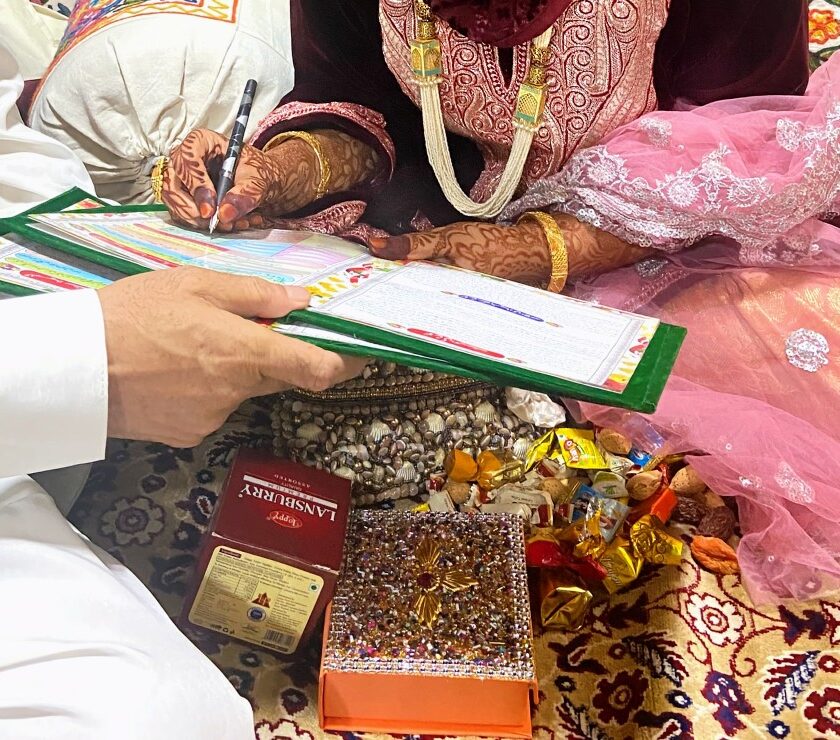
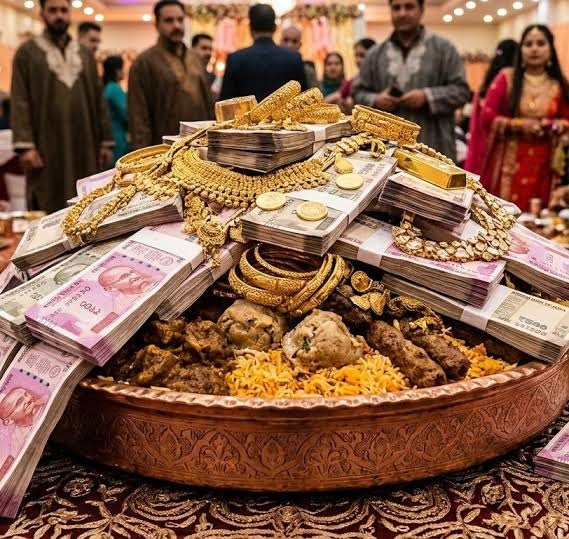
Wazwan was once a celebration of Kashmiri hospitality. But when seven dishes became 20, 25 or more, and weddings became competitions in meat, gold and display, the question changed: are we preserving culture, or pricing ordinary families out of marriage?
Srinagar: There was a time when a Kashmiri wedding could be remembered for the warmth of the people rather than the weight of the meat.
A wedding feast was generous, but it was not necessarily a competition.
Seven principal Wazwan dishes were enough to make guests feel honoured. Families cooked according to their means. Relatives helped. Neighbours participated. The feast was important, but it was part of the wedding, not the measure of the family’s social standing.
Today, the conversation around a wedding can sound very different.
How many quintals of mutton?
How many dishes?
How many guests?
How much gold?
Which marriage hall?
How elaborate was the decoration?
How expensive was the bride’s dress?
Who catered the wedding?
And, increasingly, how did it look on social media?
Somewhere between tradition and aspiration, the Kashmiri wedding has acquired a new economy of display.
The problem is not Wazwan.
The problem is when Wazwan, jewellery, clothes, hospitality and ceremony become instruments of social comparison.
And the consequences are reaching far beyond the dinner table.
Families are borrowing.
Young people are postponing marriage.
Parents are struggling to finance weddings.
Unemployment is making the decision even harder.
And a generation that is already entering adulthood later because of education and employment uncertainty is facing another financial barrier before it can establish a household.
This is no longer simply a question about food.
It is a question about the economics of marriage and the changing social fabric of Kashmir.
Seven Dishes Were Never a Sign of a Poor Wedding
The seven-dish Wazwan is not some invented modern austerity measure.
Kashmir’s own official cultural material describes seven dishes as essential to traditional occasions, including tabakh maaz, rista, rogan josh, daniwal korma, aab gosh, marchhwangan korma and gushtaba.
At the same time, the Government of India’s Incredible India portal describes Wazwan as a much larger traditional spread, commonly presented as a 36-course feast.
That apparent contradiction tells us something important.
Wazwan has never been one rigid menu.
It has evolved.
It has expanded.
Different families, regions and generations have served different combinations.
What has changed more dramatically in recent decades is not simply the number of recipes.
It is the economic meaning attached to the feast.
A larger Wazwan increasingly communicates abundance.
And abundance, in a status-conscious society, can become a form of social currency.
From Seven to Twenty, Then Beyond
A recent Reuters report on Kashmir’s Wazwan tradition quoted veteran Waza Ghulam Nabi Baba recalling a time when there were seven mutton dishes, compared with around 20 dishes today.
Another report from 2024 described Kashmiri wedding Wazwan as ranging from seven dishes to 20 or more, with mutton quantities often discussed in quintals. Wazas interviewed for that report recalled that smaller weddings were easier to manage and placed less pressure on cooks.
This evolution should not automatically be described as cultural destruction.
Cultures change.
Food traditions change.
Wedding customs change.
The real question is when adaptation becomes excess.
There is a difference between adding a few dishes because tastes changed and turning the feast into a financial contest.
There is a difference between feeding guests generously and measuring a family’s honour by how much meat it can afford.
There is a difference between celebrating culture and performing wealth.
That distinction is increasingly important in Kashmir.
When the Wedding Becomes a Status Statement
A wedding once brought families together.
Today, in many cases, it also places families under observation.
People notice.
They compare.
They remember.
And social media has amplified the process.
A wedding is no longer confined to the guests sitting around the Trami.
Photographs are posted.
Videos are circulated.
Bride and groom entries are recorded.
Decorations are displayed.
Jewellery is photographed.
Food is discussed.
The wedding becomes a public performance.
The pressure can therefore reach families who never intended to compete.
A father may know that he cannot afford an extravagant wedding.
A mother may know that the family has more important financial obligations.
A young couple may prefer something simple.
But then comes the question that has become deeply embedded in Kashmiri social life:
“Log kya kahenge?”
What will people say?
A recent Kashmir Life analysis described social approval as an increasingly costly force behind extravagant weddings, debt and anxiety.
That phrase may be only four words.
But for some families, it can carry a multi-lakh-rupee price tag.
The Economics of One Wedding
There is no single reliable official figure for the average cost of a Kashmiri wedding across the Valley.
That is important because estimates circulating in media reports vary enormously depending on whether they include jewellery, dowry, household goods, multiple ceremonies and gifts.
A 2026 local report cited wedding expenses of roughly ₹30–40 lakh in some cases, while older academic fieldwork produced much lower averages.
These figures should not be treated as a statistical average for all Kashmiri families.
But together they reveal something more useful:
Wedding expenditure has become economically significant enough to affect marriage decisions.
A 2019 study of marriage economics among youth in Kashmir found food to be the largest expenditure category in its surveyed sample, followed by clothing, jewellery, furnishings and electronic goods. Its reported average expenditure was around ₹10 lakh per marriage for both sides at the time of the study.
The study is older and its sample cannot be treated as representative of today’s entire Valley.
But it provides an important baseline.
If wedding costs rise while household incomes do not rise proportionately, marriage becomes harder to finance.
That is basic household economics.
The Poor Father Pays Twice
A low-income father can experience the wedding economy differently from a wealthy family.
For the wealthy, an expensive wedding may be a choice.
For a poor or lower-middle-income family, the same wedding may be a debt decision.
There may be pressure to arrange:
- an elaborate feast;
- jewellery;
- clothes;
- furniture;
- electronic goods;
- gifts;
- multiple ceremonies;
- venue and decoration;
- transportation;
- photography and videography.
The cost does not stop at the Wazwan.
The Wazwan is simply the most visible part of a much larger wedding economy.
And when a family cannot afford it, the alternatives are uncomfortable.
Borrow.
Sell an asset.
Use savings meant for education.
Delay the wedding.
Or compromise and face social judgement.
None of these is a trivial choice.
The Wedding Can Be Postponed, But Age Does Not Stand Still
This is where the cultural question meets the demographic question.
Marriage is already being delayed for reasons that have little to do with food.
Young people are studying longer.
Government jobs are highly sought after.
Private employment is often uncertain.
Housing is expensive.
Young men may feel unable to marry without stable earnings.
Young women increasingly pursue education and careers before marriage.
These changes are not inherently negative.
Education and employment can strengthen individual autonomy and household security.
But when economic uncertainty combines with extravagant marriage expectations, the delay can become much longer.
A 2026 Oxford University study of 46 recently married and unmarried people from different socioeconomic backgrounds in Kashmir found that the financial burden of traditional weddings and economic insecurity were among the central themes associated with delayed marriage. The study also documented the emergence of mass marriages as an affordable alternative.
A separate study on late marriage in Kashmir similarly identified poverty, unemployment, dowry, extravagant weddings, educational delays and waiting for government employment among the factors associated with delayed marriage.
So the problem cannot honestly be reduced to:
“Young people do not want to marry.”
For many, the issue is more complicated.
They may want to marry.
They may simply feel they cannot afford the marriage expected of them.
Unemployment Makes the Wedding Bill Heavier
This is perhaps the most important part of the story.
A young person without stable employment does not look at a ₹20-lakh or ₹30-lakh wedding bill in the same way as someone with a secure income.
For him, the wedding may represent years of savings.
For his parents, it may represent retirement money.
For the family, it may mean debt.
J&K’s Economic Survey 2025-26 reported that the overall unemployment rate had declined from 6.7 per cent in 2019-20 to 6.1 per cent in 2023-24, while labour-force participation and the worker population ratio had improved.
Those improvements matter and should not be ignored.
But aggregate unemployment figures do not capture the entire experience of young people entering the labour market.
The question for marriage is not merely:
“Are you employed?”
It is:
“Do you have enough predictable income to establish a household?”
A temporary job and a secure career do not carry the same meaning when someone is contemplating marriage.
That is why employment insecurity can continue affecting marriage decisions even when headline labour indicators improve.
Marriage Has Become a Financial Milestone Before It Becomes a Family Milestone
Traditionally, marriage marked the formation of a household.
Today, many young Kashmiris first feel they must achieve financial stability before they are socially permitted to marry.
Find a job.
Build savings.
Buy or arrange housing.
Help the family.
Accumulate jewellery.
Prepare for the wedding.
Then marry.
That sequence can push marriage further into adulthood.
The irony is striking.
The wedding is supposed to begin a family’s economic life.
Instead, the economic demands of the wedding can become a barrier to beginning that life.
And Then There Is the Health Question
This part requires care.
It would be wrong to say that late marriage itself is a disease or that every person who marries later will experience health problems.
That is not what the medical evidence says.
The relevant issue is reproductive age.
Female fertility declines with age, with the decline becoming faster from the mid-30s, according to the American College of Obstetricians and Gynecologists. Pregnancy at older ages is also associated with higher risks of certain complications, although individual outcomes vary considerably.
The same guidance notes that fertility treatment success also declines with age and recommends fertility evaluation after six months of trying for women aged 35 and older, rather than waiting a full year.
This does not mean women should be pressured into early marriage.
That would simply replace one form of social pressure with another.
The lesson is different:
Marriage and family planning should be based on informed individual choices, economic realities and medical awareness, not on a social race to produce an extravagant wedding.
The Bigger Problem Is Not Late Marriage Alone
Kashmir’s changing marriage age cannot be blamed entirely on wedding extravagance.
Education matters.
Employment matters.
Urbanisation matters.
Changing expectations matter.
Housing matters.
Gender roles matter.
Economic uncertainty matters.
The cost of marriage is one piece of a much larger transition.
But it is a piece that society can actually influence.
A young person cannot single-handedly create jobs.
A family cannot control the housing market.
A student cannot shorten the time required for professional education.
But communities can decide whether a marriage must cost ₹5 lakh, ₹15 lakh, ₹30 lakh or much more.
That part is socially constructed.
The Strange Economics of “Izzat”
There is an economic concept hiding inside the Kashmiri wedding.
Izzat.
Respect.
Social standing.
Reputation.
A family spends money partly because it wants the wedding to be remembered positively.
But if everyone is spending to maintain status, the social benchmark keeps rising.
One family serves ten dishes.
Another serves fifteen.
Another serves twenty.
One gives a certain amount of jewellery.
The next gives more.
A marriage hall becomes more elaborate.
Photography becomes more expensive.
Decorations become bigger.
Eventually, what was once exceptional becomes normal.
And once it becomes normal, families that cannot afford it feel inadequate.
This is how a social arms race develops without anybody formally deciding to start one.
The Wazwan Is Not the Enemy
This distinction deserves emphasis.
Wazwan is one of Kashmir’s most important cultural traditions.
It carries culinary knowledge, craftsmanship, family histories and hospitality.
The Government of India’s cultural tourism material describes it as a 36-course traditional feast and an important part of Kashmiri identity.
The solution is therefore not to attack Wazwan.
It is to separate Wazwan from extravagance.
A traditional feast does not need to become a competition.
A family can serve fewer dishes.
It can invite fewer people.
It can choose quality over quantity.
It can preserve the ceremonial meaning of the Trami without trying to demonstrate wealth.
Culture survives when its meaning survives.
It does not require every generation to reproduce its most expensive version.
History Itself Shows That Simplicity Is Possible
There is an interesting lesson in Kashmir’s own recent history.
In 2004, during difficult economic conditions, Kashmiris were reported to be cutting Wazwan down to around seven dishes from the 20–25 varieties that had become common in some weddings.
In other words, moderation is not an imported idea.
Kashmir has done it before.
The seven-dish wedding is not necessarily a symbol of deprivation.
It can be a symbol of proportion.
What Happened to the Wazas?
The transformation is affecting the people who actually make the feast.
Reuters recently reported on 74-year-old Waza Ghulam Nabi Baba, whose family has preserved the tradition across generations. His son, however, has moved towards restaurant work rather than relying exclusively on the physically demanding wedding circuit.
That is another revealing change.
The same economic forces that are changing the wedding are changing the profession that sustains it.
Long hours.
Overnight preparation.
Heavy physical labour.
Seasonal work.
Demand for increasingly elaborate menus.
Younger members of some Waza families are looking towards restaurants and hospitality businesses that offer more predictable working conditions.
So even the custodians of tradition are adapting.
That is not necessarily cultural death.
It may actually be cultural survival through a new economic model.
Food Waste Is the Other Side of the Feast
There is another issue that deserves more attention: waste.
When a feast is designed around abundance, the incentive is often to prepare more rather than less.
Nobody wants guests to say there was not enough.
The result can be substantial food waste, particularly when guest numbers are uncertain or multiple dishes are prepared simply because social expectations demand them.
The contradiction is obvious.
Families may borrow money to put enormous quantities of food on tables while many households around them struggle with basic expenses.
A celebration becomes less meaningful when abundance itself becomes the objective.
The Wedding Hall Has Become an Economic Ecosystem
Modern Kashmiri weddings support a large chain of livelihoods.
Wazas.
Butchers.
Caterers.
Decorators.
Photographers.
Videographers.
Dress designers.
Jewellers.
Transport operators.
Event managers.
Beauty professionals.
Venue owners.
Florists.
Musicians and entertainers.
This means extravagant weddings cannot simply be described as “wasteful” without recognising that thousands of people earn from the wedding economy.
The answer is not to destroy that economic activity.
It is to change its scale and structure.
A simpler wedding can still employ local businesses.
A smaller guest list still requires food.
A modest ceremony still needs clothing, photography and transport.
The economic activity does not have to disappear.
Only the pressure to make everything bigger needs to weaken.
The Rise of Mass Marriages Says Something Important
Mass marriages are often presented as a social or religious reform.
But there is an economic story underneath.
When multiple couples marry in a common ceremony, some costs can be shared or reduced.
The 2026 Oxford study found that mass marriages were emerging in Kashmir as pragmatic responses to financial pressure, although they remain contested because questions of status, gender and social approval do not disappear automatically.
Their emergence is therefore significant.
It tells us that some families are actively searching for ways around the economics of the conventional wedding.
They are not necessarily rejecting marriage.
They are rejecting the price attached to it.
The Most Vulnerable Pay the Highest Price
Extravagance does not affect everyone equally.
A wealthy family can absorb a large wedding bill.
A middle-class family may have to reduce savings.
A lower-income family may have to borrow.
A family with several daughters can face repeated financial pressure.
This is where wedding culture intersects with inequality.
A custom that is affordable for one income group can become oppressive for another.
The social expectation, however, may remain identical.
Everyone is expected to “do it properly.”
But “properly” is increasingly defined by what the wealthier segment can afford.
That is how inequality enters culture.
The Girl Should Not Become the Price of the Wedding
There is another dimension that cannot be ignored.
The pressure surrounding marriage frequently falls particularly heavily on families with daughters, especially where jewellery, dowry, household goods and ceremonial expenses are expected.
Research published in 2025 on economically vulnerable unmarried women in Kashmir found that dowry expectations and pressure for extravagant wedding expenditure were among the structural and cultural factors associated with delayed or non-marriage among the women studied. The research involved 108 unmarried women in low-income occupations and households.
The implication is serious.
If a daughter becomes associated with an enormous financial liability, marriage itself can become something families postpone because they cannot afford the social package attached to it.
That is not a problem with daughters.
It is a problem with the expectations surrounding marriage.
What About Tradition?
Tradition deserves respect.
But tradition is not the same thing as every practice that has accumulated around it.
Wazwan is tradition.
Hospitality is tradition.
The Trami is tradition.
Community participation is tradition.
But a particular number of dishes, a particular quantity of meat, a particular amount of jewellery or a particular scale of decoration may simply be contemporary convention.
That distinction gives Kashmir room to reform without abandoning its identity.
Kashmir Does Not Need to Choose Between Tradition and Modernity
The debate is often framed incorrectly.
Either preserve tradition.
Or become modern.
That is a false choice.
Kashmir can preserve Wazwan while reducing waste.
It can maintain the Trami while serving fewer dishes.
It can honour guests without feeding hundreds of people.
It can preserve the role of Wazas while allowing younger Waza families to build restaurant careers.
It can celebrate marriage without turning the ceremony into a financial competition.
It can respect elders while allowing young couples to make decisions about their own future.
Culture does not become weaker because it becomes affordable.
It becomes more accessible.
The Real Cultural Invasion Is Not Foreign Food
The phrase “cultural invasion” is tempting because something clearly has changed.
But the evidence points to something more complicated.
This is not simply an outside culture replacing Kashmiri culture.
It is consumer culture entering an existing Kashmiri tradition.
Social media.
Status consumption.
Commercial wedding services.
Competitive hospitality.
Changing ideas of success.
Urban lifestyles.
Greater exposure to wealth.
These forces have interacted with traditional customs.
The result is not a replacement culture.
It is a new version of the old culture, sometimes carrying a much higher price.
That is why blaming outsiders alone misses the central issue.
The transformation is happening inside Kashmiri households too.
The Question Every Family Should Ask
Before adding another dish, another ceremony or another expensive requirement, perhaps the question should be simple:
Can we afford this without borrowing?
And then another:
If we could afford it, would we actually choose it?
Those two questions can change a wedding.
Because sometimes people are not spending because they want to.
They are spending because they believe they have to.
And that is where social reform begins.
Let the Seven Dishes Return
Perhaps Kashmir does not need to abolish the feast.
Perhaps it needs to rediscover proportion.
Seven dishes can feed people.
A modest Wazwan can honour guests.
A small wedding can be beautiful.
A shorter guest list can be dignified.
A simple bride can be radiant.
A groom does not need to arrive like a celebrity.
Parents do not need to spend their retirement savings proving their love.
And young couples should not have to wait years for the day they can afford to satisfy everyone else’s expectations.
The Real Cost of a Wedding Is What Comes After It
A wedding lasts a day.
A marriage is supposed to last a lifetime.
That difference should guide the economics.
If a family spends everything on the wedding, what remains for the household that begins afterwards?
Rent.
Housing.
Education.
Healthcare.
Children.
Employment transitions.
Unexpected emergencies.
A young couple needs financial stability far more than it needs a 25-dish feast.
The money saved from unnecessary display could become a home deposit.
A business investment.
A professional course.
An emergency fund.
Or simply peace of mind.
That is not a smaller celebration.
It is a larger investment in the marriage itself.
Kashmir’s Social Fabric Is Not Destroyed Yet
The situation is serious, but declaring Kashmir’s social fabric destroyed would itself be an exaggeration.
The same society that produces extravagant weddings also produces mass marriages.
The same families that compete over Wazwan can organise simple ceremonies.
The same Waza tradition that has survived for centuries is adapting to restaurants.
And the same young people who face social pressure are increasingly questioning it.
That means the culture is not dead.
It is negotiating.
The question is what direction that negotiation takes.
A Wedding Should Not Decide a Family’s Financial Future
Kashmir has survived political upheaval, economic uncertainty, social transformation and generational change.
Its traditions survived because people adapted them.
Wazwan survived because each generation carried it forward.
The task now is not to destroy it.
It is to prevent it from becoming a burden.
The seven-dish wedding should not be remembered as a symbol of poverty.
It can become a symbol of wisdom.
Because hospitality does not require excess.
Love does not require debt.
Dignity does not require display.
And marriage does not need to begin with a family wondering how it will recover financially from the celebration.
The real question before Kashmir is therefore not:
“How many dishes can we serve?”
It is:
“What kind of society do we want those dishes to represent?”
A society where a father quietly borrows money because he fears what neighbours will say?
Or one where the community says something very different:
Celebrate what you can afford. Feed people with love. Marry without debt. Build the life after the wedding.
Perhaps that is not abandoning Kashmiri tradition.
Perhaps that is saving it from becoming a burden.