Mehbooba Mufti, Imran Reza Ansari Join Indian Delegation at Ayatollah Ali Khamenei’s Funeral in Tehran
By: News Desk | 03 July 2026
Kashmir Leaders Attend Historic State Funeral in Iran
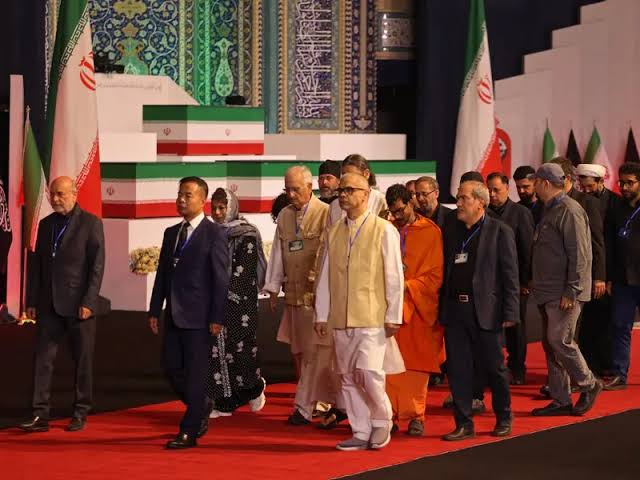
Former Jammu and Kashmir Chief Minister Mehbooba Mufti and senior Shia politician Imran Reza Ansari are among the prominent Indian political figures attending the state funeral of Iran’s late Supreme Leader, Ayatollah Ali Khamenei, in Tehran.
Their participation comes as Iran hosts one of the largest state mourning ceremonies in its modern history, with millions of mourners expected to take part over several days and official delegations arriving from more than 100 countries.
For Kashmir, the presence of the two leaders carries significance that extends beyond diplomacy, reflecting the Valley’s longstanding cultural, religious and historical links with Iran.
Indian Delegation Reflects Diplomatic Outreach
India has sent an official delegation led by Minister of State for External Affairs Pabitra Margherita and Bihar Governor Syed Ata Hasnain, representing New Delhi at the state funeral.
Alongside the official government delegation, several political leaders accepted invitations from Iranian authorities, including:
- Mehbooba Mufti, President of the People’s Democratic Party (PDP)
- Congress leader Salman Khurshid
- Imran Reza Ansari, senior Shia politician from Jammu & Kashmir
- Other political and religious representatives from Jammu & Kashmir and Ladakh
According to India’s Ministry of External Affairs, the high-level representation underscores the “civilisational ties and people-to-people connections” that continue to shape India-Iran relations despite shifting geopolitical dynamics.
Mehbooba Mufti’s Presence Holds Political Significance
Mehbooba Mufti’s participation has drawn particular attention because she is reportedly the only non-Shia political leader from Jammu & Kashmir and Ladakh invited by Iranian authorities.
Before departing for Tehran, Mufti described the invitation as an honour and said she was attending to express condolences following the death of Ayatollah Khamenei.
Political observers view her attendance as both a diplomatic gesture and a reflection of the People’s Democratic Party’s longstanding engagement with issues concerning West Asia and the Muslim world.
Imran Reza Ansari Represents Kashmir’s Shia Community
Senior Peoples Conference leader Imran Reza Ansari, who also heads the All Jammu and Kashmir Shia Association, travelled to Tehran after receiving an invitation from Iranian authorities.
His participation carries special importance for Kashmir’s sizeable Shia community, particularly in districts such as Budgam and parts of Srinagar, where religious and scholarly links with Iran have existed for generations.
Ansari described attending the funeral as an honour while expressing gratitude to the Iranian government for facilitating the visit.
Why Kashmir Shares Strong Cultural Links with Iran
The relationship between Kashmir and Iran stretches back centuries.
Persian served as the official language of Kashmir for hundreds of years, deeply influencing:
- Kashmiri literature
- Administration
- Architecture
- Poetry
- Religious scholarship
Many Kashmiri scholars historically travelled to Iran for higher Islamic education, while Iranian scholars also contributed to Kashmir’s intellectual and cultural traditions.
For Kashmir’s Shia community, Iran continues to hold religious significance because of its seminaries, theological institutions and spiritual leadership.
India Balances Diplomacy and Strategic Interests
India’s participation in the funeral reflects its broader diplomatic approach toward Iran.
Despite growing strategic partnerships with countries such as the United States and Israel, India continues to maintain strong engagement with Tehran due to several shared interests, including:
- Energy security
- Regional stability
- Connectivity through the Chabahar Port
- Historical civilisational ties
- Trade and cultural exchanges
Sending an official delegation while allowing political leaders from different parties to attend signals New Delhi’s effort to preserve bilateral relations during a sensitive period.
Funeral Draws International Attention
The funeral of Ayatollah Ali Khamenei has become one of the most closely watched international events of the year.
Iran has organized multi-day mourning ceremonies across Tehran, Qom, Najaf, Karbala and Mashhad, with millions expected to participate and delegations arriving from dozens of countries.
For Tehran, the event serves not only as a national farewell but also as a demonstration of political continuity and international engagement following a period of regional conflict.
Political and Diplomatic Implications
For Jammu & Kashmir
The participation of Mehbooba Mufti and Imran Reza Ansari enhances the visibility of Kashmir’s political and religious leadership on an international platform.
For India-Iran Relations
India’s representation reinforces its policy of maintaining diplomatic engagement with Iran while balancing relationships with other key partners in the Middle East.
For Kashmir’s Shia Community
The attendance of prominent Shia leaders is likely to be viewed as recognition of the community’s historical religious connections with Iran.
For Regional Politics
The funeral has become more than a religious ceremony—it is also a major geopolitical event, attracting political leaders, diplomats and religious figures from across Asia, Africa and the Middle East.
Snapshot
| Aspect | Significance |
|---|---|
| Political | Mehbooba Mufti and Imran Reza Ansari represent prominent political voices from Jammu & Kashmir at an international event. |
| Diplomatic | India’s official participation highlights its continued engagement with Iran despite complex regional geopolitics. |
| Religious | Kashmir’s Shia community gains symbolic representation through religious and political leaders attending the ceremonies. |
| Strategic | The visit reflects India’s broader effort to maintain balanced relations across West Asia. |
The Bottom Line
The participation of Mehbooba Mufti and Imran Reza Ansari in Ayatollah Ali Khamenei’s funeral goes beyond ceremonial protocol. It reflects the intersection of Kashmir’s historical links with Iran, the Valley’s religious diversity, and India’s carefully calibrated foreign policy.
As Tehran hosts one of the largest state mourning ceremonies in recent history, the presence of Indian political and official representatives underscores that India-Iran relations continue to rest on a foundation of civilisational ties, diplomatic engagement and enduring people-to-people connections, even amid a rapidly changing geopolitical landscape.