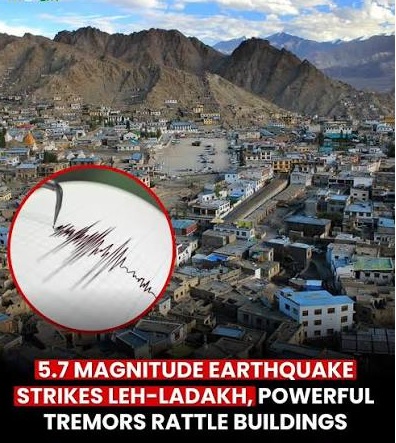
5.5-Magnitude Earthquake Jolts Leh, Ladakh: No Major Damage Reported
By: News Desk | 13 Aug 2026
A 5.5-magnitude earthquake jolted Leh in Ladakh early Thursday morning, August 13, sending residents rushing out of homes and buildings. No casualties or major structural damage were reported in the immediate aftermath, but the shallow earthquake has once again highlighted the seismic vulnerability of the fragile Himalayan region.
According to the National Centre for Seismology (NCS), the earthquake occurred at 6:05:15 am IST at a depth of approximately 10 kilometres. The recorded coordinates were 36.881°N latitude and 74.402°E longitude, with the event classified as a 5.5-magnitude earthquake in Leh, Ladakh.
The early reports are reassuring: there were no immediate reports of casualties or significant property damage. Authorities, however, continue to monitor the situation because damage assessments following an earthquake can take time, particularly in mountainous terrain where access to remote settlements can be difficult.
5.5-Magnitude Earthquake Strikes Leh Early in the Morning
The timing of Thursday’s earthquake meant that many people were indoors when the ground began shaking.
A magnitude 5.5 earthquake is capable of producing noticeable shaking, although the actual effects on buildings and people depend on several factors, including depth, distance from the epicentre, local geology, construction quality and ground conditions.
In Leh, where traditional structures exist alongside modern concrete buildings, the performance of individual structures can vary considerably.
The NCS recorded the earthquake at a relatively shallow depth of 10 km. A shallow earthquake can produce stronger shaking near the epicentral region than a deeper earthquake of the same magnitude, although actual ground intensity depends on several geological and structural factors.
Where Was the Leh Earthquake Located?
The NCS placed the earthquake at:
- Magnitude: 5.5
- Date: August 13, 2026
- Time: 6:05:15 am IST
- Depth: 10 km
- Latitude: 36.881°N
- Longitude: 74.402°E
- Location: Leh, Ladakh
The event has been listed by the National Centre for Seismology as a reviewed earthquake, providing greater confidence in the preliminary location and magnitude information.
Why Is Ladakh Prone to Earthquakes?
Ladakh sits within one of the world’s most tectonically active mountain systems.
The Himalayas were created by the continuing convergence of the Indian and Eurasian tectonic plates. The Indian Plate continues to move northward and interact with the Eurasian Plate, generating enormous geological stresses.
Those stresses are periodically released through earthquakes.
This is why earthquakes are not unusual across the broader Himalayan region, stretching from Pakistan and northern India through Nepal, Bhutan and Tibet.
For Ladakh, seismic risk is particularly important because the region combines active tectonics, rugged terrain, remote settlements and challenging infrastructure conditions.
The Bigger Risk Is Not Always the Earthquake Itself
An earthquake of moderate magnitude does not automatically translate into a disaster.
The level of damage depends heavily on the vulnerability of the built environment.
A well-engineered earthquake-resistant building can withstand shaking far better than a poorly constructed structure, even when both are exposed to the same earthquake.
This makes building quality and seismic design critical for Leh and other Himalayan settlements.
Potential vulnerabilities include:
- Older masonry structures
- Poorly reinforced buildings
- Heavy roofs and unsecured structural elements
- Construction on unstable or unsuitable ground
- Inadequate adherence to seismic building standards
- Narrow roads that can become difficult to access after structural failures
- Remote settlements where emergency assistance may take longer to arrive
For a mountainous region, disaster resilience therefore has to begin before an earthquake happens.
No Major Damage Reported — But Monitoring Matters
Initial reports following the August 13 earthquake indicated no casualties or major damage.
That is welcome news, but the absence of immediate reports should not be interpreted as proof that every part of the wider region is unaffected.
Remote Himalayan communities can be difficult to assess immediately after a seismic event.
Road access, communication networks and geographical isolation can delay field verification.
For this reason, authorities typically continue monitoring after the initial tremor for reports of structural damage, landslides or other secondary effects.
Earthquakes Can Trigger Secondary Hazards in the Himalayas
For Ladakh, seismic risk is not limited to collapsing buildings.
Earthquakes can potentially destabilise already-fragile mountain slopes.
Depending on local geology and ground conditions, strong shaking can contribute to:
Landslides
Loose rock and unstable slopes can become more vulnerable following seismic shaking.
Rockfalls
Mountain roads can be exposed to falling rocks and debris, particularly along steep cuttings.
Road Disruptions
Even relatively limited slope failures can obstruct roads connecting remote communities.
Infrastructure Damage
Water pipelines, electricity networks and other lifelines can be vulnerable to ground movement.
These secondary hazards make earthquake preparedness especially important in mountainous areas.
Leh Has Already Experienced Earthquake Activity This Year
Thursday’s earthquake is not an isolated seismic event for Leh.
A 5.7-magnitude earthquake struck Leh in January 2026, according to the National Centre for Seismology, with the tremor occurring at a much greater depth of around 171 kilometres. No immediate casualties or major damage were reported at the time.
The comparison is useful because it shows that earthquakes of different depths can occur in the same broader region.
However, it would be misleading to suggest that the January and August earthquakes are necessarily directly connected without a detailed seismological assessment.
Earthquake sequences and tectonic relationships require analysis of fault mechanisms, locations, depths and aftershock patterns.
Earthquake-Resistant Construction Is Critical for Leh
The most effective earthquake strategy is not simply responding quickly after the ground shakes.
It is reducing vulnerability before the event.
For Leh and other Himalayan towns, that means stronger implementation of seismic building codes, particularly for new construction and major renovations.
Engineers and planners need to consider:
- Structural reinforcement
- Appropriate foundation design
- Building height and configuration
- Soil and geological conditions
- Lightweight and properly secured structural elements
- Emergency access routes
- Seismic retrofitting of vulnerable buildings
Public buildings such as schools, hospitals and emergency-service facilities deserve particular attention because they must remain operational when communities need them most.
What Residents Should Do During an Earthquake
The safest response during an earthquake is to avoid panic and protect yourself from falling objects.
If indoors:
- Drop, Cover and Hold On.
- Move away from windows and glass.
- Avoid running toward staircases while the building is shaking.
- Do not use elevators.
- Stay inside until the shaking stops and authorities advise otherwise.
If outdoors:
- Move away from buildings, walls, trees and electrical lines.
- Stay in an open area where possible.
If driving:
- Stop safely away from bridges, buildings, power lines and unstable slopes.
- Remain inside the vehicle until the shaking ends.
After the earthquake, residents should watch for damaged structures, gas leaks, electrical hazards and unstable slopes.
Ladakh’s Environmental Fragility Adds Another Layer of Risk
Ladakh’s environment is exceptionally sensitive.
The region’s high altitude, arid landscape, limited vegetation and steep terrain mean that natural recovery from physical disturbances can be slow.
Infrastructure development is also expanding in areas where environmental conditions are already demanding.
That creates a difficult planning equation:
How can Ladakh modernise its infrastructure without increasing its exposure to natural hazards?
Earthquake resilience should therefore be incorporated into broader environmental planning rather than treated as a separate disaster-management issue.
The Real Warning Behind the 5.5-Magnitude Leh Earthquake
Thursday’s earthquake did not become a major disaster.
That is precisely why it should be treated as a warning rather than merely a news event.
The absence of casualties provides an opportunity to examine what worked, identify vulnerable buildings and strengthen emergency systems before a larger earthquake occurs.
Himalayan regions cannot prevent earthquakes.
They can, however, reduce the consequences.
That requires better construction, stronger enforcement of seismic standards, scientific monitoring, public awareness, emergency planning and protection of critical infrastructure.
Ladakh Needs Resilience, Not Just Response
The 5.5-magnitude earthquake that struck Leh is another reminder that seismic activity is part of the natural reality of the Himalayas.
For residents, the immediate relief is that no casualties or major damage were reported.
For planners and policymakers, however, the message is more serious.
A future earthquake could occur at a different location, depth or magnitude, potentially producing very different consequences.
The safest strategy is therefore to prepare during periods of calm.
Ladakh’s fragile Himalayan landscape demands infrastructure that is not only modern but also earthquake-resistant, environmentally responsible and capable of supporting communities during emergencies.
The ground has shaken.
The larger question is whether Ladakh’s infrastructure is ready for the next time it does.