One Screen, One Scam: Inside Kashmir’s Silent UPI Spoofing Crisis
By: Javid Amin | 05 July 2026
When “Payment Successful” Means Nothing At All
Picture a Saturday afternoon at Lal Chowk. The counter is three customers deep, the till hasn’t stopped ringing, and a young man in a hurry holds up his phone to show a green tick and the words “Payment Successful.” The shopkeeper glances at it, nods, and hands over the shirt. Thirty seconds later, the customer is gone — and so is the money that never actually arrived.
This isn’t a one-off story. It’s a pattern that’s now playing out across Kashmir’s busiest bazaars with uncomfortable regularity, and a new field study has finally put numbers to what shopkeepers have been quietly grumbling about for months: UPI spoofing scams are draining Kashmir’s small businesses, and most traders have no idea how — or where — to report it.
The study, conducted by the Department of Public Administration at Amar Singh College under the guidance of department head Zubair Nazeer Malik, surveyed 102 merchants across Srinagar and Anantnag. The findings are stark: 57.8% of merchants — nearly 6 in 10 — reported direct financial losses from fraudulent digital transactions, and a staggering 90.2% had no idea an official cybercrime reporting channel even existed before researchers told them.
In a Valley where UPI has quietly become the default way to pay for everything from a loaf of bread to a designer suit, that awareness gap isn’t just a statistic. It’s an open door.
How the UPI Spoofing Scam Actually Works
The mechanics of this fraud are almost insultingly simple — which is precisely why it works so well.
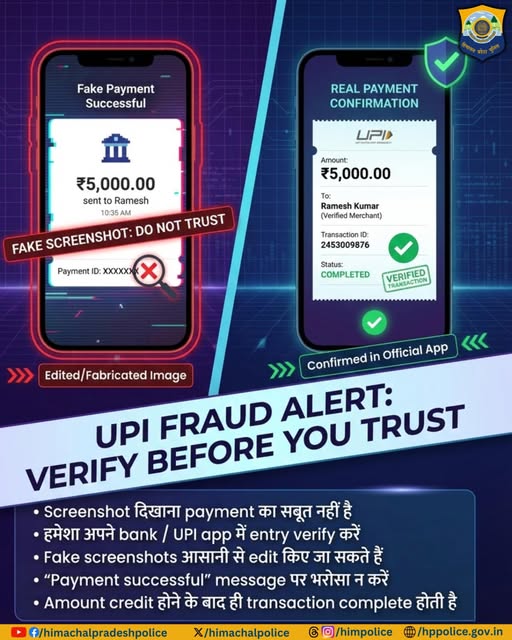
Step one: The fake screen. A “customer” scans the shopkeeper’s QR code or claims to have transferred money to their UPI ID. Instead of a real transaction going through, they show a doctored or spoofed screen — sometimes a manipulated screenshot, sometimes a fake payment app designed to mimic Google Pay, PhonePe, or Paytm right down to the logo and the cheerful “ding” sound. To the naked eye, in a two-second glance, it looks exactly like the real thing.
Step two: The pressure play. Busy market hours are the fraudster’s best friend. A crowded counter, a queue building up, someone insisting the “network is just a little slow” — every one of these ordinary market conditions becomes a tool for manipulation. The scam doesn’t exploit a flaw in UPI’s technology at all; it exploits the shopkeeper’s trust and time crunch.
Step three: The disappearing act. By the time the merchant checks their bank balance, notices the missing credit, and looks up — the customer, and the goods, are long gone.
The Amar Singh College study captured this pattern in granular detail: 38.2% of merchants said they’d faced spoofing attempts once or twice, while another 36.3% said it happened to them frequently — meaning for a large share of traders, this isn’t a rare misfortune, it’s a recurring cost of doing business. The study’s researchers were blunt about where the fault lies: fraud happened “at the point of sale via fake confirmations and false network-delay claims,” with merchants releasing goods without checking actual account credit — a failure of verification, not a failure of UPI’s underlying system.
Where It’s Happening: A Valley-Wide Problem
This isn’t confined to one lane or one market. Researchers fanned out across some of the most commercially dense stretches in the region — Lal Chowk, Maharaja Bazaar, Gonikhan Market, Gogji Bagh, Hyderpora, Kokar Bazaar, Makkah Market, and Janglatmandi in Anantnag town — and found the same story repeating with only minor variations.
The financial damage, while often modest per incident, adds up fast in high-volume, low-margin businesses:
- 25 merchants (24.5%) lost less than ₹500 per incident — mostly street food vendors, milk sellers, and stationery shop owners.
- 20 merchants (19.6%) lost between ₹500 and ₹2,000 — largely clothing boutiques, footwear stores, and cosmetic shops.
- 9 merchants (8.9%) — including electronics dealers, garment traders, and dry fruit sellers — lost more than ₹2,000 in a single incident.
None of these numbers look catastrophic in isolation. But for a fruit seller or a milk vendor running on thin daily margins, even a ₹500 loss stings. And when it happens “once or twice” — or worse, “frequently” — the cumulative bleed becomes a real threat to the business’s bottom line.
The QR Code Blind Spot Nobody’s Talking About
Here’s where the study uncovers something the popular conversation around UPI fraud usually misses entirely: the QR code itself is often sitting there, unprotected, like a house key left under the doormat.
A visual security audit conducted alongside the survey found that 60.8% of merchants displayed their QR codes as loose paper stickers — not laminated, not framed, not secured in any way. Only 39.2% had bothered to protect theirs. Worse, a large share had their QR codes positioned outside the counter, in crowded, poorly supervised spots — a setup that leaves them wide open to “QR sticker swap fraud,” where a fraudster simply pastes a counterfeit QR code over the genuine one. Customers scan what they believe is the shop’s code; the money instead lands in a stranger’s account, and the shopkeeper doesn’t find out until settlement time — or never.
It’s a low-tech attack on a high-tech payment system, and it’s almost entirely preventable with something as basic as a laminated sticker kept within eyesight of the till.
Why Kashmir’s Bazaars Are Especially Exposed
Three forces have converged to make Kashmir’s traders a soft target.
Digital adoption outran digital literacy. UPI usage across Kashmir’s markets accelerated sharply in the years following the pandemic, as both customers and shopkeepers embraced the convenience of tap-and-go payments. But the awareness campaigns needed to keep pace with that adoption simply didn’t happen at the same speed. The result is a generation of merchants who are fluent in accepting a UPI payment but far less confident about verifying one.
Small businesses rarely get formal training. Unlike large retail chains with dedicated point-of-sale systems and back-office verification, most Kashmiri shopkeepers are one- or two-person operations. There’s no IT department, no fraud-prevention briefing, no standard operating procedure — just a shopkeeper, a phone, and their own judgment.
Rush hour is fraud hour. The study’s own researchers flagged social engineering — the deliberate exploitation of crowded counters and sales pressure — as a key tactic. When ten customers are waiting and one of them is holding up a screen that says “paid,” verification is the first casualty of convenience.
The Real Crisis Isn’t the Scam — It’s the Silence After It
If there’s one number in this study that should worry policymakers more than any other, it isn’t the fraud rate. It’s the reporting rate.
Ninety-two of the 102 merchants surveyed — 90.2% — didn’t know an official cybercrime reporting channel existed. Only 10 (9.8%) had heard of the National Cyber Crime Helpline, 1930. That means the overwhelming majority of shopkeepers who lose money to a spoofing scam simply absorb the loss and move on — no complaint filed, no case number generated, no data point added to the pool that law enforcement uses to track and catch repeat offenders.
This is more than an inconvenience for individual victims. Every unreported case is a lost opportunity for investigators to spot patterns, trace serial fraudsters, and build the evidence needed for arrests. Silence, in this context, doesn’t just fail the victim — it protects the scammer’s next target too.
Fighting Back: What’s Already Working
It isn’t all bleak. The same study that exposed the scale of the problem also found genuine signs of merchant resilience — habits that, once adopted, close the door on this particular scam almost completely.
Traders who had already been burned once were changing behavior fast:
- Verifying inside their own app rather than trusting a customer’s screen — checking the actual credited balance, not a screenshot.
- Waiting for SMS bank alerts before releasing goods, even if it means a short pause at the counter.
- Installing soundbox devices — small audio units linked directly to the bank account that announce “₹500 received” out loud, removing the need to even look at a phone screen.
The research team didn’t just document the problem and walk away, either. During the survey itself, they actively coached merchants on spotting fake confirmations, verifying through official apps, and reporting fraud via the 1930 helpline — and reported that many shopkeepers saved the number on the spot, with market associations offering to spread the word further through trader networks.
What Every Shopkeeper Should Do Starting Today
Cybersecurity doesn’t have to mean complicated technology. For a shop counter, it comes down to five habits:
- Never accept a screenshot as proof of payment. A screenshot can be edited, faked, or generated by a spoof app in seconds. The only proof that matters is the credit showing up in your own banking or UPI app.
- Wait for the SMS or soundbox confirmation before handing over goods — even if it costs you ten extra seconds and an impatient customer.
- Secure your QR code. Laminate it, mount it inside the counter where you can see it, and check periodically that no one has pasted a counterfeit sticker over it.
- Train every staff member, not just the owner. Fraud prevention shouldn’t depend on one experienced person being at the till at all times.
- Report every incident — even small ones. File a complaint at the National Cybercrime Portal (cybercrime.gov.in) or call the 1930 helpline. Even if you don’t expect your money back, every report adds to the data trail that helps police identify repeat scammers.
Snapshot: The Numbers That Matter
| Factor | Verified Finding | Impact |
|---|---|---|
| Merchants surveyed | 102 across Srinagar & Anantnag markets | Statistically meaningful field sample |
| Financial losses reported | 57.8% (59 merchants) | Majority of traders directly hit |
| Spoofing attempts (occasional) | 38.2% faced it once or twice | Widespread exposure |
| Spoofing attempts (frequent) | 36.3% faced it repeatedly | Recurring operational risk |
| Awareness of reporting channels | 90.2% unaware before the study | Cases go unreported, funds unrecovered |
| Knew the 1930 helpline | Only 9.8% | Near-total awareness gap |
| Unsecured QR codes | 60.8% as loose paper stickers | High risk of QR-swap fraud |
| Emerging defenses | App verification, SMS alerts, soundbox devices | Proven to reduce fraud risk |
The Outlook: Awareness Is the Only Patch That Works
There is no software update that fixes this problem, because the vulnerability isn’t in the UPI network — it’s in the gap between how fast digital payments spread and how slowly fraud awareness followed. The National Payments Corporation of India has been consistent in its guidance: never treat a screenshot as proof, never scan a code to receive money, and always verify inside your own app before completing a sale. The tools to prevent this fraud already exist. What’s missing in Kashmir’s bazaars is simply the knowledge that they exist.
The Amar Singh College study offers a template for what closes that gap: direct, in-person awareness drives that don’t just survey shopkeepers but actively train them, market by market, counter by counter. Until that kind of sustained outreach becomes routine — backed by trader associations, banks, and local police — Kashmir’s merchants will remain exactly where this study found them: doing brisk business on fast, modern payment rails, while standing dangerously exposed to one of the oldest tricks in the fraud playbook — a screen that lies.
If you’re a shopkeeper who has faced a similar fraud, report it at cybercrime.gov.in or call the 1930 National Cyber Crime Helpline. Every report matters, even if the loss seems small.