NH-44 Disruptions Raise Fresh Fears for Kashmir’s Apple Growers as Harvest Season Approaches
By: News Desk | 08 Aug 2026
For Kashmir’s fruit growers, the road from an orchard to a distant market can be as important as the crop itself.
As the 2026 apple harvest and dispatch season approaches, that journey is once again becoming a source of anxiety.
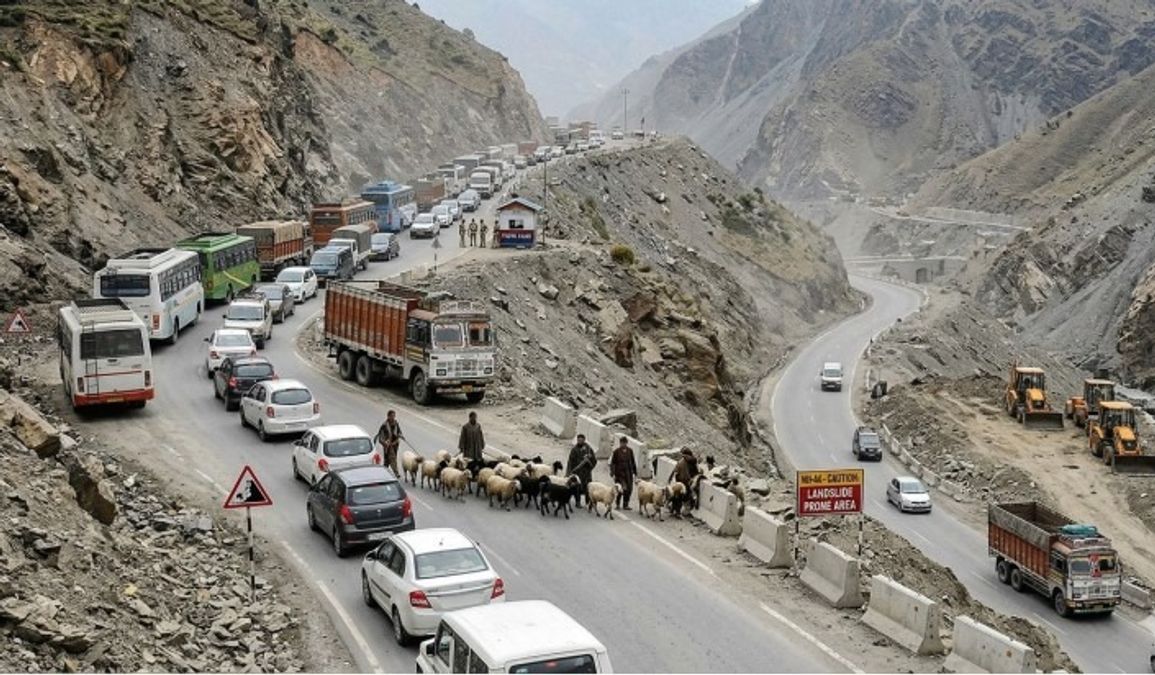
The Jammu–Srinagar National Highway (NH-44)—the principal road corridor connecting the Kashmir Valley with markets and supply chains outside the region—has witnessed repeated disruptions this year, particularly across vulnerable stretches of Ramban and Banihal.
Landslides, shooting stones, heavy rain, single-lane restrictions and prolonged traffic congestion have repeatedly slowed the movement of vehicles.
In late July, a fresh landslide in the Udhampur sector reportedly left more than 1,700 trucks stranded, underlining how quickly a highway disruption can become a major logistics problem.
The problem is particularly sensitive for horticulture.
Apple cannot simply wait indefinitely in a truck while a road is blocked.
Every additional hour can increase exposure to heat, poor ventilation, rough handling and delays at subsequent points in the supply chain.
That is why apple growers and traders are now pressing authorities to give priority passage to fruit-laden trucks, with some calling for arrangements resembling a dedicated “green corridor” during the critical harvest period.
NH-44: Kashmir’s Economic Lifeline Under Pressure
NH-44 is much more than a highway for ordinary commuters.
It is a critical economic artery through which food, fuel, medicines, construction material and agricultural produce move between Jammu and Kashmir and the rest of the country.
For the horticulture sector, its importance is even greater.
A large proportion of Kashmir’s commercial fruit ultimately has to travel outside the Valley, with major markets in northern and western India forming an important part of the distribution network.
The J&K government’s 2026 horticulture roadmap describes the Union Territory as a major national apple-producing region and identifies Shopian, Kulgam, Pulwama, Anantnag, Kupwara and Baramulla among the principal apple-producing areas. It also identifies horticulture infrastructure and market connectivity as key areas requiring continued development.
That makes reliable transportation a core part of the economics of Kashmir’s orchard industry.
A good crop can generate income only when it reaches the buyer in marketable condition.
Why This Year’s Highway Disruptions Matter
The latest concern is not based on a single highway closure.
NH-44 has experienced a series of disruptions during 2026.
In April, landslides and shooting stones blocked stretches between Karol Bridge and Chanderkote in Ramban district, forcing authorities to suspend traffic until clearance operations were completed.
The situation has remained volatile during the summer and monsoon period.
In July, landslides and shooting stones again affected movement through Ramban, while another major disruption in Udhampur resulted in a large number of trucks being stranded.
A recent scientific assessment of the Banihal–Ramban corridor has also highlighted the structural nature of the problem. Researchers identify steep terrain, fragile geology, active tectonic conditions, extreme precipitation and infrastructure-related slope modification as interacting factors behind recurrent landslide hazards along NH-44.
For transporters, that means the problem cannot always be solved simply by clearing a fallen boulder or removing debris.
The highway passes through a landscape where weather and geology can rapidly change road conditions.
Apple Harvest Adds a New Layer of Pressure
The timing is crucial.
Kashmir’s apple season is not a single-day event. Different varieties and growing zones mature at different times, with early harvests beginning before the main commercial movement gathers pace.
As harvesting accelerates, thousands of orchardists, labourers, commission agents, packers, transporters and traders become dependent on the same logistics network.
The movement typically begins at the orchard.
Apples are picked, graded, packed and loaded into trucks before beginning the journey towards markets outside Kashmir.
Any disruption on the highway can therefore affect several actors simultaneously.
For the farmer, the concern is the price received.
For the trader, it is the condition of the consignment when it reaches the market.
For the transporter, it is fuel, driver time and vehicle utilisation.
For the buyer, it is whether the fruit arrives when expected.
A highway delay therefore becomes an economic problem across the entire chain.
Why Time Matters So Much for Apples
Apples are more resilient than some highly perishable fruits, but they are still a time-sensitive agricultural commodity.
Quality can deteriorate through bruising, poor temperature management, inappropriate storage and prolonged handling.
The longer a loaded truck remains stationary, the greater the uncertainty.
There is also a market dimension.
Wholesale markets operate around expected arrivals. When a large number of trucks arrive late or simultaneously after a prolonged blockade, the resulting supply fluctuation can affect prices and trading conditions.
For growers already dealing with rising labour, packaging, pesticide, fertiliser and transportation costs, an avoidable logistics loss can significantly reduce margins.
This is why the phrase “every hour matters” is not merely a political slogan for fruit growers.
It reflects the economics of moving a perishable crop through a mountainous transport corridor.
Growers and Traders Want Priority for Fruit Trucks
The demand for special treatment of fruit-laden vehicles has now become more prominent.
Apple growers and traders have urged authorities to prioritise loaded fruit trucks on NH-44, particularly when traffic is being regulated because of weather conditions, landslides or the Amarnath Yatra.
The argument is straightforward.
If traffic has to be released selectively during a disruption, vehicles carrying perishable agricultural produce should be given priority alongside other essential categories.
The proposed idea is often described as a “green corridor” for fruit trucks.
This would not necessarily mean giving every fruit vehicle unrestricted passage.
Instead, authorities could establish a coordinated system under which fruit-laden trucks are identified and moved through vulnerable stretches as soon as road conditions permit.
Such a system would require coordination between traffic police, highway authorities, district administrations and transport operators.
What a Fruit Green Corridor Could Look Like
A practical fruit-priority system could include several measures.
01. Dedicated Identification
Fruit-laden trucks could be clearly identified through permits, digital passes or other verification mechanisms.
This would reduce the possibility of unrelated commercial vehicles using the priority system.
02. Priority Release After Road Clearance
When a blocked stretch reopens, verified fruit trucks could be allowed to move in the first available convoy rather than being placed at the end of a long queue.
03. Real-Time Traffic Information
Growers and transporters should receive regular updates on:
- Landslides
- Road closures
- Single-lane restrictions
- Convoy timings
- Weather warnings
- Alternative routes where available
04. Coordination With Fruit Mandis
Authorities could coordinate expected truck movement with major wholesale markets so that receiving markets can prepare for delayed or concentrated arrivals.
05. Emergency Holding Areas
Designated safe parking and staging areas would help prevent fruit trucks from being left randomly along the highway during closures.
Such a system would not eliminate landslide risk.
But it could reduce the economic damage caused by unavoidable disruptions.
The Problem Is Bigger Than Apples
While apple growers are currently among the most visible stakeholders, NH-44’s vulnerability affects the entire Kashmir economy.
A prolonged closure can disrupt:
Horticulture: Fruit trucks and agricultural supplies.
Retail: Consumer goods entering the Valley.
Construction: Cement, steel and other materials.
Fuel supply: Movement of petroleum products.
Tourism: Buses, taxis and private vehicles.
Pilgrimage: Amarnath Yatra traffic.
Healthcare: Movement of patients and medical supplies.
That interconnectedness is what makes NH-44 strategically important for the Valley.
A highway disruption is rarely confined to the road itself.
Its economic effects spread outward.
Amarnath Yatra Adds to Traffic Pressure
The current period also overlaps with the Amarnath Yatra, creating an additional layer of traffic-management pressure.
The highway is being used by pilgrims, tourist vehicles, passenger buses, commercial vehicles and freight carriers at the same time.
Authorities therefore have to balance multiple priorities.
Pilgrims need safe passage.
Ordinary commuters need mobility.
Essential supplies need to move.
And now fruit growers need to begin transporting the season’s crop.
This is why a transparent priority framework becomes particularly important during periods of heavy traffic.
Without advance planning, the same vehicles can become trapped in queues created by a combination of weather restrictions and traffic regulation.
The Hidden Cost: Transporters Pay Too
The economic cost of highway disruption is not limited to farmers.
A truck stuck for 12 or 24 hours still consumes resources.
Drivers need food and accommodation.
Vehicles consume fuel through idling and repeated movement.
Delivery schedules are missed.
A delayed truck may also miss its expected unloading window at a mandi.
For transporters operating on thin margins, repeated delays can quickly become expensive.
Those costs eventually move through the supply chain.
The grower may pay more for transportation.
The trader may reduce the purchase price to account for uncertainty.
The consumer may ultimately pay more at the other end.
A highway bottleneck can therefore become an invisible tax on the entire economy.
Why Kashmir’s Horticulture Cannot Afford Repeated Disruptions
Horticulture is one of the pillars of Kashmir’s rural economy.
The sector supports orchard owners, farm labourers, packaging units, transporters, cold-storage operators, commission agents, traders and wholesalers.
The J&K horticulture development roadmap estimates that the Union Territory contributes more than 70% of India’s apple production, while highlighting the need for stronger cold-storage and market infrastructure.
That scale makes logistics infrastructure a strategic economic issue.
Kashmir does not simply need to produce high-quality apples.
It needs to deliver them efficiently.
The more competitive national fruit markets become, the more important reliability will be.
A buyer in Delhi, Mumbai or another major market is ultimately concerned with quality, quantity, price and delivery.
If a supplier repeatedly faces unpredictable transport delays, the buyer may look for alternative sources.
That is why highway reliability is connected directly to Kashmir’s market reputation.
The Bigger Weakness: Too Much Dependence on One Road
The recurring NH-44 problem also exposes a deeper structural vulnerability.
Kashmir’s road connectivity to the rest of India remains heavily dependent on a difficult mountain corridor.
When that corridor is disrupted, there are limited immediate alternatives for large-scale freight movement.
The expansion of the Udhampur–Srinagar–Baramulla Rail Link has created a major alternative for passenger connectivity, but road freight remains indispensable for agricultural produce and many categories of commercial goods.
That means the solution cannot simply be “use the train”.
For a horticulture economy dependent on large-scale road freight, India and J&K need to develop a multimodal logistics strategy.
Railways, roads, storage facilities, refrigerated logistics and modern mandis all have to work together.
Can Railways Eventually Reduce the Pressure?
In the long term, expanded railway connectivity could reduce some pressure on roads, particularly for passenger movement and selected categories of freight.
But fruit transportation presents its own logistical requirements.
Fresh produce needs appropriate loading, handling, scheduling and potentially temperature-controlled facilities.
Therefore, simply having a railway line does not automatically create a horticulture logistics solution.
What Kashmir needs is an integrated supply chain in which orchards connect efficiently to collection centres, cold stores, railheads and wholesale markets.
That would make the horticulture economy considerably more resilient.
Government’s Immediate Challenge: Keep the Corridor Moving
The most immediate requirement is not a grand new project.
It is better management of the existing corridor during the vulnerable season.
The authorities already issue traffic advisories warning fruit growers and load carriers to ensure adequate fuel and follow designated parking arrangements before undertaking journeys on NH-44.
That is useful, but the scale of the horticulture season calls for more proactive planning.
A seasonal NH-44 horticulture traffic plan could be prepared before the main dispatch period.
It could identify:
- High-risk landslide locations
- Fruit-truck staging points
- Emergency parking areas
- Priority convoy arrangements
- Communication channels
- Alternative holding locations
- Coordination mechanisms with mandis
Such preparation would make the system less dependent on ad hoc decisions after every landslide.
The Weather Factor Cannot Be Ignored
The biggest challenge is that authorities cannot control the mountain.
Heavy rain can trigger landslides without much warning.
Shooting stones can make a road unsafe even when the carriageway itself appears open.
In such situations, forcing trucks through a dangerous section would be irresponsible.
Therefore, the demand for priority movement must always be conditional on road safety.
The objective should be:
Move fruit trucks first when the road is safely passable—not move them regardless of safety conditions.
That distinction is essential.
A green corridor cannot mean bypassing geological or traffic-safety restrictions.
It must mean better prioritisation once safe movement becomes possible.
The Road Ahead for Kashmir’s Fruit Economy
The coming weeks will test how effectively Kashmir’s horticulture and transport systems can cope with the harvest.
The crop itself is only the first half of the story.
The second half is the journey from orchard to market.
If NH-44 remains vulnerable to repeated closures during the peak dispatch period, the pressure on growers and transporters will increase.
If authorities establish a transparent priority mechanism for fruit-laden vehicles, strengthen real-time communication and coordinate traffic management with the horticulture department and trade bodies, some of that pressure can be reduced.
But the longer-term answer has to be broader.
Kashmir needs stronger roads, resilient mountain infrastructure, more storage capacity, better logistics planning and greater use of multimodal transport.
NH-44 Is More Than a Highway—It Is Part of Kashmir’s Food Economy
Every truck leaving Kashmir during the apple season carries more than boxes of fruit.
It carries the income of an orchard family.
It carries wages for labourers.
It carries business for transporters and traders.
And it carries Kashmir’s reputation into markets hundreds of kilometres away.
That is why repeated NH-44 disruptions deserve attention beyond routine traffic reporting.
The question is not whether landslides can be eliminated—they cannot.
The question is whether the economic consequences of those disruptions can be reduced.
For Kashmir’s fruit growers, the answer is becoming increasingly urgent.
A safe and predictable NH-44 is not simply a convenience for commuters.
It is essential economic infrastructure for one of Jammu and Kashmir’s most important rural industries.
As the 2026 apple harvest gathers pace, the demand from growers is therefore simple: when the highway opens, let the fruit move.
And if a dedicated, coordinated fruit-truck priority corridor can help achieve that without compromising safety, it deserves serious consideration before the Valley’s biggest harvest rush reaches its peak.