Jalandhar–Pathankot Highway Accident: 3 Killed, Including 2 Srinagar Residents, Near Cholang Toll Plaza
By: News Desk | 17 Aug 2026
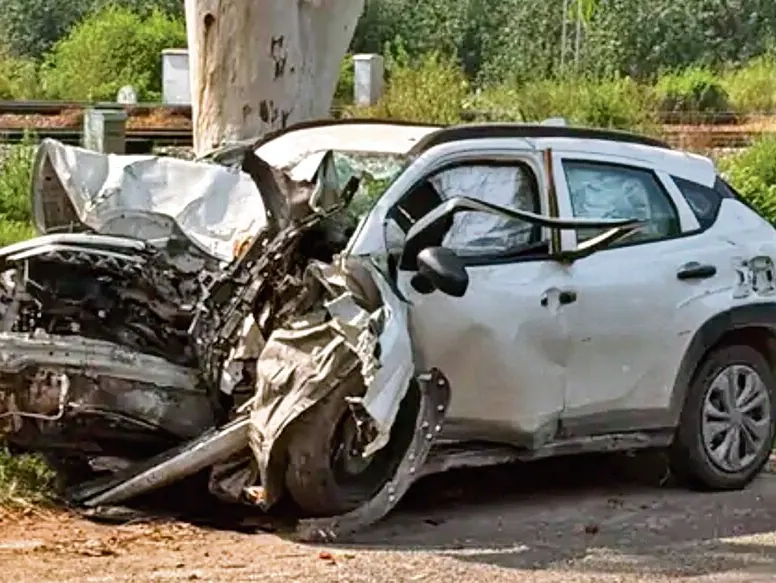
Three people, including two residents of Srinagar, were killed and three others injured after a Jammu & Kashmir-registered Toyota Fronx crashed near the Cholang Toll Plaza on the Jalandhar–Pathankot National Highway on August 16. Police have begun an investigation into the fatal road accident.
Jalandhar, August 17, 2026: A tragic road accident on the Jalandhar–Pathankot National Highway has claimed three lives, including those of two Srinagar residents, after a Toyota Fronx lost control near the Cholang Toll Plaza in the Bhogpur area on Sunday afternoon.
According to the information provided in the preliminary accident report, the vehicle was travelling from Jalandhar towards Pathankot when it reportedly went out of control, struck a roadside tree and subsequently crashed into a fruit-cart vendor.
Three people died in the accident, while three others sustained injuries and were shifted to Civil Hospital, Tanda, for treatment.
The vehicle was registered in Jammu & Kashmir.
Three Killed in Cholang Toll Plaza Crash
The deceased have been identified as:
- Sukhwinder Singh, 50, a resident of Chak Shakoor in Punjab
- Ikhlaq Qadir, a resident of Srinagar
- Aneek Amin, a resident of Srinagar
The deaths underline the human cost of highway accidents, particularly on busy national-highway corridors where high-speed traffic mixes with roadside commercial activity and local pedestrian movement.
The three injured persons were initially provided first aid before being shifted to hospital.
Accident Sequence
Based on the preliminary account, the Toyota Fronx was moving towards Pathankot when its driver apparently lost control.
The vehicle first hit a tree before veering into a roadside fruit cart.
The sequence is significant because it suggests that the collision was not limited to the vehicle and its occupants. A roadside vendor was also caught in the path of the out-of-control car.
However, the precise reason why the driver lost control remains subject to investigation. At this stage, it would be premature to attribute the crash to speeding, mechanical failure, driver fatigue, road conditions or any other specific factor without an official finding.
Police Reach the Spot, Rescue Operation Underway
Police and highway-response teams reportedly reached the accident site after the crash.
The injured were removed from the scene and transported for medical treatment.
The damaged vehicle was taken into police custody as part of the investigation.
Police also recovered belongings from inside the vehicle, including:
- Seven kit bags
- One laptop
- Three wallets containing approximately ₹4,400
- Two mobile phones
- Mobile-phone chargers
- A wristwatch
The recovered belongings were handed over to Bhogpur police station.
These details are relevant not only for the investigation but also for the identification and formal handover process involving the victims’ families.
Two Srinagar Residents Among the Dead
The deaths of Ikhlaq Qadir and Aneek Amin are likely to be particularly significant for families and communities in Srinagar.
The vehicle’s Jammu & Kashmir registration indicates that the occupants were travelling outside the Union Territory when the accident occurred.
For families back home, such incidents create an additional challenge: confirming identities, completing medico-legal procedures and arranging transportation of the deceased.
Authorities will therefore need to maintain close coordination with the victims’ families and, where necessary, officials in Jammu & Kashmir.
A Highway Accident With Multiple Points of Risk
The Cholang crash also highlights a broader road-safety issue.
The Jalandhar–Pathankot highway is an important transport corridor connecting Punjab with the northern regions. Busy highways can become particularly hazardous where high-speed traffic passes close to roadside commercial activity.
A vehicle losing control is an individual event.
But the consequences can become much larger when the road environment contains:
- roadside vendors;
- pedestrians;
- trees close to the carriageway;
- inadequate crash barriers;
- unprotected commercial activity;
- sudden access points;
- high-speed traffic.
The investigation should therefore establish not only what happened inside the vehicle but also whether the surrounding road environment complied with applicable highway-safety standards.
Was the Driver at Fault?
The preliminary report says the driver lost control.
That describes the immediate event but does not establish legal responsibility.
Police will need to determine why the vehicle lost control.
Possible factors could include:
Vehicle-related factors
- tyre failure;
- steering or braking malfunction;
- mechanical defect.
Human factors
- excessive speed;
- distraction;
- fatigue;
- sudden medical emergency;
- unsafe manoeuvring.
Road-related factors
- surface defects;
- poor visibility;
- unexpected obstruction;
- inadequate roadside protection.
Only an investigation, including examination of the vehicle and available evidence, can establish the actual cause.
Therefore, the safest journalistic formulation is “the driver reportedly lost control”, rather than stating that reckless driving caused the crash.
Why the Roadside Vendor Is an Important Part of the Story
The reported collision with a fruit-cart vendor adds another dimension to the tragedy.
Across India, roadside vendors often operate close to major roads because passing traffic provides their customer base.
This creates a difficult socio-economic balance.
For a small vendor, moving farther away from the highway can reduce income.
For road authorities, however, unprotected roadside commercial activity can create additional risks for both vendors and motorists.
The solution cannot simply be to remove livelihoods without alternatives.
Instead, highway authorities and local administrations need to identify:
- designated vending areas;
- safe setbacks from high-speed traffic;
- pedestrian access;
- protective barriers;
- adequate lighting;
- clearly marked entry and exit points.
Road safety and livelihood protection need not be competing objectives.
Investigation Will Be Crucial
The vehicle has reportedly been seized, allowing investigators to examine its mechanical condition and reconstruct the crash.
Investigators may examine:
- braking system;
- tyres;
- steering;
- vehicle damage pattern;
- road marks;
- CCTV footage;
- eyewitness statements;
- driver’s condition;
- traffic conditions;
- road geometry;
- location of the roadside vendor.
If available, CCTV footage from the toll plaza and nearby establishments could be particularly valuable in establishing the vehicle’s speed, lane position and movements immediately before the crash.
The Importance of the Black Box Question
Unlike aircraft, ordinary passenger cars generally do not have a conventional black box, but modern vehicles can contain electronic systems capable of retaining useful information depending on the model and configuration.
Investigators can therefore determine whether the particular vehicle’s electronic systems contain relevant crash or diagnostic data.
Such evidence, combined with physical inspection and CCTV footage, can provide a more reliable reconstruction than eyewitness estimates of speed.
A Tragedy That Raises Wider Highway-Safety Questions
The Cholang accident is more than another entry in India’s road-accident statistics.
It demonstrates how quickly a single loss-of-control event can become a multi-fatality crash.
A vehicle hits a tree.
It changes direction.
A roadside vendor happens to be in its path.
Within seconds, multiple lives can be lost.
This is why modern highway engineering focuses not only on preventing crashes but also on reducing the severity of crashes when drivers lose control.
That means:
- appropriate roadside clear zones;
- crash barriers where required;
- safe placement of fixed objects;
- controlled roadside access;
- pedestrian protection;
- speed management;
- proper signage and road markings.
What Authorities Should Examine After the Crash
Beyond the criminal or motor-vehicle investigation, authorities should examine the road environment around the accident site.
1. Roadside Tree Placement
Was the tree located within a designated clear zone, or was it adequately protected?
2. Vendor Location
Was the fruit cart operating legally at that location?
If not, what enforcement or alternative vending arrangement existed?
3. Crash Protection
Would a suitable safety barrier have prevented or reduced the severity of the collision?
4. Speed Environment
Was the posted speed appropriate for the surrounding development and roadside activity?
5. CCTV Coverage
Were cameras available around the toll plaza and nearby highway stretch?
6. Emergency Response Time
How quickly did emergency responders reach the site and transport the injured?
These questions could help prevent another tragedy on the same corridor.
Families Now Face the Aftermath
For the families of the three deceased, the accident is no longer a highway statistic.
It means the sudden loss of a family member.
For the three injured, there is the immediate challenge of medical treatment and recovery.
And for the families of the Srinagar victims, arrangements may also involve coordination between Punjab authorities and authorities in Jammu & Kashmir.
Such cases highlight the importance of timely identification, transparent medico-legal procedures and efficient communication with families.
Final Takeaway
The preliminary account of the Cholang Toll Plaza accident is clear on the broad facts: a Jammu & Kashmir-registered Toyota Fronx travelling towards Pathankot reportedly lost control, struck a tree and then hit a roadside fruit vendor. Three people died, including two Srinagar residents, while three others were injured.
But the underlying cause of the loss of control has not yet been conclusively established.
Police investigation, vehicle examination, eyewitness accounts and available CCTV footage will be important in determining what happened in the seconds before the crash.
The tragedy also raises a wider question for highway authorities:
When a vehicle leaves the road, is the surrounding road environment designed to prevent one mistake from becoming a multiple-fatality disaster?
That is the question that deserves attention alongside determining individual responsibility.