BJP Turns Up Heat on Omar Abdullah Government as Political Battle Moves to the Streets
By: News Desk | 17 Aug 2026
The political contest between the Bharatiya Janata Party and the National Conference-led government in Jammu and Kashmir is moving into a more confrontational phase.
The BJP has announced a mass agitation against the Omar Abdullah government, accusing the ruling party of failing to meet election commitments and falling short on governance, employment, public services and development.
The campaign is not being confined to Assembly debates or press conferences.
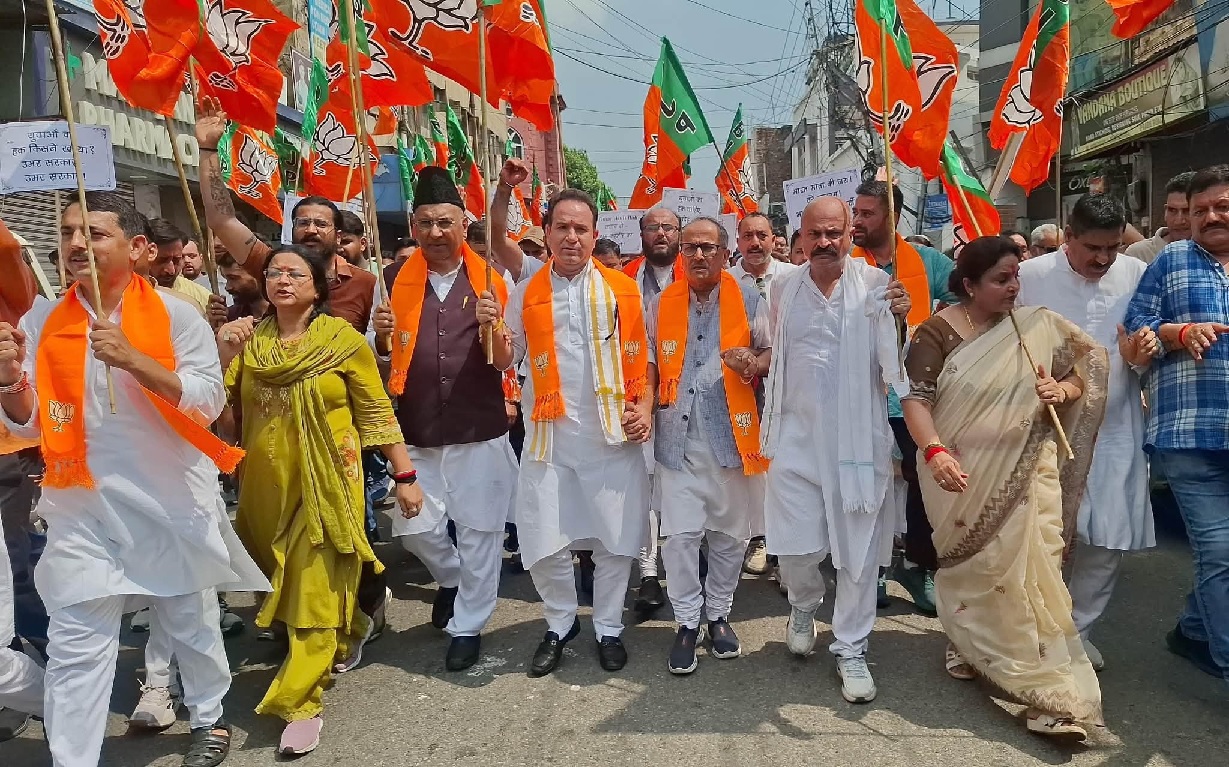
The BJP has planned protests and grassroots mobilisation across Jammu and Kashmir, with the first phase in Kashmir followed by demonstrations in Jammu and later expansion to district and Assembly constituency levels.
The political calculation is clear: the BJP wants to take its criticism directly to voters and turn questions about the NC government’s performance into a wider political campaign.
For the National Conference, meanwhile, the challenge is to demonstrate that its government can deliver on everyday issues while simultaneously pursuing its larger demand for restoration of Jammu and Kashmir’s statehood.
The result is a political contest increasingly defined by two competing messages:
The BJP is asking: Where is the governance?
The NC is asking: Where is the statehood?
BJP Announces Mass Agitation Against NC Government
The latest agitation plan was finalised during a BJP organisational meeting at the party headquarters in Trikuta Nagar, Jammu.
J&K BJP president and Rajya Sabha MP Sat Sharma, Leader of Opposition Sunil Sharma and senior party functionaries discussed the political situation and the party’s response to what they described as failures of the NC government.
The BJP announced that its campaign would begin with a protest in Kashmir on July 20, followed by demonstrations across Jammu from August 1 and subsequently at the district and Assembly constituency levels.
Sat Sharma accused the NC government of failing to meet public expectations and said the BJP would highlight what it considers shortcomings in governance.
Sunil Sharma said the BJP had given the government sufficient time to perform and would now hold it accountable both inside the Assembly and on the streets.
That language signals a significant escalation.
The BJP is no longer presenting its criticism simply as an opposition response.
It is building an organised political movement around it.
What Is the BJP Accusing the NC Government Of?
The BJP’s criticism covers several areas.
Employment and youth opportunities
Employment is one of the most politically sensitive issues in Jammu and Kashmir.
The BJP has repeatedly accused the NC government of failing to fulfil commitments made during the 2024 Assembly elections.
In June, the BJP’s youth wing held a separate protest in Jammu, accusing the government of failing to fulfil its alleged promise of providing one lakh jobs to educated youth. BJYM activists gathered at Kachi Chawani and raised slogans against the administration.
The employment issue gives the opposition a particularly powerful political talking point because unemployment directly affects young people and their families.
For the BJP, the argument is straightforward:
If the government promised jobs, voters should be able to see measurable progress.
The NC government, however, has its own explanation for the challenges facing the administration, including inherited vacancies and longstanding administrative issues.
The competing claims underline the importance of distinguishing political allegations from independently established government performance data.
Governance Becomes the BJP’s Main Weapon
The BJP has increasingly tried to shift the political conversation away from the constitutional debate and towards everyday governance.
Sunil Sharma has argued that the NC government should concentrate on issues such as electricity, drinking water, employment and public services rather than using statehood as a political shield.
This is a strategically important line of attack.
The National Conference’s demand for statehood has strong political resonance, but governance is something voters experience every day.
A household does not experience statehood as an abstract constitutional concept.
It experiences:
- whether water reaches the tap;
- whether electricity supply is reliable;
- whether roads are usable;
- whether government offices function efficiently;
- whether young people can find employment;
- whether public hospitals and schools provide services.
The BJP is attempting to make these everyday experiences the basis of its opposition campaign.
Jammu Becomes a Critical Political Arena
The BJP’s decision to expand its agitation across Jammu is particularly significant.
The region has traditionally been the party’s strongest electoral base in Jammu and Kashmir.
The BJP won the majority of its Assembly seats in the Jammu region in the 2024 election, while the National Conference established itself as the principal force in the Kashmir Valley.
That geographical pattern gives Jammu an important role in the opposition’s strategy.
The BJP wants to present itself as the political voice of Jammu’s aspirations and challenge any perception that the NC government is more responsive to Kashmir than Jammu.
This narrative has appeared repeatedly in BJP statements.
Sat Sharma has said the party would oppose what it describes as discrimination against Jammu and policies that could affect the future of J&K’s youth.
The political objective is therefore larger than a single protest.
It is about reinforcing the BJP’s identity as Jammu’s principal political counterweight to the NC.
The Regional Divide Remains a Powerful Political Narrative
Jammu and Kashmir’s politics cannot be understood solely through the traditional government-versus-opposition lens.
There is also a strong regional dimension.
The BJP’s political strength is concentrated in Jammu.
The National Conference’s electoral base is much stronger in the Kashmir Valley.
This produces an environment where almost every major policy debate can acquire a regional dimension.
Questions over:
- government employment;
- development projects;
- infrastructure;
- administrative appointments;
- tourism;
- investment;
- public spending;
- political representation
can all become part of the wider Jammu-versus-Kashmir political narrative.
The BJP is clearly aware of this dynamic.
Its current agitation gives the party an opportunity to argue that Jammu deserves greater political attention and development.
BJP vs NC: Governance Versus Statehood
The biggest political divide between the two parties is becoming increasingly clear.
The National Conference has made restoration of statehood a central demand.
The BJP argues that the NC is using statehood protests to divert attention from governance problems.
When the NC announced its Jantar Mantar protest in Delhi, BJP Leader of Opposition Sunil Sharma called the exercise an “eyewash” and accused the government of trying to divert attention from what he described as poor governance.
The BJP subsequently announced its own protest campaign in Jammu and Kashmir.
This effectively created two competing political theatres.
NC’s political message
Restore statehood.
BJP’s political message
Deliver governance.
The two issues are not necessarily mutually exclusive, but the parties are presenting them as competing political priorities.
Security Adds Another Layer to the Political Fight
Security remains an especially sensitive subject in Jammu and Kashmir.
The BJP frequently highlights the security situation as one of the areas where it believes the Narendra Modi government has delivered greater stability.
In June, Sunil Sharma claimed that the security situation had improved substantially under the central government while accusing the NC government of failing to adequately address youth employment. Those were his political assessments, not independent measures of security performance.
This creates another division in the political narrative.
The BJP emphasises:
security + integration + development.
The NC emphasises:
elected governance + statehood + political rights.
Voters are ultimately being asked to judge which combination better represents their priorities.
Development: The Ground-Level Test for the NC Government
The development argument may prove more difficult for the ruling National Conference to manage.
The BJP is highlighting infrastructure and civic issues because these are visible.
Roads, drainage, water supply, electricity and public services can be photographed, experienced and discussed in neighbourhoods.
That makes them powerful political campaign material.
The NC government, however, has argued that it inherited years of administrative neglect.
For example, senior NC leader and minister Javed Rana has said the government is addressing longstanding drinking-water problems in Jammu’s Kandi belt and working to improve potable water access.
This produces a familiar political contest.
The opposition says:
The government has failed.
The government says:
We inherited the problem and are fixing it.
Ultimately, voters will judge which explanation is more convincing based on results.
Why the BJP Is Taking the Fight Beyond Jammu City
The BJP’s plan to expand the agitation from Jammu to districts and Assembly constituencies is politically important.
It suggests that the party wants the campaign to become a sustained grassroots exercise.
A large rally can generate headlines for one day.
A booth-level campaign can influence political perceptions for months.
The BJP’s organisational machinery gives it an advantage in this respect.
Its leadership has already directed party workers and different organisational wings to take the campaign to the grassroots.
The strategy can help the BJP:
- identify local grievances;
- strengthen its booth network;
- mobilise youth;
- maintain pressure on the government;
- build an anti-incumbency narrative;
- prepare its organisation for future elections.
That makes the current protests about more than immediate political pressure.
They are also an exercise in long-term electoral positioning.
The NC Cannot Ignore the Political Pressure
For the Omar Abdullah government, the BJP’s agitation creates a difficult political environment.
The government must defend its record while continuing its statehood campaign.
That means it needs to demonstrate progress on issues that are not constitutional.
Employment.
Infrastructure.
Water supply.
Tourism.
Healthcare.
Education.
Public administration.
These are areas where political slogans eventually encounter measurable outcomes.
If the NC can show progress, it can weaken the BJP’s governance narrative.
If problems persist, the BJP will have more material with which to build its opposition campaign.
Weather Disasters Have Added to the Political Pressure
The BJP’s criticism also intensified during a period of severe weather-related disruption in Jammu and Kashmir.
Flash floods, landslides and cloudbursts affected several areas in July, causing deaths and infrastructure damage.
The BJP used the situation to criticise the NC government’s political priorities.
On July 22, Sunil Sharma accused the Chief Minister and NC leadership of engaging in “political theatrics” in Delhi while J&K was dealing with rain-related disasters, and the BJP demanded compensation for affected families.
The NC, for its part, maintained its political focus on the statehood campaign while Omar Abdullah returned to J&K amid the weather crisis.
This episode illustrates how quickly natural disasters can become political flashpoints.
For citizens, however, the priority is usually practical:
rescue, relief, compensation and restoration of infrastructure.
Is Jammu Really Being Sidelined?
This is one of the most politically sensitive questions in the current debate.
The BJP argues that Jammu’s aspirations have been ignored or inadequately addressed.
But the NC rejects the broader suggestion that its government is deliberately discriminating against Jammu.
Government representatives have pointed to development and public-service initiatives in the region, including efforts to address the Kandi area’s water crisis.
The truth is therefore more complicated than the competing slogans suggest.
Jammu has genuine development concerns.
Kashmir has its own political and economic concerns.
The challenge for any J&K government is to demonstrate that public resources and administrative attention are distributed fairly across both regions.
What the BJP Protest Means for J&K Politics
The agitation could have several consequences.
1. Greater pressure on the Omar government
The government will face sustained criticism inside and outside the Assembly.
2. Stronger BJP mobilisation in Jammu
The protests can reinforce the BJP’s organisational presence in its core region.
3. A sharper regional political narrative
The BJP is likely to continue presenting itself as the defender of Jammu’s interests.
4. Statehood versus governance will dominate debate
The NC will continue demanding statehood while the BJP attempts to move the conversation towards performance.
5. Local issues could become electoral issues
Water, roads, jobs and public services may increasingly become political benchmarks for the government.
The Real Battle Is Over Public Trust
At its core, the BJP’s protest campaign is about something larger than individual policy failures.
It is about public trust.
The BJP wants voters to believe that the NC made promises it cannot deliver.
The NC wants voters to believe that it inherited difficult problems and needs time and greater constitutional authority to address them.
That is a battle no press conference can settle.
Only performance can.
If employment numbers improve, infrastructure projects move forward and public services become more reliable, the government’s defence becomes stronger.
If those improvements remain difficult to see, the BJP’s criticism becomes easier to sell.
Conclusion: Jammu Becomes the Next Major Political Battlefield
The BJP’s escalating agitation against the National Conference government marks a new phase in Jammu and Kashmir’s post-election politics.
What began as criticism inside the Assembly is increasingly moving onto the streets.
The BJP is targeting the NC over governance, employment, infrastructure and public services, while simultaneously challenging its statehood campaign.
The National Conference, meanwhile, continues to argue that restoration of statehood is a central democratic demand and cannot be dismissed as a political diversion.
For Jammu, the BJP’s mobilisation has another significance.
It reinforces the party’s attempt to position itself as the strongest political voice of the region and to turn local grievances into a broader political narrative.
But the coming contest will not be decided by slogans alone.
The BJP must convince voters that its criticism reflects genuine public concerns rather than routine opposition politics.
The NC must demonstrate that its promises can translate into visible improvements on the ground.
And for ordinary people, the ultimate test is much simpler:
Are the roads better?
Is water reaching homes?
Are young people finding jobs?
Are public services improving?
Does Jammu feel adequately represented?
Those answers—not the volume of political slogans—will determine whether the BJP’s street campaign becomes a lasting anti-incumbency movement or simply another chapter in Jammu and Kashmir’s increasingly competitive political landscape.