Mehbooba Mufti Says She Is a “Dimagi Naxal” Over Article 370 Stand, Escalating Kashmir Political Row
By: News Desk | 17 Aug 2026
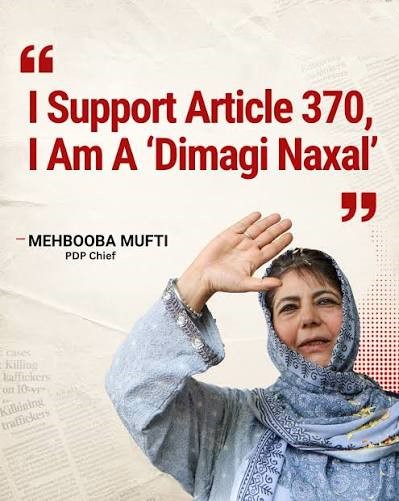
Former Jammu & Kashmir Chief Minister and PDP president Mehbooba Mufti has embraced the controversial “dimagi Naxal” label after Prime Minister Narendra Modi used the term in his Independence Day address, saying she will continue to support Article 370 despite criticism and political attacks.
Her remark has added a fresh layer to the already intense debate over Article 370, dissent, Kashmir’s political identity and the limits of opposition politics after August 5, 2019.
Recent reporting confirms that Mehbooba made the remark in response to the controversy surrounding Modi’s use of “dimagi Naxal.” She said her continued support for Article 370 was enough to attract the label and indicated that she was not going to retreat from that position.
What Mehbooba Mufti Actually Said
Mehbooba’s intervention came amid a wider political controversy over the phrase “dimagi Naxal”, which Prime Minister Narendra Modi used during his Independence Day address from the Red Fort.
Modi contrasted what he described as the declining threat from armed Naxalism with what he called a continuing ideological challenge from “dimagi Naxals”. The remark triggered a political debate, with opposition leaders accusing the government of using the term to stigmatise dissent.
Mehbooba subsequently positioned herself within that debate.
Her message was essentially that if supporting Article 370 and the political dignity of Jammu and Kashmir earns her the “dimagi Naxal” label, she is prepared to accept it.
That gives her statement a deliberately confrontational political character.
Rather than rejecting the label, she is attempting to reclaim it as a badge of dissent.
Why “Dimagi Naxal” Has Become a Political Flashpoint
The phrase itself has acquired a very specific political meaning in the current debate.
“Dimagi” literally refers to the mind or intellect, while “Naxal” is associated with the Maoist/Naxalite insurgency.
Modi’s Independence Day remarks used the expression to describe people whom he portrayed as ideological supporters of Naxalism rather than armed insurgents.
The Opposition has interpreted the phrase differently.
Critics argue that attaching the Naxal label to ideological opponents risks blurring the distinction between violent insurgency and peaceful political dissent.
That distinction is precisely where Mehbooba has positioned herself.
Her argument is not that she supports armed rebellion.
Rather, she is saying that her opposition to the 2019 constitutional changes is a political and constitutional position.
That distinction is central to understanding her statement.
Article 370 Remains at the Heart of Mehbooba’s Politics
For Mehbooba Mufti, the controversy cannot be separated from the events of August 5, 2019.
The Union government ended Jammu and Kashmir’s special constitutional status and reorganised the erstwhile state into the Union Territories of Jammu and Kashmir and Ladakh.
The Supreme Court subsequently upheld the Union government’s decision in December 2023, while directing that statehood for Jammu and Kashmir be restored at the earliest.
Mehbooba and the PDP have continued to oppose the 2019 changes politically.
Her latest remarks therefore represent a continuation of an established position rather than a sudden change of strategy.
The core message is:
Criticism, political isolation or controversial labels will not make her abandon Article 370.
Mehbooba’s “Resistance” Politics After 2019
The PDP president has increasingly built her political identity around resistance to what she describes as the erosion of Jammu and Kashmir’s political and constitutional identity.
That has included demands for:
- restoration of Article 370;
- restoration of statehood;
- protection of constitutional rights;
- greater political space for J&K;
- dialogue on Kashmir; and
- what she describes as dignity for the people of the region.
The political challenge for Mehbooba is that Article 370 is no longer simply an electoral issue.
It has become a symbol around which competing visions of India and Jammu & Kashmir are organised.
For the BJP, the 2019 decision represents greater constitutional integration.
For the PDP and other critics, it represents the loss of a political arrangement they believe was central to J&K’s relationship with India.
Mehbooba’s latest statement fits squarely into the second narrative.
From “Article 370” to “Dissent”: Mehbooba Widens the Argument
What makes the latest remark politically interesting is that Mehbooba is no longer arguing only about Article 370.
She is also arguing about how dissent itself is described.
Her position effectively asks:
If a political leader peacefully campaigns for restoration of a constitutional provision, does that make the person anti-national or extremist?
That is a much broader question than the constitutional dispute itself.
It touches on India’s democratic tradition of political opposition.
Mehbooba wants her supporters to see the “dimagi Naxal” label not as evidence of extremism, but as an example of how dissenting voices can be politically branded.
Her rhetoric therefore attempts to convert an accusation into a political identity.
NC Hits Back: PDP’s BJP Alliance Comes Under Scrutiny
The controversy has also reopened an uncomfortable chapter in Mehbooba Mufti’s political career: her alliance with the BJP.
The National Conference has seized on the issue to accuse the PDP of contributing to the political circumstances that eventually preceded the 2019 changes.
Recent reporting shows the NC attacking Mehbooba and the PDP over their former alliance with the BJP, arguing that the party cannot distance itself from the consequences of the political arrangement it once entered into.
This gives the NC an obvious political counterattack.
The argument is essentially:
How can the PDP present itself as the uncompromising defender of Article 370 when Mehbooba Mufti once governed J&K in alliance with the BJP?
It is a politically powerful question.
But it is also an old one.
The BJP-PDP Coalition: The Contradiction That Still Haunts Mehbooba
Mehbooba Mufti became Chief Minister in 2016 after the PDP formed a coalition government with the BJP.
The alliance was controversial from the beginning.
The PDP had traditionally positioned itself as a regional party focused on reconciliation, dialogue and political engagement in Kashmir.
The BJP, meanwhile, had a fundamentally different position on Article 370.
The coalition nevertheless went ahead.
The government eventually collapsed in June 2018 when the BJP withdrew support.
A year later, the Union government moved to fundamentally alter J&K’s constitutional status.
This history provides ammunition to Mehbooba’s critics.
Her supporters, however, argue that political circumstances changed dramatically after the collapse of the coalition and especially after 2019.
That disagreement remains part of the larger “who betrayed Kashmir?” debate that continues to dominate regional politics.
The PDP’s Political Dilemma
Mehbooba’s latest statement may energise her core supporters, but it also highlights the difficult position facing the PDP.
The party must simultaneously:
- maintain its distinct identity from the National Conference;
- challenge the BJP’s post-2019 political narrative;
- retain support among voters who want Article 370 restored;
- defend its own political record; and
- remain relevant in a regional political landscape dominated by the NC.
The “dimagi Naxal” remark gives Mehbooba a strong headline.
But headlines alone cannot solve the PDP’s larger organisational and electoral challenges.
Why the Remark Matters for Kashmir Politics
Mehbooba’s statement comes at a politically sensitive time.
The National Conference government is facing pressure from within its own ranks over the pace of its campaign for Article 370 and statehood.
NC MP Aga Syed Ruhullah Mehdi has publicly criticised the party’s strategy and even indicated that he could resign from Parliament if the leadership does not accept his political proposals.
That means Mehbooba’s intervention arrives amid an already active debate over whether mainstream Kashmiri parties are doing enough to defend the political promises they made to voters.
The political competition is therefore shifting.
It is no longer simply:
BJP vs Kashmir-based parties.
It is increasingly:
BJP vs NC vs PDP — and each regional party accusing the others of compromising Kashmir’s interests.
Mehbooba’s Political Message to Kashmir
There is also a clear domestic audience for her statement.
By describing herself as a “dimagi Naxal,” Mehbooba is speaking directly to those Kashmiris who believe that supporting Article 370 has increasingly become a form of political dissent.
Her message is:
I am not abandoning this position because of political pressure.
That allows her to reinforce her credentials as a regional leader willing to challenge the Centre.
It also helps differentiate the PDP from the NC at a time when the two parties are competing over the same political space.
But Is Supporting Article 370 the Same as Supporting Naxalism?
No.
This distinction needs to be made clearly.
Supporting or opposing Article 370 is a constitutional and political position.
Naxalism/Maoist insurgency refers to an armed revolutionary movement with a history of violent attacks and insurgent activity.
A politician advocating restoration of Article 370 through elections, Parliament, public campaigns or constitutional processes is not, by that fact alone, participating in an armed insurgency.
Mehbooba’s own framing is based on precisely this distinction.
She is using the controversial label to describe what she considers intellectual or political resistance, not armed rebellion.
That distinction should remain clear in responsible political reporting.
Critics See Political Opportunism
Not everyone accepts Mehbooba’s framing.
Critics argue that adopting a provocative label can be an effective way to generate headlines and energise a shrinking political base.
From this perspective, the “dimagi Naxal” remark is less about constitutional law and more about political messaging.
The argument from her critics is that Mehbooba is using the controversy to:
- revive the PDP’s visibility;
- reinforce her anti-BJP credentials;
- distinguish herself from the NC;
- keep Article 370 at the centre of public debate; and
- mobilise supporters around a familiar grievance.
That criticism is part of the political debate and should not be confused with an established fact about her motives.
Supporters See It as a Defence of Democratic Dissent
Her supporters interpret the statement very differently.
For them, the significance lies in Mehbooba refusing to retreat from an unpopular position in the eyes of the Centre.
They argue that:
A constitutional disagreement should not automatically be equated with extremism.
From that perspective, Mehbooba is defending the right of elected political leaders to campaign for constitutional change through democratic means.
This is why the phrase has gained political traction beyond the immediate Article 370 debate.
The Larger Kashmir Question: Can Dissent Survive Without Being Branded?
The controversy ultimately raises a larger question for Jammu and Kashmir.
The region has experienced decades of conflict, militancy, political instability and competing national narratives.
Since 2019, the political environment has changed substantially.
The government emphasises integration, development and security.
Regional parties emphasise identity, political rights, statehood and constitutional guarantees.
The challenge is finding space for these competing arguments without automatically treating political disagreement as hostility to the nation.
That is the line Mehbooba is attempting to draw with her latest remark.
Article 370: Political Demand or Constitutional Dead End?
There is another important reality.
The Supreme Court’s December 2023 judgment upheld the Union government’s 2019 decision to abrogate Article 370.
That means the current debate over Article 370 is primarily political, not simply a pending legal challenge to the 2019 decision.
For parties such as the PDP, the question has therefore become how to keep the demand politically alive.
Mehbooba’s approach is to keep speaking about it.
The NC has adopted a somewhat different strategy, combining the demand for restoration of Article 370 with a more immediate campaign for statehood.
That difference could become increasingly important in future J&K elections.
The Political Battle Is Now About Memory, Identity and Trust
Mehbooba’s “dimagi Naxal” statement cannot be viewed in isolation.
It is part of a much larger political contest over who represents Kashmir’s interests after 2019.
The BJP says the old constitutional arrangement was an obstacle to integration.
The NC says the political mandate it received requires it to continue fighting for the rights lost after 2019.
The PDP says Article 370 must remain central to Kashmir’s political discourse.
And leaders such as Ruhullah are now pushing the NC itself to go further.
In this environment, political labels become weapons.
“Anti-national.”
“Dynastic.”
“Pro-BJP.”
“Soft separatist.”
“Dimagi Naxal.”
Each label attempts to define the opponent before voters hear the opponent’s argument.
What Mehbooba’s Remark Means for the PDP
For Mehbooba Mufti, the immediate political benefit is obvious.
She has once again placed herself at the centre of the Article 370 debate.
The controversy gives the PDP an opportunity to project itself as a party that has not abandoned its constitutional demands.
But there is also a risk.
The more provocative the language becomes, the easier it becomes for opponents to shift the debate away from Article 370 itself and towards questions of nationalism and political legitimacy.
That could be precisely the trap the PDP needs to avoid.
The Bottom Line
Mehbooba Mufti’s decision to embrace the “dimagi Naxal” label is a calculated political response to one of the most controversial phrases in India’s current political discourse.
Her message is clear:
She says she will continue to support Article 370 and the political dignity of Jammu and Kashmir despite criticism.
But the controversy is bigger than Mehbooba.
It has reopened several unresolved political questions:
- Can support for Article 370 remain a mainstream democratic position?
- Where should the line be drawn between political dissent and ideological extremism?
- Can regional parties challenge the post-2019 constitutional order while remaining within constitutional politics?
- Has the NC moved too far towards pragmatism?
- Can the PDP overcome the political baggage of its former BJP alliance?
- And, most importantly, who gets to define what constitutes legitimate dissent in Jammu and Kashmir?
For now, Mehbooba has chosen confrontation over retreat.
By turning “dimagi Naxal” into a label she is willing to wear, she is attempting to transform political criticism into a symbol of resistance.
Whether that strategy strengthens the PDP—or further polarises Kashmir’s already divided political landscape—will be decided not by the controversy itself, but by how voters respond to it.