After the Resignation: Ruhullah’s Real Test Begins Now
From National Conference Star Campaigner to Its Most Prominent Dissenter, Can He Turn Public Sympathy Into a Political Force?
By: Javid Amin | 03 November 2026
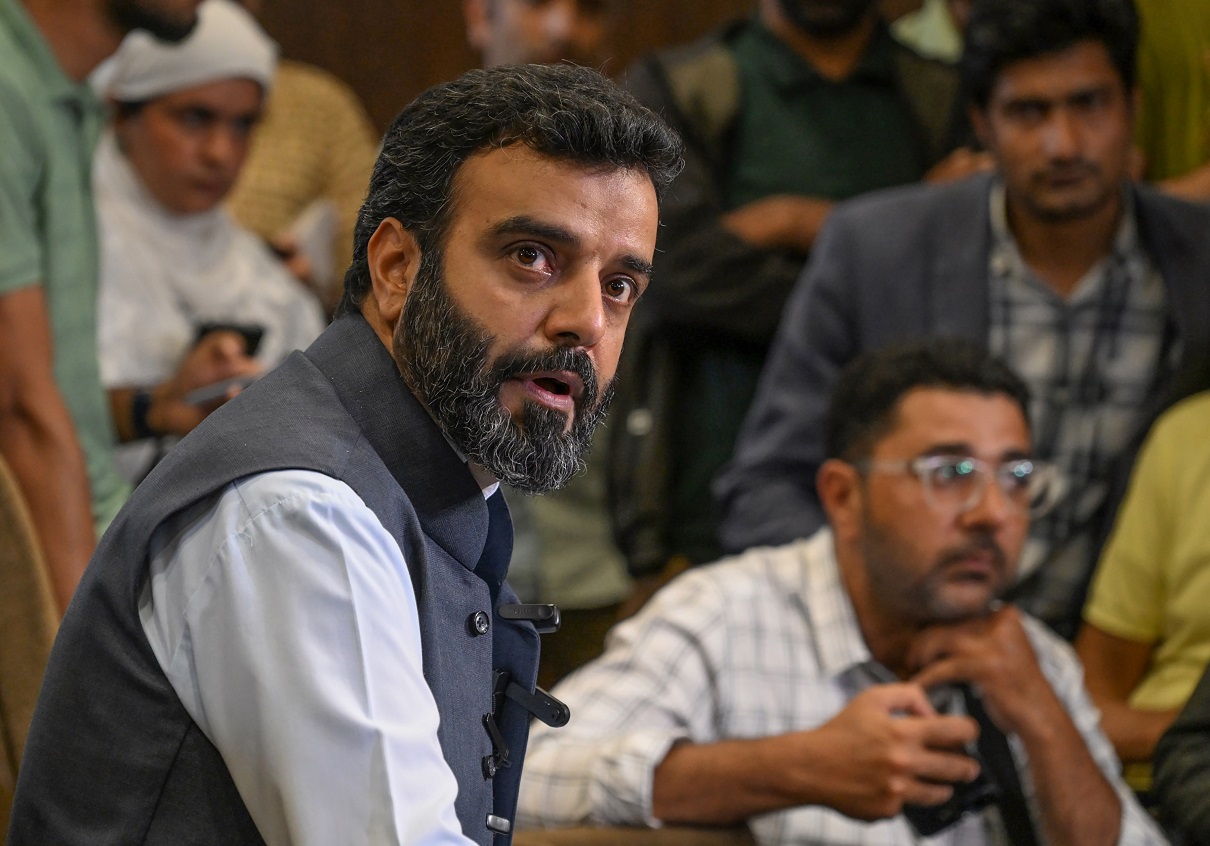
Budgam/Srinagar: Aga Syed Ruhullah Mehdi’s decision to walk away from the Jammu and Kashmir National Conference marks a significant moment in the Valley’s political landscape. At a public gathering in Budgam on Tuesday, the Srinagar MP announced his departure from the party and resignation from the Lok Sabha, accusing the NC leadership of moving away from promises made to voters on Article 370, constitutional rights, reservation policy and the release of political prisoners. The announcement comes after months of public disagreements with the party leadership and growing criticism of Chief Minister Omar Abdullah’s government. (India Today, The New Indian Express)
For Ruhullah, the decision is being presented as an act of political conviction. For the National Conference, it is an uncomfortable break with a leader who had played an important role in its 2024 election campaign.
But the political significance of this moment will not be decided by the announcement alone.
Leaving a party is one thing. Building a political alternative capable of challenging it is another.
That is the test Ruhullah now faces. Can he convert the attention surrounding his departure into a durable political movement, or will his influence remain tied to the organisation he has just left?
The Rise of Ruhullah: A Leader Who Helped Build the NC’s 2024 Momentum
Ruhullah was not an ordinary party member who walked away after a disagreement. He had spent nearly 24 years associated with the National Conference and emerged as one of its prominent public campaigners.
A three-time MLA from Budgam and former minister, he was extensively used by the party during the 2024 Assembly elections. His speeches and public appearances helped the NC communicate its political message across different parts of Jammu and Kashmir. The New Indian Express described him as a star campaigner who was deployed beyond his own constituency during the election campaign. (The New Indian Express)
His political importance was not limited to his electoral record. Ruhullah had developed a distinct public identity around constitutional rights, the restoration of Article 370 and questions of political accountability.
That identity eventually brought him into conflict with the leadership he had helped campaign for.
After the NC formed the government, Ruhullah repeatedly questioned whether the party was pursuing its electoral commitments with sufficient seriousness. He was particularly critical of what he saw as the government’s growing emphasis on statehood while the demand for restoration of special status appeared to be losing political priority.
The disagreement was not simply about the pace of government action. It was about what the NC’s 2024 mandate actually represented.
Ruhullah argued that voters had supported the party on a set of promises and that those promises could not be pushed aside once power had been secured. The NC leadership, meanwhile, had to operate within the constitutional and political realities of a Union Territory whose special status was removed in August 2019.
The two positions eventually became difficult to reconcile.
The Mandate Question: What Exactly Is Ruhullah Claiming?
At the centre of Ruhullah’s break with the NC is a question that could have wider political consequences: does an election victory give a party a mandate to govern, or does it also create an obligation to pursue the promises on which that victory was secured?
Ruhullah’s argument is that the NC sought votes by promising to fight for the restoration of Article 370, protect the rights of the people, address reservation concerns and seek the release of political prisoners. He believes the party has failed to pursue those commitments with the urgency voters expected.
His criticism also touches on the party’s approach to statehood. He has objected to treating restoration of statehood as the outer limit of Jammu and Kashmir’s political aspirations, arguing that such an approach risks accepting the constitutional changes introduced in 2019 as permanent.
The NC leadership may see its position differently. Restoring statehood is itself a major political demand, and the elected government has limited authority over constitutional questions that ultimately involve the Union government and Parliament.
This difference matters. Ruhullah’s allegations of political retreat are his assessment of the party’s conduct, not an independent legal finding that the NC has abandoned every relevant commitment.
Yet the political question remains serious: if a party makes a promise during an election campaign, how should voters judge its performance when the party later says circumstances restrict what it can deliver?
Ruhullah has chosen to make that question the foundation of his departure.
The First Test: Can He Retain Support Without the NC Machinery?
Until now, Ruhullah’s electoral and political influence has operated within the National Conference’s organisational structure.
That structure matters in Kashmir, as it does elsewhere in Indian politics. Elections are not won through speeches alone. They require workers who can reach voters, local leaders who can manage constituency-level networks, polling agents, campaign resources, candidate selection and sustained political engagement between elections.
The NC has spent decades building that machinery.
Ruhullah’s departure raises a difficult question: how much of his political support belongs to him personally, and how much was attached to the party he represented?
His three Assembly victories, ministerial experience and prominence during the 2024 campaign give him an established political profile. But they do not automatically prove that the same voters would support him under a new political banner.
The distinction will become clearer only when he contests an election independently or builds a political platform that can be tested at the ballot box.
For now, the size of his personal electoral base remains uncertain.
Mufti Mohammad Sayeed: The Example of Building a Successful Alternative
The most relevant historical comparison is former Chief Minister Mufti Mohammad Sayeed.
Mufti left the Congress and founded the Peoples Democratic Party in July 1999. But the PDP did not become a major political force overnight. It developed through a carefully constructed political narrative, local leadership networks and a sustained attempt to challenge the National Conference’s long-standing dominance.
The party entered the Assembly in 2002 with 16 seats in the 87-member House and formed a coalition government with the Congress. Mufti became Chief Minister in November that year. The party later expanded its electoral base and won 28 Assembly seats in 2014, before forming a coalition government with the BJP in 2015. (PDP official website, Scroll)
The important lesson is not that Ruhullah can simply repeat Mufti’s political journey. The political environment has changed considerably since 1999.
The PDP emerged at a time when the NC had a dominant position in the Valley and a section of the electorate was looking for a different political voice. Mufti offered an alternative narrative and gradually built the organisation required to carry it.
He also developed a wider coalition that could appeal beyond his immediate political base.
The PDP model demonstrates that a successful breakaway requires more than a popular leader. It needs an organisation, a political message and the ability to attract voters across constituencies.
That is a much larger task than mobilising a crowd around a resignation.
Ghulam Nabi Azad: Why Personal Stature Is Not Enough
The experience of Ghulam Nabi Azad offers a different lesson.
Azad entered Jammu and Kashmir politics with an extraordinary national profile. He had served as Chief Minister, Union Minister and a senior Congress leader. When he left the Congress in 2022 and launched the Democratic Progressive Azad Party, expectations were high that his experience and political connections could create a strong alternative.
The electoral results, however, exposed the gap between personal stature and organisational reach.
In the 2024 Lok Sabha elections, the DPAP failed to make a major impact. Its candidates forfeited their deposits, and the party struggled to translate Azad’s reputation into a broad electoral base. Its performance in the subsequent Assembly elections also failed to establish it as a major force. (Hindustan Times, The Tribune)
Azad’s experience is a warning against assuming that a prominent political figure can carry an organisation into existence through personal credibility alone.
He had national recognition, administrative experience and a network of political contacts. What proved difficult was building a sufficiently strong electoral structure in a changed political environment.
Ruhullah must take note of that distinction. Public attention can create an opening, but it cannot substitute for a functioning political organisation.
Sajjad Lone: Political Survival Is Not the Same as Political Dominance
Sajjad Lone’s People’s Conference provides another useful comparison.
Lone has managed to retain a political identity despite operating in a difficult environment dominated by larger parties and competing political narratives. His party has maintained a presence in north Kashmir and remains part of the Valley’s political conversation.
But survival has not translated into dominance.
The 2024 Lok Sabha election illustrated the difficulty facing smaller regional parties. Lone contested the Baramulla seat but finished behind Engineer Rashid and the National Conference candidate. His party’s performance also weakened in areas traditionally regarded as its strongholds. (The Indian Express)
The People’s Conference has retained a political foothold, but it has not displaced the NC or PDP as one of the Valley’s principal electoral forces.
This is an important distinction for Ruhullah. A leader can remain relevant, influence public debate and occasionally affect government formation without becoming the central force in regional politics.
The question is not simply whether he can survive outside the NC. It is whether he can build enough support to influence the political direction of Jammu and Kashmir.
Altaf Bukhari and Apni Party: The Challenge of Creating a New Political Identity
Altaf Bukhari’s Apni Party offers a more recent example of the difficulties involved in building a new regional organisation.
Formed in 2020, the party brought together several political figures, including former members of the PDP. It attempted to position itself around governance, development, administrative pragmatism and engagement with the Centre.
The party established an organisational presence, but its electoral performance exposed its limitations.
In the 2024 Lok Sabha elections, its candidates failed to secure a major breakthrough. Bukhari himself lost the Chanapora Assembly seat later that year. The party did not win an Assembly seat in the 2024 election. (Hindustan Times, The Tribune)
Apni Party’s experience suggests that organisational activity and political networking do not automatically create voter enthusiasm.
Ruhullah’s challenge may be the reverse. He has a recognisable ideological position and a public profile, but he has yet to demonstrate that he can build an organisation capable of sustaining that appeal.
What Makes Ruhullah’s Political Position Different?
Ruhullah is not entering this phase as a leader whose main pitch is administrative experience or development management.
His argument is built around political accountability, constitutional identity and the claim that the NC has not remained faithful to its election commitments.
That gives him a clear political theme.
It also gives him a potential audience among voters who believe that the demand for restoration of special status should remain central to regional politics.
His family background and established political presence in Budgam may also help him retain a local base. He has influence among sections of the Shia community, although the extent of that support should not be assumed to be uniform or transferable to a new political organisation.
Similarly, his appeal among younger voters is often discussed by supporters and political observers, but its actual electoral strength has not yet been independently measured.
These are potential advantages, not guarantees.
The larger challenge is to turn a political position into a platform that can address the concerns of voters across different regions, communities and constituencies.
The Strengths He Can Build On
1. An established political identity
Unlike a newcomer, Ruhullah does not need to introduce himself to the electorate. His years in the NC, his record as an MLA and his role in the 2024 campaign give him an existing public profile.
2. A clear political message
His criticism is centred on identifiable issues: Article 370, constitutional rights, reservation policy, political prisoners and accountability for election promises. A defined message can help a new political initiative establish its identity.
3. A constituency-level base
His repeated electoral success in Budgam gives him a starting point. However, the real test will be whether that support extends beyond his home constituency.
4. The credibility of dissent
Supporters may interpret his departure as evidence that he was unwilling to remain in a party whose actions he believes contradict its promises. That perception could strengthen his political standing among voters who share his criticism.
But credibility is not permanent. It has to be maintained through consistent positions, transparent decision-making and a clear political direction.
The Risks That Could Weaken His Position
1. The absence of a tested organisation
This is the most immediate problem. There is no established statewide political structure publicly demonstrated around Ruhullah that can be compared with the NC’s existing network.
Building district units, identifying local organisers, managing election campaigns and selecting credible candidates will require time and resources.
2. A limited geographical base
His electoral record is strongest in Budgam. His prominence during the 2024 campaign gave him visibility elsewhere, but campaign visibility is not the same as a reliable vote base.
He will need to demonstrate that his message can connect with voters in north Kashmir, south Kashmir, Srinagar and the Jammu region.
3. The NC’s political response
The National Conference is unlikely to leave the political space uncontested. Its leadership can argue that Ruhullah has chosen to walk away rather than work within the party, while presenting itself as the established vehicle for regional representation.
It may also accuse him of weakening the political opposition by dividing votes.
Whether that argument gains traction will depend on how voters assess the party’s own record and Ruhullah’s conduct after leaving it.
4. The danger of a personality-centred movement
A political platform built entirely around one leader can attract attention quickly, but it may struggle to survive internal disagreements or the absence of that leader.
Ruhullah will need a second line of leadership, not merely a circle of loyal supporters.
5. The difficulty of converting constitutional demands into a broader programme
Article 370 and statehood are important political issues, but a regional political organisation must also address employment, education, public services, local governance, economic opportunity and the concerns of different regions.
A movement that speaks only to political grievance may find it difficult to build a lasting electoral coalition.
What Happens Next? Three Possible Political Routes
Scenario One: An Independent Political Movement
Ruhullah could initially continue public mobilisation without immediately announcing a new party.
This would allow him to retain flexibility, engage with supporters and test the extent of his influence before committing to a formal organisational structure.
The advantage is that he would not have to rush into building a party before identifying its political base.
The risk is that public momentum can fade if it is not followed by sustained activity and a clear programme.
Scenario Two: A New Political Party
A formal political outfit would give Ruhullah an organisational identity and a structure through which to contest future elections.
It would also require him to make difficult decisions about leadership, candidates, funding, regional representation and political alliances.
The advantage would be institutional continuity. The risk would be that a new party could struggle to compete with established organisations before it has built a credible network.
Mufti Mohammad Sayeed’s experience shows that building a regional party is possible, but it requires sustained political work rather than a single moment of public mobilisation.
Scenario Three: A Wider Platform for Political and Constitutional Rights
A third possibility is a pressure group or political platform that works beyond conventional party structures.
Such a formation could bring together activists, public representatives, civil society figures and people who share concerns about constitutional rights and political accountability.
This route may allow Ruhullah to engage with a wider audience without immediately entering a direct electoral contest with the NC.
However, a pressure group cannot exercise the same influence as an elected political party. Its ability to shape policy would depend on public mobilisation and the response of political institutions.
The Larger Question for the National Conference
Ruhullah’s exit is not an isolated development for the NC.
The party is already facing reported discontent among a group of legislators following the October 27 cabinet expansion. Some MLAs have reportedly demanded changes in the government, greater consultation and a stronger approach to election promises. The leadership has publicly resisted the suggestion that the disagreements amount to an organised rebellion.
Ruhullah’s departure adds another dimension to that internal strain.
The two developments should not be treated as one coordinated revolt. The legislators’ reported demands concern cabinet representation, government functioning and party consultation, while Ruhullah’s departure is rooted in his public disagreement over the NC’s political and constitutional agenda.
Still, the combined effect is difficult to ignore. The party now faces questions about internal consultation, the credibility of its election promises and its ability to retain leaders who believe its political direction has changed.
The challenge for Omar Abdullah is not only to manage dissent within the party but also to demonstrate that the government can deliver meaningful results within the limits of its constitutional authority.
The Parliamentary Question: Is the Srinagar Seat Vacant Yet?
Ruhullah’s announcement also raises a separate constitutional and parliamentary question.
A public declaration that an MP is resigning is not, by itself, the final procedural step that makes a Lok Sabha seat vacant. Under Article 101(3)(b) of the Constitution, a member’s seat becomes vacant when the resignation is accepted by the Speaker. The Speaker must also satisfy himself that the resignation is voluntary and genuine.
Therefore, while reports on November 3 describe Ruhullah as having resigned, the formal parliamentary position should be confirmed through the Lok Sabha’s official records and any communication from the Speaker’s office.
If the resignation is formally accepted, the Srinagar constituency could face a by-election, subject to the applicable constitutional and electoral provisions.
That election would be the first major opportunity to measure the political consequences of his departure.
It would also test whether the NC can retain the constituency without him and whether Ruhullah can command support outside the party’s established electoral machinery.
Ground Assessment: The Crowd Is Only the Beginning
The gathering in Budgam has given Ruhullah a public platform to announce his decision and explain his position. The political response to the event may generate considerable attention in the coming days.
But crowd size, public enthusiasm and social media discussion are not reliable substitutes for electoral evidence.
The more important indicators will emerge over the next few months:
- Does he attract elected representatives or established local leaders?
- Can he build functioning organisational units beyond Budgam?
- Does he present a detailed political and economic programme?
- Can he retain support when the immediate emotion surrounding his departure subsides?
- Will he contest the next available election, and under what political banner?
- Can he appeal to voters who support the NC but disagree with its current leadership?
These questions will reveal whether his departure is the beginning of a new political formation or primarily an act of protest against the party he once helped campaign for.
Final Verdict: The Principle Test Is Only the First Test
Aga Syed Ruhullah Mehdi has taken a politically consequential decision by announcing his departure from the National Conference and resignation from the Srinagar Lok Sabha seat.
His supporters may see it as a sacrifice of office for principle. His critics may question whether leaving the party is the most effective way to pursue the promises he says have been abandoned.
Both interpretations will now be tested by what he does next.
Mufti Mohammad Sayeed demonstrated that a breakaway leader can build a major political force, but only through sustained organisation and a broad political strategy. Ghulam Nabi Azad showed that national stature does not guarantee regional electoral success. Sajjad Lone demonstrated that a smaller party can remain relevant without becoming dominant. Altaf Bukhari’s experience has underlined the difficulty of turning a new political platform into a successful electoral organisation.
Ruhullah’s path is still unwritten.
His immediate challenge is to show that his political influence is not dependent on the National Conference’s name, workers and election machinery. His longer-term challenge is to build a platform that can speak beyond one constituency and one political issue.
The resignation may have ended his association with the NC. It has not yet established what comes after it.
In Kashmir’s competitive political landscape, the real measure of Ruhullah’s decision will not be the crowd that heard his announcement in Budgam. It will be the organisation he builds, the political programme he offers and the votes he can win when he stands on his own.