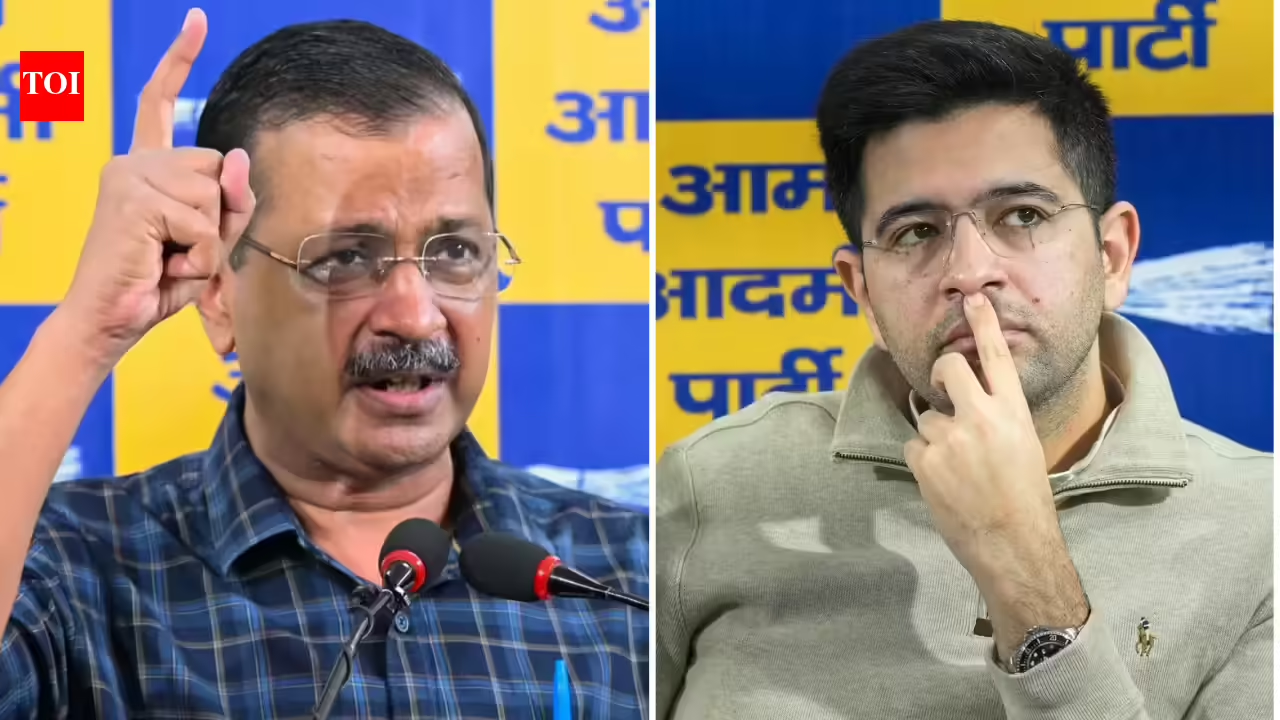
Raghav Chadha’s Exit from AAP: A Sign of Deeper Fault Lines Within the Party
By: Javid Amin | 24 April 2026
A Political Moment That Raises Bigger Questions
The sidelining of Raghav Chadha from a key parliamentary role in the Aam Aadmi Party (AAP) is not just an isolated personnel decision—it reflects deeper structural tensions within a party once celebrated for its promise of “new politics.”
With Arvind Kejriwal at the helm, AAP’s journey from an anti-corruption movement to a national political force has been rapid. But that rise has also been accompanied by repeated exits of prominent leaders, raising persistent concerns about internal democracy, leadership style, and long-term stability.
What Happened: Timeline and Immediate Trigger
In April 2026, AAP replaced Chadha as Deputy Leader in the Rajya Sabha with Ashok Kumar Mittal.
AAP’s Official Position:
- Chadha had been largely absent from party activities
- He remained silent during critical moments, including legal and political challenges faced by Kejriwal
- The decision was framed as an internal, performance-based reshuffle
Political Signals:
- His exclusion from AAP’s star campaigner list
- Reduced visibility in party events and campaigns
- Growing perception within party ranks of disengagement
Taken together, these signals pointed less to a sudden fallout and more to a gradual distancing.
Facts vs Speculation: Separating Narrative from Noise
Established Facts
- Chadha was removed from a key parliamentary leadership role
- He had earlier faced suspension in the Rajya Sabha over an alleged procedural violation
- His name surfaced in the broader excise policy probe, impacting his political standing
- AAP leadership cited inactivity and lack of participation as reasons for sidelining
Political Speculation
- Allegations that he was “soft” on the BJP in Parliament
- Rumors of a potential shift toward the Bharatiya Janata Party (BJP)
- Claims that he was a “black sheep” within AAP
Reality Check:
Crucially, Ashok Mittal publicly dismissed claims of Chadha working for the BJP as baseless. No credible evidence has emerged to support theories of defection or horse-trading.
The more grounded explanation lies in internal friction—not external alignment.
A Pattern, Not an Exception
Chadha’s case fits into a broader pattern that has defined AAP’s internal trajectory since its early years.
Notable Exits Include:
- Prashant Bhushan
- Yogendra Yadav
- Kumar Vishwas
- Ashutosh
- Swati Maliwal
Most departures have cited:
- Ideological differences
- Centralization of decision-making
- Discomfort with leadership style
This recurring churn has gradually shifted AAP’s image—from a collective movement to a leader-centric organization.
Internal Politics vs External Pressure
Internal Dynamics
AAP insiders reportedly viewed Chadha as:
- Increasingly focused on personal image
- Less aligned with the party’s aggressive political strategy
- Not fully engaged in confronting political opponents
External Pressures
- Legal challenges, including the excise policy investigation
- Parliamentary controversies affecting credibility
- Heightened scrutiny from political rivals
These combined pressures appear to have weakened Chadha’s standing within the party hierarchy.
Impact on AAP’s Credibility
1. Erosion of “New Politics” Narrative
AAP built its brand on transparency, accountability, and internal democracy. Frequent exits of high-profile leaders undermine that narrative.
2. Leadership Centralization Debate
Critics argue that decision-making within AAP has become increasingly centralized around Kejriwal, leaving limited space for dissent.
3. Loss of a Key Public Face
Chadha represented a younger, articulate, urban-friendly face of AAP—particularly appealing to middle-class voters. His sidelining creates a communication gap.
Electoral and Political Implications
Short-Term
- Limited immediate electoral damage, as Chadha was not a mass mobilizer on the ground
- Opposition parties may amplify the narrative of internal instability
Medium-Term
- Risk of alienating urban and educated voter segments
- Potential weakening of AAP’s national expansion strategy
Long-Term
- Continued exits could institutionalize the perception of instability
- AAP may need to recalibrate its internal governance model to retain leadership talent
The Bigger Picture: Not Horse-Trading, But Internal Fracture
Despite widespread speculation, there is no substantive evidence to classify Chadha’s exit as a case of horse-trading or political defection.
Instead, the episode reflects:
- Internal disillusionment
- Strategic disagreements
- Leadership-driven restructuring
For voters, however, the distinction may matter less than the broader perception: repeated internal conflicts weaken trust in political promises.
Final Analysis: A Test of AAP’s Institutional Strength
Raghav Chadha’s exit is not just about one leader—it is a stress test for AAP’s organizational resilience.
The party now faces a critical question:
Can it evolve from a personality-driven movement into a stable political institution capable of accommodating dissent and retaining talent?
If not, such episodes may continue to recur—each one chipping away at the credibility AAP once built as a disruptor in Indian politics.