Farooq Abdullah vs Aga Ruhullah: NC Rift Deepens Over Article 370, Resignation Challenge
By: News Desk | 24 Aug 2026
Farooq Abdullah’s Challenge Changes the Nature of the NC Dispute
The argument inside the National Conference has entered a more consequential phase.
For weeks, Aga Syed Ruhullah Mehdi has been publicly questioning his party’s political direction, particularly its decision to emphasise restoration of statehood rather than making the restoration of Article 370 and wider constitutional guarantees the central demand.
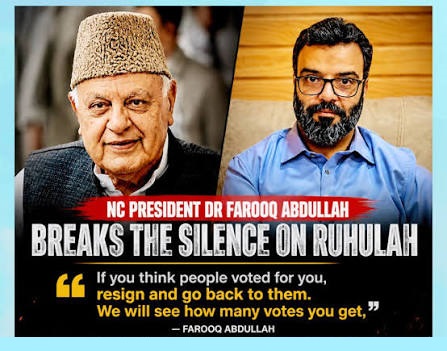
Now, National Conference president Farooq Abdullah has answered him directly—and unusually bluntly.
On August 24, Farooq challenged the Srinagar Lok Sabha MP to resign from Parliament and return to the electorate if he believes the mandate belongs to him personally. He also told Ruhullah that if he believes Article 370 can be restored, he should take the issue up in Parliament.
The message was unmistakable:
If Ruhullah believes he represents the people’s mandate independently of the NC, prove it at the ballot box.
That takes the dispute beyond an ideological disagreement.
It turns it into a question of mandate, loyalty and political legitimacy.
What Farooq Abdullah Actually Said
Farooq’s intervention contained several layers.
First, he rejected the idea that Ruhullah is being prevented from raising Article 370.
His position was essentially that Ruhullah is free to make the argument in Parliament—but should do so through the constitutional and parliamentary route rather than attacking the party publicly.
“If he thinks Article 370 can be restored, he should take up the issue in Parliament,” Farooq said, according to Kashmir News Service.
Then came the sharper challenge.
Farooq questioned Ruhullah’s claim to an independent political mandate and told him, in substance:
Resign, go back to the voters and see how many votes you receive.
That is not routine party criticism.
It is a direct test of political strength.
Why the Resignation Challenge Matters
Ruhullah is not an ordinary NC functionary.
He is the elected Lok Sabha member from Srinagar.
And that distinction is at the heart of the dispute.
Ruhullah has argued that he was given a political mandate to fight for Jammu and Kashmir’s constitutional rights. In recent remarks, he accused the NC of shifting away from Article 370 and constitutional guarantees toward statehood and governance-related issues.
NC leaders have responded that he contested the election on the party ticket.
Earlier this month, senior NC leader Choudhary Mohammad Ramzan made essentially the same challenge: if Ruhullah believes the votes were his personally, he should resign and contest again.
Farooq has now elevated that argument to the party’s highest level.
The question being put to Ruhullah is therefore:
Was the 2024 Srinagar Lok Sabha mandate personal, or was it an NC mandate?
The answer could shape the future of the dispute.
But There Is an Important Contradiction in the NC’s Position
The matter is not as simple as saying, “Ruhullah won because of the NC.”
He undoubtedly contested on the National Conference ticket.
But parliamentary elections are also contests between individual candidates.
Voters may support:
- the party;
- the candidate;
- the candidate’s family or political background;
- a particular ideological position;
- or some combination of all four.
Therefore, Farooq’s challenge is politically powerful, but a fresh election would not necessarily produce a scientifically clean answer to the question of how much of Ruhullah’s 2024 vote was “personal” and how much was “party”.
It would instead create a new political test under completely different circumstances.
That distinction matters.
A fresh election today would take place after months of public disagreement, after Ruhullah’s criticism of the NC leadership and potentially after a formal break.
The result would demonstrate his present political strength—not retrospectively separate the 2024 vote into “Ruhullah votes” and “NC votes”.
Ruhullah’s Response Has Already Raised the Stakes
Ruhullah has not retreated.
On August 23, he reportedly challenged the party to issue him a show-cause notice rather than simply asking him to resign. He reiterated that he would continue his campaign for restoration of Article 370.
That is significant.
A politician seeking compromise would normally lower the temperature at this point.
Ruhullah is doing the opposite.
He is effectively saying:
If the party believes I have violated its discipline, formally charge me.
That shifts the argument from personal criticism to organisational procedure.
It also creates a dilemma for the NC.
If the party issues a show-cause notice, it risks turning the disagreement into a formal disciplinary confrontation.
If it does not, Ruhullah can continue portraying himself as a party member being publicly targeted without formal action.
The Rift Did Not Begin With Farooq Abdullah
The latest confrontation is the culmination of several weeks of increasingly public disagreement.
On August 19, Ruhullah accused the NC of “deviating” from its stated position and said the party’s campaign for restoration of statehood risked diluting the larger question of Article 370 and constitutional guarantees.
He argued that political parties should be judged by their:
- manifestos;
- ideology;
- stated policies;
rather than by individual statements.
That was a pointed argument because it placed the NC’s own manifesto and political commitments above the authority of individual leaders.
In other words:
Ruhullah was not simply saying Omar Abdullah was wrong. He was arguing that the party leadership itself was drifting away from what the party had promised voters.
Then Came the Resignation Threat
The confrontation became much more serious when Ruhullah said he had made up his mind to resign from Parliament within months after taking his political campaign to a “certain level.”
He also proposed a dramatic political solution.
According to his account, Omar Abdullah could resign as Chief Minister, contest a Lok Sabha election and lead the constitutional campaign from Parliament.
That proposal reveals how fundamentally Ruhullah sees the current political strategy differently from the NC government.
He does not appear to believe that simply governing Jammu and Kashmir while demanding statehood is enough.
He wants the party to put the constitutional question at the centre of its political strategy.
Farooq Abdullah’s Position Is More Nuanced Than It First Appears
There is an important point that can easily get lost amid the confrontation.
Farooq Abdullah himself has not abandoned the Article 370 position.
On August 6, he reiterated that the abrogation of Article 370 was a constitutional issue and said support for the issue would continue.
He has also continued to demand restoration of Article 370 and full statehood.
So this is not simply:
Farooq Abdullah versus Article 370.
It is more accurately:
Farooq Abdullah versus Ruhullah’s method, timing and challenge to the party leadership.
That distinction is crucial.
Both men can oppose the post-2019 constitutional changes while disagreeing profoundly about how the NC should pursue that objective.
The Real Disagreement: Strategy, Not Necessarily the Final Goal
This may be the most important finding from the recent statements.
The NC leadership and Ruhullah are not necessarily on opposite sides of every constitutional question.
The disagreement is increasingly about political strategy.
Ruhullah’s approach
Keep Article 370 and constitutional guarantees at the centre of the political campaign, even if the demand is difficult to achieve.
NC leadership’s approach
Continue advocating restoration of Article 370 and statehood, but govern within the existing constitutional and administrative framework and use parliamentary and democratic channels to pursue political objectives.
The difference is subtle—but politically explosive.
Ruhullah sees excessive pragmatism as potentially normalising the post-August 5 arrangement.
The leadership appears to see political engagement and governance as necessary tools for pursuing longer-term objectives.
Farooq’s “Wrong Path” Remark Is More Than Personal Criticism
Farooq also described Ruhullah as being on the “wrong path” and advised him to seek guidance from the Quran.
The language is unusually personal for a senior party president addressing an elected MP from his own organisation.
It suggests that Farooq believes the dispute has crossed from policy disagreement into a question of political conduct.
That is consistent with his emphasis on party loyalty.
Farooq also pointed to the sacrifices made by NC workers over generations and stressed the importance of organisational commitment.
The underlying message is straightforward:
The NC is bigger than any one elected representative.
But Ruhullah Is Making the Opposite Argument
Ruhullah’s position is effectively:
The party is accountable to the people—not the other way around.
In recent remarks, he has argued that J&K’s political leadership has repeatedly failed to regain powers lost over the years and that political parties must remain answerable to the public.
That is a potent argument for an elected MP.
It also creates a direct clash with party discipline.
Farooq says:
You won on the NC ticket.
Ruhullah says:
I was elected to represent the people.
Both statements can be true simultaneously.
The real issue is what happens when party policy and an elected representative’s interpretation of the public mandate diverge.
The NC Has Another Problem: It Cannot Easily Call Ruhullah Anti-Article 370
This is perhaps the most awkward part of the confrontation for the party.
Farooq Abdullah himself continues to support the restoration of Article 370.
Therefore, accusing Ruhullah simply of opposing the NC’s constitutional position would not accurately describe the dispute.
Instead, the party is challenging his method and organisational conduct.
That is a much more defensible position.
But it is also more difficult politically because Ruhullah can respond:
If we agree on the ultimate objective, why am I being asked to resign for demanding that objective more forcefully?
That is the question the NC leadership will have to answer.
Why the Srinagar Seat Makes This Fight Especially Important
Ruhullah represents Srinagar.
That is not a politically insignificant constituency.
The Srinagar parliamentary seat has enormous symbolic importance in Valley politics, and Ruhullah’s electoral mandate gives him a platform that ordinary party dissenters do not possess.
A resignation followed by a fresh contest would therefore become much more than a personal election.
It could become a referendum on:
Ruhullah vs NC leadership.
If he wins again, his argument about an independent political base becomes considerably stronger.
If he loses badly, Farooq’s challenge would gain enormous political weight.
That is precisely why the resignation proposal is so dangerous for both sides.
A Fresh Election Could Become a Referendum on the NC Itself
Suppose Ruhullah accepts the challenge.
The campaign would almost certainly not be fought merely around one MP.
It would become a three-way narrative:
Ruhullah’s argument
“I stood by the constitutional commitments made to the people.”
NC leadership’s argument
“He won because the party gave him the platform and mandate.”
BJP’s likely argument
“The NC is divided over promises it cannot deliver.”
That would make a Srinagar by-election extraordinarily consequential.
It could reshape the political balance inside the Valley.
Why Farooq Is Also Trying to Prevent a Wider Revolt
Farooq specifically downplayed speculation about a revolt within the NC, saying disagreements are normal in political organisations and should not automatically be interpreted as rebellion against the leadership.
That is revealing.
If there were no concern about the dispute spreading, there would be little reason to address the “revolt” narrative.
Farooq’s public response is therefore doing two jobs simultaneously:
- Putting Ruhullah under pressure.
- Reassuring the wider party organisation that the leadership remains in control.
This is classic damage control during an internal political dispute.
The Nasir Aslam Wani Factor
The conflict has also involved Omar Abdullah’s adviser Nasir Aslam Wani, who previously indicated that he did not have information about whether Ruhullah remained on the party’s rolls.
Ruhullah responded by daring the party to issue a formal show-cause notice.
That exchange is important because it illustrates how the dispute has moved through different layers of the NC:
Wani → Ruhullah → party leadership → Farooq Abdullah.
What began as criticism of the government’s political direction has gradually become a question of membership and organisational discipline.
That is a significant escalation.
Farooq’s Challenge Could Backfire
There is another side to the story.
By challenging Ruhullah to resign and contest again, Farooq has given his rival an opportunity.
If Ruhullah accepts and wins, he returns with an even stronger political argument.
He could then say:
“The people have confirmed that my mandate is not dependent on the NC leadership.”
That would be politically damaging for the party.
It could also embolden other dissenting voices.
On the other hand, if Ruhullah does not resign, the NC leadership can argue that his political claims exceed his willingness to face the electorate independently.
Either way, Farooq has raised the stakes.
The Bigger Question: Who Owns the 2024 Mandate?
This is ultimately the most important question.
The NC won a significant mandate in the 2024 Jammu and Kashmir Assembly election and formed the government under Omar Abdullah.
But the Ruhullah dispute concerns a different election: the 2024 Lok Sabha election, in which he won the Srinagar seat on an NC ticket.
The party’s argument is organisational:
The candidate contested under the NC symbol and therefore the party contributed decisively to the victory.
Ruhullah’s argument is representative:
The voters elected him to fight for their political and constitutional interests.
Neither principle automatically cancels the other.
Political parties provide organisational machinery, symbols and cadres.
Candidates bring personal credibility, local networks and voter appeal.
The real value of a fresh election would be that it could test the balance between those two forces.
This Is Becoming a Test of the NC’s Political Identity
The National Conference now faces a dilemma that goes beyond Ruhullah.
If it suppresses dissent too aggressively, it could appear intolerant of internal debate.
If it allows every senior leader to publicly challenge the leadership, organisational discipline could weaken.
If it focuses exclusively on statehood, Ruhullah’s criticism could gain traction among voters who expect the party to keep Article 370 central.
If it pushes Article 370 too aggressively, it confronts the legal and constitutional reality created after the Supreme Court’s December 2023 judgment upholding the Union government’s 2019 decision.
The party therefore has very little room for an easy answer.
What This Means for Omar Abdullah
Although Farooq has taken centre stage in the latest confrontation, Omar Abdullah remains central to the dispute.
Ruhullah has directly criticised Omar’s political strategy and even suggested that the Chief Minister could move to Parliament to lead the constitutional campaign.
Omar, meanwhile, has defended the government’s approach and the party’s priorities.
The more the disagreement continues, the more difficult it becomes to separate:
NC party policy from Omar Abdullah’s government policy.
That distinction is especially important because Farooq himself recently stressed that the party and the government have separate roles.
But for voters, those lines can be difficult to maintain.
Three Possible Outcomes
1. Reconciliation
Farooq could intervene personally and find a compromise between Ruhullah and the party leadership.
This remains possible because Ruhullah has publicly expressed respect for Farooq and previously indicated that Farooq’s intervention could influence his decision about resignation.
2. Formal Disciplinary Action
The party could issue a show-cause notice or initiate disciplinary proceedings.
That would formalise the confrontation and potentially force Ruhullah to choose between party discipline and his independent political position.
3. Ruhullah Resigns and Fights Again
This is the most dramatic scenario.
A fresh Srinagar contest could become an unofficial referendum on the NC’s political direction.
A Ruhullah victory would strengthen his hand enormously.
A defeat would vindicate the party’s argument that the mandate was fundamentally organisational.
The Most Interesting Twist: Farooq and Ruhullah Are Not Ideological Opposites
This is what makes the story more complicated than a simple “NC rebellion”.
Farooq Abdullah has not abandoned Article 370.
Ruhullah has not abandoned the NC’s broader political tradition.
Both invoke Kashmir’s constitutional rights.
Both speak about the party’s historical legacy.
Both claim to represent the people’s aspirations.
Their disagreement is over who is interpreting those aspirations correctly and how aggressively the party should pursue them.
That makes this an internal ideological battle—not merely a personal feud.
Conclusion: The NC Has Reached a Political Crossroads
Farooq Abdullah’s challenge to Aga Syed Ruhullah Mehdi has transformed a simmering disagreement into a direct test of political legitimacy.
The message from the NC president is clear:
If Ruhullah believes his mandate is personal, he should prove it.
Ruhullah’s response is equally clear:
If the party believes he has violated its line, it should formally confront him rather than merely asking him to leave.
Between those two positions lies the deeper crisis.
The National Conference must now decide whether it can accommodate a powerful internal voice demanding a harder line on Article 370 while maintaining the discipline required of a governing party.
And Ruhullah must decide whether his political convictions are strong enough to survive outside the protection of the party organisation that helped put him in Parliament.
For now, neither side appears ready to blink.
The next move may determine whether this remains an unusually public internal debate—or becomes a genuine NC political rupture.