Jammu Gets Development Push Under Omar Abdullah Government; What Is Kashmir Getting?
By: News Desk | 22 October 22 2026
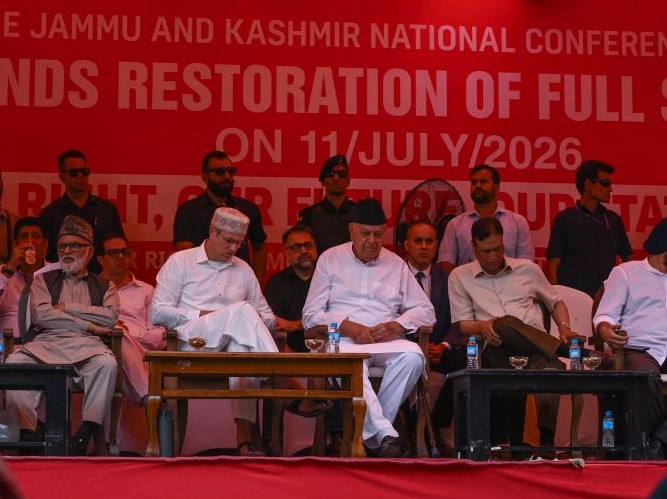
Jammu: The National Conference has defended the Omar Abdullah-led government’s development agenda in Jammu, with senior party leader and Jammu Provincial President Rattan Lal Gupta asserting that the region is receiving due attention in infrastructure, drinking water, electricity, healthcare, education and employment generation.
Gupta’s remarks come amid a continuing political debate over balanced development across Jammu and Kashmir, where regional priorities, public services and the distribution of development spending remain important subjects of public discussion.
Highlighting projects in Jammu, Gupta pointed to road improvements covering more than 300 roads under NABARD-supported initiatives, water-supply schemes worth crores of rupees, urban infrastructure upgrades and a longer-term target of improving electricity availability towards round-the-clock supply by 2027–28. He also cited healthcare upgrades, education initiatives, rural development and tourism infrastructure as areas receiving attention.
But it also raises a broader question: when a political leader lists development projects in Jammu, what comparable benefits are reaching Kashmir?
That question deserves an answer based on documented projects, funding, implementation and outcomes—not regional slogans or competing claims.
Jammu’s Development Agenda: Roads, Water and Urban Infrastructure
Road connectivity remains one of the major priorities highlighted by Gupta. According to his statement, more than 300 roads are targeted for improvement through NABARD-supported projects.
However, the number of roads targeted for improvement should not be confused with the number already completed. The practical impact will depend on project-wise approvals, funding, construction schedules, road conditions and maintenance after completion.
Water infrastructure forms another major part of the development package described by Gupta.
Key projects highlighted for Jammu province
Udhampur water-supply augmentation
₹124.19 crore
A scheme intended to strengthen water-supply infrastructure.
₹16.33 crore
A project focused on used-water management and related infrastructure.
₹9.18 crore
An urban infrastructure improvement project.
₹20 crore combined
₹13.5 crore for Sidhra and Ragoora areas and ₹6.5 crore for Barani areas, as cited in the report.
Project values reported in the October 22 statement attributed to Rattan Lal Gupta. The amounts indicate reported project costs, not independently verified expenditure or completion.
For households, a water-supply scheme matters when water reaches taps reliably. For urban residents, infrastructure improvements matter when they ease congestion, improve public spaces or strengthen local commerce. For rural communities, road projects matter when they remain usable throughout the year.
The same standards should apply across both divisions of Jammu and Kashmir.
Electricity, Healthcare and Education: The Next Test of Delivery
Gupta also highlighted the government’s ambition to improve electricity availability, with a target of moving towards 24-hour power supply by 2027–28. The plan includes modernising the distribution network and improving power management.
Yet a target is not the same as a guarantee. Actual results will depend on generation, power purchases, distribution capacity, infrastructure upgrades, revenue collection and the reduction of technical and commercial losses.
Healthcare and education are similarly important components of the government’s development agenda. Gupta cited hospital upgrades, improved diagnostic facilities, telemedicine, smart classrooms and vocational education.
The relevant measure is not simply how many facilities are announced or upgraded, but whether patients receive timely treatment and students gain better educational outcomes.
Employment and Tourism: Can Development Create Sustainable Livelihoods?
Employment remains one of the most important measures of whether development is reaching ordinary families.
Gupta cited Mission YUVA, the Jammu and Kashmir government’s entrepreneurship programme, which aims to facilitate around 1.37 lakh enterprises and generate approximately 4.25 lakh employment opportunities over five years. The targets apply to the Union Territory as a whole, not exclusively to Jammu province.
However, the distinction between a target and a realised outcome is essential. Enterprises facilitated are not necessarily all operational businesses, and projected employment opportunities should not be presented as jobs already created.
Tourism is another area identified by Gupta, particularly the development of religious, heritage and nature-based destinations in Jammu. Better roads, visitor facilities and local services can support businesses such as hotels, transport operators, guides, restaurants and handicraft sellers.
Jammu and Kashmir’s Development Debate: Why Regional Balance Matters
Jammu and Kashmir is geographically diverse. Jammu’s plains, border settlements and mountain districts face different infrastructure requirements from Kashmir’s valley, rural settlements, urban centres and high-altitude areas.
That diversity makes a uniform development formula impractical. A road project in a remote mountain area may have a different purpose from an urban road upgrade. Water requirements, electricity demand, healthcare access and economic opportunities also vary between districts.
The more useful question is whether funding and projects respond to these differing needs fairly.
Gupta’s statement emphasises that development in Jammu must reach beyond the provincial capital and include border areas, villages and disadvantaged communities. That is a reasonable objective. But inclusive development must also be demonstrated through transparent information about spending and results across the entire Union Territory.
The political debate becomes less productive when development is framed as a contest in which one region can progress only at the expense of the other.
Residents of Jammu and Kashmir share many practical priorities: reliable electricity, clean drinking water, accessible healthcare, good schools, jobs, road connectivity and accountable public institutions. Different districts may need different investments, but the standard of public service should be fair.
What Is Kashmir Getting? Projects and Benefits Beyond Jammu
The question of Kashmir’s development should be answered with identifiable initiatives and verified figures, rather than by assuming that every project announced for Jammu has an equivalent project in Kashmir.
The Omar Abdullah government has outlined several initiatives that cover the entire Union Territory and therefore include Kashmir.
In April 2026, the Union government announced approvals worth approximately ₹3,566 crore for rural road projects under PMGSY-IV in Jammu and Kashmir. The allocation is for the Union Territory; project-level details are needed to establish the specific benefits for individual Kashmir districts.
The government has reported pre-primary classes in 15,550 schools, 1,735 kindergartens, 4,200 smart classrooms in development and expanded information and communication technology facilities. These are Union Territory-wide figures, not Kashmir-only totals.
The government’s reported programme includes hospital and diagnostic upgrades, expanded digital healthcare and a provision for 80 telemedicine centres across Jammu and Kashmir. District-wise operational details are necessary to assess how many residents in Kashmir are benefiting.
The government has reported expanding weather-based crop insurance to crops including apples and saffron, alongside mango and litchi. Apple and saffron are particularly relevant to Kashmir’s agricultural economy, although coverage and claims must be assessed using crop- and district-specific data.
Mission YUVA aims to facilitate 1.37 lakh enterprises and generate 4.25 lakh employment opportunities across Jammu and Kashmir over five years. Young entrepreneurs in Kashmir are eligible to benefit, but the actual regional distribution of assistance and employment needs to be measured.
That is where the public accountability question becomes important.
A transparent regional development report should identify allocations and actual expenditure for Jammu and Kashmir separately, list district-wise projects, publish completion timelines and show measurable outcomes. It should also distinguish projects that are merely approved from those under construction or already operational.
Without that information, claims of balanced development remain difficult for residents to assess independently.
Darbar Move and the Politics of Regional Development
The annual Darbar Move has historically carried administrative and symbolic significance for Jammu and Kashmir, with government offices traditionally shifting between Srinagar and Jammu according to the seasonal schedule.
The practice has also been associated with debates over regional representation, administrative costs and the distribution of government attention. In that context, Gupta’s remarks underline the National Conference’s effort to assure Jammu residents that development is not being concentrated elsewhere.
But regional confidence cannot be sustained by statements alone. It depends on visible improvements in public services and confidence that government decisions respond to people’s needs across districts.
For the government, the challenge is to show that development is both geographically inclusive and economically meaningful. For the public, the most useful measure is whether promised projects lead to reliable services, better access and more opportunities.
Conclusion: Development Must Be Measured by Results, Not Regional Claims
Rattan Lal Gupta’s statement presents the National Conference government’s development agenda in Jammu as a programme centred on roads, water, electricity, healthcare, education, tourism and employment.
The projects and targets he cited provide a basis for assessing the government’s priorities, but their real value will depend on implementation, timely completion and benefits reaching residents.
Kashmir, meanwhile, is covered by several Union Territory-wide programmes, including rural road development, school improvements, healthcare expansion, agricultural support and Mission YUVA. The scale of benefits reaching the Valley cannot be established accurately without more detailed regional expenditure and implementation data.
What is Kashmir getting? It is included in several major development programmes, but the public deserves a clearer district-wise account of the money spent, projects completed, services improved and jobs actually created.
Ultimately, Jammu and Kashmir does not need a competition over which region receives greater attention. It needs development that is transparent, equitable and measured by outcomes—so that residents in Jammu, Kashmir and remote border areas can see tangible improvements in their daily lives.
Follow Us on WhatsApp
Get Breaking News, Exclusive Updates & In-Depth Analysis from Kashmir and beyond, delivered straight to your phone.
Join our WhatsApp Channel: Follow Now