Paradise at Risk: Kashmir’s Tourism Boom Meets a Civic Sense Crisis
By: Javid Amin | 05 March 2026
The early morning mist rises slowly over Dal Lake as the first shikaras begin to glide across the water.
For centuries, travellers have come to Kashmir to witness scenes like this — the quiet beauty of mountains reflected in lakes, the calm of pine forests, the soft silence of snow-covered meadows.
Poets once described the valley as “heaven on earth.”
Today, millions of tourists arrive each year hoping to experience that same magic.
But beneath the postcard-perfect scenery, a troubling reality is becoming increasingly difficult to ignore.
Plastic bottles lie scattered across mountain viewpoints.
Disposable food containers pile up near rivers.
Portable speakers blast music across quiet valleys.
Tourists film dramatic reels on fragile landscapes, often ignoring safety warnings or environmental restrictions.
For many locals, the problem is no longer occasional.
It is becoming routine.
And slowly, a question is emerging across Kashmir’s tourism circles:
Is the tourism boom beginning to damage the paradise it depends on?
India’s Exploding Travel Economy
India’s tourism industry has entered a powerful growth phase.
Domestic tourism has surged dramatically as travel becomes more accessible to India’s rapidly expanding middle class.
Weekend getaways, bike trips to the mountains, budget backpacking adventures and group holidays are now common travel trends among young Indians.
Industry estimates suggest tourism contributes over ₹20 trillion annually to India’s economy, supporting millions of jobs across hospitality, transport, food services and local crafts.
The government has also identified tourism as a major economic growth driver.
Infrastructure development, improved highways, airport expansion and digital travel platforms have all helped make travel easier than ever before.
Few destinations have benefited more from this tourism surge than Kashmir.
After years of instability and travel disruptions, the valley has re-emerged as one of India’s most sought-after travel destinations.
Tourists flock to experience:
-
Skiing slopes in Gulmarg
-
Trekking routes in Sonamarg
-
River valleys in Pahalgam
-
Houseboat stays on Dal Lake
-
Alpine lakes hidden in the Himalayas
Hotels often report full occupancy during peak seasons.
For many Kashmiri families, tourism is not just an industry.
It is a lifeline.
Taxi drivers, pony operators, guides, restaurant workers, artisans and hotel employees all depend on visitors.
Yet the very success of tourism is now creating new challenges.
The Trash Trail: Littering Across Kashmir’s Scenic Spots
Walk through some of Kashmir’s most visited locations after the crowds leave.
The picture changes quickly.
Empty snack packets lie along trekking paths.
Plastic bottles gather near picnic areas.
Disposable plates are left behind in meadows.
Local environmental groups regularly organise cleanup drives in tourist hotspots.
Volunteers often collect hundreds of kilograms of waste in a single day.
Many locals say the issue is not lack of dustbins.
It is lack of civic sense.
Even when waste disposal facilities are available, some visitors simply leave garbage behind.
In fragile mountain ecosystems, this has serious consequences.
Plastic waste can remain in the environment for decades.
Animals may ingest it.
Streams that feed local water systems can become polluted.
For communities that depend on natural resources, this is deeply concerning.
Gulmarg’s Meadows: Beauty Under Pressure
Gulmarg is one of Kashmir’s most famous destinations.
In winter, its slopes attract skiers and snowboarders from across the world.
In summer, the meadows transform into vast green landscapes dotted with wildflowers.
But popularity has its price.
During peak tourist seasons, thousands of visitors arrive each day.
Traffic congestion becomes common on the narrow mountain roads.
Parking spills onto grassy areas.
Some visitors wander off designated trails, damaging fragile alpine vegetation.
Environmental experts warn that alpine meadows are extremely sensitive.
Even repeated foot traffic can permanently alter the plant ecosystem.
When litter accumulates in such areas, the damage becomes even harder to reverse.
Dal Lake: The Struggle to Protect an Icon
Dal Lake is not just a tourist attraction.
It is a symbol of Kashmir itself.
The lake supports an entire ecosystem of livelihoods.
Houseboat owners, shikara operators, vegetable farmers and local fishermen all depend on its waters.
However, the lake has long faced environmental pressures.
Rapid tourism growth has increased the volume of plastic waste around lakefront areas.
Food packaging and disposable bottles are common sights near popular viewing points.
Authorities and environmental organisations have launched repeated cleanup campaigns.
Strict regulations for houseboats and waste management have also been introduced.
Yet the challenge remains ongoing.
When thousands of visitors gather daily around a fragile water body, even small acts of negligence accumulate into significant environmental stress.
The Noise Problem: When Peaceful Valleys Turn Loud
Many people visit Kashmir for a simple reason.
Peace.
The valley’s natural silence is part of its charm.
But in some tourist areas, that silence is increasingly interrupted by loud music from portable speakers and vehicle sound systems.
Residents say some visitors treat scenic spots like party venues.
Music played late at night disturbs not only locals but also other travellers seeking quiet.
For wildlife in nearby forests, excessive noise can also cause disturbance.
Local tourism operators worry that if this trend continues, it could damage the very experience that attracts visitors.
Alcohol and Public Behaviour
Another sensitive issue in Kashmir tourism involves alcohol consumption.
While alcohol is legally available in certain licensed establishments, public drinking in scenic locations has become controversial.
Locals frequently report finding empty liquor bottles in forests, parking areas and picnic spots.
In some cases, intoxicated tourists have created disturbances in public spaces.
For many residents in the culturally conservative region, such behaviour feels deeply disrespectful.
Tourism authorities face a difficult balancing act.
They want to welcome visitors while also preserving the cultural identity of the region.
The Instagram Effect
Modern tourism is increasingly shaped by social media.
Travel is no longer just about personal experience.
It is also about online visibility.
Dramatic photos, viral reels and adventurous videos attract attention and followers.
But the pursuit of social media fame can lead to dangerous behaviour.
Across India’s tourist destinations, authorities have recorded incidents of visitors attempting risky stunts for content.
These include:
-
Standing dangerously close to cliffs
-
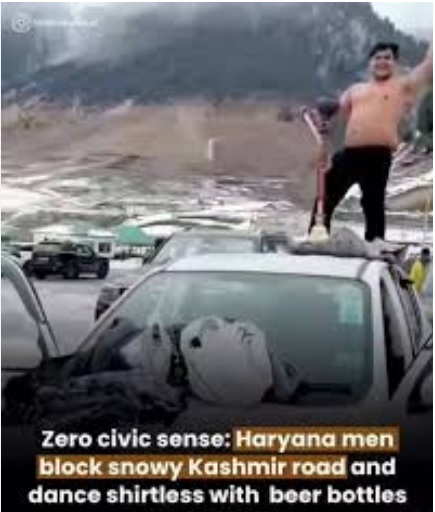
Blocking roads for photo shoots
-
Driving vehicles onto fragile snow surfaces
-
Ignoring safety barriers
In Kashmir’s delicate ecosystems, such behaviour can be particularly harmful.
Voices From the Valley
Local residents often express mixed feelings about tourism.
On one hand, visitors bring economic opportunity.
On the other, irresponsible behaviour can strain community relationships.
A shopkeeper near Pahalgam describes the situation simply:
“Tourists are welcome here. But some people treat the valley like a playground instead of someone’s home.”
A houseboat owner on Dal Lake shares similar concerns.
“If tourists respect the place, everyone benefits. But when people throw garbage into the lake, it hurts our livelihood.”
These voices reflect a growing sentiment across the valley.
Tourism must be sustainable to survive.
Tourism Is Kashmir’s Economic Lifeline
Despite these challenges, tourism remains vital for the region.
Thousands of families depend directly on tourist income.
Handicraft markets sell traditional Kashmiri shawls and carpets.
Guides lead trekking expeditions through mountain trails.
Local restaurants serve traditional cuisine to visitors from across India and the world.
When tourism thrives, the entire regional economy benefits.
This is why most locals are not calling for fewer tourists.
Instead, they are calling for better tourists.
Responsible Travel: The Only Sustainable Future
Experts say the future of Kashmir tourism depends on a shift toward responsible travel.
Visitors can make a significant difference through simple actions:
-
Avoid single-use plastic
-
Carry reusable bottles
-
Respect local customs and traditions
-
Dispose of waste responsibly
-
Keep noise levels low in natural areas
Travel influencers and content creators also play an important role.
By promoting responsible behaviour online, they can shape the culture of travel for millions of followers.
Protecting Paradise
Kashmir remains one of the most beautiful destinations in the world.
Its mountains, forests, rivers and lakes form an ecosystem that is both breathtaking and fragile.
Tourism has the power to support local communities and showcase this beauty to the world.
But tourism without responsibility can quickly turn into exploitation.
The valley’s future depends on balance.
Visitors must recognise that paradise is not just a destination.
It is a living landscape that requires care.
Because the question facing Kashmir today is not whether people should visit.
The question is how they choose to behave when they arrive.
If travellers respect the land and its people, Kashmir can remain the paradise it has always been.
If not, the damage may take generations to repair.