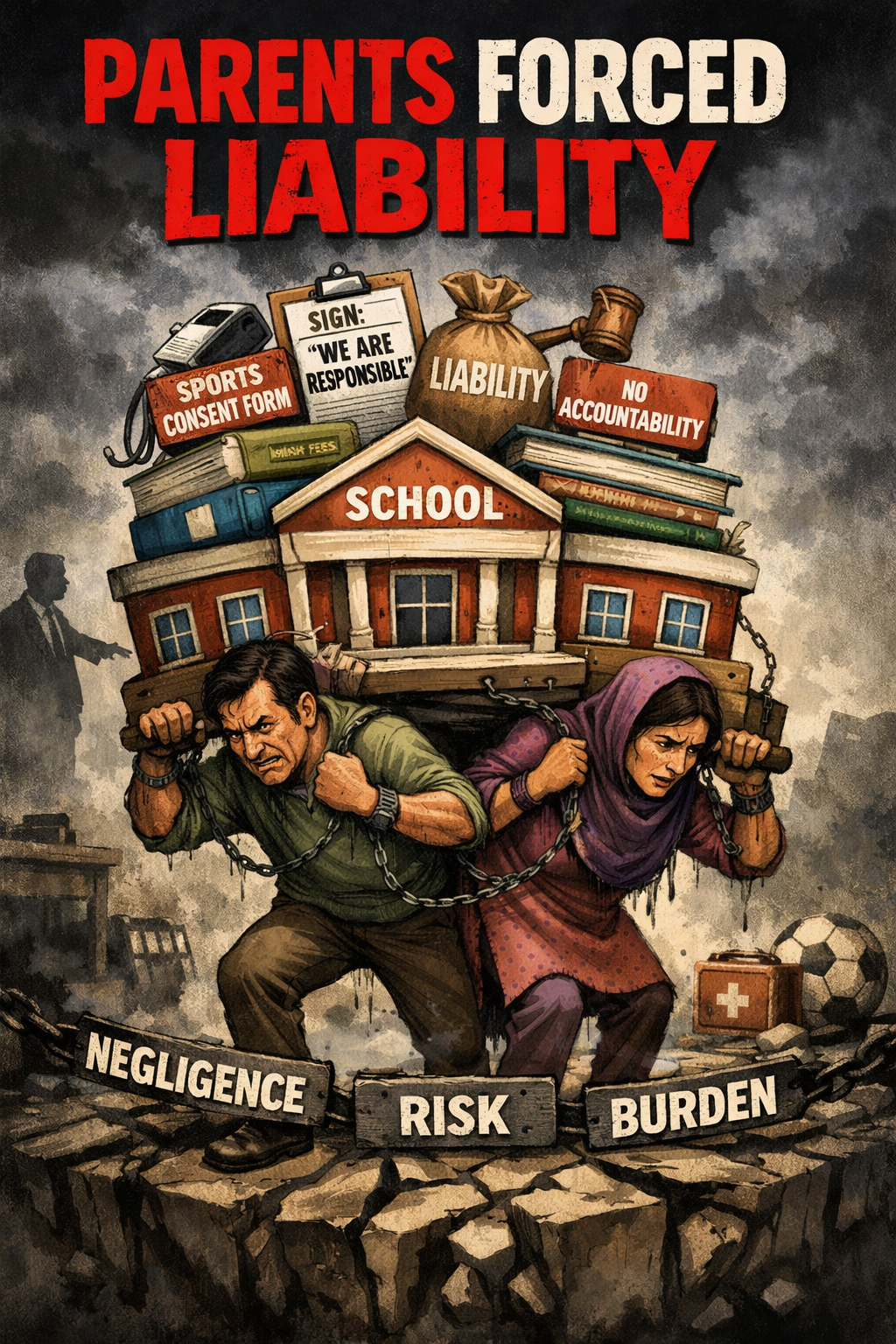
Parents Made Liable: Kashmir Schools’ Consent Forms Trigger Safety and Accountability Debate
By: Javid Amin | 04 May 2026
A fresh controversy is brewing across Kashmir’s education sector, where private schools are facing sharp criticism for introducing consent forms that appear to transfer responsibility for student safety onto parents. Already grappling with rising educational expenses and shifting institutional policies, families now find themselves confronted with what many describe as an “unfair and coercive clause.”
At the heart of the issue lies a single line that has triggered widespread concern:
“We would be responsible for any mishappening.”
The Clause That Sparked Outrage
The disputed clause has reportedly been introduced in sports and extracurricular activity consent forms distributed by several private schools in Srinagar and other parts of the Valley.
On the surface, such forms are routine—schools typically require parental consent before involving students in physical activities or excursions. However, the wording of this particular clause has raised serious red flags.
Parents and observers argue that the statement is deliberately vague, lacking clarity on what constitutes a “mishappening,” and more importantly, who is legally accountable when such incidents occur.
For many, the concern is not just about language—but intent.
Duty of Care vs. Shifting Liability
Under widely accepted educational and legal norms, schools carry a non-negotiable duty of care. This means that any child participating in school-supervised activities—whether on campus or outside—is under the institution’s responsibility.
What Experts Point Out
- Institutional Responsibility: Schools are legally and morally obligated to ensure safety protocols, trained supervision, and risk management during all activities.
- Implied Waiver Risk: By signing such consent forms, parents may unknowingly weaken their ability to hold schools accountable in case of negligence.
- Legal Ambiguity: While such clauses may not fully stand in court, they can create confusion and discourage legal challenges.
Legal analysts emphasize that liability cannot be casually transferred through broadly worded declarations, especially when minors are involved.
Parents Speak: “This Is Not Consent, It’s Pressure”
Across Srinagar, parents are voicing frustration and disbelief.
Many describe the clause as exploitative, arguing that it places them in an impossible position: either sign the document or risk their child being excluded from activities.
One parent summed up the sentiment:
“If my child is under the school’s supervision, how can I be responsible for what happens there? This is not consent—it feels like pressure.”
This growing resentment reflects a deeper unease about the evolving relationship between families and private educational institutions.
A Pattern of Growing Discontent
The consent form controversy does not exist in isolation. It adds to a series of long-standing concerns among parents in Kashmir:
Recurring Issues Highlighted by Families
- Frequent Fee Hikes: Often justified under vague “development” or “activity” charges.
- Compulsory Purchases: Branded uniforms, books, and supplies tied to specific vendors.
- Policy Volatility: Frequent changes in rules without adequate consultation or transparency.
Education observers note that these trends collectively point toward the commercialization of schooling, where institutions increasingly operate like businesses rather than public-serving entities.
What Education and Social Experts Are Saying
Education Advocates
They warn that such practices risk eroding the foundational values of education, where trust, care, and responsibility should be central.
By treating parents as customers rather than stakeholders, schools risk undermining their own credibility.
Legal Voices
Lawyers suggest that while the clause may not be enforceable in its current form, it serves as a deterrent mechanism, discouraging parents from questioning institutional authority.
Social Commentators
Many see this as part of a broader societal shift—where institutions prioritize risk management and reputation control over genuine accountability.
Ground Reality Check
Informal interactions with parents and local education observers in Srinagar indicate that:
- Not all schools have adopted the clause, but its spread is increasing.
- Many parents sign documents without fully understanding legal implications, due to time pressure or fear of repercussions.
- There is currently limited regulatory clarity or enforcement addressing such wording in consent forms.
This gap between policy and practice is where most concerns are emerging.
The Larger Question: Who Is Responsible for a Child’s Safety?
At its core, this controversy raises a fundamental question:
Can responsibility for a child’s safety be shifted away from the institution entrusted with their care?
The answer, according to most legal and ethical frameworks, is no.
Schools are not just service providers—they are custodians of children during school hours and activities. Any attempt to dilute that responsibility risks weakening the very structure of trust that education relies upon.
Editorial Perspective: A Warning Sign for the Education System
This is not merely about a clause in a consent form—it is a reflection of a wider trust deficit.
When parents begin to question whether schools will stand by their responsibilities, the impact goes beyond paperwork. It affects confidence, participation, and ultimately, the quality of education itself.
In Kashmir, where families already navigate economic and social challenges, such developments add another layer of anxiety.
Education, at its best, is a partnership between schools and parents.
But when that partnership begins to feel one-sided, it signals the need for urgent introspection—and possibly, regulation.
Conclusion
The controversy surrounding consent forms in Kashmir’s private schools is a reminder that clarity, accountability, and trust are not optional in education—they are essential.
As the debate grows, all eyes will be on whether authorities step in to provide guidelines—or whether parents themselves push back against what they see as an unfair transfer of responsibility.
For now, one thing is clear:
Parents are no longer willing to sign away accountability without asking difficult questions.