Mehbooba Mufti Calls for United Political Front in J&K on Ladakh Model
By: Javid Amin | 25 May 2026
PDP Chief Urges Regional Parties to Rise Above Politics, Revive PAGD for Jammu and Kashmir’s Political Future
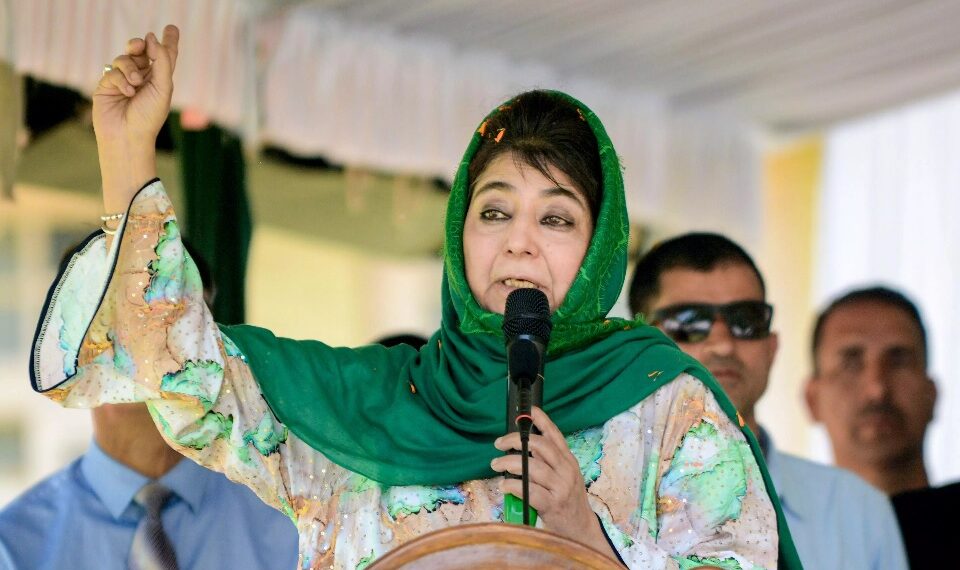
In a significant political statement from Srinagar, Mehbooba Mufti on Monday called for the formation of a united political front in Jammu and Kashmir, drawing inspiration from the collective movement launched by leaders in Ladakh after the constitutional changes of 2019.
The president of Peoples Democratic Party urged political parties across Jammu and Kashmir to once again come together under a common platform, similar to the People’s Alliance for Gupkar Declaration (PAGD), to collectively engage with New Delhi on issues concerning the region’s political rights, governance, and constitutional future.
Speaking to reporters in Srinagar, Mufti said the Centre’s recent engagement with Ladakh-based groups reflected what she described as “course correction” following the August 2019 decisions that revoked Jammu and Kashmir’s special status and reorganized the erstwhile state into two Union Territories.
Mehbooba Praises Leh and Kargil Leadership
Referring to the joint movement launched by civil society and political groups in Leh and Kargil, Mehbooba Mufti said Ladakh’s leadership had demonstrated political maturity by setting aside regional and religious differences to pursue common demands.
According to Mufti, leaders from Leh and Kargil remained focused despite political pressures and conducted over 20 rounds of dialogue with the Centre, eventually compelling New Delhi to engage with their concerns.
She said the Ladakh movement showed how unity and sustained political engagement could produce results even without an elected legislative assembly.
“Whether it is the people of Leh or Kargil, the local leadership there rose above regional and religious interests, held multiple rounds of talks with the Centre and managed to achieve something,” Mufti said.
Her remarks come amid ongoing discussions between Ladakh-based groups and the Union government over demands including statehood, constitutional safeguards under the Sixth Schedule, employment protections, and land rights.
Call to Revive PAGD in Jammu and Kashmir
People’s Alliance for Gupkar Declaration, formed in 2020 by several regional political parties including the PDP and the Jammu and Kashmir National Conference, was created in response to the constitutional changes introduced by the Centre in August 2019.
The alliance initially brought together mainstream political parties seeking restoration of Jammu and Kashmir’s special constitutional position and statehood.
Mufti said the formation of PAGD had earlier created political pressure that eventually led the Centre to convene an all-party meeting with regional leaders.
However, she admitted that electoral politics later weakened the alliance’s collective momentum.
“When we formed the PAGD, the Centre was compelled to call us for an all-party meeting. But later, we became trapped in electoral politics,” she stated.
The PDP chief suggested that political divisions and electoral competition diluted the broader objective of collective engagement with Delhi.
Comparing Jammu and Kashmir with Ladakh
Mufti drew a direct comparison between the political situation in Jammu and Kashmir and the developments in Ladakh, arguing that Ladakh’s leadership achieved progress despite lacking an elected assembly or parliamentary influence comparable to Jammu and Kashmir.
She pointed out that parties in Jammu and Kashmir currently have elected representation in both Parliament and the local legislature, yet have struggled to persuade the Centre to begin a similar structured dialogue process.
“The people of Leh and Kargil did not get distracted by electoral politics. They had no Assembly, yet they managed to achieve so much,” she remarked.
The statement is being interpreted by political observers as both a criticism of fragmented regional politics and a strategic attempt to reposition the PDP within the broader discourse on post-2019 political engagement.
The Broader Political Context
The remarks come at a politically sensitive time in Jammu and Kashmir, where mainstream regional parties continue to demand restoration of full statehood, constitutional safeguards, and greater political autonomy following the abrogation of Revocation of Article 370.
Since 2019, political parties in the region have repeatedly debated the effectiveness of electoral participation versus collective political resistance and dialogue with the Centre.
Meanwhile, developments in Ladakh — particularly the joint movement involving Leh and Kargil-based organisations — have increasingly become a reference point in regional political discussions.
The Ladakh leadership’s ability to maintain a united front despite ethnic, religious, and regional differences has drawn attention across political circles in Jammu and Kashmir.
Political Reactions Expected Across the Valley
Mufti’s call for reviving a united political platform is likely to trigger fresh debate among regional parties, especially regarding the future of PAGD and the possibility of coordinated political engagement.
Analysts believe the statement also reflects growing concern among regional parties over political fragmentation ahead of future electoral and constitutional developments in Jammu and Kashmir.
While no immediate response was issued by other major parties, the remarks are expected to revive discussions on opposition unity, statehood restoration, and Centre-region relations.
Political observers note that despite ideological differences, many regional parties continue to share concerns over representation, governance, and constitutional protections in the Union Territory.
A Push for Consensus Politics
At its core, Mehbooba Mufti’s statement appears aimed at reviving consensus-based regional politics at a time when Jammu and Kashmir’s political landscape remains deeply fragmented.
By invoking the “Ladakh model,” the PDP chief attempted to frame unity and sustained dialogue as more effective tools than competitive electoral politics alone.
Whether her appeal translates into renewed political coordination remains uncertain, but the statement has once again brought the debate around regional unity, constitutional engagement, and post-2019 political strategy back to the centre of Jammu and Kashmir’s political discourse.