CJP Protest at Parliament Street: Swatantra Bhardwaj Row Puts Delhi Police Under Fresh Scrutiny
By: Javid Amin | 04 September 2026
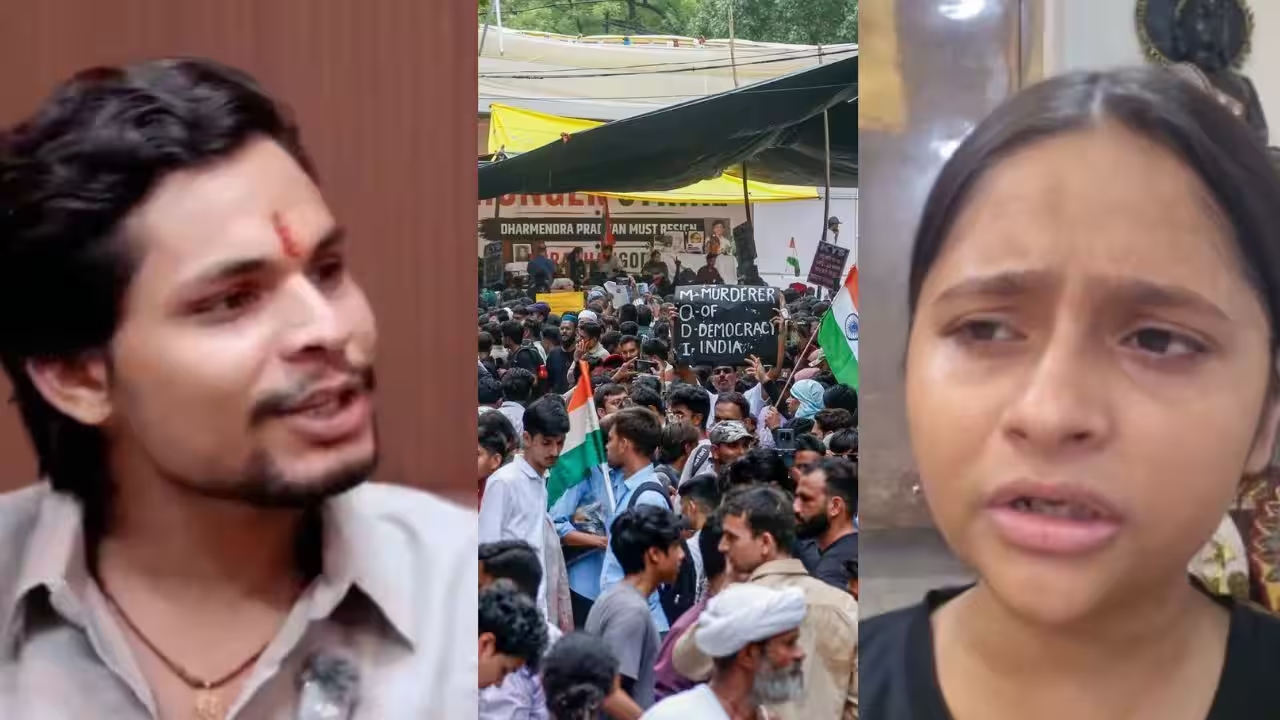
A confrontation at Delhi’s Jantar Mantar in June has returned to the political spotlight after a video in which self-styled Hindutva influencer Swatantra Bhardwaj allegedly boasted about injuring the father of student activist Nishu Azad triggered a fresh demand for police action.
The Cockroach Janta Party (CJP) is set to visit Parliament Street Police Station in New Delhi on September 4, seeking stronger action against Bhardwaj in connection with the incident involving Nishu’s father, Sanjay Kumar. The development has quickly moved beyond a dispute between protesters and an alleged assailant. It now touches on a larger and increasingly familiar question in Indian public life: how should the law respond when political confrontation, social-media influence and allegations of communal provocation collide?
Importantly, however, the available evidence does not support describing the present protest simply as a demand for an FIR over “hate speech”. A police case concerning the alleged assault was already registered. The current dispute is primarily about the nature of the alleged assault, the subsequent video statements, the adequacy of police action and allegations of political influence.
That distinction matters.
CJP heads to Parliament Street Police Station
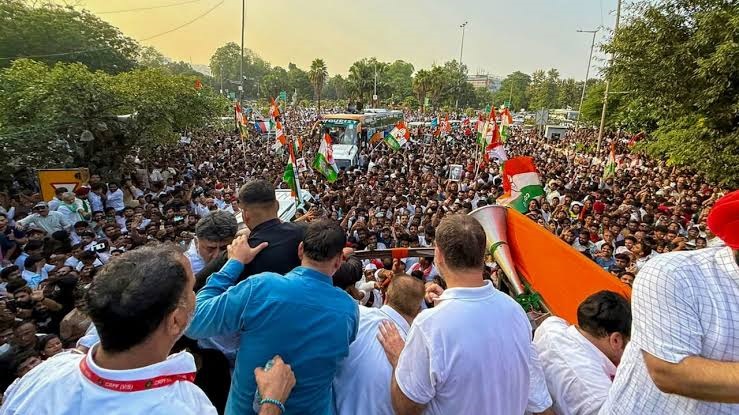
CJP spokesperson Saurav Das said party members would reach the Parliament Street Police Station at around 10 am on Friday to demand action against Bhardwaj. Co-convener Ashutosh Ranka also appealed to supporters to join the protest.
Nishu Azad has said she will accompany her father.
The immediate trigger is a video that surfaced online in which Bhardwaj appears to discuss the confrontation with Sanjay Kumar. In the video, he claims that he “cracked” Kumar’s skull and makes a series of assertions about his political connections.
The claims have been seized upon by opposition leaders and CJP activists as evidence that the incident deserves a fresh examination.
But there is a significant complication: Delhi Police disputes the description of Kumar’s injuries as a fractured or “cracked” skull.
That disagreement is now at the heart of the controversy.
What happened at Jantar Mantar?
According to Delhi Police, the underlying incident occurred on June 23, 2026, during a CJP protest at Jantar Mantar.
Police identified the injured man as Sanjay Kumar, 38, a resident of Ghaziabad. During a scuffle, he sustained a head injury from a kada—a bangle worn by one of the people involved, according to the police account.
Kumar was medically examined at Ram Manohar Lohia Hospital. Police said doctors classified his injuries as “simple in nature” and specifically rejected claims that the injury was caused by a weapon or that medical records established a fractured skull.
A case was registered at Parliament Street Police Station on Kumar’s complaint.
Police also said two men, Suraj Kumar, 24, and Swatantra Bhardwaj, 21, were detained from the protest site. They were subsequently served notices and interrogated during the investigation. Police said a chargesheet would be filed before the competent court.
This is an important correction to the original narrative circulating around the protest: the dispute is not about whether any police case exists. A case was registered. The disagreement is over whether the investigation and legal action have been sufficiently stringent.
The video that reignited the controversy
The controversy intensified after a video appeared in which Bhardwaj discusses the incident in unusually provocative terms.
He claims that he injured Kumar severely and says he was not jailed afterwards. He also refers to Delhi minister Kapil Mishra, Union minister Chirag Paswan and Prime Minister Narendra Modi as people with whom he has close ties.
Those claims have not, however, been independently established as evidence of political intervention.
The Press Trust of India contacted Mishra and Paswan for their responses, but no response was reported. Delhi Police, meanwhile, explicitly rejected allegations that the case had been affected by undue influence, saying the matter had been dealt with according to law and procedure.
That creates two very different narratives.
The first comes from Bhardwaj’s own public claims, which have been interpreted by opponents as suggesting political protection.
The second is the official police position: the accused was identified, detained, questioned, and subjected to legal procedure, while the investigation continues.
Neither claim should automatically be treated as proof of the other.
Why the “cracked skull” claim matters
Few details have generated as much heat as the alleged skull injury.
Bhardwaj’s video presents the injury as extremely serious. Delhi Police’s medical account presents a markedly different picture.
According to the police statement, Kumar’s injury was caused by a kada during the scuffle and doctors at RML Hospital classified the injuries as simple. Police therefore described claims about a fractured skull as unsupported by the medical-legal record.
That does not mean the underlying assault allegation disappears.
A head injury during a public protest remains a matter for investigation, irrespective of whether the injury ultimately meets the threshold for a more serious criminal charge.
What it does mean is that descriptions of the incident need to be separated from established medical facts.
For a case that is rapidly becoming a political symbol, that distinction is crucial.
CJP says police action is not enough
CJP’s argument is different.
The party says the video amounts to an open admission by Bhardwaj and questions why more stringent action was not taken against him. CJP spokesperson Saurav Das has alleged that the injury was serious and that the police did not invoke the provisions the group believes appropriate.
The organisation therefore wants the matter pursued more aggressively.
Its protest also places the case in the broader context of CJP’s increasingly confrontational relationship with state institutions following its student-led political mobilisation.
Recent CJP activity has included protests and demands involving youth issues, police accountability and government commitments, helping transform what began as a pressure movement into a more visible political force.
Rahul Gandhi and opposition parties enter the dispute
The controversy has also attracted opposition attention.
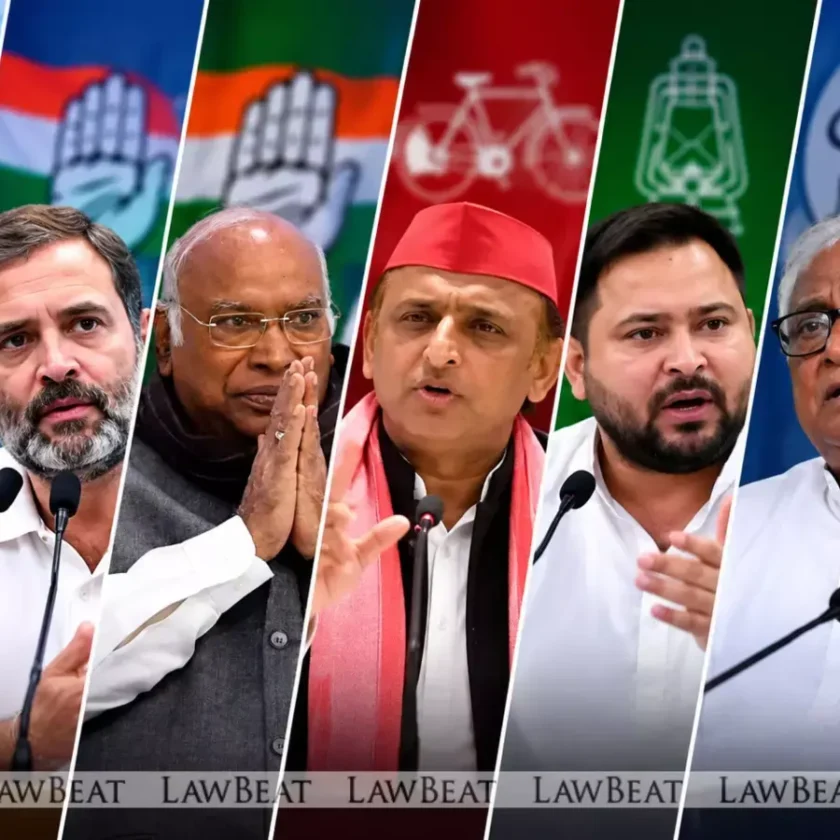
Leader of Opposition in the Lok Sabha Rahul Gandhi questioned why Bhardwaj remained free and raised allegations of political protection. The Congress, AAP and TMC have also criticised the handling of the matter.
Those interventions have increased the political stakes.
For the opposition, the episode fits into a wider argument about selective enforcement and the alleged proximity between political power and aggressive online influencers.
For the BJP and the Delhi Police, however, the crucial question is whether accusations of political patronage are being inferred from Bhardwaj’s own statements rather than established through evidence.
That distinction will ultimately have to be settled through investigation rather than political rhetoric.
From social-media controversy to a law-and-order question
The case illustrates a newer challenge for India’s political landscape.
Political confrontation no longer ends when protesters leave the street. Clips recorded at demonstrations can circulate for days or weeks, while statements made on podcasts, Instagram and other platforms can reopen disputes long after the original incident.
That has changed the dynamics of accountability.
An alleged act at a protest may initially be treated as a local law-and-order issue. A later video can transform it into a national political controversy.
That appears to be what has happened here.
Bhardwaj’s alleged remarks have become nearly as important politically as the original confrontation because they raise questions about what was said, what actually happened, and whether the public account corresponds with the medical and investigative record.
The hate-speech angle needs careful handling
The original description of the protest framed it primarily as a demand for action against a Hindutva influencer accused of spreading hate speech and communal polarisation.
The available reporting supports a narrower and more precise description.
The immediate CJP action on September 4 is centred on the alleged assault on Sanjay Kumar and Bhardwaj’s subsequent public claims about that incident. The police case cited in current reports concerns the confrontation at Jantar Mantar.
That does not rule out wider allegations about inflammatory online content. But such allegations should not be presented as established criminal findings unless a specific complaint, FIR, police investigation or court proceeding establishes them.
For news organisations, this is more than a semantic issue. It is the difference between reporting an allegation and declaring guilt.
Why Parliament Street has become the focal point
There is also symbolism in CJP choosing Parliament Street Police Station.
The area has long been associated with demonstrations, political pressure and confrontation between protesters and the state. Taking a grievance to the police station rather than merely holding another street protest gives the campaign a clear institutional target: the police investigation itself.
CJP is effectively asking a simple question—if the alleged assault was already reported and the accused later spoke publicly about it, should the authorities now take additional action?
Delhi Police’s answer is that action has already been taken and that the investigation is proceeding according to law.
The next step, therefore, is likely to be judged less by competing political claims and more by the documentary trail: the FIR, medical record, statements of witnesses, video evidence and eventual chargesheet.
A larger test for political accountability
The episode also raises a broader question about the role of political influencers in India’s increasingly digital political ecosystem.
Influencers can mobilise supporters, shape narratives and amplify political messages without holding elected office. Their proximity—or claimed proximity—to politicians can therefore become politically significant even when there is no evidence that a politician actually directed or interfered with an official action.
That makes public claims of political access particularly consequential.
If Bhardwaj’s statements about political backing are accurate, the authorities would need to establish what, if anything, was actually communicated or done.
If they are exaggerated, that too is significant—because claims of political protection can themselves distort public confidence in institutions.
Either way, the appropriate test is evidence.
What happens next?
The immediate development is CJP’s visit to Parliament Street Police Station and its demand for stronger action.
Delhi Police has already said that the case is under investigation and that a chargesheet will be filed before the competent court. It has also rejected allegations of undue influence.
The unresolved questions are therefore straightforward:
- What exactly does the FIR allege?
- What do the complete medical records establish about Kumar’s injury?
- What does the available video evidence show about the confrontation?
- What statements have witnesses given?
- What legal provisions will ultimately be included in the chargesheet?
- And, separately, is there any evidence supporting the allegations of political interference?
Those questions matter far more than the increasingly polarised social-media debate.
The bigger picture
The CJP’s Parliament Street protest is not simply another demonstration in Delhi’s crowded political calendar. It sits at the intersection of student activism, caste politics, social-media influence, Hindutva politics, police accountability and the increasingly blurred line between online rhetoric and offline confrontation.
Yet the controversy also demonstrates why politically charged cases require restraint.
The allegations against Bhardwaj deserve investigation. CJP is entitled to demand accountability. The police are entitled to rely on medical and investigative evidence. Political leaders are entitled to question government action.
But none of those positions, by themselves, establish guilt or political interference.
Ultimately, the credibility of the case will depend on whether the evidence can withstand scrutiny—not on who shouts the loudest outside Parliament Street.