Kashmir’s Walnut Harvest Turns Deadly Again: Four Workers Die as Farmers Demand Safer Orchards
By: News Desk | 03 September 2026
Four fatal falls in Qazigund, Tral, Uri and Pulwama at the start of the 2026 walnut season have revived a long-standing question: why does harvesting one of Kashmir’s most valuable crops still require workers to climb trees 40–75 feet high with little protection?
Srinagar: The first walnuts of autumn should normally signal the beginning of one of Kashmir’s most important agricultural seasons.
Instead, this year’s harvest has opened with four deaths.
As walnut harvesting got underway in early September, Mohammad Maqbool Bhat of Qazigund, Ghulam Mohammad Ganai of Tral, Ashiq Hussain of Uri and Hilal Ahmad Mir of Pulwama reportedly died after falling from walnut trees while harvesting or threshing the crop. The incidents, reported across different parts of the Valley, have once again exposed an occupational danger that has existed for generations.
The victims were not engaging in an unusual activity. They were doing seasonal work that thousands of Kashmiris depend upon.
That is precisely what makes the deaths so troubling.
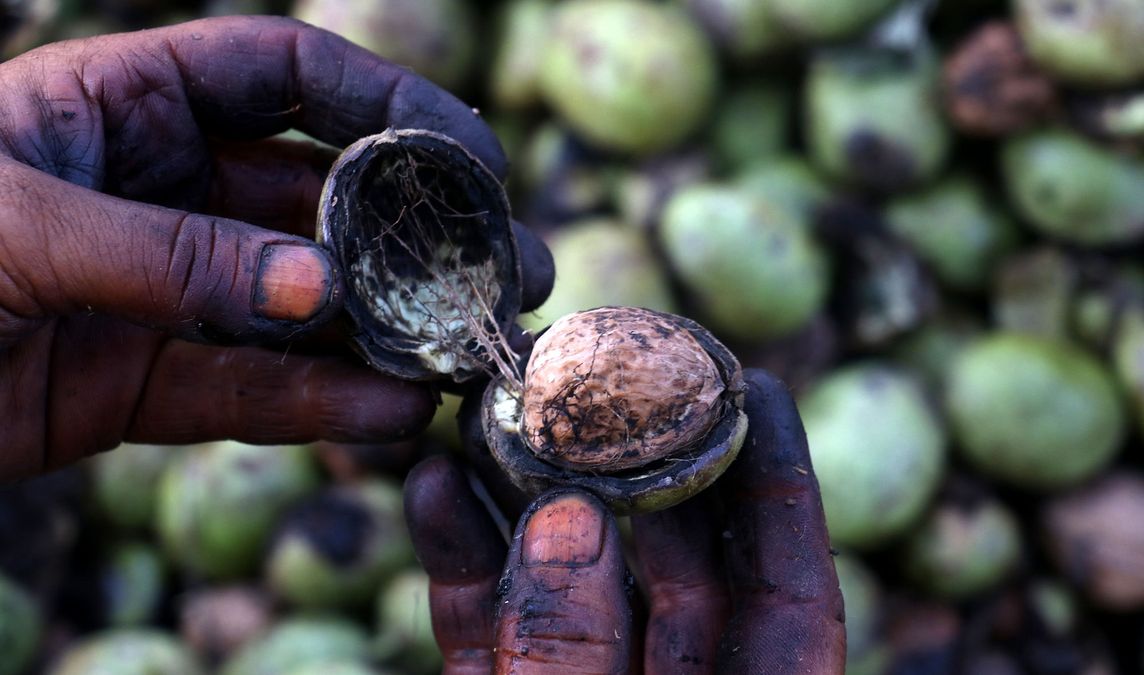
Walnut harvesting is a familiar autumn sight in rural Kashmir: a worker high among the branches, a long bamboo or wooden pole in his hands, walnuts raining onto the ground below. But what appears almost routine from a distance involves considerable exposure to falls from height.
And when a worker slips, there is often no harness to stop him, no safety net beneath him and little margin for error.
The walnut may survive the fall.
The person often does not.
Four deaths in the opening days of the walnut harvest
The latest incidents were reported between September 2 and 3.
In Damjan, Qazigund, Mohammad Maqbool Bhat reportedly fell while harvesting walnuts. Reports identified him as the sole breadwinner of his family, survived by two children.
In Laribal, Tral, Ghulam Mohammad Ganai fell while threshing walnuts. He was taken to SMHS Hospital in Srinagar but later succumbed to his injuries.
In Pawadan village of Uri, 35-year-old Ashiq Hussain reportedly fell while threshing walnuts and was declared dead at the Sub-District Hospital.
And in Puchal village of Pulwama, Hilal Ahmad Mir suffered serious injuries after falling from a walnut tree and later died. Reports identified him as a father of two.
The four deaths occurred in different districts, but the circumstances were strikingly similar.
A tree.
A worker.
A harvesting pole.
A fall.
And, in each case, a family left to deal with the consequences.
Why walnut harvesting is so dangerous in Kashmir
The danger begins with the tree itself.
Traditional walnut trees can become exceptionally tall. A peer-reviewed study based on Kashmir’s experience describes walnut trees reaching approximately 40 to 75 feet. The fruit matures roughly from August through October, creating a narrow seasonal window in which large numbers of workers are exposed to the same occupational risk.
The harvesting method makes the situation more difficult.
Workers commonly climb the tree and position themselves on branches before using long sticks to knock down walnuts. The technique is deeply embedded in the region’s agricultural tradition, but it leaves workers exposed at substantial height.
A branch can be wet.
Bark can be slippery.
A worker can lose his footing while reaching for a distant branch.
Or the pole itself can disturb his balance.
At ground level, such mistakes might mean a bruise.
At 50 or 60 feet, they can mean a fatal injury.
Recent reports say walnut labourers may work 7.5 to 8.5 hours a day during the harvest, often without helmets, harnesses, fall-arrest systems or other specialised protection.
The problem is therefore not simply that workers climb trees.
It is that they climb them without a modern fall-protection system around a job that inherently involves working at height.
The medical evidence is older — but the warning remains relevant
The statistics frequently cited during every walnut season have their roots in medical research dating back more than a decade.
A study published in 2010 examined 115 patients admitted to SKIMS Medical College between 2003 and 2007 after walnut-tree falls.
Its findings were stark.
Ninety-four per cent of the falls occurred between August and October, precisely when walnut harvesting takes place. More than half of the patients — 63 of 115 — also had non-orthopaedic injuries. Head injury was the most common associated injury, affecting 34 patients. Thoracolumbar, heel and distal-radius fractures were among the commonly recorded fractures.
That 94% figure is important, but it needs to be presented accurately.
It does not mean that 94% of all tree falls in Kashmir today are walnut-related, nor does it represent the number of walnut workers injured every year.
It means that, in that particular five-year hospital dataset, 94% of the recorded walnut-tree falls happened between August and October.
Yet the seasonal pattern remains strikingly relevant.
The danger peaks precisely when the crop is ready.
When a harvesting accident becomes a lifelong disability
Death is the most visible consequence of a fall.
Disability can be the less visible one.
A worker who survives a fall with spinal-cord damage may not return to the orchard. He may not return to any form of physical labour.
The consequences can extend for decades.
Research into spinal injuries caused by walnut-tree falls in Kashmir has documented severe neurological damage, including paraplegia and other forms of permanent disability. A study of spinal injuries found that walnut-tree falls accounted for a substantial share of serious cases treated at the tertiary-care level.
That transforms the nature of the accident.
A fatal fall removes a wage earner overnight.
A disabling fall can create a household that suddenly needs income, medical care, rehabilitation and long-term assistance — while losing the person’s ability to earn.
For poor rural families, the distinction can be devastating.
A newer study puts the economic cost into sharper focus
The problem has also been examined through more recent research.
A 2025 study titled From Injury to Economic Strain: Assessing the Unseen Costs of Labour Risks in Kashmir’s Walnut Harvesting Industry examined 150 walnut labourers in Kupwara and Ganderbal and analysed hospital records involving 95 workers treated at SKIMS Soura during the harvesting period.
The study identified falls from height as the major occupational hazard.
Among those 95 hospital cases, 12 workers were brought dead, while another 13 died within 24 to 72 hours of admission, according to the study’s reported findings. It also found that workers in the 18–35 age group formed the majority of those affected.
Those figures should not be interpreted as a complete census of all walnut-harvesting deaths in Kashmir.
They represent the cases covered by the study.
But they provide something more important than a single season’s death toll: evidence that the danger is not anecdotal.
It is measurable.
And it has an economic cost that extends well beyond the hospital gate.
The workers are not simply “unskilled labour”
There is another dimension often overlooked in discussions about walnut harvesting.
The people who climb these trees are usually not amateurs.
Walnut threshers develop considerable practical skill. They know how to move across branches, where to position themselves and how to strike the fruit without damaging the crop.
Reports from Kashmir have described specialised walnut harvesters travelling seasonally to different areas for work. The job can provide income for workers and their families during a limited agricultural window.
Skill, however, cannot eliminate physics.
A highly experienced worker can still fall.
And traditional knowledge cannot substitute entirely for fall-arrest technology.
That is why the answer should not be to blame workers for taking risks. The more useful question is why an economically important agricultural activity has not been systematically modernised around worker safety.
The walnut economy is too important to ignore
The irony is that walnut harvesting remains economically significant precisely because Kashmir has a major walnut-growing industry.
Government-linked agricultural data shows Jammu and Kashmir remains India’s largest walnut-producing region in terms of area and production. APEDA, citing National Horticulture Board data for 2024-25, puts India’s walnut cultivation area at 96.68 thousand hectares and production at 322.08 thousand tonnes, with J&K accounting for the largest share.
The crop supports farmers, seasonal harvesters, traders, transporters, processors and other parts of the rural economy.
In Uri alone, recent reporting estimated that the walnut trade creates seasonal direct and indirect employment for tens of thousands of people.
So this is not an obscure agricultural activity affecting a handful of workers.
It is a sizeable rural economy.
And the more valuable the crop becomes, the more urgent it is to make the process of collecting it safe.
Farmers want shorter trees — and science already points in that direction
One of the most practical demands coming from growers is a transition away from very tall traditional trees toward improved planting material and better orchard management.
The logic is straightforward.
If workers do not have to climb 60 or 70 feet, the risk of a catastrophic fall can be reduced.
But replacing traditional orchards is not as simple as cutting down old trees and planting new ones.
Walnut trees take years to mature, and growers cannot afford to sacrifice existing income without a viable transition plan.
That is where modern walnut varieties and propagation technologies become important.
ICAR-Central Institute of Temperate Horticulture in Srinagar has been working on improved walnut planting material, grafting and budding technologies. ICAR has reported successful propagation of improved walnut material and efforts to increase the availability of quality planting stock.
Earlier ICAR material also highlighted budded and grafted walnut plants that can begin bearing considerably earlier than conventional seedling trees.
The solution, therefore, is not necessarily to abandon Kashmir’s traditional walnut economy.
It is to modernise the orchard without destroying the livelihood attached to it.
Farmers are asking for hybrid and improved varieties
Growers interviewed in the wake of the latest deaths have called for greater adoption of shorter walnut varieties and government support for replacing ageing trees.
The argument is twofold.
First, shorter trees could make harvesting safer.
Second, old seedling trees may have low productivity compared with improved planting material.
A farmer from Qazigund quoted in recent reports argued that old trees should be replaced and that improved plants should be supplied to growers with government support.
But there is an important agricultural caveat.
“Hybrid” should not become a catch-all word for any short walnut tree.
What Kashmir needs is scientifically evaluated, locally suitable planting material that combines manageable tree architecture with reliable yield, kernel quality, disease tolerance, climate suitability and economic viability.
The transition should be based on agronomic evidence rather than simply on tree height.
Safety gear could save lives before new orchards mature
New orchards will take years.
Workers are climbing trees this season.
That means orchard modernisation cannot be the only response.
The immediate intervention is safety.
A basic walnut harvesting safety kit could include:
- a properly fitted climbing/fall-arrest harness;
- secure ropes and anchor systems;
- helmets;
- non-slip footwear;
- protective gloves;
- safety nets where feasible;
- safe climbing ladders or platforms;
- trained ground support;
- first-aid equipment; and
- emergency communication arrangements.
Not every safety measure will work equally well in every orchard.
But doing nothing should no longer be considered the default.
Mechanical harvesting may offer the longer-term answer
There is also encouraging evidence that safer technology need not remain theoretical.
Researchers at SKUAST-K have worked on mechanised walnut harvesting for conventional trees approximately 50–60 feet high. A tractor-operated harvester developed by researchers uses a vibration mechanism and a telescopic pole to transfer vibration to tree limbs, providing an alternative to physically climbing the tree.
This is exactly the kind of innovation that deserves greater attention.
The objective should not necessarily be to mechanise every walnut orchard overnight.
Instead, government agencies, cooperatives and grower groups could test machinery through shared custom-hiring centres, allowing small farmers to access equipment without purchasing expensive machines individually.
That model could make technological adoption far more realistic for smallholders.
The GST debate needs a correction too
Another issue raised by growers concerns taxation.
Recent reports quote walnut growers and traders calling for relief from the 5% GST currently applicable to walnuts and arguing that imported walnuts are putting pressure on local producers.
But the historical context matters.
The Union government’s official material records that GST on walnuts was reduced from 12% to 5% in 2025 as part of a broader tax reform.
So the present demand is better described as a call for further relief, potentially to zero GST, rather than a request to reduce the existing rate from a higher slab.
The import issue is separate.
India’s walnut market faces competition from foreign suppliers, and growers have repeatedly expressed concern that cheaper imported walnuts can weaken prices for local produce. But any policy response has to balance consumer prices, farmer incomes, import competition and market access.
The tax debate, in other words, is part of the larger economic question surrounding the crop.
It should not be presented as the cause of harvesting deaths.
Protecting the walnut tree can also create a safety paradox
Walnut trees enjoy legal protection in Jammu and Kashmir under the Jammu and Kashmir Preservation of Specified Trees Act, 1969, and cutting or pruning protected trees requires permission.
The law exists for an understandable reason: walnut trees have economic and ecological value.
But the current safety debate raises a more complicated question.
What happens when an old, declining or structurally unsafe walnut tree itself becomes a workplace hazard?
Farmers need a system that allows legitimate scientific pruning, orchard renewal and replacement of unproductive trees without encouraging indiscriminate felling.
That requires coordination between horticulture authorities and the agencies responsible for tree protection.
The answer cannot be “cut the trees.”
Nor can it be “never touch them.”
It has to be managed orchard renewal.
Why awareness campaigns alone will not be enough
Every year, safety warnings can be issued.
Posters can be printed.
Meetings can be held.
Workers can be told to “be careful.”
But a worker standing 50 feet above the ground with a bamboo pole needs more than advice.
He needs equipment.
He needs training in its use.
And the equipment needs to be available at a price he can afford.
This is where government intervention can make a meaningful difference.
A subsidised seasonal safety-kit programme could be introduced before the harvest. Panchayats, horticulture offices, cooperatives and farmer associations could organise short practical demonstrations on safe climbing and emergency response.
Insurance could also be linked to registered seasonal harvesting teams.
The cost of such a programme would likely be tiny compared with the medical and social cost of a single catastrophic injury.
A safer walnut harvest could begin with a simple policy package
A comprehensive response does not require one grand technological revolution.
It could begin with several smaller interventions working together.
| Problem | Practical response |
|---|---|
| Very tall traditional trees | Gradual orchard renewal with scientifically selected improved varieties |
| Workers climbing without protection | Subsidised helmets, harnesses, ropes and non-slip footwear |
| Unsafe traditional harvesting | Mechanised and telescopic harvesting tools |
| Lack of training | Pre-season safety camps and demonstrations |
| Fatal injuries | Seasonal accident insurance and family compensation |
| Emergency delays | Local first-aid and rapid referral protocols |
| Small farmers unable to buy machinery | Community/custom-hiring equipment centres |
| Ageing orchards | Scientific pruning and phased replacement |
| Weak market position | Better grading, processing, branding and market access |
| Tax concerns | Review of GST burden in consultation with growers |
The critical point is that worker safety and agricultural productivity do not have to be competing goals.
They can reinforce one another.
Kashmir’s walnut problem is ultimately a question of dignity
There is something deeply uncomfortable about the way these deaths are described as “seasonal accidents.”
They are seasonal.
They are accidents.
But they are not entirely unpredictable.
The medical literature has documented the pattern for years. The harvesting months are known. The hazards are known. The tree heights are known. The injuries are known.
What remains uncertain is why the response remains so limited.
A walnut harvester’s life should not be treated as an unavoidable cost of producing a premium agricultural commodity.
The workers who climb these trees are part of the walnut economy.
They are not expendable components of it.
The harvest should bring walnuts home — not workers to hospital
Kashmir’s walnut season is one of the region’s oldest agricultural traditions.
It is also an important source of income.
But tradition cannot become an excuse for preventable danger.
The four deaths reported at the beginning of the 2026 season should therefore be treated not merely as four isolated tragedies in Qazigund, Tral, Uri and Pulwama, but as a warning at the start of the harvest itself.
There is still time this season to put basic protections in place.
There is time to distribute safety equipment.
There is time to train workers.
There is time to deploy safer harvesting methods where available.
And there is time to begin planning the transition toward better-designed orchards.
The longer-term goal should be clear: a Kashmir where walnut trees remain part of the landscape and economy, but climbing them no longer has to be a gamble between earning a livelihood and returning home alive.
The walnut should remain a symbol of Kashmir’s agricultural wealth.
Its harvest should not remain a recurring symbol of preventable loss.