The 1,600 Kg Meat Seizure Has Become More Than a Food Safety Story
By: Javid Amin | 17 November 2026
Srinagar: The seizure of approximately 1,600 kilograms of deteriorated buffalo meat at Budgam Railway Station has triggered a wider public debate in Jammu and Kashmir, bringing the issue of food safety beyond government inspections and enforcement agencies and into the region’s religious and social institutions.
Taking serious note of the incident and growing concerns over unsafe food products, the Mirwaiz Umar Farooq-led Muttahida Majlis-e-Ulama (MMU) has decided to dedicate this week’s common Friday sermon to food adulteration, declining commercial ethics and collective responsibility.
The proposed Khutbah, titled “Food Adulteration, Moral Decline and Collective Responsibility,” will be delivered in mosques across Jammu, Kashmir and Ladakh on Friday, November 20, as part of the MMU’s initiative to address pressing social concerns through coordinated religious guidance.
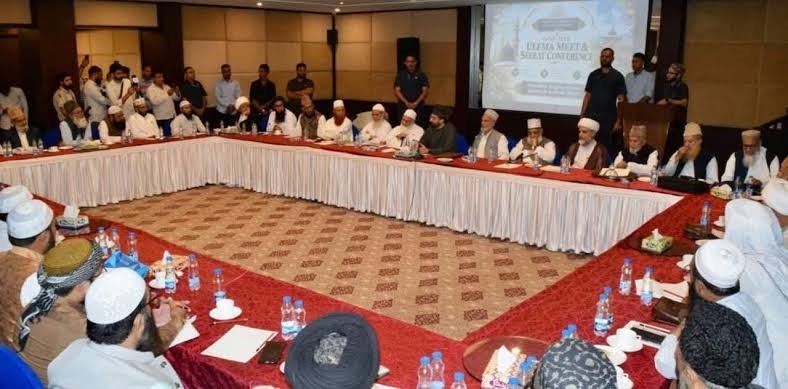
The decision was taken during a meeting of the MMU Khutbah Consultative Committee at the Auqaf Office of the historic Jamia Masjid in Srinagar on November 17. The committee deliberated on the contents of the sermon and agreed to focus on public awareness, ethical business practices, government accountability and stricter enforcement of food safety regulations.
The intervention comes at a particularly sensitive time. The latest meat seizure has revived memories of previous food safety controversies in Kashmir, where inspections uncovered substantial quantities of rotten, decomposed, improperly labelled and unsafe meat products.
What makes the latest development significant is that the issue is no longer being viewed simply as a question of whether a particular consignment was transported legally. It has become a question of consumer confidence, commercial responsibility and the ability of regulatory institutions to protect ordinary households from unsafe food.
What Happened at Budgam Railway Station? Inside the 1.6-Tonne Meat Seizure
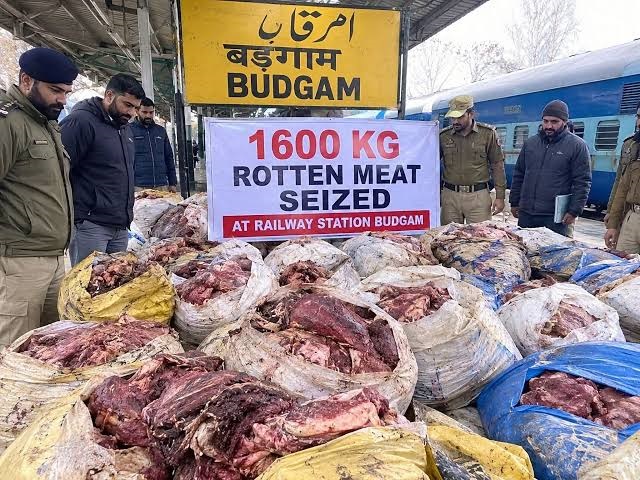
The incident that prompted the MMU’s intervention unfolded at Budgam Railway Station on November 14, when Railway Police and food safety officials intercepted a suspicious consignment of meat transported through railway cargo.
According to reports, the consignment contained approximately 1,600 kg of buffalo meat packed in 44 boxes. Railway Police reportedly became suspicious after noticing blood leaking from the consignment and a foul smell emanating from the boxes.
The meat had reportedly arrived from Delhi in a parcel train and was intended for delivery in the Srinagar area.
Following the alert, officials from the Railway Police, Food Safety Department, Veterinary Department and district administration inspected the consignment. The veterinary examination found the meat deteriorated and unfit for human consumption.
The J&K Food and Drug Administration subsequently confirmed serious violations concerning the declaration, transportation and maintenance of prescribed cold-chain conditions.
According to the administration’s statement, the consignment had not been provided with adequate refrigeration or dry-ice arrangements to maintain the required frozen transportation temperature of minus 18 degrees Celsius or below.
The meat was also subjected to preliminary testing through the Food Safety on Wheels facility, which indicated that it was unsafe for consumption. The entire consignment was seized and destroyed under the applicable provisions of the Food Safety and Standards Act, 2006.
The involvement of multiple agencies is important because the incident was not merely a routine inspection of a retail outlet. It exposed weaknesses that can emerge much earlier in the food supply chain, including sourcing, packaging, transportation, documentation and temperature-controlled storage.
Police have also initiated an investigation to establish the people responsible for transporting and handling the consignment.
However, one distinction deserves attention: the authorities established that the seized meat was unfit for human consumption; that finding alone does not establish that every consignment of buffalo meat entering Kashmir is adulterated or that the meat had already reached consumers. The investigation must establish the source, intended distribution and responsibility of those involved.
The Numbers Reveal a Bigger Food Safety Challenge in Jammu and Kashmir
The Budgam seizure has attracted attention because of its size, but government figures suggest that the problem of unsafe meat is considerably broader than a single incident.
During the February 2026 Budget Session, Health and Medical Education Minister Sakeena Itoo informed the Jammu and Kashmir Legislative Assembly that 12,183.5 kg of rotten meat, valued at approximately Rs 29.19 lakh, had been destroyed across the Union Territory during the 2025-26 financial year up to December 2025.
The minister also reported:
-
1,676 inspections conducted across J&K.
-
Approximately 2,139 kg of meat seized.
-
12,183.5 kg of rotten meat destroyed.
-
144 meat and meat-product samples collected.
-
18 samples reported as non-conforming to prescribed standards.
The distinction between meat seized and meat destroyed matters. These are separate enforcement categories and should not be added together without understanding the underlying records.
The official figures also demonstrate that food safety enforcement is not confined to Kashmir Valley. Srinagar accounted for the largest reported quantity of destroyed rotten meat, followed by Jammu and Kupwara.
A district-wise breakdown published alongside the Assembly response showed:
| District | Rotten meat destroyed |
|---|---|
| Srinagar | 4,220 kg |
| Jammu | 3,881 kg |
| Kupwara | 1,520.5 kg |
| Ganderbal | 770 kg |
| Anantnag | 700 kg |
| Pulwama | 450 kg |
| Budgam | 234 kg |
| Bandipora | 162 kg |
| Baramulla | 125 kg |
| Shopian | 121 kg |
Source: Figures reported from the J&K Government’s Assembly reply for 2025-26 up to December 2025. District figures are reported enforcement totals, not estimates of the total quantity of unsafe meat circulating in each district.
The same Assembly proceedings also highlighted concerns about dairy products. The Health Minister informed the House that approximately 7,665 kg of adulterated or substandard cheese had been seized or destroyed in Jammu and Samba.
These figures provide an important perspective. Food safety concerns extend beyond meat to products that form part of everyday household consumption.
At the same time, the government has maintained that the reported incidents should not be interpreted as proof that food adulteration is widespread across the entire market. The figures represent identified violations and enforcement actions, not the percentage of all food products that are unsafe.
That distinction is essential. The purpose of food safety statistics should be to identify vulnerabilities, improve enforcement and protect consumers, rather than create unnecessary panic.
Why Cold-Chain Violations Can Make Meat Dangerous
One of the most important aspects of the Budgam incident is the reported failure to maintain the required cold chain during transportation.
Meat is a highly perishable food product. Unlike many packaged commodities, it requires carefully controlled temperatures from the point of processing until it reaches the retailer or consumer.
A cold chain is the uninterrupted system of temperature-controlled storage and transportation used to preserve perishable food.
When frozen meat is exposed to unsuitable temperatures, its safety and quality can deteriorate. Bacterial multiplication, spoilage and contamination risks can increase, particularly when temperature control is interrupted for extended periods.
The Food Safety and Standards Authority of India (FSSAI) has prescribed specific requirements for the storage and transportation of meat products.
For frozen meat, the required temperature is generally minus 18 degrees Celsius or below. Chilled meat, by contrast, is subject to a different temperature requirement, generally 4 degrees Celsius or below.
The distinction is important because frozen and chilled products cannot be treated as interchangeable categories.
In an advisory dated October 15, 2026, the FSSAI specifically reminded food business operators that perishable commodities, including meat, fish, paneer and khoa, must be maintained under prescribed temperature conditions throughout the supply chain.
The advisory also emphasised:
-
Transportation in clean, covered and hygienic vehicles or conveyances.
-
Use of appropriate food-grade packaging.
-
Protection against dust, moisture, pests and cross-contamination.
-
Maintenance of prescribed temperatures during storage and transportation.
-
Proper documentation and traceability of consignments.
The Budgam incident brings these requirements into sharper focus.
A food product may originate from an authorised supplier, but that alone does not guarantee its safety when transportation and storage conditions are compromised. Every link in the supply chain must meet the required standards.
For consumers, this means that food safety cannot be judged simply by appearance, price or the reputation of a shop. Regulatory checks, traceability and proper handling are equally important.
MMU’s Intervention: Bringing Islamic Teachings into the Food Safety Debate
The MMU’s decision to address food adulteration through Friday sermons gives the issue a wider social dimension.
The organisation, headed by Mirwaiz Umar Farooq, brings together religious bodies and clerical representatives from Jammu and Kashmir. Its proposed common Khutbah is intended to communicate a shared message on a matter that affects households irrespective of their economic position or social background.
The consultative meeting at the Auqaf Office of Jamia Masjid brought together religious scholars and representatives who deliberated on the sermon.
The theme, “Food Adulteration, Moral Decline and Collective Responsibility”, reflects an approach that treats unsafe food not merely as a regulatory violation but also as an ethical failure.
Under Islamic teachings, honesty in trade, fair measurement, fulfilling contractual obligations and avoiding harm to others are important moral principles.
The sale of unsafe food directly challenges these principles.
A trader who knowingly sells spoiled meat or conceals the condition of a product does more than violate a commercial regulation. Such conduct can expose families to health risks while undermining the trust on which everyday business depends.
Similarly, consumers have a responsibility to avoid knowingly purchasing or distributing unsafe products and to report suspicious practices through appropriate channels.
The proposed sermon is therefore expected to emphasise five interconnected responsibilities:
-
Public awareness: Educating consumers about unsafe food, proper handling and responsible purchasing.
-
Ethical business practices: Encouraging honesty, transparency and accountability among traders.
-
Government responsibility: Demanding effective inspection, monitoring and enforcement.
-
Community participation: Encouraging people to report suspected violations instead of remaining silent.
-
Collective accountability: Recognising that food safety requires cooperation between authorities, traders, suppliers and consumers.
This is where the religious intervention could have an impact beyond the immediate controversy. Religious institutions have established communication networks within communities, and Friday sermons provide an opportunity to discuss issues affecting everyday life.
Food Adulteration Is Not Just About Rotten Meat
There is a tendency to associate food adulteration exclusively with spoiled meat, but the problem is much wider.
Food safety violations can involve the use of prohibited substances, contamination, misleading labels, improper storage, expired products, unauthorised additives and the substitution of cheaper ingredients for declared products.
These practices can affect meat, dairy products, edible oils, spices, sweets, packaged foods and other commonly consumed commodities.
In Kashmir, where households depend on local markets, neighbourhood butcher shops and an extensive network of suppliers, confidence in food quality is particularly important.
The problem also has an economic dimension.
Families pay for food with the expectation that what they purchase is genuine, safe and suitable for consumption. When unsafe products enter the market, consumers suffer a financial loss alongside the potential health risks.
Small businesses and legitimate traders also face consequences. A major food safety controversy can damage consumer confidence across an entire market, including businesses that follow proper hygiene and storage practices.
This is why enforcement must distinguish between responsible traders and deliberate violators.
Punishing genuine violations is necessary, but blanket suspicion against an entire trade can create unnecessary economic disruption.
A transparent regulatory system must protect consumers without unfairly damaging honest businesses.
Government Accountability: Inspections Must Lead to Lasting Action
The latest incident also raises questions about the effectiveness of existing food safety monitoring systems.
The J&K administration has undertaken enforcement drives and reported substantial quantities of unsafe food being seized and destroyed. These actions demonstrate that regulatory agencies are identifying violations.
However, the real test of enforcement is not simply the quantity of meat destroyed during inspections.
It is whether authorities can prevent unsafe products from entering the supply chain in the first place.
The Budgam seizure raises several practical questions:
-
How was the consignment accepted for railway transportation without adequate cold-chain arrangements?
-
Were the required food safety and veterinary documents available?
-
Who was responsible for sourcing, packaging and transporting the meat?
-
Was the intended destination properly identified?
-
Can the supply chain be traced to establish whether similar consignments were transported earlier?
-
What action will be taken against those found responsible?
These questions require investigation and documentary evidence. They should not be treated as established findings against any individual or business before the authorities complete their inquiry.
The government also needs to strengthen coordination between food safety officials, railway authorities, police, veterinary departments and municipal bodies.
Food safety enforcement should extend from wholesale storage facilities and transportation networks to retail outlets, restaurants and other points of sale.
The MMU’s demand for government accountability is therefore relevant to a wider administrative challenge: ensuring that enforcement is preventive, continuous and measurable rather than limited to action after suspicious consignments are discovered.
The Role of Consumers: Food Safety Cannot Be Left to Inspectors Alone
While the responsibility for enforcing food safety regulations rests with the government, consumers also have an important role in preventing unsafe products from entering their homes.
People purchasing meat and other perishable products should pay attention to basic indicators of quality and hygiene.
Some practical precautions include:
-
Purchase meat from authorised and hygienic establishments.
-
Check whether frozen products are stored under appropriate refrigeration conditions.
-
Avoid products with unusual odours, discolouration or damaged packaging.
-
Check labelling, expiry dates and storage instructions on packaged food.
-
Avoid purchasing meat from unverified suppliers or suspiciously cheap sources.
-
Report suspected cases of unsafe food to the Food Safety Department.
The J&K FDA has also urged consumers to report the sale and distribution of unsafe food products through its official complaint channel, cfsjandk.fnd@jk.gov.in.
However, consumer awareness must complement, not replace, regulatory enforcement. An ordinary buyer cannot be expected to identify every form of contamination or determine whether a commercial cold chain has been maintained throughout transportation.
That responsibility remains with licensed food businesses and the regulatory authorities.
A Friday Sermon That Could Start a Wider Conversation
The MMU’s decision to take up food adulteration across mosques in Jammu, Kashmir and Ladakh is significant because it recognises that some of the most pressing public concerns cannot be addressed through government orders alone.
Food is a daily necessity. Every household, regardless of income, depends on the market for products that are safe to consume.
When that basic trust is threatened, the consequences extend beyond individual consumers. They affect public health, commercial relationships, the credibility of regulatory institutions and the reputation of legitimate businesses.
The proposed Friday Khutbah offers religious leaders an opportunity to reinforce a simple but important message: earning a livelihood cannot come at the cost of another person’s health.
But the impact of the initiative will ultimately depend on what follows the sermon.
Will traders adopt better practices? Will consumers become more vigilant? Will the government strengthen inspections and supply-chain monitoring? And will those responsible for transporting unsafe food face appropriate legal consequences?
These are the questions that matter beyond November 20.
The 1,600 kg meat seizure at Budgam Railway Station may have prevented a dangerous consignment from entering the consumer market, but it has also exposed vulnerabilities that require sustained attention.
The real measure of success will not be how many people hear the sermon on Friday. It will be whether the message translates into safer markets, more responsible businesses and stronger protection for consumers across Jammu and Kashmir and Ladakh.