Srinagar Martyrs’ Graveyard Sealed on July 13: Omar Abdullah Says Curbs Contradict ‘Normalcy’ Claims
By: Javid Amin | 13 July 2026
Security barricades around Naqshband Sahib prevent political leaders and citizens from paying tribute, triggering a fresh political controversy in Jammu and Kashmir
A fresh political controversy unfolded in Srinagar on July 13, 2026, after authorities imposed strict security restrictions around the Martyrs’ Graveyard at Naqshband Sahib, preventing political leaders, party workers and members of the public from offering tributes on Martyrs’ Day.
Barricades, checkpoints and heavy deployment of police and paramilitary personnel effectively sealed access to the historic graveyard, where the 22 Kashmiris killed on July 13, 1931, are buried. The restrictions sparked criticism from opposition parties, particularly the National Conference (NC), which accused the administration of curtailing democratic rights and attempting to erase an important chapter of Kashmir’s political history.
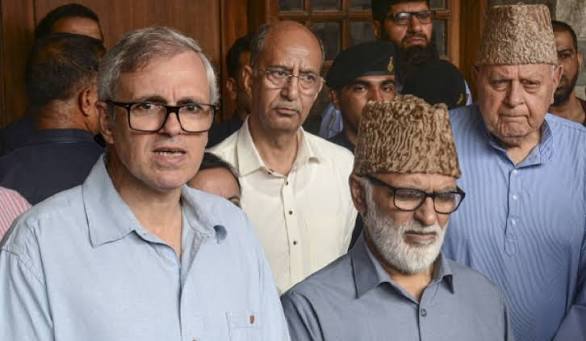
Jammu and Kashmir Chief Minister Omar Abdullah described the denial of access as evidence that official claims of “normalcy” in the Union Territory do not match the reality on the ground.
Authorities Tighten Security Around Naqshband Sahib
From the early hours of July 13, security forces established multiple layers of barricades leading to the Martyrs’ Graveyard in Srinagar’s old city.
Roads leading to the cemetery were either blocked or heavily regulated, while police personnel monitored movement in the surrounding areas. Political delegations attempting to reach the site were stopped, and entry for the general public was also restricted.
Officials maintained that the security arrangements were aimed at preserving law and order and preventing any untoward incident during a politically sensitive anniversary.
Such restrictions have become increasingly common in recent years as authorities seek to prevent large political gatherings linked to contentious historical commemorations.
Omar Abdullah: ‘This Is Not Normalcy’
Reacting to the restrictions, Omar Abdullah launched a sharp criticism of the administration, arguing that preventing people from paying respects to the 1931 martyrs contradicts repeated official assertions that Jammu and Kashmir has returned to normal after the constitutional changes of August 2019.
According to Omar Abdullah, if the situation were truly normal, citizens and elected representatives would be allowed to peacefully visit the graveyard and offer prayers without extraordinary security restrictions.
He argued that commemorating historical events is a democratic exercise and should not be viewed as a law-and-order challenge in itself.
His remarks quickly became one of the dominant political narratives surrounding this year’s observance of Martyrs’ Day.
Why July 13 Remains Politically Significant
July 13 commemorates the 1931 killings outside the Central Jail in Srinagar, where 22 protesters were killed during demonstrations against the administration of the then Dogra Maharaja.
For decades, the day was officially observed in the erstwhile State of Jammu and Kashmir as Martyrs’ Day, with government functions, floral tributes and official participation by political leaders.
Following the 2019 reorganisation of Jammu and Kashmir and the abrogation of Article 370, July 13 was removed from the list of official public holidays by the Union Territory administration. Since then, official commemorations have ceased, while political parties—particularly the National Conference and the People’s Democratic Party (PDP)—have continued to describe the day as an important part of Kashmir’s political and historical memory.
The interpretation of the 1931 events remains contested in contemporary politics. Supporters regard those killed as martyrs in the struggle for political rights, while some others question the legacy and significance attached to the events. This difference in historical interpretation continues to influence political debates in the region.
Security Versus Democratic Space
The restrictions have once again highlighted the recurring debate between security management and democratic freedoms in Jammu and Kashmir.
The administration’s position has generally been that preventive measures are necessary whenever intelligence inputs indicate the possibility of unrest or public disorder.
Opposition parties, however, argue that peaceful commemorative gatherings should be facilitated rather than restricted, particularly when they involve elected representatives and citizens wishing to pay tribute.
This contrast in perspectives has become a defining feature of Kashmir’s political landscape in the post-2019 period.
Political Reactions Intensify
The National Conference described the restrictions as inconsistent with democratic values and argued that preventing peaceful homage sends the wrong political message.
Leaders from other regional parties also criticised the restrictions, maintaining that historical remembrance should not become a security issue.
The Bharatiya Janata Party (BJP) and the administration have consistently maintained that security decisions are taken on the basis of law-and-order assessments and are not intended to prevent legitimate political expression.
As in previous years, the issue quickly moved beyond the cemetery itself and became part of the broader political debate over governance, civil liberties and public space in Jammu and Kashmir.
Impact on the ‘Normalcy’ Narrative
One of the most significant political consequences of the restrictions is their impact on the ongoing debate over normalcy in Jammu and Kashmir.
Since 2019, the Union Government has highlighted improvements in security, tourism, infrastructure, investment and electoral participation as indicators that conditions in the region have stabilised.
Opposition leaders argue that restrictions on political activities, public commemorations and movement present a different picture.
Omar Abdullah’s remarks were aimed directly at this contradiction, suggesting that visible security barricades around a historic graveyard undermine claims that democratic life has fully returned to normal.
Public Sentiment and Historical Memory
For many Kashmiris, July 13 is not merely a date on the calendar but a symbol of political identity and historical memory.
Families, civil society members and political workers have traditionally visited the Martyrs’ Graveyard to offer prayers and pay respects.
The inability to do so has generated disappointment among sections of the public who view the restrictions as limiting the space for peaceful remembrance.
At the same time, differing interpretations of the 1931 events mean that public opinion remains divided, reflecting the broader political diversity within Jammu and Kashmir.
Media Spotlight on Security Restrictions
Images of barricaded roads, security checkpoints and political leaders being prevented from reaching the graveyard attracted widespread attention across national and regional media.
The visuals reinforced the symbolic significance of the day’s events and ensured that the debate extended beyond Srinagar into the national political discourse.
For the opposition, these images became evidence supporting their criticism of the government’s handling of political expression.
For the administration, the measures were presented as precautionary steps designed to maintain public order.
Challenges Ahead
Balancing Security and Civil Liberties
Authorities continue to face the challenge of maintaining public order while allowing democratic and cultural expression in a politically sensitive region.
Managing Historical Narratives
The competing interpretations of the July 13, 1931 events ensure that Martyrs’ Day will remain a politically charged occasion, requiring careful handling by both the administration and political parties.
Political Polarisation
The controversy is likely to deepen existing political divisions, with regional parties and the BJP continuing to present sharply different narratives regarding governance, history and constitutional rights.
The Road Ahead
The events surrounding July 13, 2026, demonstrate that questions of history, identity and democratic participation remain deeply intertwined in Jammu and Kashmir’s political landscape.
For Omar Abdullah and the National Conference, the denial of access to the Martyrs’ Graveyard has become a symbol of what they describe as shrinking democratic space and an inconsistency in official claims of normalcy.
For the administration, the restrictions reflect a security-first approach intended to prevent potential disturbances on a politically sensitive anniversary.
As Jammu and Kashmir continues to navigate its post-2019 political trajectory, commemorative events such as Martyrs’ Day are likely to remain flashpoints where questions of security, historical memory and democratic freedoms intersect, ensuring that the debate over the region’s political future remains firmly in the public spotlight.