Green Corridor for Fruit Trucks: Why Kashmir’s Apple Economy Is Racing Against the Clock
By: Javid Amin | 03 Aug 2026
Every August, thousands of trucks loaded with fresh apples, pears and plums begin the long haul from Kashmir’s orchards to markets across India. This year, that journey is once again running into landslides, security convoys and highway shutdowns — and the Valley’s traders are asking for a fix that’s been talked about for years but never fully delivered: a dedicated green corridor.
There’s a rhythm to August in Kashmir that has nothing to do with tourism or politics. It’s harvest rhythm — trucks queuing outside Sopore’s sprawling fruit mandi before dawn, orchard owners in Shopian and Pulwama racing to pick Gala apples before they overripen, and transporters doing mental math on how many hours a box of pears can survive in a stalled truck before it starts losing value. This year, that math isn’t working out, and the Kashmir Chamber of Commerce and Industry has decided to say so loudly.
The Demand: A True Green Corridor, Not Just Good Intentions
The call, echoed by chamber leaders and horticulture bodies alike, is straightforward: treat perishable fruit cargo the way emergency medical transport is treated — with guaranteed, uninterrupted passage. Sheikh Ashiq Ahmad, a senior chamber voice and former KCCI president, has publicly urged the administration to prioritise fruit trucks on the Srinagar-Jammu highway through dedicated corridors, ensure round-the-clock clearance at checkpoints, and cut down on unnecessary halts. His appeal also pushes for something traders say has been missing for years — real-time updates during weather disruptions so transporters can actually plan alternate routes instead of finding out about a closure only after their trucks are already stuck on the road.
It’s a simple ask on paper. In practice, it means rethinking how one of India’s most strategically sensitive highways shares space between pilgrims, security convoys, ordinary commuters, and a harvest season that waits for no one.
Why August Matters So Much
Timing is everything in this story. August is when early apple varieties, along with plums and pears, hit peak dispatch volume from Kashmir’s three biggest fruit belts — Sopore, Shopian, and Pulwama. Sopore’s mandi alone, widely regarded as Asia’s largest fruit market, sends out dozens of truckloads daily during this window, and that volume only climbs as the season progresses.
These aren’t hardy, shelf-stable goods. Early-season varieties like Gala apples and plums have a short window before quality — and therefore price — starts falling. A truck that sails through in 20 hours delivers fruit at full value; the same truck stuck for three extra days delivers fruit that mandis outside the Valley will pay noticeably less for, if they’ll take it at all. For growers already operating on thin margins, that difference isn’t trivial — it’s the line between a profitable season and a loss-making one.
The Bottleneck: What’s Actually Slowing the Trucks Down
The Jammu-Srinagar National Highway — the only all-weather road connecting the Valley to the rest of the country — is under strain from multiple directions at once this season, and horticulture stakeholders have been vocal about all of them:
- Landslides and shooting stones. Heavy monsoon rain has repeatedly triggered slope failures along the vulnerable Ramban-Banihal-Udhampur stretch, in one recent instance stranding roughly 1,700 trucks near Udhampur after a fresh landslide, with priority clearance going first to passenger vehicles.
- The Amarnath Yatra. With the annual pilgrimage in full swing, convoys of pilgrim vehicles are given first-priority passage on safety grounds — a necessary precaution, but one that routinely eats into the movement windows available for goods traffic.
- Planned maintenance work. NHAI has also been carrying out slope-widening and debris-clearance work on sensitive stretches, at times closing the highway entirely for what officials call a “traffic dry day” — timing that growers and transporters say keeps colliding, year after year, with the exact weeks their harvest needs to move.
- Security-related halts. Fruit associations in Sopore have separately flagged trucks being stopped at multiple points along the highway for security clearances tied to the Yatra, adding further unpredictability to already tight delivery schedules.
Layer these on top of each other, and a route that should ideally move fruit within a day or two can stretch into a multi-day ordeal — exactly the kind of delay perishable produce cannot absorb.
The Cost of Getting This Wrong: Last Year’s Warning Sign
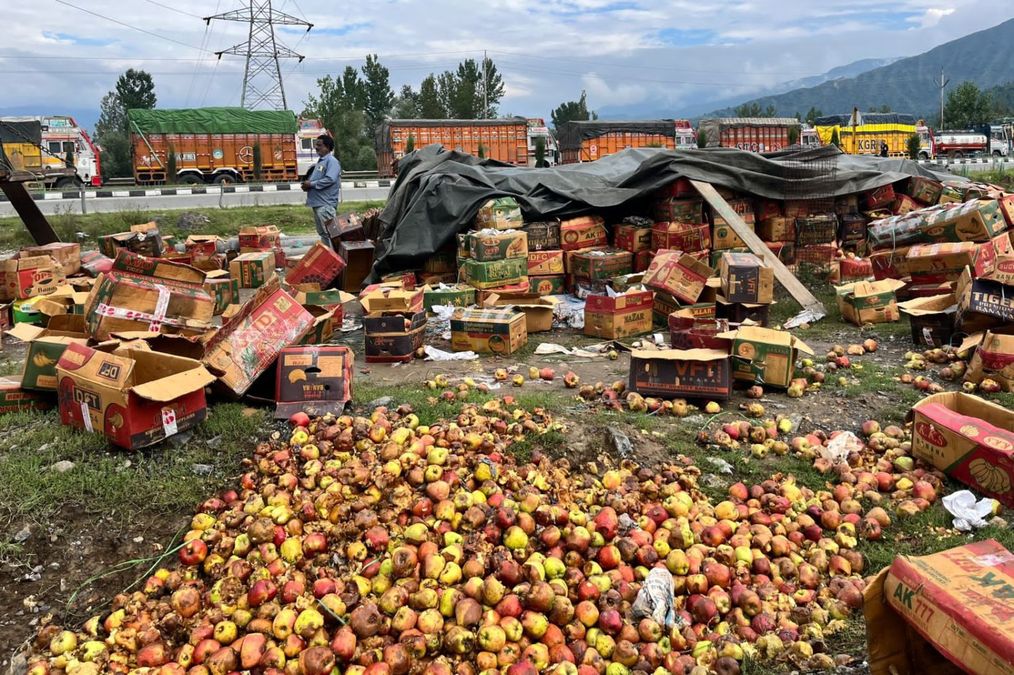
This isn’t a hypothetical worry. Kashmir’s trade bodies point to last year’s harvest season as a cautionary tale: a highway closure that stretched past 20 days left hundreds of fruit-laden trucks stranded, threw the horticulture sector into disarray, and produced estimated losses exceeding ₹1,000 crore, according to KCCI’s own leadership at the time. Fruit that rotted or was damaged during that stranding fetched far lower prices in outside mandis — assuming it could still be sold at all.
That episode looms large over this year’s appeals. Political leaders who visited stranded truckers this season referenced it directly, with one pointing out that growers’ apples rotted on the highway for a full month the previous year and questioning why maintenance work keeps landing during peak harvest weeks rather than before or after the season.
The Numbers Behind the Urgency
The scale of what’s at stake is worth spelling out. Kashmir’s apple industry alone supports livelihoods for lakhs of families and contributes close to ₹12,000 crore annually to Jammu and Kashmir’s economy — nearly all of it dependent on this single highway to reach wholesale markets in Delhi, Punjab, Haryana, Uttar Pradesh and beyond. There is no meaningful alternate route. Rail links remain limited for this kind of bulk perishable freight, and air freight is neither scalable nor affordable for an industry moving fruit by the truckload, not the crate.
That single-corridor dependency is precisely why traders argue this deserves emergency-style treatment, not routine traffic management. A missed day on this highway during harvest season doesn’t just delay a delivery — it can wipe out a grower’s margin for that batch entirely.
What’s Already Being Done — and Why Traders Say It’s Not Enough
To be fair to the administration, this year hasn’t been a story of total inaction. The Divisional Commissioner of Kashmir has issued a formal advisory directing traffic police to earmark a dedicated five-kilometre stretch between Levdoora and the Navyug Tunnel specifically for parking fruit and vegetable-laden trucks, allowing them to be identified and released as priority cargo once the daily Yatra convoy has passed. Under this arrangement, growers and transporters are asked to load and park at the designated site by 9 am, positioning their trucks to move as soon as the window opens. The advisory explicitly acknowledges that agriculture and horticulture are critical to the region’s economy and states the administration’s commitment to supporting growers.
It’s a genuine step — but it’s also, by design, a second-priority arrangement. Pilgrim convoys still move first; fruit and vegetable trucks follow. For a highway already squeezed by landslides and maintenance closures, that ordering means perishable cargo is often working with whatever time window is left over, rather than a guaranteed corridor of its own. That gap between “priority after the convoy passes” and “true green corridor, uninterrupted” is exactly what KCCI and horticulture bodies are now pushing to close.
Voices From the Ground
What comes through clearly in on-record statements from traders, transporters and drivers this season is a shared sense that the system asks perishable cargo to absorb risks that other sectors don’t have to. Drivers stranded during highway closures have pointed out that maintenance work seems to recur during the exact weeks apple season peaks, arguing it could just as easily be scheduled before or after the harvest window. Sopore’s fruit trade leadership has separately flagged security-related halts as adding an extra, unpredictable layer of delay on top of weather and infrastructure disruptions that growers already have to plan around.
The common thread in nearly every account: nobody is arguing against highway maintenance or the Yatra’s security needs. The ask is coordination — enough advance notice and enough of a protected window that a season’s worth of orchard labour doesn’t rot on a mountain road because two unrelated priorities happened to collide.
What a Real Green Corridor Would Need to Look Like
Based on what growers, traders and transporters have been asking for across multiple statements this season, a workable green corridor for Kashmir’s fruit economy would likely need to combine a few elements:
- Guaranteed daily movement windows for perishable cargo that don’t depend entirely on what’s left over after pilgrim convoys and maintenance work are accommodated.
- Real-time, reliable communication — official advisories issued early enough that transporters can genuinely reroute or reschedule, rather than finding trucks already queued when a closure is announced.
- Season-aware maintenance scheduling — shifting major NHAI restoration work, where feasible, outside the peak dispatch weeks of August and September.
- Formal recognition of perishable freight as priority cargo, similar in spirit to how ambulances and emergency vehicles are treated, rather than as ordinary goods traffic competing for the same lane space as everything else.
The Bigger Picture
This story isn’t really about traffic management — it’s about how much of Kashmir’s real economy still runs through a single, 250-kilometre mountain highway that also happens to carry one of India’s largest annual pilgrimages and sits in one of the country’s most landslide-prone terrains. Every stakeholder in this debate — growers, transporters, chamber leaders, and even the administration’s own advisories — agrees on the underlying problem. Where they differ is on how far the current arrangement of “priority after the convoy” needs to go before it becomes the genuine, guaranteed green corridor that traders say the harvest season demands.
If the administration does eventually move from a designated parking stretch to a fully protected, round-the-clock corridor for perishable cargo, it wouldn’t just resolve one season’s anxiety — it could become a template other fruit- and vegetable-growing regions across India’s hill states study closely. For now, though, growers in Sopore, Shopian and Pulwama are doing what they do every August: picking fast, loading fast, and hoping the road cooperates just long enough for this year’s harvest to reach the market fresh.
This report draws on statements and on-ground reporting from Kashmir-based outlets including Greater Kashmir, Rising Kashmir, Kashmir Reader, Kashmir Vision, Kashmir Images, and Deccan Herald, along with advisories from the Divisional Commissioner Kashmir and updates from the National Highways Authority of India (NHAI). Figures on economic losses and industry value are as cited by Kashmir Chamber of Commerce and Industry (KCCI) leadership and industry stakeholders; readers should treat them as trade-body estimates pending official confirmation.