Kashmir Cloudbursts Trigger Flash Floods: Shopian, Pahalgam, Lolab Hit by Intense Rain
By: News Desk | 03 Aug 2026
Kashmir Under a Fresh Weather Assault
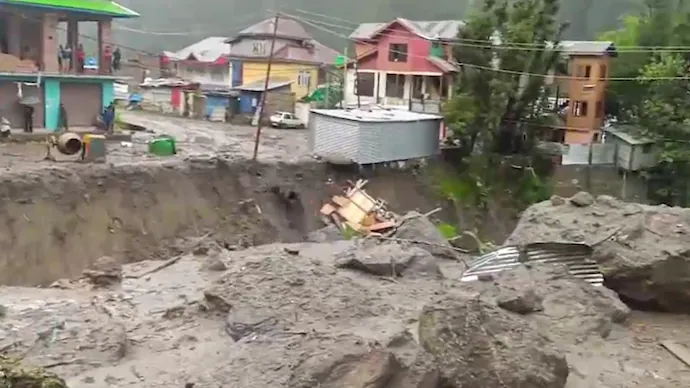
Kashmir witnessed a fresh spell of extreme weather on Monday, August 3, as multiple cloudbursts, intense localised rainfall and flash floods struck several parts of the Valley, inundating homes, damaging infrastructure and disrupting normal life.
From Shopian in south Kashmir to Pahalgam in Anantnag and Lolab in north Kashmir’s Kupwara district, sudden surges of water turned streams and waterways into dangerous torrents within minutes.
The most tragic incident was reported from Lolab, where a 50-year-old woman died after a cloudburst accompanied by severe hailstorm triggered flash floods in the Hamli Warnow area, according to local reports.
In Shopian, Badrhama village was inundated following what local reports described as the third consecutive cloudburst in three days, highlighting the extraordinary intensity and repeated nature of the weather disturbances affecting parts of south Kashmir.
Meanwhile, the Pahalgam region once again experienced the destructive force of sudden rainfall and overflowing streams. Earlier flooding in Awoora and nearby areas had already inundated hotels and houses and forced the evacuation of tourists. Fresh reports from August 3 indicated cloudburst activity affecting Batkoot and Awoora and triggering flash floods.
The sequence has renewed concerns over Kashmir’s growing exposure to short-duration, high-intensity rainfall events, particularly in mountainous areas where steep slopes, narrow valleys and rapidly swelling streams leave communities with little time to react.
Shopian Faces Repeated Cloudburst Threat
The situation in Shopian has emerged as one of the most worrying developments in the latest weather episode.
Badrhama village was inundated after a third consecutive cloudburst was reported in the area within three days. The repeated downpours have created a dangerous cycle in which already saturated ground and drainage systems face fresh surges of water.
When intense rain falls repeatedly over a short period, the ground’s ability to absorb additional water decreases. Streams rise rapidly, drainage channels become overwhelmed and runoff from higher elevations moves towards settlements at considerable speed.
For villages located near natural waterways, the difference between heavy rain and a flash flood can be measured in minutes.
The Shopian episode therefore carries a wider warning for the Valley.
It demonstrates that the danger is not limited to one isolated cloudburst.
Repeated extreme rainfall over the same catchment can significantly magnify the consequences.
Residents in affected areas have reported flooding of homes and disruption to normal life, while local administration and response agencies have been monitoring the situation.
The full extent of agricultural and infrastructure damage is still being assessed.
Pahalgam’s Vulnerable Villages Again in the Path of Flash Floods
The Pahalgam region has experienced several episodes of intense rainfall and flash flooding during the current summer season.
On July 11, a sudden cloudburst in the Awoora and Dehwathu forest areas triggered flash flooding in a stream, inundating several hotels and houses. Tourists staying in affected properties were evacuated and moved to safer locations, with no casualties reported in that incident.
The damage was reportedly more extensive than initial accounts suggested. A subsequent report described damage to hotels, huts, roads, power infrastructure and agricultural fields along the Overa stream, with around 11 villages reportedly affected.
Fresh cloudburst activity reported on August 3 in Batkoot and Awoora has now added to concerns about the vulnerability of communities living around streams and mountain waterways in the wider Pahalgam belt.
The repeated flooding is particularly significant for a region that is also one of Kashmir’s most important tourism destinations.
Pahalgam’s tourism economy depends heavily on road connectivity, hotels, guesthouses, transport services, pony operators, restaurants and local businesses.
When flash floods damage roads or disrupt electricity and water supply, the impact extends beyond immediate physical damage.
It can quickly affect:
- Tourist movement
- Hotel bookings
- Local transportation
- Agricultural activity
- Road connectivity
- Power supply
- Drinking water systems
- Small businesses dependent on tourism
This is why flood resilience in Pahalgam must be viewed as both a disaster-management issue and an economic priority.
Lolab Cloudburst Turns Deadly
The most serious human tragedy in the latest spell was reported from Lolab in Kupwara district.
According to reports, a 50-year-old woman lost her life in Hamli Warnow after a cloudburst accompanied by a severe hailstorm triggered flash floods.
The incident serves as a painful reminder of the speed at which mountain flash floods can develop.
Unlike conventional river floods, which may provide hours or even days of warning as water levels gradually rise, flash floods can occur suddenly after intense rainfall in upper catchments.
The rain may fall several kilometres away from the settlement.
But the resulting floodwater can race downstream through a narrow stream or nallah, carrying mud, rocks, branches and other debris.
By the time residents realise what is happening, escape routes may already be compromised.
The loss of life in Lolab therefore underlines the need for:
- Better localised weather monitoring
- Faster early-warning mechanisms
- Community-level emergency communication
- Identification of high-risk stream corridors
- Regular clearance of vulnerable drainage channels
- Safer evacuation routes
- Greater public awareness about flash-flood behaviour
The tragedy also reinforces a key point: a weather warning is useful only when it reaches people in time and when communities know what action to take.
Why Cloudbursts Are So Dangerous in Kashmir
A cloudburst is generally understood as an exceptionally intense and highly localised rainfall event, typically involving very heavy precipitation over a short period.
In Kashmir’s mountainous terrain, the consequences can be particularly severe.
The geography itself creates a natural risk multiplier.
Steep slopes allow rainwater to run downhill rapidly. Narrow valleys concentrate the flow. Streams and nallahs can rise almost instantly. Loose soil, rocks and debris can be swept into the water, turning a flash flood into a destructive wall of mud and debris.
The danger becomes greater when:
- Rainfall is concentrated over a small area
- The ground is already saturated
- Streams are blocked or constricted
- Houses are built close to waterways
- Roads cut across natural drainage routes
- Slopes are unstable
- Early warnings do not reach vulnerable communities
This is why a cloudburst that affects a relatively small geographical area can still cause enormous local damage.
The latest incidents across Shopian, Anantnag and Kupwara demonstrate precisely this pattern.
Is Climate Change Making Kashmir’s Rainfall More Extreme?
The latest weather events have inevitably renewed the debate over climate change.
However, it is important to distinguish between individual weather events and long-term climate trends.
It would be scientifically premature to attribute every cloudburst directly to climate change without event-specific attribution studies.
At the same time, climate scientists have warned that a warming atmosphere can influence the intensity and distribution of extreme precipitation. Warmer air can hold more moisture, potentially increasing the intensity of rainfall when conditions trigger precipitation.
For Kashmir, this raises an important planning challenge.
Even if it is impossible to predict exactly where the next cloudburst will occur, authorities can prepare for a future in which extreme rainfall events pose a greater risk to settlements, roads, agriculture and tourism infrastructure.
That means climate resilience must become part of mainstream development planning.
Agriculture Faces a Double Threat
The agricultural economy of Kashmir is particularly vulnerable to sudden extreme weather.
The Valley’s farmers depend on relatively predictable seasonal conditions for paddy cultivation, horticulture and other agricultural activities.
But intense rainfall can cause damage in several ways.
Standing crops can be submerged.
Topsoil can be washed away.
Orchards can suffer from waterlogging and erosion.
Livestock can become vulnerable when shelters are flooded.
Road closures can prevent farmers from transporting produce to markets.
For horticulture-dependent areas, the economic impact can extend well beyond the immediate weather event.
A single extreme rainfall episode may damage not only the current crop but also soil quality, irrigation infrastructure and orchard land.
The repeated cloudbursts reported in parts of south Kashmir therefore deserve close monitoring from both disaster-management and agricultural authorities.
A comprehensive damage assessment will be necessary once floodwaters recede.
Tourism Again Finds Itself on the Front Line
Kashmir’s tourism sector is another major casualty whenever extreme weather strikes.
Pahalgam’s recent experience demonstrates the vulnerability of tourism infrastructure built close to streams and natural drainage corridors.
Hotels and houses were inundated during the July cloudburst, while roads and other infrastructure were damaged in some affected areas. Tourists were evacuated from vulnerable properties and moved to safer locations.
For visitors, the lesson is clear.
Kashmir’s breathtaking mountain landscapes are also dynamic environments.
A clear morning does not guarantee a safe afternoon in the mountains.
Tourists travelling during periods of heavy rainfall should avoid:
- Standing near fast-flowing streams
- Parking vehicles beside rivers or nallahs
- Crossing flooded roads
- Entering narrow mountain valleys during intense rain
- Travelling on vulnerable roads without checking local advisories
Tourism authorities and hotel operators also need to strengthen emergency evacuation protocols in flood-prone locations.
The Hidden Risk: Roads, Bridges and Drainage
The visible damage caused by flash floods is only part of the story.
The larger risk lies in infrastructure.
Mountain roads are particularly vulnerable to:
- Landslides
- Road washouts
- Culvert blockages
- Bridge damage
- Slope failures
- Falling boulders
- Flooding of low-lying stretches
When a road is blocked, entire communities can become temporarily isolated.
For Kashmir, where many villages depend on a limited number of road corridors, even a relatively small landslide can create major disruption.
Drainage is another critical issue.
Urban expansion without adequate stormwater infrastructure can transform heavy rainfall into serious waterlogging.
In rural areas, the encroachment or narrowing of natural drainage channels can similarly increase flood risk.
The latest incidents should therefore trigger a wider review of drainage and flood pathways—not just emergency relief after each disaster.
The Warning for Jammu Cannot Be Ignored
Reports of expanding cloud formations and unstable atmospheric conditions have also raised concerns about the possibility of intense rainfall and cloudbursts in parts of the Jammu region.
However, such possibilities should not be confused with a confirmed prediction that a cloudburst will occur at a specific location.
Cloudbursts are inherently localised and difficult to predict precisely.
The appropriate response is therefore preparedness rather than panic.
Residents in vulnerable mountainous areas should monitor official weather bulletins and district-level advisories, particularly when heavy rainfall is forecast.
Authorities, meanwhile, should remain prepared for sudden changes in conditions.
Kashmir’s Flood Risk Is Becoming a Governance Challenge
The latest events come against the backdrop of a larger debate about Kashmir’s preparedness for extreme weather.
The Valley has experienced devastating floods before, including the catastrophic 2014 disaster.
But the nature of risk is evolving.
Kashmir now has:
- Greater urbanisation
- More tourism infrastructure
- Expanding road networks
- Increased construction in vulnerable areas
- Higher economic activity
- Growing pressure on wetlands and natural drainage systems
At the same time, extreme rainfall events can overwhelm traditional infrastructure within a very short period.
This means disaster management cannot remain focused only on post-event rescue.
Kashmir needs a stronger prevention and resilience framework.
That should include:
Real-Time Monitoring
More automatic weather stations and hydrological monitoring systems are needed in vulnerable mountain catchments.
Localised Early Warnings
Warnings must reach villages—not just appear on official websites or social media feeds.
Flood-Resilient Infrastructure
Roads, bridges, culverts and drainage systems should be designed with extreme-weather scenarios in mind.
Protection of Natural Drainage
Streams, wetlands and flood channels must not be treated as vacant land available for uncontrolled construction.
Community Preparedness
People living near streams should know where to evacuate and how to respond when water levels rise suddenly.
Better Land-Use Planning
High-risk areas should be identified and mapped before new construction is permitted.
What Residents Should Do During a Cloudburst or Flash-Flood Warning
During intense rainfall, a few basic precautions can save lives.
Avoid Rivers and Streams
Never approach a swollen river or stream to take photographs or assess the water level.
Do Not Cross Flooded Roads
Even shallow-looking water can conceal damaged roads, open drains or strong currents.
Move to Higher Ground
If water begins entering your home or locality, move to a safer and elevated location rather than waiting for the situation to worsen.
Keep Emergency Supplies Ready
Households in vulnerable areas should maintain essential medicines, drinking water, torches, power banks and important documents in waterproof packaging.
Protect Livestock
Farmers should move animals to safer shelters when heavy rainfall is forecast.
Follow Official Alerts
Residents should rely on district administration, police, disaster-management agencies and official weather bulletins rather than unverified social-media claims.
Avoid Unnecessary Mountain Travel
During periods of intense rainfall, travel through vulnerable mountain roads and passes should be avoided unless essential.
The Bigger Question: Is Kashmir Ready for More Extreme Weather?
The latest cloudbursts have once again exposed a difficult reality.
Kashmir’s vulnerability is not limited to one district.
It stretches from the upper mountain catchments to villages, towns and cities downstream.
From Lolab to Shopian and Pahalgam, the geography may differ, but the underlying challenge is similar: intense rainfall can rapidly overwhelm natural and man-made drainage systems.
The death of a woman in Lolab is the most tragic reminder of the human cost.
The repeated flooding in Shopian shows how consecutive extreme events can compound risk.
The situation around Pahalgam highlights the vulnerability of tourism infrastructure and settlements near streams.
Together, these incidents form a pattern that deserves serious attention.
Not every cloudburst can be prevented.
But many of the consequences can be reduced.
Better forecasting can provide precious minutes of warning.
Stronger infrastructure can withstand greater flows.
Protected waterways can carry water more safely.
Well-trained communities can evacuate faster.
And effective land-use planning can prevent people and infrastructure from being placed directly in harm’s way.
Conclusion: Kashmir Needs to Prepare Before the Next Cloudburst
The latest weather episode is a reminder that Kashmir’s relationship with extreme weather is changing.
A cloudburst may last only a short time.
Its consequences can last for months.
Homes can be damaged. Roads can disappear. Crops can be destroyed. Tourism can suffer. And, most painfully, lives can be lost.
The immediate priority must be rescue, relief and accurate assessment of the damage in affected areas.
But once the waters recede, the larger questions must be confronted.
Are vulnerable settlements being mapped?
Are natural drainage channels being protected?
Are roads and bridges being built for future climate risks?
Do communities have reliable early-warning systems?
Are tourism facilities located and operated with adequate flood-risk safeguards?
Kashmir cannot stop every cloudburst.
But it can become better prepared for what follows.
The lesson from Shopian, Pahalgam and Lolab is not simply that the weather has become dangerous.
It is that preparedness, early warning and resilient infrastructure are no longer optional—they are essential to protecting Kashmir’s people, economy and future.