What the Labels Actually Mean: Extraction and Refining Are Different Things
By: News Desk | 11 November 2026
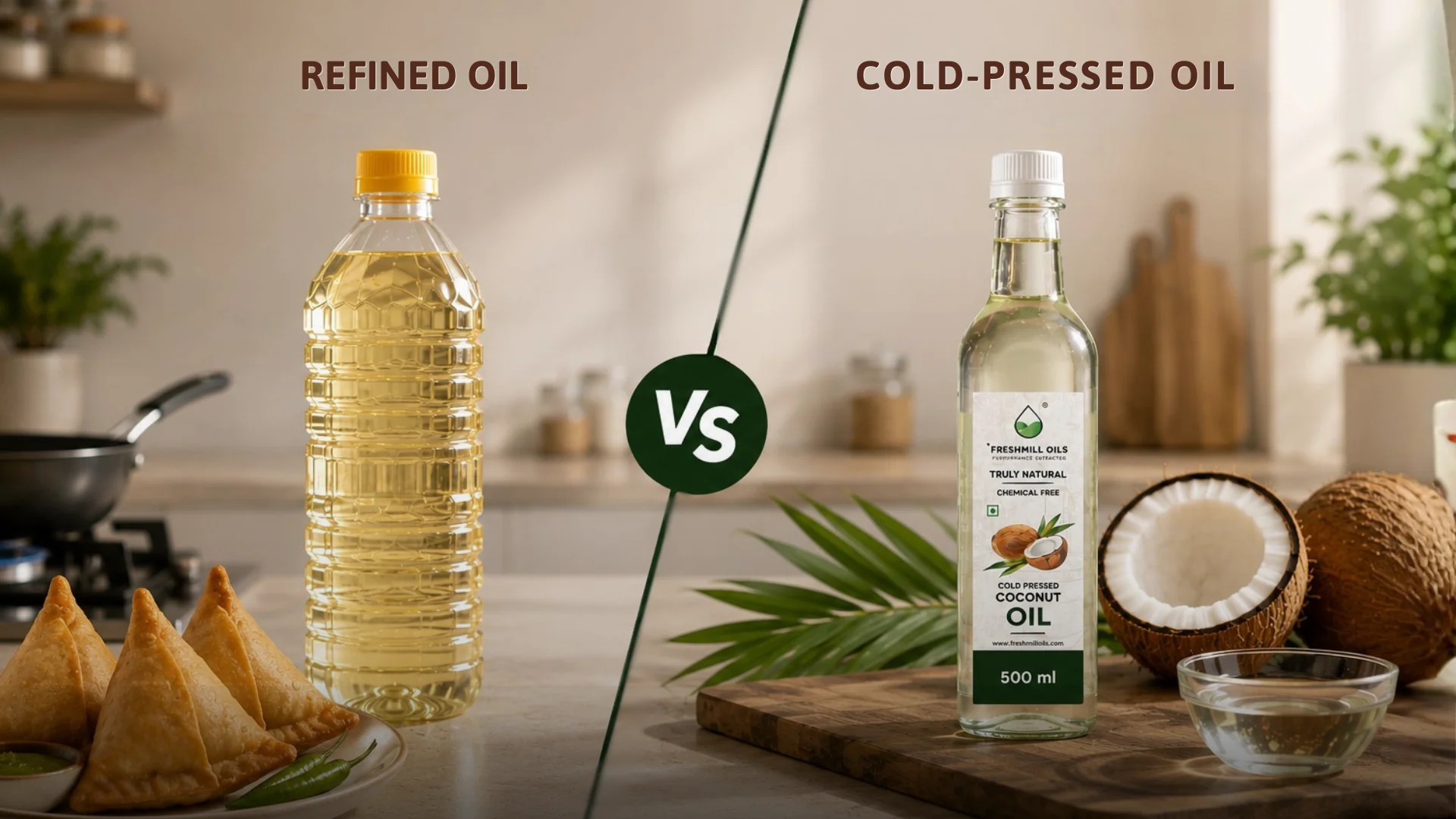
Before deciding which cooking oil is healthier, consumers need to understand an important distinction: oil extraction and oil refining are two different processes.
Extraction refers to how oil is obtained from seeds or other oil-bearing materials. Refining refers to the treatment of crude oil after extraction to improve its quality, stability, appearance and suitability for consumption.
This distinction is often missing from advertisements.
An oil can be extracted mechanically or through solvent extraction and subsequently refined. Therefore, refined oil is not necessarily synonymous with chemically extracted oil.
The three categories need to be understood separately.
1. Refined Oil: Is Industrial Processing Really Bad?
Refined cooking oil is produced through a series of processes designed to remove unwanted substances and make the oil suitable for everyday consumption.
Depending on the source and manufacturing method, refining may involve:
- Degumming: Removes phospholipids and other substances that can affect oil stability.
- Neutralisation: Reduces free fatty acids.
- Bleaching: Uses approved adsorbent materials to remove pigments and certain impurities.
- Deodorisation: Uses steam to remove unwanted odours and flavours.
- Filtration: Removes remaining suspended particles.
These processes produce oil with a more uniform appearance, neutral flavour and generally longer shelf life.
The nutritional question, however, is more complicated.
According to the ICMR-National Institute of Nutrition’s Dietary Guidelines for Indians 2024, refining removes certain undesirable compounds from crude oils. It also removes some naturally occurring minor components, including antioxidants and phytosterols.
Importantly, refining does not necessarily change the basic fatty acid composition of the oil.
This means that the health value of a refined oil still depends considerably on the seed from which it was obtained.
Advantages of refined oil
- Generally more stable during storage.
- Neutral flavour suitable for different cuisines.
- Removes several undesirable compounds present in crude oil.
- Often more affordable and widely available.
- Suitable for many everyday cooking applications when the oil is properly manufactured and used.
Limitations
- Some naturally occurring antioxidants and phytosterols are reduced.
- The original flavour and aroma are largely removed.
- Processing quality and storage conditions matter.
- A refined oil rich in saturated fats does not become heart-friendly simply because it has been refined.
There is also a misconception that solvent-extracted oils necessarily contain dangerous quantities of chemicals.
Indian food safety standards require solvent-extracted mustard oil to undergo refining before human consumption. The prescribed maximum hexane residue in the refined oil is 5 parts per million.
The important issue is whether the product meets applicable safety standards, not whether its manufacturing process sounds industrial.
Refined oil should not automatically be considered unhealthy or unsafe.
2. Cold-Pressed Oil: The Appeal of Traditional Extraction
Cold-pressed oil has gained considerable popularity among health-conscious consumers.
Unlike conventional industrial extraction, genuine cold-pressed oil is obtained through mechanical pressing without the application of heat during extraction.
This helps retain more of the oil’s natural flavour, aroma and certain minor nutritional compounds.
Common varieties include:
- Cold-pressed mustard oil.
- Cold-pressed groundnut oil.
- Cold-pressed sesame oil.
- Cold-pressed coconut oil.
- Cold-pressed sunflower oil.
The biggest attraction is minimal processing.
However, there is an important qualification.
The ICMR-NIN 2024 guidelines explain that cold-pressed oils may retain antioxidants and phytonutrients, but they can also contain undesirable substances found in crude oils.
These may include free fatty acids, gums, waxes, phospholipids and, depending on the raw material and production conditions, pesticide residues and other contaminants.
In other words, less processing preserves certain natural compounds, but it does not automatically guarantee a safer or purer product.
Advantages of cold-pressed oil
- Retains more natural flavour and aroma.
- Preserves certain antioxidants and phytonutrients.
- Mechanical extraction avoids solvent extraction.
- Offers distinctive taste for traditional cooking.
- Provides an alternative to heavily refined products.
Limitations
- Usually more expensive.
- Often has a shorter practical shelf life.
- Quality depends heavily on seed quality and storage.
- Some varieties are less suitable for prolonged high-temperature cooking.
- Unrefined oil can retain undesirable compounds that refining would otherwise remove.
Consumers should therefore look beyond the words cold-pressed and natural.
The quality of the raw material, manufacturing hygiene, filtration, freshness and storage are equally important.
3. Kachi Ghani Mustard Oil: What Makes It Different?
Kachi Ghani is traditionally associated with mustard oil extracted through mechanical crushing.
It has a distinctive pungent aroma and flavour, making it popular in North Indian cooking and several regional cuisines.
Unlike highly refined mustard oil, traditionally extracted Kachi Ghani mustard oil generally retains more of its characteristic pungency and natural flavour compounds.
One particularly important compound is allyl isothiocyanate, which contributes to mustard oil’s sharp smell and taste.
There is also a specific regulatory provision worth knowing.
Under India’s Food Safety and Standards regulations, mustard oil may be labelled Kachi Ghani or Cold Pressed if its natural allyl isothiocyanate content is at least 0.20% by weight.
This is an important distinction because the terms are not simply attractive marketing expressions. They have a defined regulatory condition for mustard oil.
However, meeting this condition does not establish that the oil is nutritionally superior to every refined or other cold-pressed oil.
Advantages of Kachi Ghani mustard oil
- Retains traditional mustard flavour.
- Provides naturally occurring unsaturated fatty acids.
- Contains alpha-linolenic acid, a plant-based omega-3 fatty acid.
- Particularly suitable for recipes where mustard flavour is desirable.
- Offers a less-refined alternative when genuinely produced and properly stored.
Limitations
- Quality varies with mustard seed varieties and manufacturing conditions.
- Strong aroma does not independently establish purity.
- It may contain considerable erucic acid, depending on the mustard variety.
- Unfiltered or poorly stored oil can deteriorate.
- Higher price does not guarantee authenticity.
The last two nutritional considerations deserve particular attention.
Refined vs Cold-Pressed vs Kachi Ghani: A Practical Comparison
| Feature | Refined oil | Cold-pressed oil | Kachi Ghani mustard oil |
|---|---|---|---|
| Extraction | Mechanical or solvent extraction | Mechanical pressing | Traditional mechanical mustard pressing |
| Processing | Extensive refining | Minimal processing | Generally minimally processed |
| Aroma | Usually neutral | Natural aroma retained | Characteristic pungent mustard aroma |
| Antioxidants | Some minor compounds reduced | More natural compounds retained | Natural compounds may be retained |
| Shelf life | Generally longer | Usually shorter | Depends on processing and storage |
| Taste | Neutral | Depends on seed | Strong mustard flavour |
| Main consideration | Fatty acid profile and refining quality | Raw material quality and stability | Authenticity and erucic acid content |
An important point: Cold-pressed and Kachi Ghani are not entirely separate categories. Kachi Ghani is traditionally associated with cold-pressed mustard oil. The distinction is primarily about the particular oil and its extraction tradition.
4. The Biggest Question: Which Cooking Oil Is Actually Healthier?
This is where the discussion needs to move beyond marketing.
Nutrition experts generally place greater importance on the fatty acid composition of an oil than on whether it is refined or unrefined.
Dietary fats are broadly divided into three categories:
Saturated fats (SFA): Found in varying amounts in coconut oil, palm oil, butter, ghee and other fats.
Monounsaturated fats (MUFA): Found in oils such as groundnut and olive oil, as well as mustard oil.
Polyunsaturated fats (PUFA): Include essential omega-3 and omega-6 fatty acids, found in oils such as soybean, sunflower, safflower and mustard.
The body needs dietary fat. It supports cell membranes, hormone production, nutrient absorption and several metabolic functions.
However, the type of fat matters.
The World Health Organization recommends replacing saturated and trans fats with unsaturated fats wherever possible. Its guidance also recommends limiting saturated fat to less than 10% of total daily energy and trans fat to less than 1%.
This is why simply choosing an oil because it is natural or cold-pressed is not enough.
For example, coconut oil is completely natural and can be cold-pressed. Yet it contains a high proportion of saturated fatty acids.
Likewise, mustard oil contains a favourable combination of monounsaturated and polyunsaturated fatty acids, but its erucic acid content introduces another nutritional consideration.
The healthiest choice must therefore consider the complete fatty acid profile.
5. The Mustard Oil Debate: What Consumers Should Know About Erucic Acid
One issue rarely discussed in advertisements for Kachi Ghani mustard oil is erucic acid.
Erucic acid is a naturally occurring monounsaturated fatty acid found in mustard and rapeseed varieties.
Traditional mustard varieties can contain substantial quantities of this fatty acid.
A 2018 study published in Food Chemistry, involving researchers associated with India’s National Institute of Nutrition, examined 320 samples of edible oils and fats. The mustard oil samples analysed contained erucic acid in the range of approximately 48.5% to 54.2% of their fatty acids.
This finding is important because high exposure to erucic acid has raised food-safety concerns.
The European Food Safety Authority (EFSA), in its 2016 scientific assessment, identified the heart as the principal target organ for erucic acid toxicity in animal studies. It established a tolerable daily intake of 7 milligrams per kilogram of body weight per day.
However, this evidence requires careful interpretation.
The EFSA assessment was substantially based on animal studies. Its assessment of human dietary exposure in European populations found average exposures below the established tolerable intake. Those figures cannot automatically be applied to Indian households, where mustard oil consumption patterns may differ.
India’s food safety regulations also recognise a separate category of low-erucic-acid rapeseed or mustard oil, with a maximum erucic acid content of 2% of total fatty acids.
This distinction is particularly relevant to consumers.
A Kachi Ghani label is not the same as a low-erucic-acid certification.
The regulatory condition for using the Kachi Ghani or Cold Pressed description concerns natural allyl isothiocyanate content. It does not establish that the oil is low in erucic acid.
Therefore, it would be incorrect to declare all mustard oil unsafe. Equally, it would be misleading to advertise every traditional mustard oil as universally the healthiest cooking oil.
The sensible approach is moderation, dietary variety and attention to the oil’s actual composition.
6. Does High-Temperature Cooking Destroy the Benefits of Oil?
Another important consideration is how the oil behaves when heated.
Every cooking oil has a different composition and level of oxidative stability.
When oil is exposed to excessive heat, oxygen and prolonged cooking, chemical changes begin to occur.
These include oxidation, hydrolysis and polymerisation.
Such reactions can produce undesirable compounds and gradually reduce the quality of the oil.
The smoke point is commonly used as a measure of cooking suitability. It is the temperature at which oil begins to produce visible smoke.
However, smoke point alone does not tell the complete story.
The oil’s fatty acid composition, free fatty acid content, natural antioxidants, temperature and duration of heating also influence its stability.
A refined oil may perform better in certain high-temperature applications because refining removes free fatty acids and other impurities. But that does not make every refined oil suitable for repeated deep frying.
Similarly, a cold-pressed oil is not automatically suitable for every cooking method.
Practical advice:
- Avoid heating oil until it starts smoking.
- Use oils according to their composition and intended cooking application.
- Avoid prolonged deep frying as a regular cooking habit.
- Do not repeatedly expose the same oil to high temperatures.
- Prefer sautéing, steaming, boiling, grilling and baking more often.
The objective should be to preserve food quality rather than simply chase a high smoke-point number.
7. The Hidden Danger: Repeatedly Reusing Cooking Oil
For many households, the biggest mistake may not be the choice of oil but what happens after frying.
In several Indian kitchens, leftover oil from frying pakoras, samosas, puris and other snacks is stored and reused.
Restaurants and commercial food establishments may also use frying oil repeatedly unless proper monitoring and replacement practices are followed.
This creates a food-safety concern.
Repeated heating causes oxidation and the formation of Total Polar Compounds (TPC). As their concentration increases, the oil becomes progressively unsuitable for consumption.
The Food Safety and Standards Authority of India has prescribed a maximum TPC limit of 25% for used cooking oil. Oil exceeding this limit is not considered safe for human consumption.
FSSAI’s Repurpose Used Cooking Oil (RUCO) initiative aims to prevent degraded cooking oil from re-entering the food chain by promoting its collection and conversion into biodiesel.
The ICMR-NIN 2024 guidelines also address this issue directly.
They advise households to avoid using the same oil for frying again. The guidelines permit filtered leftover frying oil to be used in curry preparation, but recommend consuming it within a day or two rather than storing it for extended periods.
For the safest household practice, avoiding the reuse of frying oil altogether is preferable.
Watch for these warning signs:
- Oil becomes unusually dark.
- Excessive foaming develops.
- Oil becomes thick or sticky.
- It develops an unpleasant or rancid smell.
- It begins smoking at a lower temperature than expected.
These signs indicate deterioration, although their absence does not guarantee that the oil is safe.
Adding fresh oil to old frying oil does not reverse the chemical deterioration that has already occurred.
8. How to Identify Genuine Cooking Oil Before Buying
Consumers often assume that expensive packaging, a traditional-looking bottle or a strong natural aroma guarantees quality.
Unfortunately, none of these is sufficient evidence.
A genuine product should be traceable to its manufacturer and meet the applicable food safety standards.
Here are the checks worth making before purchasing cooking oil.
Check the FSSAI licence
Look for the FSSAI logo and licence or registration number.
Consumers can verify the authenticity and status of food business licences through the official Food Safety Compliance System (FoSCoS).
A printed number should not simply be accepted at face value. Verify that it corresponds to the actual manufacturer or responsible food business.
Check the manufacturer’s details
A properly labelled product should provide identifiable manufacturer or packer information.
Look for:
- Manufacturer’s name and address.
- Brand details.
- FSSAI licence number.
- Batch or lot number.
- Manufacturing or packaging date.
- Best-before information.
- Net quantity.
- Consumer complaint contact details.
Understand the extraction claim
If a product is advertised as cold-pressed, the manufacturer should clearly explain its extraction method.
For Kachi Ghani mustard oil, consumers should look for a traceable product with a clear manufacturing identity.
Vague phrases such as premium natural oil or traditional healthy oil do not establish how the product was actually made.
Do not judge oil by colour
Colour varies naturally according to the seed variety, extraction method, filtration and refining process.
A darker oil is not necessarily purer.
A lighter oil is not necessarily adulterated.
The same applies to cloudiness and sedimentation.
Some less-filtered oils may contain natural suspended material, but sediment is not proof of authenticity or superior nutrition. Excessive suspended matter or separated water should raise concerns about product quality.
Is a strong smell proof of genuine mustard oil?
No.
A characteristic pungent aroma is consistent with mustard oil’s natural compounds, but smell alone cannot establish purity.
An adulterated product can still have a strong smell, while variations in genuine products can occur because of differences in seed varieties and processing.
Be cautious about unusually low prices
Manufacturing costs depend on seed quality, extraction, packaging, distribution and storage.
A product selling far below the prevailing market price deserves closer examination.
However, a low price alone is not proof of adulteration, just as an expensive bottle is not proof of purity.
9. What India’s Food Safety Data Reveals About Cooking Oil Quality
The concern about adulteration is not entirely theoretical.
FSSAI conducted an All-India Edible Oil Survey in August 2020, examining 4,461 samples across the country. The report was published in January 2022 and involved 43 FSSAI-notified laboratories.
The findings provide an important picture of the challenges facing India’s edible oil market.
Among the 4,461 samples:
- Approximately 69.3% complied with the applicable requirements.
- Around 30.7% failed at least one parameter.
- 2.42% failed safety parameters.
- 24.21% failed quality parameters.
- 12.82% failed misbranding or labelling requirements.
These categories overlap and should not be added together.
The survey also found:
- Argemone oil in 15 of the 4,433 samples tested for it, representing 0.34%.
- Ten of those 15 Argemone-related failures involved mustard oil.
- Mineral oil was detected in 25 of the 4,238 samples tested for it.
- Sixty oil samples, or 1.34%, exceeded prescribed lead limits, with the majority of these failures involving mustard oil samples from Jammu and Kashmir.
Argemone oil adulteration is particularly serious. FSSAI has identified its association with epidemic dropsy and other health complications, including eye damage.
However, the figures must be interpreted responsibly.
This was a survey conducted in 2020, not a measurement of current market-wide adulteration in November 2026. The report also acknowledged variations in sample collection and laboratory testing capabilities.
It would therefore be incorrect to suggest that every third bottle of cooking oil currently sold in India is unsafe.
The survey does, however, demonstrate why laboratory testing, accurate labelling, manufacturer traceability and food safety enforcement matter.
FSSAI has continued to call for enforcement action. Its February 2026 advisory, for example, asked state food safety authorities to conduct inspections and sampling of edible oils as part of its festive anti-adulteration drive.
The message is clear: consumer vigilance and regulatory monitoring must go together.
10. Why ‘Cholesterol-Free’ and ‘Heart Healthy’ Can Be Misleading
Cooking oil advertisements frequently use expressions such as:
- Cholesterol-free.
- Heart-friendly.
- Natural.
- Pure.
- Premium.
- Healthy choice.
Some of these descriptions can create an impression of nutritional superiority without providing meaningful information about the product.
For instance, cholesterol is naturally found in animal-source foods. Plant oils do not naturally contain dietary cholesterol.
Therefore, describing an ordinary vegetable oil as cholesterol-free does not make it uniquely healthy.
Similarly, an oil being plant-based does not automatically mean it has a favourable fatty acid profile.
The words natural and organic also do not independently establish purity, freshness or nutritional superiority.
Consumers should focus on the actual oil source, fatty acid composition, food safety compliance and appropriate usage.
Health claims should never replace nutritional information.
11. How Much Cooking Oil Should an Indian Household Use?
Even a nutritionally suitable oil can contribute to excessive calorie intake when consumed in large quantities.
One gram of fat provides approximately nine calories.
This makes portion control an important part of healthy eating.
The ICMR-NIN’s 2024 Dietary Guidelines recommend limiting visible fats according to individual calorie requirements and physical activity.
The suggested range is approximately 20 to 50 grams per person per day, with around 27 to 30 grams for a 2,000-calorie diet.
This is not a universal prescription for every individual. Requirements vary according to age, activity, physiological status and the rest of the diet.
It is also important to remember that visible fats include cooking oils and added fats such as ghee and butter. Fats naturally present in nuts, seeds, pulses, cereals and other foods contribute to overall intake as well.
A practical household approach would include:
- Measuring cooking oil rather than pouring it freely.
- Avoiding excessive deep-fried food.
- Including nuts and seeds in the diet.
- Using a variety of nutritious food sources.
- Limiting foods containing industrial trans fats.
- Avoiding excessive consumption of ghee, butter and saturated fats.
A healthy diet is not built around one expensive bottle of oil.
It is built around balanced food choices.
12. The Right Way to Store Cooking Oil
Even genuine cooking oil can deteriorate if stored incorrectly.
Exposure to sunlight, oxygen, moisture and heat can accelerate oxidation and rancidity.
Follow these basic precautions:
- Store oil in a cool, dark place.
- Keep the bottle tightly closed after every use.
- Avoid storing oil next to the cooking stove.
- Purchase quantities that can be consumed within a reasonable period.
- Avoid transferring oil into unsuitable containers.
- Do not mix old, used frying oil with fresh oil.
- Follow the manufacturer’s storage and best-before instructions.
Smaller quantities are often preferable for households that use particular oils infrequently.
Freshness is an important part of oil quality, regardless of the extraction method.
13. Do’s and Don’ts: A Practical Guide for Consumers
What households should do
- Buy cooking oil from traceable manufacturers or trusted local mills.
- Verify the FSSAI licence.
- Check manufacturing and best-before dates.
- Understand the difference between refined and cold-pressed oil.
- Choose an oil according to its fatty acid profile and cooking requirements.
- Use cooking oil in moderation.
- Store oil away from sunlight and heat.
- Avoid repeatedly heating frying oil.
- Include nuts, seeds and other sources of healthy fats in the diet.
- Report suspected adulteration to the relevant food safety authority.
What households should avoid
- Assuming that darker oil is always purer.
- Believing that expensive oil is automatically healthier.
- Trusting every influencer’s nutritional recommendation.
- Treating strong aroma as proof of authenticity.
- Assuming that all refined oils are harmful.
- Assuming that every cold-pressed oil is free from contaminants.
- Treating Kachi Ghani as a guarantee of low erucic acid.
- Reusing frying oil repeatedly.
- Trusting unverified home tests as conclusive evidence of purity.
- Consuming oil with an unusual rancid smell or clear signs of deterioration.
14. Frequently Asked Questions About Cooking Oil
Is Kachi Ghani mustard oil healthier than refined oil?
Not necessarily. Kachi Ghani retains characteristic flavour and certain natural compounds, but its nutritional value also depends on fatty acid composition, erucic acid content, authenticity and storage. A properly manufactured refined oil with a favourable fatty acid profile can also be a suitable choice.
Is cold-pressed oil good for everyday cooking?
It can be used for everyday cooking, provided it is genuine, properly stored and appropriate for the cooking method. Not every cold-pressed oil is suitable for prolonged high-temperature frying.
Is refined sunflower oil harmful?
Not simply because it is refined. Sunflower oil is generally rich in unsaturated fats, particularly omega-6 polyunsaturated fatty acids. The quantity consumed and cooking practices matter. Excessive consumption of any oil is undesirable.
Can Kachi Ghani mustard oil be used daily?
Mustard oil is traditionally used in many Indian households. However, its erucic acid content deserves consideration. The Kachi Ghani label does not establish that an oil is low in erucic acid. Moderation and dietary variety remain sensible approaches.
Does cloudy oil mean it is pure?
No. Cloudiness can occur in less-filtered oils, but it does not prove purity or safety. Only appropriate quality testing can establish compliance with food safety standards.
Can cooking oil be reused after frying?
Repeated frying should be avoided. The ICMR-NIN recommends not using the same oil for frying again. At home, filtered leftover oil may be used in curry preparation within a day or two, but avoiding reuse altogether is preferable.
Is expensive cold-pressed oil worth buying?
It may be worth buying for its flavour and minimally processed characteristics, but price alone cannot establish nutritional quality. Check the manufacturer, ingredients, extraction method and product traceability.
Final Verdict: The Best Cooking Oil Is the One You Understand
The debate between refined, cold-pressed and Kachi Ghani cooking oil is not as simple as choosing the most natural-looking or expensive bottle.
Each category has its own advantages and limitations.
Refined oils offer consistency, longer shelf life and the removal of several undesirable compounds. Cold-pressed oils retain more natural flavour and certain beneficial minor components, but can also retain undesirable substances present in crude oil. Kachi Ghani mustard oil offers a traditional flavour and a distinctive fatty acid profile, but its erucic acid content should not be ignored.
There is no scientifically established universal ranking that places Kachi Ghani first, cold-pressed second and refined oil third.
For Indian households, the better approach is to choose genuine products with suitable fatty acid profiles, consume them in moderation and avoid repeatedly heating or reusing oil.
A healthy lifestyle cannot be achieved by changing one bottle in the kitchen while ignoring the rest of the diet.
Remember three things:
- Do not buy oil simply because it is clear.
- Do not buy oil simply because it is expensive.
- Do not buy oil simply because it is labelled natural or cold-pressed.
Buy it because you understand its source, composition, manufacturing process and quality.
In the end, the most important ingredient in choosing cooking oil is not marketing. It is informed judgment.
Health note: This article provides general nutritional and food-safety information. People with specific medical or dietary requirements should seek advice from a qualified healthcare professional or registered dietitian.