NC Invites Sonia Gandhi, Mirwaiz Umar Farooq, Grand Mufti and 52 Leaders for Jantar Mantar Protest on J&K Statehood
By: News Desk | 09 July 2026
The National Conference (NC) has significantly expanded its campaign for the restoration of Jammu and Kashmir’s statehood by inviting 52 political, religious and civil society leaders from across the country to participate in its proposed protest at Jantar Mantar in New Delhi.
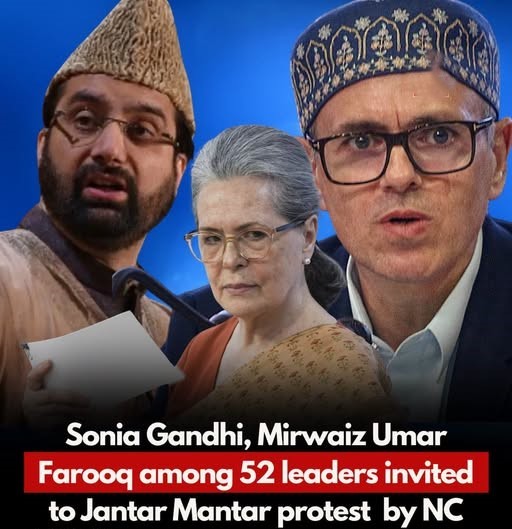
Among the prominent invitees are Congress Parliamentary Party Chairperson Sonia Gandhi, Hurriyat Conference chairman Mirwaiz Umar Farooq, and Jammu and Kashmir Grand Mufti Nasir-ul-Islam, reflecting the party’s effort to build one of the broadest platforms yet around the demand for restoring statehood.
The outreach goes beyond traditional party politics, with invitations reportedly extended to leaders across the political spectrum, religious institutions and civil society organizations. Through this strategy, the National Conference hopes to present the statehood issue as a matter of constitutional governance and democratic representation rather than a purely regional political demand.
NC Broadens Its Statehood Campaign
The proposed protest marks an important phase in the National Conference’s political strategy.
Since returning to government in Jammu and Kashmir, the party has consistently maintained that restoring statehood remains its foremost constitutional objective. By organizing a demonstration in the national capital and inviting leaders from diverse backgrounds, the NC is attempting to transform the campaign into a nationwide democratic movement.
Party leaders say the objective is to remind the Union government of its repeated commitment to restore statehood and to seek greater clarity on when that promise will be fulfilled.
The choice of Jantar Mantar, India’s best-known venue for democratic protests, reflects the party’s intention to take the debate directly to the national political stage.
Sonia Gandhi Among Key Political Invitees
The inclusion of Sonia Gandhi underscores the National Conference’s effort to strengthen coordination within the INDIA bloc.
By reaching out to senior Congress leadership and other opposition parties, the NC hopes to project the restoration of Jammu and Kashmir’s statehood as an issue concerning constitutional federalism, democratic governance and Centre–State relations.
If major opposition parties participate, the protest could emerge as one of the most significant joint opposition mobilizations on Jammu and Kashmir since the 2019 constitutional changes.
Political observers believe broader opposition participation would increase national visibility and intensify pressure on the Centre to outline a roadmap for restoring statehood.
Invitation to Mirwaiz Umar Farooq and Grand Mufti Nasir-ul-Islam
In a move that broadens the scope of the campaign beyond electoral politics, the National Conference has also invited Mirwaiz Umar Farooq and Grand Mufti Nasir-ul-Islam.
The inclusion of religious leaders appears aimed at demonstrating that the demand for statehood extends across different sections of Kashmiri society.
By inviting both political and religious figures, the party seeks to project the protest as a collective expression of public sentiment rather than a campaign limited to one political organization.
Whether all invitees choose to participate remains to be seen, and attendance should not be assumed until confirmed by the individuals or their offices.
Invitation Extended to All Political Parties
Besides members of the INDIA bloc, the National Conference has reportedly invited all political parties in Jammu and Kashmir to join the protest.
This broader outreach reflects the party’s attempt to build consensus on an issue that has found support across much of the region’s political spectrum, despite differences on other constitutional and political questions.
By encouraging participation from parties with differing ideologies, the NC hopes to demonstrate that statehood restoration enjoys support beyond partisan affiliations.
Why Statehood Remains the Central Issue
The demand for restoring Jammu and Kashmir’s statehood has remained one of the region’s most prominent political issues since August 5, 2019, when the erstwhile state was reorganized into the Union Territories of Jammu and Kashmir and Ladakh following the abrogation of Article 370.
The Union government has repeatedly stated—including before the Supreme Court—that statehood will be restored at an appropriate time. However, no specific timeline has been announced, prompting continued demands from regional parties for greater clarity.
For the National Conference, securing statehood has consistently been presented as the immediate constitutional priority.
Political Strategy: Expanding Beyond Party Politics
The National Conference’s latest outreach reflects a carefully calibrated political strategy.
Instead of limiting the campaign to its own cadre and allies, the party is seeking to build a coalition comprising:
- Opposition political parties.
- Religious leaders.
- Civil society organizations.
- Professional associations.
- Public representatives from different regions.
This approach is intended to strengthen the argument that the restoration of statehood represents a broad democratic aspiration rather than a narrow electoral issue.
It also complements the party’s earlier efforts to secure resolutions from sections of civil society supporting the demand.
Political Implications
1. Wider Opposition Consolidation
If senior opposition leaders respond positively, the protest could become a significant display of political unity around Jammu and Kashmir’s constitutional status.
2. Religious and Civil Society Engagement
The invitations to Mirwaiz Umar Farooq and Grand Mufti Nasir-ul-Islam indicate an attempt to include voices beyond mainstream politics, potentially giving the campaign broader social resonance.
3. Increased National Attention
A larger gathering at Jantar Mantar would likely bring renewed national focus to the issue of statehood and place additional political scrutiny on the Union government’s timeline.
4. Rising Public Expectations
By inviting a wide range of stakeholders, the National Conference has raised expectations that the campaign will continue beyond a single demonstration through sustained political engagement.
Political Snapshot
| Aspect | Details | Political Significance |
|---|---|---|
| Venue | Jantar Mantar, New Delhi | National platform for constitutional debate |
| Invitees | 52 political, religious and social leaders | Broadens participation beyond party politics |
| Key Leaders Invited | Sonia Gandhi, Mirwaiz Umar Farooq, Grand Mufti Nasir-ul-Islam | Expands political and community outreach |
| Core Demand | Restoration of Jammu and Kashmir’s statehood | Central constitutional issue |
| Political Objective | Build a united platform | Increase pressure on the Union government |
Challenges Ahead
While the National Conference’s outreach has widened the scope of the campaign, its success will ultimately depend on participation and sustained follow-up.
Several questions remain unanswered:
- How many invited leaders will attend the protest?
- Will INDIA bloc parties issue a joint statement?
- Can regional political rivals unite on the issue despite broader ideological differences?
- Will the Centre respond with greater clarity on its commitment to restore statehood?
The answers to these questions will determine whether the protest becomes a symbolic political event or the beginning of a longer constitutional campaign.
Outlook
The National Conference’s decision to invite 52 leaders, including Sonia Gandhi, Mirwaiz Umar Farooq, Grand Mufti Nasir-ul-Islam, and representatives from across the political spectrum, represents its most ambitious effort yet to broaden support for the restoration of Jammu and Kashmir’s statehood.
If the outreach translates into substantial participation at Jantar Mantar, the demonstration could elevate the statehood debate from a regional political demand to a national constitutional issue. However, the campaign’s long-term impact will depend not only on the turnout but also on whether it leads to sustained political engagement and constructive dialogue with the Union government.
Editorial Note: While the National Conference has announced invitations to numerous political and religious leaders, attendance by individual invitees—including Sonia Gandhi, Mirwaiz Umar Farooq and Grand Mufti Nasir-ul-Islam—should be considered unconfirmed unless they publicly accept or their offices officially announce participation. This distinction is important for accurate and balanced reporting.