Mehbooba Mufti Slams Mirwaiz House Arrest on Eid 2026 as Jamia Masjid Remains Closed for 8th Year
By: Javid Amin | 27 May 2026
PDP Chief Says Restrictions on Eid Prayers Have “Become a Custom” in Kashmir
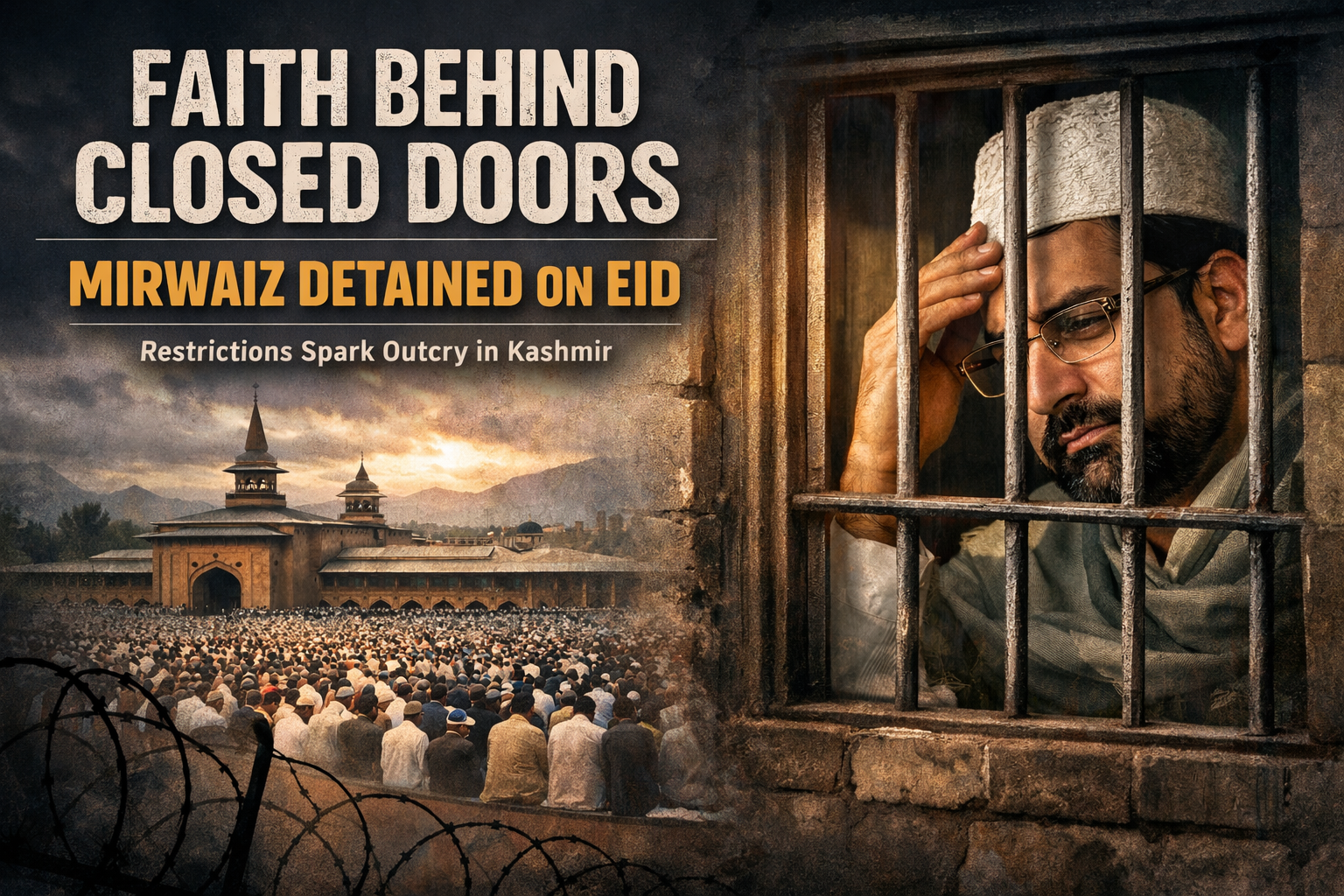
On Eid-ul-Adha 2026, former Jammu and Kashmir Chief Minister and PDP president Mehbooba Mufti sharply criticised the administration for placing Kashmir’s chief cleric Mirwaiz Umar Farooq under house arrest and preventing him from offering Eid prayers at the historic Jamia Masjid in Srinagar.
The remarks came after authorities allegedly stopped the Mirwaiz from leaving his residence on Eid-ul-Adha and barred congregational prayers at both Jamia Masjid and Eidgah in Srinagar.
Speaking to reporters, Mehbooba Mufti described the action as “mindless” and said nothing justified placing a religious leader under house detention on one of Islam’s holiest festivals.
She further linked the restrictions to what she called a broader pattern of repression in Kashmir, including the continued detention of thousands of Kashmiri prisoners and undertrials allegedly separated from their families for years.
What Happened on Eid-ul-Adha 2026?
Mirwaiz Prevented from Leading Eid Prayers
According to multiple reports, Mirwaiz Umar Farooq was confined to his residence in Srinagar ahead of Eid-ul-Adha celebrations and was not allowed to deliver the traditional Eid sermon or participate in congregational prayers at Jamia Masjid.
The Mirwaiz was also reportedly stopped days earlier from visiting Budgam and attending commemorative events related to his father’s death anniversary.
Authorities simultaneously disallowed Eid congregations at the historic Jamia Masjid and Eidgah grounds in Srinagar’s old city.
The closure once again prevented thousands of worshippers from gathering at one of Kashmir’s most significant religious and cultural centres.
Since When Has Jamia Masjid Been Closed for Eid Prayers?
Eid Congregations Disallowed Since 2019
Reports indicate that Eid prayers at Srinagar’s Jamia Masjid and Eidgah have repeatedly been disallowed since August 2019, following the abrogation of Article 370 and the reorganisation of Jammu and Kashmir into a Union Territory.
According to reports published during Eid-ul-Adha 2026, this marked the eighth consecutive year that Eid prayers were not permitted at the historic mosque and Eidgah grounds.
The restrictions have also extended to several major Islamic occasions over recent years, including:
- Eid-ul-Fitr
- Jumat-ul-Vida (last Friday of Ramadan)
- Shab-e-Qadr
- Shab-e-Barat
Authorities have repeatedly closed the mosque or restricted entry during these events.
Jamia Masjid, one of Kashmir’s most historically and politically important mosques, can accommodate nearly 50,000 worshippers inside the complex, with thousands more gathering in surrounding courtyards during major festivals.
Since When Has Mirwaiz Umar Farooq Been Under House Arrest?
Repeated Detentions Since August 2019
Mirwaiz Umar Farooq was initially placed under prolonged house detention in August 2019 following the revocation of Article 370. He remained under restrictions for nearly four years before being formally released in 2023.
However, despite the end of his prolonged detention, authorities have continued to place him under intermittent house arrest during politically or religiously sensitive occasions.
Throughout 2024, 2025, and 2026, several incidents were reported where the Mirwaiz was either:
- Prevented from delivering Friday sermons
- Confined to his residence
- Barred from attending religious gatherings
- Restricted during Eid and Ramadan congregations
In March 2026 alone, he was reportedly placed under house arrest during:
- Jumat-ul-Vida prayers
- Shab-e-Qadr observances
- Ramadan gatherings at Jamia Masjid
Political observers say these restrictions have become a recurring feature of Kashmir’s religious and political landscape after 2019.
Mehbooba Mufti’s Criticism
“Nothing Justifies This Mindless Action”
Reacting to the Eid restrictions, Mehbooba Mufti accused the administration of systematically curbing religious freedoms in Kashmir.
She reportedly stated that:
- “Nothing justifies the mindless action” of placing the Mirwaiz under house arrest
- Preventing worshippers from offering Eid prayers violates basic religious rights
- The repeated closures of Jamia Masjid have “become a custom”
The PDP chief argued that Kashmiris are increasingly being denied the freedom to practice religion openly during important Islamic festivals.
She also highlighted the issue of undertrial detainees and Kashmiri prisoners lodged in jails outside Jammu and Kashmir, claiming many families have remained separated for years.
The comments fit into the PDP’s broader political narrative accusing the administration of shrinking democratic and civil liberties in the region after the constitutional changes of 2019.
Religious and Political Symbolism of Jamia Masjid
More Than a Mosque in Kashmir’s Public Life
The Jamia Masjid in Srinagar is not merely a religious structure. It has historically served as:
- A centre of Islamic learning
- A political gathering space
- A symbol of Kashmiri Muslim identity
- A venue for major religious congregations
For decades, Friday sermons delivered by the Mirwaiz at Jamia Masjid have carried both religious and political significance.
Because of this symbolic role, restrictions on the mosque are often interpreted politically as well as administratively.
Many Kashmiris view the closure of Jamia Masjid during major festivals as an assertion of state control over religious and public life.
Public Sentiment: “Eid with a Heavy Heart”
Across Srinagar and other parts of the Valley, many worshippers expressed disappointment over the continued restrictions.
Residents and worshippers told local media that Eid celebrations increasingly feel emotionally incomplete without congregational prayers at Jamia Masjid and Eidgah.
Mirwaiz Umar Farooq himself stated that an entire generation of Kashmiri children is growing up without witnessing the traditional Eid gatherings historically associated with the mosque.
Families described celebrating Eid “with a heavy heart,” reflecting a wider sense of frustration and alienation among sections of the population.
Human Rights and Political Implications
Debate Over Religious Freedom
The repeated restrictions have once again revived debate around:
- Freedom of religion
- Civil liberties
- Preventive detention
- Public assembly rights
- Due process in Kashmir
Critics argue that denying congregational prayers during major Islamic festivals raises serious constitutional and human rights concerns.
Authorities, however, have generally defended such restrictions on grounds of security and maintenance of public order, especially during politically sensitive occasions.
Opposition Narrative Gains Momentum
The Eid developments are also likely to strengthen opposition parties politically.
Mainstream parties such as the PDP and National Conference increasingly cite these incidents while criticising the post-2019 governance framework in Jammu and Kashmir.
Analysts say repeated restrictions on religious gatherings contribute to:
- Political alienation
- Distrust toward institutions
- Emotional discontent among youth
- Renewed debate on democratic rights in Kashmir
A Continuing Cycle of Restrictions and Resentment
The events surrounding Eid-ul-Adha 2026 once again highlighted the deeply sensitive intersection of religion, politics, and security in Kashmir.
For the administration, restrictions appear tied to concerns about maintaining law and order. For critics and many worshippers, however, the repeated closure of Jamia Masjid and periodic confinement of the Mirwaiz symbolise shrinking religious and civic space in the Valley.
With Eid prayers barred at the mosque for the eighth consecutive year and Mirwaiz Umar Farooq repeatedly placed under restrictions since 2019, the issue continues to resonate far beyond a single religious event.
For many Kashmiris, the controversy reflects a larger unresolved debate about identity, freedom, and the future of public life in post-Article 370 Jammu and Kashmir.