Seven Years After Article 370 Abrogation, Kashmir’s Political Fault Line Remains Unchanged
By: Javid Amin | 05 Aug 2026
Seven years after the abrogation of Article 370, the constitutional decision continues to shape every major political debate in Jammu & Kashmir. Although the Union Territory has witnessed administrative reforms, infrastructure projects, elections, and renewed discussions on statehood, the question of Article 370 remains at the heart of the region’s politics.
For the Bharatiya Janata Party (BJP), the August 5, 2019 decision represents a landmark constitutional reform that integrated Jammu & Kashmir more closely with the rest of India and laid the foundation for improved governance, investment, and development.
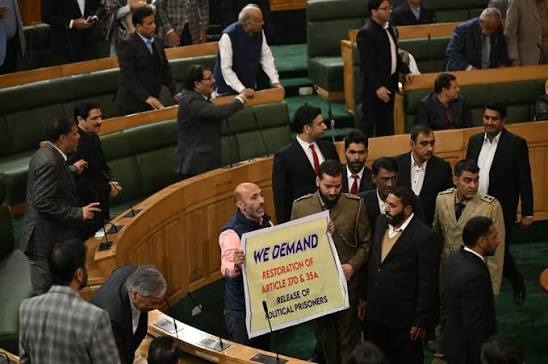
Regional political parties—including the National Conference (NC), Peoples Democratic Party (PDP), and other opposition groups—continue to argue that the abrogation fundamentally altered Jammu & Kashmir’s constitutional relationship with the Union of India. They maintain that the issue remains central to the region’s political future.
The anniversary has therefore become more than a date on the calendar—it represents two competing visions for Jammu & Kashmir.
A Decision That Redefined Jammu & Kashmir
On August 5, 2019, Parliament revoked the provisions of Article 370 and reorganized the erstwhile State of Jammu & Kashmir into the Union Territories of Jammu & Kashmir and Ladakh.
The move ended the region’s special constitutional status and extended most provisions of the Indian Constitution directly to the Union Territory.
The decision also altered the administrative structure by replacing statehood with Union Territory status, a development that continues to influence political debates.
Since then, successive anniversaries have become occasions for both celebration and protest, reflecting the enduring divide over the constitutional changes.
BJP’s Position: Integration, Development and Governance
The BJP continues to defend the abrogation as one of the most significant constitutional decisions in independent India.
According to the party, the removal of Article 370 has:
- Strengthened national integration.
- Extended constitutional rights and central laws uniformly.
- Improved governance and administrative efficiency.
- Accelerated infrastructure development.
- Encouraged investment and tourism.
- Enhanced transparency in public administration.
Government leaders frequently cite investments in roads, railways, healthcare, education, and tourism as indicators of progress since 2019.
The BJP also argues that the constitutional change has created greater opportunities for economic growth while improving security conditions.
National Conference: Statehood Alone Is Not Enough
The National Conference (NC) has consistently maintained that restoring statehood, while important, cannot replace the constitutional protections that existed before August 2019.
Party leaders argue that Article 370 represented the constitutional basis of Jammu & Kashmir’s relationship with the Union of India and should be restored through constitutional and democratic means.
The NC has repeatedly emphasized that:
- Restoration of statehood remains an immediate priority.
- Constitutional safeguards continue to be a long-term political objective.
- Democratic institutions should be strengthened.
- Political dialogue remains essential for lasting stability.
The party continues to pursue its political and legal positions through democratic institutions.
PDP Continues Campaign for Constitutional Restoration
The Peoples Democratic Party (PDP) has remained one of the strongest critics of the 2019 decision.
Led by Mehbooba Mufti, the party argues that the abrogation represented a breach of constitutional commitments and altered the political identity of Jammu & Kashmir.
The PDP frames its campaign around themes including:
- Constitutional rights.
- Democratic representation.
- Political dignity.
- Federal principles.
- Peaceful political engagement.
Every August 5, the party renews its demand for restoring constitutional safeguards through peaceful and democratic means.
Article 370 Continues to Shape Public Debate
Beyond political parties, Article 370 remains an emotionally significant issue for many residents of Jammu & Kashmir, although views differ across regions and communities.
Supporters of restoration argue that the constitutional change affected the region’s political autonomy and identity.
Supporters of the abrogation contend that the move removed legal barriers, strengthened national integration, and created new opportunities for development and governance.
These differing perspectives continue to influence electoral campaigns, public discussions, and policy debates.
How the Political Narrative Has Evolved Since 2019
| Year | Major Development | Political Significance |
|---|---|---|
| 2019 | Article 370 revoked; Jammu & Kashmir reorganized into Union Territories | Constitutional and administrative transformation |
| 2020–2021 | Legal challenges filed before the Supreme Court | Constitutional validity became subject of judicial review |
| 2022–2023 | Regional parties intensified political campaigns | August 5 increasingly observed as “Black Day” by several opposition parties |
| 2024–2025 | Debate over restoration of statehood gained prominence | Political focus expanded to governance and democratic representation |
| 2026 | Seventh anniversary observed under heightened security | Article 370 remains the defining political issue |
Governance and Statehood Continue to Dominate Discussions
Alongside Article 370, the restoration of Jammu & Kashmir’s statehood remains another major political issue.
The Union Government has repeatedly stated that statehood will be restored at an appropriate time, though no official timeline has been announced.
Regional political parties argue that the continued absence of full statehood affects democratic governance and administrative accountability.
As a result, Article 370 and statehood have become closely linked in political discussions across the Union Territory.
Security and Politics Remain Interconnected
Every anniversary of August 5 is accompanied by extensive security arrangements.
Authorities routinely deploy additional police and Central Armed Police Forces, establish checkpoints, monitor social media, and impose restrictions on public gatherings to prevent law-and-order problems.
Regional parties often criticize these restrictions, arguing that peaceful political expression should be protected, while the administration maintains that preventive measures are necessary to ensure public safety.
The recurring security arrangements illustrate how political developments continue to influence policing strategies in Jammu & Kashmir.
A Debate That Extends Beyond Kashmir
The political significance of Article 370 extends well beyond Jammu & Kashmir.
National political parties frequently invoke the issue during elections, parliamentary debates, and policy discussions, making it one of the most prominent constitutional questions in contemporary Indian politics.
For supporters of the abrogation, it symbolizes national integration and constitutional uniformity.
For opponents, it represents the continuing debate over federalism, democratic consent, and constitutional safeguards.
This broader national dimension ensures that Article 370 remains relevant in political discourse across India.
Outlook
Seven years after the abrogation of Article 370, the constitutional change continues to define Jammu & Kashmir’s political landscape.
While the BJP presents the decision as a foundation for integration, development, and improved governance, regional parties such as the National Conference and the PDP continue to advocate for the restoration of constitutional safeguards and statehood.
The persistence of these competing narratives means Article 370 is likely to remain the central axis of Jammu & Kashmir’s politics for the foreseeable future. As long as differing constitutional and political visions continue to shape public debate, the issue will remain one of the Union Territory’s most consequential and closely watched political fault lines.
Key Highlights
- Seven years after its abrogation, Article 370 remains the defining political issue in Jammu & Kashmir.
- The BJP continues to describe the 2019 decision as a milestone for integration, governance, and development.
- The National Conference argues that restoring statehood alone is insufficient without addressing constitutional concerns.
- The PDP continues to campaign for the restoration of constitutional safeguards, describing the 2019 move as inconsistent with its interpretation of constitutional commitments.
- The debate over Article 370 continues to shape governance, elections, public discourse, and security planning in Jammu & Kashmir.
- The anniversary of August 5 remains one of the most politically sensitive dates in the Union Territory, reflecting enduring differences over its constitutional future.