Vaishno Devi Silver Offerings Shock: Purity Row Sparks Debate on Faith, Fraud, and Governance
By: Javid Amin | 21 April 2026
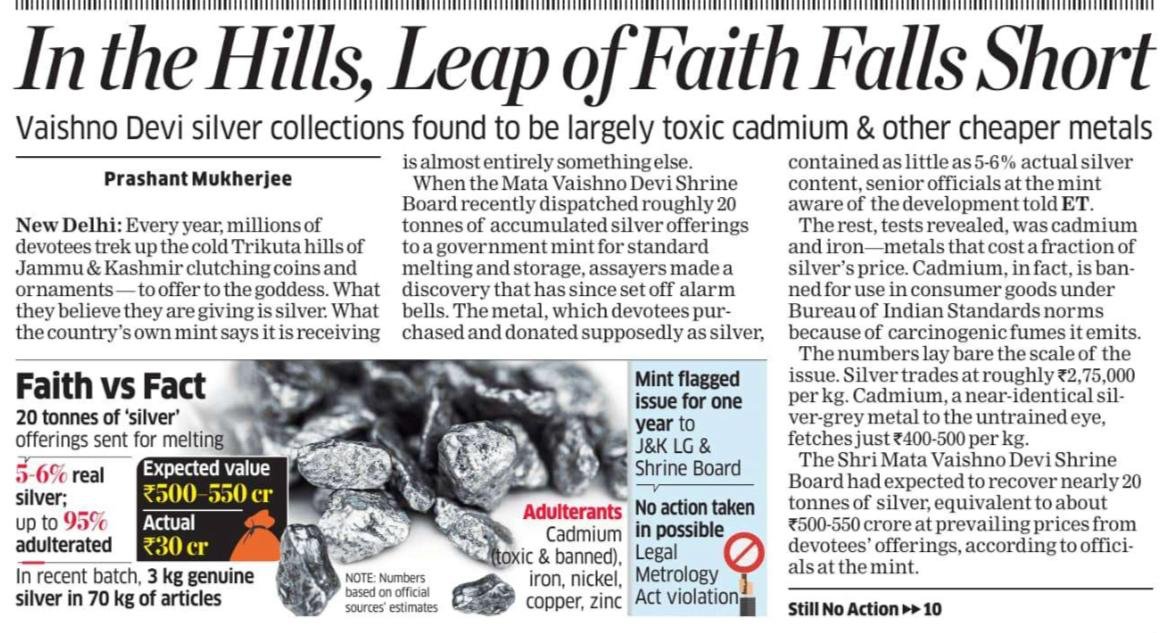
A startling revelation from one of India’s most revered pilgrimage sites—the Vaishno Devi Shrine—has triggered a wave of concern across religious, economic, and political circles.
Preliminary findings indicating that only about 5% of silver offerings made by devotees are pure have not only shaken trust but also exposed deeper systemic issues at the intersection of faith and commerce.
A Sacred Tradition Faces a Credibility Crisis
For millions of devotees visiting Vaishno Devi each year, offering silver is more than a ritual—it is an emotional expression of gratitude, faith, and devotion. Silver coins, ornaments, and idols are commonly donated as symbolic gestures of reverence.
However, the discovery that a vast majority of these offerings are adulterated has cast a shadow over this sacred practice.
At a spiritual level, the issue cuts deeper than material value. Devotees believe their offerings carry intent and purity of heart—but the physical impurity of these items now raises uncomfortable questions:
- Are devotees unknowingly being misled?
- Has commercialization diluted the sanctity of offerings?
- Who bears responsibility for ensuring authenticity?
Religious scholars and local clergy are increasingly calling for transparency mechanisms to restore faith in the system.
The Bullion Trade Under the Lens
Beyond the shrine, the controversy has put a spotlight on the local bullion ecosystem in Jammu & Kashmir. Silver adulteration is not a new concern in India, but its scale in a religious context is particularly alarming.
Industry observers point to a familiar pattern:
- Adulteration for higher margins: Traders may mix base metals with silver to reduce costs while selling at near-pure prices.
- Lack of rigorous testing: In many local markets, purity verification mechanisms are either weak or absent.
- Faith-driven demand: Religious offerings create a steady, emotion-driven market where buyers are less likely to question authenticity.
This combination makes shrines particularly vulnerable to exploitation.
Governance Challenge for Shrine Authorities
The responsibility of restoring credibility now largely rests with the Shri Mata Vaishno Devi Shrine Board (SMVDSB), which manages the shrine’s operations.
The board faces mounting pressure to:
- Introduce mandatory purity checks for all precious metal offerings
- Establish certified vendor networks for devotees
- Conduct independent audits of collected offerings
- Ensure public disclosure of findings to rebuild trust
Any delay or opacity could further erode confidence—not just in the board, but in institutional management of religious spaces.
Politics, Perception, and Public Trust
As with many issues involving religion and public institutions, the controversy is gradually entering the political discourse. Competing narratives are emerging:
- Some voices are framing it as a failure of oversight and accountability
- Others see it as an example of broader corruption in faith-linked economies
The debate mirrors earlier controversies in the region—where religion, governance, and economics intersect in complex ways. The risk here is not just reputational damage, but polarization if the issue is politicized without constructive solutions.
Impact on Pilgrimage and Local Economy
The Vaishno Devi shrine is not only a spiritual hub but also a major economic engine for the region. Any dent in its credibility can have ripple effects:
1. Pilgrim Sentiment
Trust plays a central role in religious travel. Even isolated controversies can influence perception, especially among first-time visitors.
2. Local Businesses
From shopkeepers to transport providers, thousands depend on pilgrimage-driven income. Reduced footfall or skepticism could impact livelihoods.
3. Bullion Market Regulation
Jewellers and traders may face tighter scrutiny, potentially reshaping how silver is sourced and sold in the region.
Faith vs. Fraud: A Larger Ethical Question
At its core, this controversy is not merely about metal purity—it is about ethical boundaries. When economic opportunism enters sacred spaces, it challenges the very foundation of trust that sustains religious institutions.
Devotees rarely question offerings because faith operates on belief, not verification. That makes the system inherently vulnerable—and places a higher moral responsibility on intermediaries.
What Happens Next? Likely Reforms Ahead
Ground-level inputs and policy signals suggest that corrective measures are likely in the near future:
- Hallmarking and certification systems for all precious metal offerings
- Deployment of on-site testing facilities at the shrine
- Promotion of digital donations to reduce dependence on physical offerings
- Stricter enforcement under national standards like BIS hallmarking
If implemented effectively, these steps could transform the way offerings are managed—not just at Vaishno Devi, but across major shrines in India.
The Way Forward: Restoring Trust
Rebuilding trust will require more than technical fixes. It will demand:
- Transparency in communication
- Accountability for lapses
- Active engagement with devotees
Faith, once shaken, takes time to restore—but decisive action can prevent long-term damage.
Conclusion: Beyond Silver, a Test of Integrity
The Vaishno Devi silver purity issue is a powerful reminder that even sacred ecosystems are not immune to systemic flaws.
It exposes how gaps in regulation and ethics can quietly grow until they reach a tipping point. The real test now lies in how institutions respond—whether they treat this as a crisis to contain, or an opportunity to reform.
Because ultimately, this is not just about silver.
It is about preserving the integrity of faith itself.