Centre clears Justice Sanjay Kumar Agrawal’s appointment after Supreme Court Collegium recommendation, amid an unusual controversy surrounding Rajasthan High Court’s acting Chief Justice
By: News Desk | 06 September 2026
Justice Sanjay Kumar Agrawal Is Rajasthan High Court’s New Chief Justice: Why the Appointment Matters
The Rajasthan High Court is set for a change at the top at a moment when questions about the court’s internal administration have drawn unusual public attention.
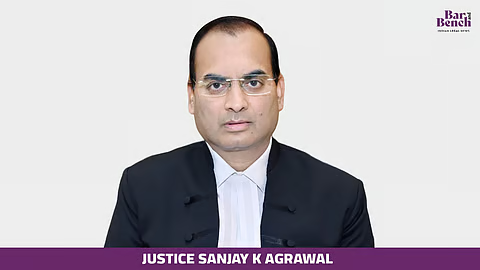
On September 5, President Droupadi Murmu approved the appointment of Justice Sanjay Kumar Agrawal as the Chief Justice of the Rajasthan High Court. The decision came just days after the Supreme Court Collegium recommended his name and against the backdrop of an escalating controversy involving the court’s Acting Chief Justice, Justice Sanjeev Prakash Sharma.
The timing is significant.
Justice Agrawal’s appointment is not simply another entry in the regular rotation of High Court chief justices. It comes after lawyers at the Rajasthan High Court’s Jodhpur and Jaipur benches protested against the functioning of Justice Sharma, while letters written by Supreme Court judge Justice Sandeep Mehta to Chief Justice of India Surya Kant raised concerns about the acting Chief Justice’s administrative and judicial functioning.
Those allegations remain allegations. They have not been established by a judicial finding, and Justice Sharma has rejected them as baseless. The CJI has also made clear that such allegations cannot themselves be treated as findings against a sitting judge.
Against that backdrop, the arrival of a regular Chief Justice gives the Rajasthan High Court an opportunity to move beyond a period of uncertainty and restore attention to its core business: hearing cases, managing its benches and maintaining confidence in the institution.
A decision that moved quickly
The Supreme Court Collegium, headed by CJI Surya Kant, recommended Justice Sanjay K. Agrawal for appointment as Rajasthan High Court Chief Justice at its meeting on August 31.
The Collegium’s resolution also dealt with the transfer of Justice Agrawal from the Chhattisgarh High Court. The recommendation came at a particularly sensitive point for Rajasthan, where Justice Sharma was serving as Acting Chief Justice.
Within days, the Centre cleared the appointment. On September 5, the President formally appointed Justice Agrawal as Chief Justice of the Rajasthan High Court. He became the court’s 44th regular Chief Justice.
The speed of the process stood out because the Collegium’s recommendation followed a period of intense discussion inside and outside the Rajasthan High Court.
Justice Sharma had gone on leave shortly before the Collegium recommended Justice Agrawal. His leave and the recommendation were closely watched because of the controversy that had unfolded around his administration of the court.
Still, the sequence should not be read as proof that the allegations against Justice Sharma were established. The public record does not support such a conclusion.
Who is Justice Sanjay Kumar Agrawal?
Justice Agrawal brings more than a decade of experience on the High Court bench and a long legal career before that.
Born on July 15, 1965, at Ratanpur in Bilaspur, he studied at Ratanpur and obtained his Bachelor of Science and Bachelor of Laws degrees from Guru Ghasidas University, Bilaspur. He later completed an LLM from Pt Ravishankar Shukla University in Raipur.
He enrolled as an advocate on January 3, 1989, and practised before the District and Sessions Court at Bilaspur, the Madhya Pradesh High Court at Jabalpur and later the Chhattisgarh High Court at Bilaspur. His practice included civil and constitutional matters.
His career also included government law work. He served as Deputy Advocate General for Chhattisgarh from 2002 to 2004 and later became the state’s Advocate General in June 2012, a position he held until his elevation to the High Court.
He was appointed an Additional Judge of the Chhattisgarh High Court on September 16, 2013, and became a permanent judge on March 8, 2016.
That background matters because a Chief Justice is not only a judge deciding cases. The office carries substantial administrative responsibility, including constitution of benches, allocation of judicial work, management of the court’s registry and broader institutional functioning.
Justice Agrawal therefore arrives in Rajasthan with experience both at the Bar and on the Bench.
The controversy that preceded the appointment
The immediate background to the change is the controversy surrounding Justice Sanjeev Prakash Sharma.
Justice Sharma, who had been serving as Acting Chief Justice, became the subject of public attention after letters written by Supreme Court judge Justice Sandeep Mehta to CJI Surya Kant became public.
The letters, dated August 2, August 10 and August 17, reportedly raised concerns about the functioning of the Rajasthan High Court under Justice Sharma. Justice Mehta alleged misuse of administrative powers and expressed concerns relating to case listings and other aspects of the court’s administration. He also referred to complaints that, in his view, raised questions about Justice Sharma’s integrity.
The contents were serious enough to trigger wider discussion within the legal community.
But this is where the distinction between an allegation and a finding becomes important.
There has been no public judicial determination establishing the allegations against Justice Sharma as fact.
Justice Sharma rejected the accusations, describing them as baseless and attributing them to animosity. He said he had already submitted his response to the Chief Justice of India and maintained that he had evidence to rebut the allegations.
The controversy therefore remains an institutional dispute that has entered the public domain, rather than a completed finding of misconduct.
Lawyers take their protest to the court premises
The controversy did not remain confined to correspondence between judges.
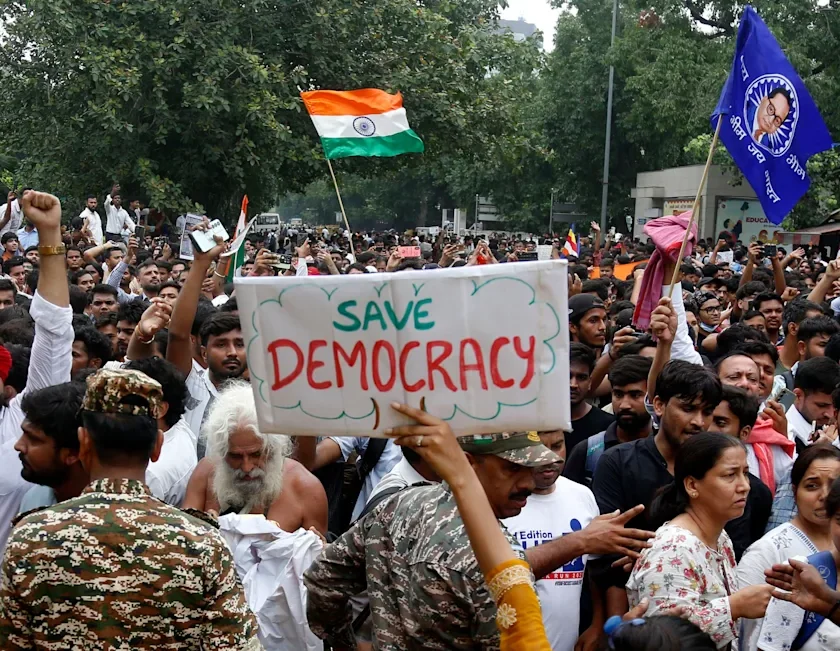
On August 31, lawyers at the Rajasthan High Court’s principal seat in Jodhpur announced a boycott of judicial work until September 6. Lawyers at the Jaipur Bench also staged a protest.
The associations demanded an impartial examination of the issues raised in the letters and called for greater transparency in the court’s administrative functioning. They also sought relief from what they described as problematic aspects of the system governing case allocation and listing.
The scenes were unusual for a constitutional court.
Lawyers are a regular part of the judicial system, but sustained protests against the functioning of a sitting Acting Chief Justice inevitably raise concerns about the relationship between the Bench, the Bar and the administration of justice.
For the lawyers involved, the issue was not presented simply as a disagreement with individual orders. Their stated concern was institutional credibility and the need for an impartial examination of the allegations.
That distinction is important because a High Court’s functioning depends not only on judges issuing orders, but also on the confidence of advocates and litigants in the fairness and predictability of its administrative systems.
The CJI’s caution matters
Chief Justice Surya Kant’s response to the controversy has also been significant.
The Supreme Court has indicated that allegations against a sitting judge must be examined through the established institutional mechanism. Publicly circulated accusations, by themselves, cannot become findings.
That principle is important beyond this particular dispute.
Judicial independence requires judges to be protected from pressure and unverified public accusations. At the same time, judicial institutions must have credible mechanisms to examine complaints when serious concerns are raised.
Both principles have to operate together.
An allegation cannot become a verdict simply because it has been widely reported. But neither can an allegation involving the administration of a constitutional court simply disappear without an appropriate institutional examination.
The challenge for the judiciary is to maintain that balance without allowing either secrecy or publicity to replace due process.
Why the appointment matters beyond one judge
The appointment of Justice Agrawal comes at a useful institutional moment for the Rajasthan High Court.
A regular Chief Justice gives the court a clearer administrative structure after a period in which the Acting Chief Justice’s functioning had become the subject of public controversy.
The new Chief Justice will inherit not only pending cases and administrative responsibilities, but also a court where questions about listings, transfers, case management and the relationship between the Bar and Bench have become part of the public conversation.
That means the first challenge may not be a dramatic judicial intervention.
It may simply be restoring normalcy.
For litigants, normalcy means predictable hearings. For lawyers, it means confidence that administrative decisions are made through established procedures. For judges, it means being able to work without institutional disputes becoming a distraction from adjudication.
And for the public, it means confidence that the High Court is functioning independently and fairly.
A long history of changing leadership
The Rajasthan High Court has seen frequent changes in its top leadership over the years, reflecting the wider pattern of judicial transfers and appointments across India’s High Courts.
The office of Chief Justice carries a relatively short tenure in many cases because judges are appointed from different High Courts and retire at the constitutionally prescribed age.
That makes administrative continuity especially important.
A Chief Justice may inherit a court with thousands of pending cases, multiple benches, a large registry and a complex roster of civil, criminal, constitutional and administrative matters.
The Rajasthan High Court’s own records list Justice Sanjeev Prakash Sharma as Acting Chief Justice immediately before the latest transition.
The new appointment therefore represents both a change of personnel and a chance to reset the court’s administrative direction.
The larger question: how transparent should judicial administration be?
The Rajasthan episode also touches a much bigger question facing India’s higher judiciary.
Judicial independence has traditionally meant that judges must be protected from executive and political interference. But independence does not mean that judicial institutions are beyond scrutiny.
The difficult part is deciding how that scrutiny should work.
When concerns involve judicial orders, there are established legal remedies. When they involve allegations of personal misconduct or administrative abuse, the process is more complicated because judges cannot be treated like ordinary public officials.
The judiciary therefore relies heavily on internal mechanisms, the Collegium and institutional oversight.
Critics have long argued that greater transparency is needed in judicial administration. Supporters of the existing system caution that excessive public disclosure can damage the independence and reputation of judges before allegations are properly examined.
The Rajasthan controversy puts that tension into a very visible setting.
The appointment of Justice Agrawal does not, by itself, resolve those larger questions.
What it does is place a new Chief Justice at the centre of an institution that needs to reassure its own stakeholders that administrative decisions will be predictable, fair and properly explained wherever disclosure is appropriate.
What lies ahead for the Rajasthan High Court
Justice Agrawal’s immediate task is unlikely to be easy.
The court will have to return to a regular administrative rhythm after weeks of unusual attention. The relationship between the Bench and Bar will require careful handling. Questions raised during the controversy may continue to attract interest even after the leadership changes.
There is also the broader workload of the court.
A Chief Justice has to balance constitutional and public-interest litigation with ordinary civil and criminal cases, while ensuring that benches are constituted efficiently and the registry operates smoothly.
That work rarely makes headlines, but it determines how quickly ordinary litigants see their cases move.
In that sense, the success of Justice Agrawal’s tenure will probably be measured less by dramatic first-day announcements and more by whether the court gradually becomes less controversial and more predictable.
A change at the top, but not the end of the story
The appointment of Justice Sanjay Kumar Agrawal closes one chapter in the immediate leadership question at the Rajasthan High Court.
But it does not automatically close the controversy that preceded it.
The allegations involving Justice Sanjeev Prakash Sharma remain allegations unless and until they are examined and a competent authority reaches a finding. Justice Sharma has denied them. The Supreme Court has indicated that the matter must be dealt with through the appropriate institutional process rather than through public debate alone.
For the Rajasthan High Court, the more important test now is practical.
Can the institution regain its footing?
Can the Bar and Bench rebuild confidence?
Can administrative decisions become routine rather than controversial?
And can the judiciary demonstrate that serious complaints can be examined without either compromising judicial independence or allowing legitimate questions to remain unanswered?
Justice Agrawal begins his tenure with a substantial legal career behind him. The circumstances in which he takes charge, however, mean that his first responsibility will extend beyond the courtroom.
He will be expected to restore a sense of institutional stability.
For a High Court, that may be the most important judgment of all.