J&K Sex-Racket Raids Put Human Trafficking, Exploitation and Victim Protection Under Spotlight
By: News Desk | 06 September 2026
Recent police raids in Jammu, arrests in alleged prostitution cases and earlier trafficking investigations involving Srinagar are exposing a darker question: how effectively can Jammu and Kashmir distinguish organised exploitation from consensual adult sex work while protecting women and children caught in criminal networks?
The latest raids may have begun with intelligence inputs and searches of private premises, but the larger story is considerably more complicated.
Across Jammu and Kashmir, police action against alleged prostitution and immoral trafficking has brought renewed attention to the movement of vulnerable women, the use of apparently legitimate businesses as fronts, interstate recruitment networks and the difficult line between prostitution and human trafficking.
In Jammu alone, police action during 2026 has included raids in Greater Kailash, spa and massage centres and, most recently, an alleged racket in Akhnoor. Separately, a major Delhi-J&K trafficking investigation in 2025 uncovered a network accused of transporting vulnerable minors and labourers to Srinagar for forced domestic work.
The cases are different. But together they raise the same uncomfortable question: what happens to people who become commodities in a criminal economy?
And perhaps even more importantly, what happens after the police raid is over?
Recent Jammu raids bring the issue back into public view
The most recent confirmed case came from Akhnoor in Jammu district.
On July 4, 2026, Jammu and Kashmir Police said they raided a house in Ward No. 2, Kashmiri Mohalla, following information about alleged immoral trafficking activities. Three people — identified by police as Ravi Gupta, Sarishta Devi and Sahil Sharma — were arrested.
Police registered FIR No. 164/2026 at Akhnoor police station under relevant provisions of the Immoral Traffic (Prevention) Act, 1956 (ITPA). Investigators said they were examining whether other people were involved and attempting to determine the wider extent of the alleged operation.
That case is significant not because three people were arrested — such arrests are not unusual in trafficking-related policing — but because it arrived after several other operations in Jammu during the preceding months.
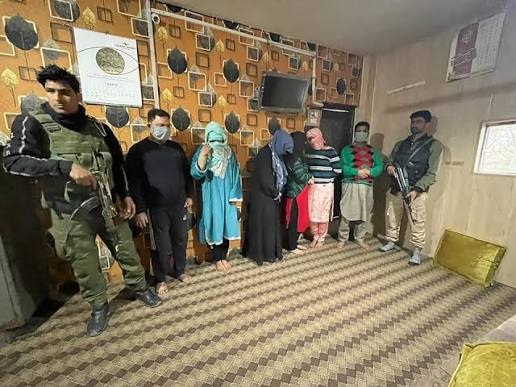
In March, police reported busting an alleged prostitution racket in a residential property in Greater Kailash. Three women were rescued and three people were arrested. Police said the premises were allegedly being used to procure women and induce them into prostitution, and registered a case under Sections 3, 5 and 7 of the ITPA.
The language used by police is important here.
“Rescued” does not automatically mean “trafficked”.
That determination requires investigation into how a person entered the situation, whether force, fraud, coercion, deception or inducement was involved, who controlled the person’s movement or earnings and what the person actually experienced.
That distinction has become even more important following a landmark Supreme Court judgment this year.
The Thai-national cases added another layer to the Jammu investigation
Jammu’s crackdown also intensified around spa and massage centres.
In February 2026, police reportedly detained Thai nationals during separate operations involving spa centres. Subsequent reporting said the cases prompted authorities to examine whether foreign nationals were being employed or housed without the required documentation and whether apparently legitimate wellness businesses were being used to facilitate illegal activities.
Then, in May, Gangyal Police raided a rented property in the Bandhu Rakh area of Kunjwani and detained five people, including two Thai women, in connection with alleged immoral activities. The property was reportedly rented by a Jammu and Kashmir Police Special Police Officer, although available reports did not establish that the officer himself was an accused in the alleged racket.
That qualification is important.
The involvement of a property linked to a police employee naturally raises questions about oversight and possible facilitation, but the fact that a police officer rented a property does not, by itself, establish involvement in trafficking or prostitution.
Investigators would have to establish knowledge, participation, facilitation or another legally relevant connection.
The case nevertheless exposed a weakness that extends beyond prostitution: how are foreign workers entering local labour markets, who verifies their documents, who employs them and who monitors the establishments in which they work?
The Jammu district administration subsequently tightened regulation of spa and massage centres, including requirements relating to undertakings and operational details. Reports said several establishments were sealed for alleged violations.
But the deeper trafficking story runs through Srinagar
While the recent Jammu cases have generated headlines around alleged prostitution, one of the strongest recent examples of organised trafficking linked to J&K involved something different: forced domestic labour.
In August 2025, Delhi Police, working with Jammu and Kashmir Police, busted what investigators described as an interstate trafficking network operating between Delhi-NCR and Srinagar.
The investigation began after two minor girls, aged 15 and 13, were reported missing from Delhi.
Technical surveillance reportedly traced them to Srinagar. They were rescued in June 2025. According to police, statements made before the Child Welfare Committee indicated that the girls had been lured at Old Delhi Railway Station, transported through Jammu and taken to Srinagar, where they were forced into unpaid domestic work.
The investigation subsequently led to four arrests.
Police alleged that one accused, identified as Salim-ul-Rehman alias Wasim, operated a placement agency in Bemina, Srinagar, and claimed during interrogation that approximately 500 people had been trafficked through the network over two years.
Police also alleged that the syndicate charged different amounts depending on the victim’s gender, reportedly ₹20,000–25,000 for males and ₹40,000–60,000 for females.
Another accused was allegedly involved in transporting victims from Delhi towards Jammu and Kashmir. Subsequent searches in Srinagar resulted in further arrests and the rescue of another 16-year-old child.
These allegations remain allegations unless established in court. But the investigation illustrates something crucial.
Human trafficking does not always look like kidnapping.
Sometimes it looks like a job offer.
Sometimes it looks like a placement agency.
Sometimes it begins at a railway station.
And sometimes the victim may cross several state borders before anyone realises that something is wrong.
NCRB figures reveal a wider problem than prostitution alone
The available NCRB-derived data adds important context.
According to reporting on Crime in India 2024, Jammu and Kashmir recorded 17 registered human-trafficking cases in 2024, compared with 10 in 2023 and eight in 2022.
The same data identified 60 trafficking victims in 2024.
Of these, 36 were reportedly trafficked for forced labour, 12 for coerced marriages, eight for sexual exploitation for prostitution and two for domestic servitude. Eight of the identified victims were girls below 18, while 36 were adult males and 16 were adult females. Police agencies reportedly rescued 58 of the identified victims.
The numbers need to be read carefully.
They are registered and identified cases and victims, not an estimate of the true scale of trafficking.
Human trafficking is notoriously underreported. Victims may fear traffickers, employers, police, family members or social consequences. Some may not initially identify themselves as victims. Others may lack documents or be economically dependent upon the very people exploiting them.
Therefore, an increase in registered cases can mean more trafficking — but it can also partly reflect improved detection and reporting.
The figures nevertheless show why reducing the conversation to “sex rackets” would be misleading.
Forced labour remains the largest reported trafficking purpose in J&K in the 2024 data.
Why prostitution and trafficking cannot simply be treated as the same thing
This is where the legal picture becomes particularly important.
India’s Immoral Traffic (Prevention) Act, 1956 criminalises a range of activities surrounding prostitution, including keeping or managing a brothel, living on prostitution earnings in specified circumstances, procuring or inducing a person for prostitution, detaining a person at premises where prostitution occurs and certain forms of solicitation. The law also contains provisions concerning rescue and protective custody.
Separately, the Bharatiya Nyaya Sanhita, 2023 contains a specific offence of trafficking under Section 143.
The BNS definition focuses on three broad components: an act such as recruiting, transporting or harbouring a person; specified means such as force, coercion, abduction, fraud, deception or inducement; and an exploitative purpose.
Importantly, the law expressly includes sexual exploitation within the concept of exploitation and says the victim’s consent is immaterial where the offence of trafficking is established.
That creates a significant legal distinction.
A person working voluntarily as an adult sex worker is not automatically a trafficking victim.
But a person recruited through deception, coercion or force and then sexually exploited may clearly fall within the trafficking framework.
The two situations can exist in the same police raid.
That is why the investigation after the raid matters as much as the raid itself.
Supreme Court changes the conversation about “rescue”
The timing of the recent J&K crackdown is particularly notable because the Supreme Court issued a major judgment on trafficking for commercial sexual exploitation on May 29, 2026.
In Prajwala v. Union of India, the court examined the complicated relationship between prostitution, trafficking, victim protection and the ITPA.
The court specifically warned against treating everyone found in prostitution-related circumstances as belonging to one homogeneous category.
It directed that magistrates should conduct an initial inquiry to distinguish adult voluntary sex workers from trafficking victims. It also emphasised that the informed consent of adult trafficking victims should play a primary role in decisions concerning rehabilitation, reintegration and protective custody, subject to safeguards where coercion, tutoring or serious safety risks are present.
The court’s reasoning goes beyond legal technicalities.
It challenges a deeply rooted assumption: that every person removed from a prostitution-related setting is automatically a passive victim who must simply be “rescued” and institutionalised.
The Supreme Court instead placed dignity, agency and individual circumstances at the centre of the response.
At the same time, it recognised the opposite danger — that traffickers can manipulate victims into claiming that their situation is voluntary.
That is why a genuine trafficking investigation cannot stop at asking a person whether she wants to leave.
Investigators must understand why she is there, who brought her, who controls her, who receives the money, whether she is free to leave, whether threats have been made and whether her apparent consent is actually free consent.
J&K already has an anti-trafficking architecture — the question is how effectively it works
Jammu and Kashmir is not starting from zero.
The J&K Police maintains dedicated Anti-Human Trafficking Units, including an Anti-Human Trafficking Police Station in Srinagar and district-level structures elsewhere. The police website lists Anti-Human Trafficking Units among its policing infrastructure.
The Union government has also pushed for district-level AHTUs and coordination between police, women help desks and other agencies.
Under the Home Ministry’s framework, district AHTUs are expected to coordinate trafficking-related matters, while women help desks are meant to support prevention, rescue, protection and investigation.
J&K’s institutional response has also been visible publicly.
In August 2025, the J&K Police Crime Branch, together with the Ministry of Home Affairs, organised a Union Territory-level anti-human trafficking conference in Srinagar. Police officers, judicial representatives, government departments, NGOs, academics and students participated in the programme, with particular attention to awareness and trafficking in the digital era.
And in March 2026, the J&K High Court examined procedural questions surrounding the functioning of special police officers under the ITPA in a case arising from Anantnag. The court sought information on whether the UT government had taken the necessary steps under Section 13 of the Act for area-wise special police officers dealing with ITPA offences.
Taken together, these developments suggest that the issue is not simply one of “more police raids”.
It is about capacity, coordination, evidence collection, specialised investigation and victim protection.
The real test begins after the police tape comes down
A successful raid makes for a visible headline.
A successful trafficking investigation is much less visible.
It may require months of work to identify recruiters, transporters, property owners, intermediaries, money handlers and people operating across state borders.
The 2025 Delhi-Srinagar investigation illustrates this perfectly. The operation required technical surveillance, cooperation between police forces in different jurisdictions, examination of placement agencies and further searches after the initial rescue.
The same principle applies to alleged prostitution networks.
If police arrest people at one location but fail to identify who recruited the women, who arranged accommodation, who controlled earnings and who financed the operation, the visible part of the network may disappear while the underlying system survives.
Trafficking is a business model.
Remove one outlet and another can appear.
Poverty, migration and the vulnerability gap
Traffickers do not necessarily search for people who are already in criminal environments.
They search for vulnerability.
A woman looking for work.
A young person from a poor household.
A minor travelling without adequate supervision.
A migrant unfamiliar with the city.
Someone desperate for accommodation.
Someone carrying debt.
Someone without documents.
Someone who believes an intermediary promising employment.
The government itself has previously identified poverty, low social status and the absence of a protective environment among factors that can contribute to trafficking for commercial sexual exploitation.
This is why anti-trafficking policy cannot be limited to police stations.
Employment verification, safe migration awareness, registration of placement agencies, checks on suspicious recruitment, child protection mechanisms and accessible complaint systems all form part of the prevention chain.
Digital recruitment is making the old trafficking model harder to detect
The traditional image of trafficking often involves a stranger approaching someone physically.
The modern version can begin with a smartphone.
A job advertisement.
A social-media message.
A promise of modelling work.
A hospitality position.
A domestic-work opportunity.
An invitation to travel.
The person may voluntarily board a bus or train — yet still become trafficked later through deception or coercion.
That is one reason the anti-trafficking conference organised in Srinagar in 2025 specifically highlighted the threat in the digital era.
For investigators, this means that digital evidence can become as important as physical evidence.
Messages, payment records, travel bookings, phone numbers, social-media accounts and location data can help establish the relationship between recruiter and victim.
For families, it means something equally important: a digital recruitment message should not automatically be treated as a genuine job opportunity.
Rehabilitation cannot mean simply sending survivors back home
One of the most important lessons from the Supreme Court’s 2026 judgment is that rescue and rehabilitation are not the same thing.
A person may be removed from an exploitative environment today and return to vulnerability tomorrow.
That is the risk of re-trafficking.
India’s current women-protection framework provides for Shakti Sadans, which bring together the earlier Swadhar Greh and Ujjawala approaches. These facilities are intended to provide shelter, food, counselling, medical care, legal assistance and vocational support to women in distress, including trafficking survivors.
But institutional support alone cannot rebuild a life.
A survivor may need:
- safe accommodation;
- trauma-informed counselling;
- medical assistance;
- legal representation;
- educational support;
- vocational training;
- financial inclusion;
- identity documentation;
- family assessment;
- protection from traffickers;
- and long-term monitoring against re-trafficking.
The objective should not be merely removal from exploitation.
It should be restoration of autonomy.
The danger of turning victims into suspects
There is another social risk.
Whenever a prostitution or trafficking raid is reported, public conversation can quickly become judgmental.
Names circulate.
Photographs spread.
Neighbours speculate.
Social media users make assumptions.
Women found at a location can be labelled before investigators have established whether they were trafficked, coerced, voluntarily working or themselves involved in facilitating a crime.
This can cause lasting damage.
The Supreme Court’s recent judgment explicitly discussed the stigma attached to sex workers and warned against treating people through simplistic categories of “innocent victim” and “guilty participant”.
For a socially conservative region such as J&K, this is especially important.
Public morality cannot replace criminal investigation.
And social stigma cannot become a second punishment for someone who may already have been exploited.
What authorities should now focus on
The emerging pattern points towards several priorities.
1. Follow the network, not just the premises
Every raid should generate questions about recruiters, financiers, transporters, landlords, intermediaries and digital contacts.
2. Separate trafficking from consensual adult sex work
Investigators must establish the circumstances of recruitment, movement and exploitation rather than assuming every person found at a location has the same status.
3. Give special attention to minors
A child found in a prostitution-related setting requires a fundamentally different protection response. Age verification, Child Welfare Committee involvement and child-protection procedures must be immediate.
4. Strengthen interstate coordination
The Delhi-Srinagar case demonstrates how quickly trafficking networks can cross jurisdictions. A recruiter may operate in Delhi, a transporter in Jammu and an exploiter in Srinagar.
5. Monitor recruitment and placement agencies
The alleged use of placement agencies in the Srinagar trafficking investigation shows why employment intermediaries require scrutiny.
6. Regulate legitimate businesses without criminalising legitimate workers
Spa centres, hotels, guesthouses and other businesses can be misused by criminals. But blanket suspicion of an entire industry or its workers can drive activity further underground.
7. Protect victims’ identities
A survivor’s dignity should not be sacrificed for a sensational headline.
8. Measure success by convictions and rehabilitation
The number of raids and arrests is easy to count.
The harder indicators are whether traffickers are convicted, victims remain safe, survivors obtain livelihoods and networks are dismantled.
J&K’s trafficking challenge is bigger than the latest raid
The recent police operations in Jammu should neither be dismissed as isolated incidents nor exaggerated into proof that every prostitution-related case is part of a massive trafficking syndicate.
The evidence points to something more nuanced.
There are confirmed trafficking investigations involving J&K, including the interstate network that allegedly transported minors and vulnerable labourers to Srinagar.
There are recent prostitution and immoral-trafficking cases in Jammu involving residential premises and spa-related establishments.
There are foreign-national documentation and regulatory questions surrounding some establishments.
And there is a growing body of official and judicial attention directed at how trafficking investigations should be conducted.
But the most important story is not the number of people arrested.
It is the people who are rarely visible in the police press note.
The woman who accepted a job because her family needed money.
The teenager who disappeared from a railway station.
The migrant worker who trusted a placement agent.
The person who was told she would be working in hospitality but found herself trapped somewhere else.
And the survivor who returns home carrying not only the memory of exploitation, but the fear that society will judge her before it understands what happened.
That is where the real test of Jammu and Kashmir’s anti-trafficking response lies.
A raid can close a room. A serious anti-trafficking system must dismantle the network, protect the survivor and prevent the next person from being pulled into it.