Delhi Building Collapse in Satya Niketan: 6 Dead, 13 Rescued as Rescue Operation Enters Day 2
By: News Desk | 06 September 2026
NEW DELHI: The dust had barely settled over Satya Niketan on Sunday afternoon when a busy student neighbourhood near Delhi University’s South Campus turned into a rescue zone.
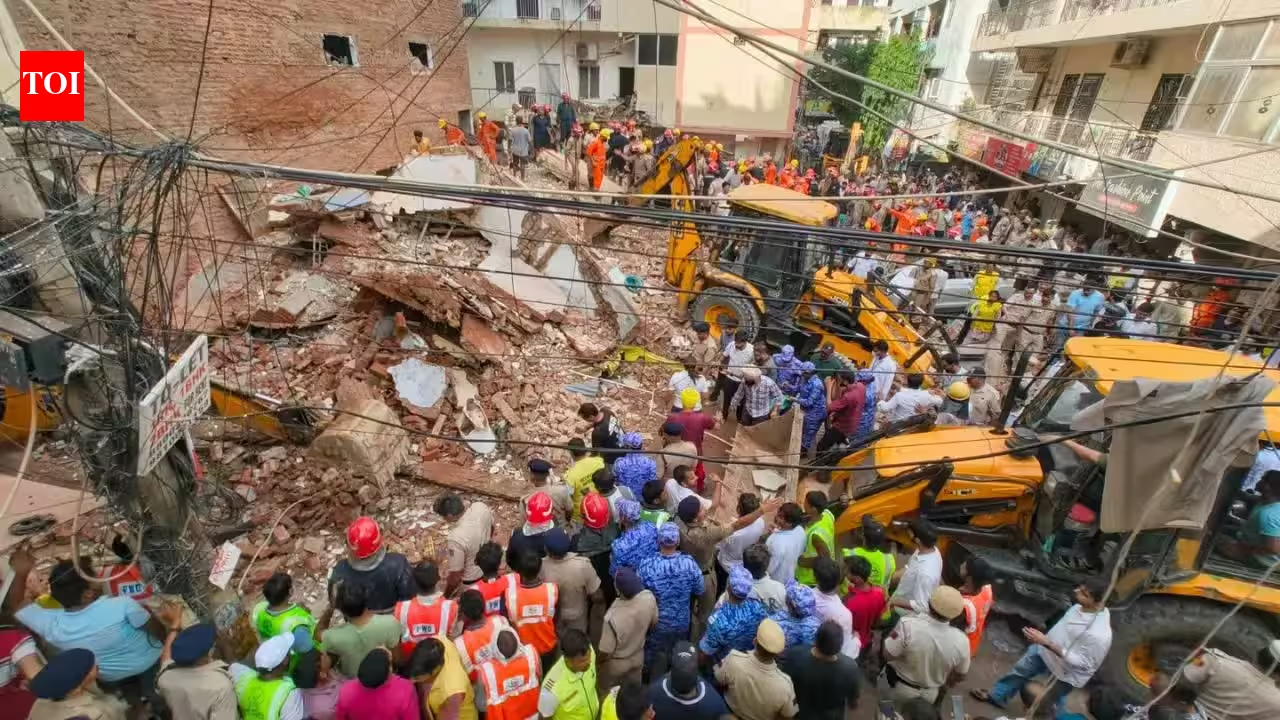
A multi-storey building being used as a boys’ paying guest accommodation collapsed around 1:30 pm on September 6, trapping students and other occupants beneath tonnes of concrete and rubble. What followed was an overnight operation involving the Delhi Fire Service, Delhi Police, National Disaster Response Force (NDRF), Delhi Disaster Management Authority and other emergency agencies.
By Monday morning, the death toll had climbed to six. At least 13 people had been rescued, according to reports citing officials, while several questions remained unanswered about the building’s condition, the renovation work reportedly underway inside it and whether construction and safety rules had been followed.
The rescue operation entered its second day as teams continued carefully clearing the debris.
Delhi building collapse: What happened in Satya Niketan?
The building, known as Hostel Daze, was being used as a student PG in the congested Satya Niketan area. Police said the structure was around four to five decades old and had a basement and multiple upper floors.
The collapse took place at around 1:30 pm while repair or renovation work was reportedly underway. Early accounts indicate that work was being carried out in the basement, although investigators have not yet established the precise technical cause of the collapse.
That distinction matters.
Initial suggestions that basement excavation or structural work triggered the failure are being examined, but they should not yet be treated as a final finding. Delhi Chief Minister Rekha Gupta said preliminary information pointed towards basement excavation and a possible structural failure, while authorities ordered a magisterial inquiry to establish what actually happened.
In other words, the tragedy has moved beyond a simple question of an “old building”. Investigators will need to determine whether ageing, alterations, overloading, foundation work, unauthorised construction, inadequate safety measures or a combination of factors contributed to the collapse.
Six dead, survivors pulled from the rubble
The casualty figures changed through the night as rescue teams worked through unstable debris.
AIIMS’ JPN Apex Trauma Centre reported receiving 11 patients following the collapse. Five were brought dead, while another critically injured patient subsequently died during treatment, taking the confirmed death toll to six. Three patients remained under treatment, according to the hospital update reported on Monday.
Reports also put the number rescued from the debris at 13, although the number of people taken to hospitals and the number physically rescued are not identical figures. This explains why early reports carried different numbers.
That discrepancy is important in a disaster where officials were initially trying to establish how many people were inside the PG.
Local accounts suggested that several dozen people could have been present, but the exact occupancy at the time of the collapse was initially unclear. One local account described a building with around 15 rooms, with two or three students sharing some rooms.
For rescue workers, that uncertainty made the search even more difficult.
A race against time inside a congested Delhi neighbourhood
Satya Niketan is not an easy location for a large-scale rescue operation. The area has narrow lanes, student accommodations, shops and closely packed structures.
Firefighters and rescue personnel had to work within a confined space while also taking precautions against further structural failure. Nearby structures were assessed and an adjoining building was evacuated after officials found it unsafe.
Rescue teams used heavy equipment to remove the collapsed material while specialist personnel searched for possible survivors.
The operation was not simply a matter of bringing in excavators and clearing everything quickly. With the possibility of survivors beneath concrete slabs, aggressive removal of debris can itself become dangerous.
That is why such operations often proceed in stages, with rescuers combining machinery, cutting equipment and manual search techniques.
There were also deeply human moments amid the chaos. A student trapped beneath the debris reportedly managed to call friends and share his location before being rescued and taken to hospital.
Such calls can make the difference between an unidentified casualty and a life saved.
What caused the Delhi building collapse?
This is perhaps the most important question, and investigators have not yet provided a final answer.
Police and government officials have pointed to renovation or repair activity as a significant line of inquiry. Reports indicate that work was being carried out in the basement shortly before the collapse.
The Chief Minister said preliminary information suggested excavation in the basement may have caused a pillar to shift. Delhi Minister Manjinder Singh Sirsa subsequently said information available to the government indicated that work in the basement of the decades-old building may have triggered the incident.
But preliminary suspicion is not the same as an engineering conclusion.
Investigators will have to examine the building’s original structural design, subsequent modifications, foundation condition, load-bearing elements, construction history and the nature of the work being carried out immediately before the collapse.
Local residents have also raised concerns about water accumulation in the basement and the condition of the foundation after days of rain. Those claims are part of the emerging picture, but they still require technical verification.
Questions over additional floors and building permissions
The investigation is also looking beyond the immediate renovation work.
Reports citing municipal officials and local residents have raised questions about whether the building had additional floors beyond what was originally permitted and whether construction rules were followed.
The Indian Express reported that construction of additional floors, repair work and the absence of adequate emergency arrangements were among the issues under scrutiny.
Another report said the structure was on a relatively small plot and that permissions may have covered a lower structure than what eventually existed. These allegations are now part of the wider investigation into the property.
This is where the Satya Niketan tragedy becomes bigger than one building.
If a structure was altered over the years without adequate structural assessment, the danger may not always be visible from the street. Additional floors, changes to internal walls, basement excavation or changes in how a building is used can alter the loads and stresses that its original design was intended to carry.
Determining whether any such changes occurred, and whether they were authorised, will therefore be central to the inquiry.
FIR registered against the building owner
Delhi Police have registered a case against the alleged owner and others in connection with the collapse.
The FIR cited provisions of the Bharatiya Nyaya Sanhita relating to culpable homicide, negligence connected with building construction or repair, and acts endangering life and personal safety. Police have also formed teams to trace people allegedly connected with the incident.
The legal process will now have to establish individual responsibility rather than simply identify a general failure.
That could include examining the owner, contractors, workers involved in the renovation, engineers, property managers and officials responsible for permissions or enforcement, depending on what the inquiry establishes.
Government orders magisterial inquiry
Chief Minister Rekha Gupta visited the site and ordered a magisterial inquiry.
The government has also indicated that officials found responsible for negligence or oversight failures will face action. On Monday, Gupta announced that the Delhi government and the Municipal Corporation of Delhi were working on a policy requiring periodic structural audits and safety certifications for buildings used for public activities, including PG accommodations, nursing homes and schools.
That announcement could prove significant.
PG accommodation has become a major part of Delhi’s student and migrant housing ecosystem, particularly around university campuses. Yet a building originally designed for one purpose can eventually be converted into a high-occupancy accommodation facility.
The safety requirements do not necessarily disappear simply because the property continues to look like an ordinary residential building.
MCD scrutiny widens after the collapse
The Municipal Corporation of Delhi has also moved against another structure in the area.
Officials evacuated and sealed an adjoining building after finding it in a dangerous condition. Separately, the MCD ordered demolition of another property in Satya Niketan, citing its “ruinous/dangerous condition”.
That response raises an uncomfortable question: how many other buildings in congested parts of Delhi are known, suspected or simply not yet identified as unsafe?
The answer cannot be obtained merely through post-disaster demolition.
A meaningful safety programme would require systematic identification of vulnerable buildings, independent structural inspections, records of renovation and alteration, occupancy checks and enforcement before a structure fails.
Satya Niketan’s larger safety problem
The collapse has exposed concerns that extend beyond the particular property.
Satya Niketan and surrounding areas have long been associated with student housing, PGs, rented rooms, eateries and other businesses. High demand for accommodation can encourage owners to maximise available space, sometimes putting pressure on buildings and infrastructure.
The Indian Express reported residents’ claims that the locality’s resettlement colony, comprising 299 houses, has witnessed multiple such incidents over the years.
There are also reports raising questions about other PG properties operated by the same accommodation provider, including narrow access routes, single entry-exit arrangements, locked gates and exposed electrical wiring. These observations do not establish that every nearby property is unsafe, but they demonstrate why authorities are now examining the wider accommodation network rather than treating the collapse as an isolated event.
The hidden risk in Delhi’s ageing buildings
Delhi’s building-safety problem is not new.
The capital contains a mixture of planned colonies, old settlements, unauthorised extensions, converted residential properties and densely occupied neighbourhoods. Over decades, some buildings undergo changes that were never part of their original design.
The danger becomes particularly serious when three things overlap: an ageing structure, high occupancy and construction or renovation without adequate structural assessment.
A building can appear stable for years and still become vulnerable when a load-bearing component is altered or when foundation-level work changes the way forces are distributed.
That is why structural engineers generally distinguish between cosmetic repair and work that affects the structural system. The latter requires careful assessment, engineering design and supervision.
The bigger question: who was watching?
The most difficult issue arising from the Satya Niketan collapse may not be whether one person made one mistake.
It is whether the system was capable of detecting the risk before people were inside the building.
A building safety regime is only as effective as its enforcement. Approval on paper means little if subsequent modifications are not monitored. A structural certificate has limited value if occupancy changes without fresh assessment. And a dangerous building notice has little protective value if action comes only after a collapse.
The government has now promised stricter audits and accountability.
The real test will come after the cameras leave Satya Niketan.
Political and student anger follows tragedy
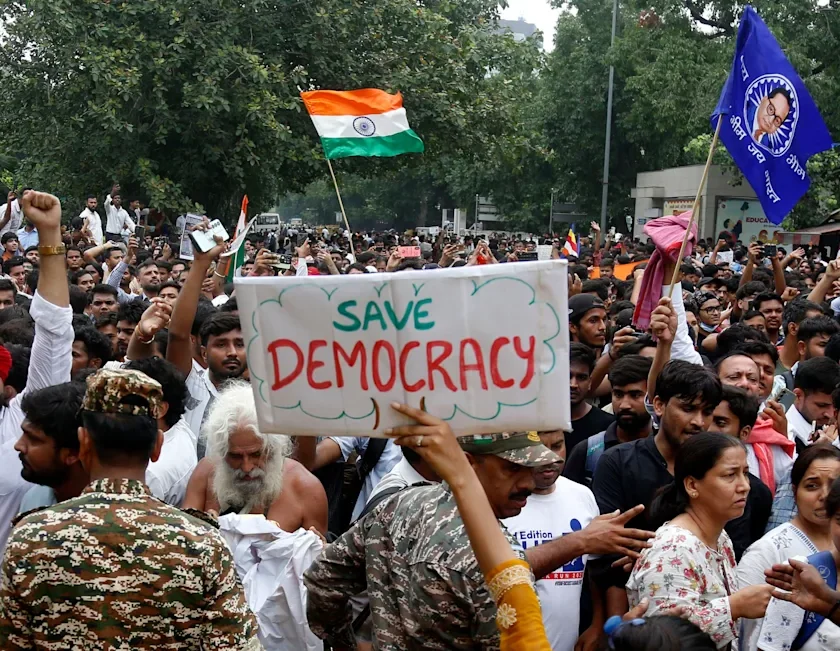
The collapse has also triggered protests, with student organisations demanding accountability and stronger safety checks for PG accommodations.
ABVP members protested at the MCD Civic Centre, while NSUI also raised questions over the safety of student housing and the rescue response.
Such political reactions are inevitable after a disaster, but the more consequential response will be administrative.
Will authorities inspect only buildings in Satya Niketan, or will the exercise extend across Delhi’s major student hubs?
Will PG operators be required to provide updated structural safety certificates?
Will unauthorised additional floors be identified before they become a danger?
And will municipal records be linked to actual occupancy and building use?
Those questions will determine whether the Satya Niketan collapse becomes another tragic entry in Delhi’s building-collapse history or a catalyst for a more systematic safety regime.
Rescue first, accountability next
For the teams still working through the rubble, the immediate priority remains simple: search every possible void and make sure nobody is left behind.
For the families of those who died, however, the rescue operation is only the beginning.
Six lives have already been lost. At least 13 people have been rescued, several requiring medical attention. Behind those numbers are students, families, friends and communities now waiting for answers.
The Satya Niketan building collapse is therefore not only a story about a structure that failed. It is a story about what happens when the safety of an urban building becomes dependent on assumptions rather than continuous inspection.
Delhi’s next challenge will be to ensure that structural safety is treated as a continuing responsibility, not an emergency response after concrete has already fallen.
The debris can eventually be removed.
The harder task will be removing the regulatory gaps that allowed the risk to remain hidden in the first place.