Mehbooba Mufti vs Sergio Gor: Why a US Ambassador’s Kashmir Visit Has Triggered a Fresh Political Debate
By: Javid Amin | 20 Aug 2026
Srinagar: A diplomatic visit that Washington could plausibly describe as an economic and tourism engagement has quickly turned into another argument over one of South Asia’s most sensitive political questions: who gets to speak about Kashmir, and on whose terms?
US Ambassador to India Sergio Gor visited Jammu & Kashmir on August 19, meeting Chief Minister Omar Abdullah in Srinagar before travelling onward to Ladakh. During the visit, Gor described Jammu & Kashmir as an “important part of India”, praised efforts by the Centre and the J&K administration to improve security and said Washington would consider reviewing its travel advisory for the region.
That statement was significant enough to trigger a diplomatic response from Pakistan.
But it was not welcomed by everyone on the Indian side either.
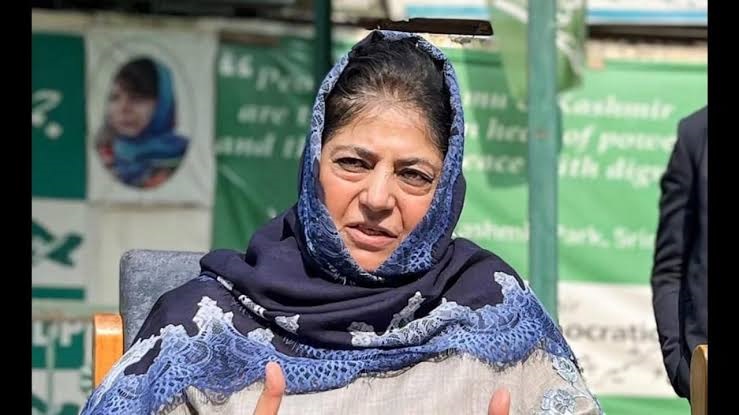
PDP president and former Jammu & Kashmir chief minister Mehbooba Mufti dismissed the importance of the American position, saying there was “no need to take the US seriously” and arguing that American interventions around the world had produced destruction rather than stability. She specifically referred to the US record from Vietnam to Iran.
Her response reveals something important about Kashmir’s political debate today.
The disagreement is not simply over whether the United States supports India.
It is over whether any foreign power should have a meaningful role in the Kashmir conversation at all.
And that distinction is crucial.
What Did Sergio Gor Actually Say in Srinagar?
The controversy began with the American ambassador’s visit.
Gor met Omar Abdullah in Srinagar on August 19. According to the ambassador’s account, discussions centred on expanding economic cooperation and creating opportunities for greater engagement between Jammu & Kashmir and the United States.
Omar Abdullah’s own account pointed to areas such as:
- tourism;
- horticulture;
- economic engagement; and
- broader India-US cooperation.
There was no public announcement of a US mediation initiative on Kashmir.
In fact, Gor’s public language moved in a direction that was politically favourable to India’s longstanding position.
He called Jammu & Kashmir an important part of India and praised security improvements made by the Centre and the local administration.
He also suggested Washington could reconsider its travel advisory for J&K.
That last point has practical importance.
A US travel advisory is not merely diplomatic language. It can influence how American tourists, businesses and institutions assess a destination.
For Kashmir’s tourism-dependent economy, any eventual reduction in the advisory could have economic consequences.
But Gor did not announce an immediate change.
He said the United States would review the advisory, meaning the process remains prospective rather than a completed policy shift.
Why Did Mehbooba Mufti React So Sharply?
Mehbooba’s response was not really about the tourism announcement.
It was about the larger principle behind foreign commentary on Kashmir.
Asked about Gor’s statement that J&K is an important part of India, she rejected the idea that Washington’s endorsement should matter.
Her argument was blunt: the US is not India’s “master” and does not need to issue a certificate before Kashmir’s political questions can be discussed.
She also pointed to America’s record of military intervention, citing Vietnam and Iran and arguing that US involvement has repeatedly produced destruction.
That is a political argument, not a legal assessment.
And it fits neatly into Mehbooba’s longstanding political position that Kashmir’s political questions cannot simply be reduced to security or territorial assertions.
Her criticism therefore operates on two levels:
First: Washington should not be treated as an authority that can validate India’s position.
Second: foreign intervention itself has a poor historical record and should not be welcomed as a solution.
There Is an Important Contradiction in Mehbooba’s Position
There is an interesting paradox here.
Mehbooba is rejecting foreign involvement while responding to a foreign diplomat’s statement about Kashmir.
That is not necessarily contradictory.
Her argument is essentially that foreign powers should not determine Kashmir’s political future, even if their statements about the region have political consequences.
This distinction matters.
A foreign ambassador visiting Kashmir is not the same thing as foreign mediation.
Diplomatic engagement, tourism cooperation and investment discussions are normal activities between governments.
Mediation is something very different: it implies an attempt to help resolve a political dispute between competing parties.
There is currently no evidence from the reported Gor-Abdullah meeting that Washington offered to mediate between India and Pakistan over Kashmir. The publicly described agenda focused on economic engagement and tourism.
So describing the visit itself as “US intervention in Kashmir” would go beyond the available evidence.
That distinction should remain central to responsible coverage.
Why the Timing Matters
Gor’s visit comes at a particularly sensitive moment.
Kashmir remains one of the most contested geopolitical issues between India and Pakistan.
At the same time, Washington’s relationship with both New Delhi and Islamabad has its own strategic calculations.
A senior US diplomat physically visiting Srinagar and then publicly describing J&K as an important part of India was therefore bound to attract attention.
The symbolism is particularly strong because this is not an ordinary diplomatic reception in New Delhi.
The ambassador went to the Valley.
He met the elected chief minister.
He spoke publicly about security.
And he discussed the possibility of reducing the American travel warning.
That creates an image of direct US engagement with the region, even if the agenda itself was largely economic.
Omar Abdullah Took a Very Different Approach
Omar Abdullah’s response has been notably more pragmatic.
Rather than rejecting the American visit, he used it to discuss economic opportunities.
The chief minister said the meeting was positive and focused on India-US relations and areas where the United States could engage with Jammu & Kashmir.
That position is politically useful for the National Conference government.
J&K needs investment, tourism and international economic confidence.
If a US ambassador visits Srinagar and subsequently signals that Washington may downgrade its travel warning, the administration has an obvious reason to welcome the development.
But Omar also appears to have been careful not to present the meeting as a negotiation over Kashmir’s political status.
That is an important balancing act.
He can welcome American economic engagement without inviting the impression that Washington has become a participant in J&K’s political dispute.
Congress Has Raised a Different Objection
Congress leader Tariq Karra offered another interpretation.
Karra said that if foreign diplomats are becoming involved in discussions around Kashmir, that reflects a failure of the Centre’s policy.
At the same time, he stressed that J&K is an integral part of India and argued that no foreign diplomat saying so is particularly extraordinary.
That position produces an interesting three-way split among Kashmir’s mainstream political actors.
PDP — Mehbooba Mufti
Rejects the relevance of US validation altogether.
NC — Omar Abdullah
Welcomes engagement, particularly economic and tourism cooperation, while keeping politics out of the meeting.
Congress — Tariq Karra
Accepts India’s position but questions why foreign diplomatic intervention has become necessary.
This is not a simple pro-US versus anti-US debate.
It is a debate over what kind of foreign engagement Kashmir should receive and what it says about India’s own diplomacy.
Pakistan’s Reaction Changes the Equation
The issue quickly moved beyond Srinagar.
Pakistan summoned the US chargé d’affaires after Gor’s remarks and lodged a formal protest.
Islamabad rejected the ambassador’s characterisation of J&K and reiterated its longstanding position that Kashmir remains a disputed territory whose final status should reflect relevant UN resolutions and the aspirations of Kashmiris.
This reaction demonstrates why even a seemingly simple phrase — “important part of India” — can carry diplomatic weight.
India has long maintained that Jammu & Kashmir is an integral part of the country.
Pakistan disputes that position.
Washington’s public language can therefore have consequences even when Washington itself is not attempting mediation.
That is exactly what happened here.
The Most Significant Shift May Be Washington’s Language
The potentially important part of Gor’s visit is not simply that he travelled to Srinagar.
It is how he described the region once he arrived.
Washington has historically maintained a careful diplomatic position on Kashmir, generally encouraging India and Pakistan to resolve outstanding issues through dialogue while avoiding language that would formally endorse either side’s sovereignty claim.
Gor’s description of J&K as an important part of India is therefore politically noteworthy.
But it should not automatically be interpreted as a formal change in US recognition policy.
There is a major difference between:
“Jammu & Kashmir is an important part of India”
and a comprehensive US declaration settling the legal status of the Kashmir dispute.
The former is what Gor said.
The latter did not happen.
That distinction is vital.
Why Mehbooba Invoked Vietnam and Iran
Mehbooba’s historical argument is part of a broader critique of American foreign policy.
By invoking US intervention in Vietnam and Iran, she is effectively saying:
Why should Kashmiris trust Washington’s involvement when American intervention elsewhere has often produced war, instability or long-term political disruption?
There is historical substance to parts of that argument, although the examples require nuance.
The Vietnam War involved massive US military intervention and caused enormous loss of life and destruction.
Iran presents a more complicated history, involving the 1953 CIA-backed overthrow of Prime Minister Mohammad Mosaddegh, decades of US-Iranian hostility, and later US military and economic pressure.
But lumping every US foreign intervention into a single category of “destruction” is ultimately a political judgement rather than a neutral historical conclusion.
That is precisely how Mehbooba was using it.
Her objective was not to produce a historical survey of American foreign policy.
It was to undermine the idea that Washington possesses special moral authority to speak about Kashmir.
The Historical Irony: America Has Been Involved in Kashmir Before
There is another layer that makes the present controversy more interesting.
The United States has not always stayed completely outside the Kashmir question.
During the Cold War and in later decades, Washington repeatedly encouraged India and Pakistan to pursue dialogue.
American administrations have also periodically expressed concern about tensions between the two nuclear-armed neighbours.
At moments of military crisis, Washington has sometimes played a diplomatic role in encouraging de-escalation.
The important distinction is that diplomatic engagement is not necessarily mediation, and mediation is not necessarily an attempt to impose a settlement.
Kashmir has historically attracted international diplomatic attention precisely because India and Pakistan are nuclear powers.
The challenge for Washington has always been to engage without appearing to internationalise a dispute that India insists is fundamentally bilateral or internal.
Why the US Travel Advisory Matters More Than the Political Soundbites
For ordinary Kashmiris, the most tangible consequence of Gor’s visit may have nothing to do with sovereignty.
It could be tourism.
The US has maintained a highly restrictive travel warning for much of Jammu & Kashmir.
Gor said Washington would examine whether the advisory should be downgraded because of improved security conditions.
That matters for the Valley’s tourism industry.
American travellers form only one segment of Kashmir’s international tourism market, but a US government downgrade can have a signalling effect.
Other international travellers, insurers, businesses and tour operators may interpret a change as evidence that security conditions have improved.
The economic chain could look like this:
Lower advisory → greater traveller confidence → more bookings → more international tourism → higher local economic activity.
But none of that is guaranteed.
Gor did not announce that the advisory had already been downgraded.
He only indicated that it would be reviewed.
And There Is a Second Security Dimension
Gor praised the Centre and the J&K administration for making the region safer.
That is politically significant because security remains one of the principal criteria behind foreign travel advisories.
It also creates an unusual situation.
A foreign diplomat is effectively acknowledging improvements in the security environment while a major section of Kashmir’s political class continues to argue that political grievances remain unresolved.
Both things can be true.
Security can improve without every political grievance disappearing.
That is an important distinction in understanding contemporary Kashmir.
Why Mehbooba’s Statement Matters for PDP
For Mehbooba Mufti, the statement also serves an important domestic political purpose.
The PDP has historically positioned itself as a regional voice advocating a political approach to Kashmir rather than relying exclusively on security measures.
Rejecting Washington’s involvement allows Mehbooba to reclaim a sovereignty-first and Kashmir-centred political identity.
Her message is essentially:
- Kashmir’s future cannot be outsourced;
- foreign governments should not define its political legitimacy;
- India’s government should address Kashmir directly;
- and American approval is neither necessary nor decisive.
That is a message likely to resonate with voters who are uncomfortable with both Pakistan’s claims and excessive international involvement.
But There Is a Political Problem for Mehbooba Too
Her criticism could also be interpreted as unnecessarily dismissive of an economic opportunity.
If the US ambassador is discussing tourism, horticulture and economic engagement rather than political mediation, rejecting the engagement wholesale could make the PDP appear opposed to international economic cooperation.
That is not necessarily what Mehbooba intended.
But politically, perception matters.
The smarter distinction would be:
Reject foreign mediation, welcome legitimate economic engagement.
Whether the PDP chooses to draw that line clearly will matter.
What Does the Visit Mean for New Delhi?
For the Centre, Gor’s remarks are broadly advantageous.
India has consistently rejected third-party mediation on Kashmir.
The ambassador’s description of J&K as an important part of India is therefore unlikely to create diplomatic discomfort in New Delhi.
The more interesting question is what happens next.
If Washington genuinely downgrades its travel advisory, New Delhi could point to that as evidence that international perceptions of security in Kashmir are improving.
If American economic engagement expands, it could further normalise international commercial interaction with the region.
But New Delhi will also want to ensure that economic engagement does not evolve into political involvement.
That distinction will likely remain central.
What Does Pakistan Fear?
Pakistan’s immediate reaction provides the answer.
Islamabad sees international recognition of India’s position as strategically damaging.
The Pakistani government’s formal protest demonstrates that even a statement by an ambassador about J&K’s status can be treated as a diplomatic event.
Pakistan therefore has an incentive to challenge such statements quickly.
But the episode also exposes a difficult reality for Islamabad:
If Washington’s language increasingly emphasises engagement with India and treats J&K primarily through the lens of tourism, security and economic cooperation, Pakistan has fewer opportunities to push Kashmir onto the international diplomatic agenda.
That does not mean the Kashmir dispute disappears.
It means the diplomatic terrain around it may be changing.
The Ladakh Leg of Gor’s Visit Is Also Significant
Gor did not stop at Srinagar.
He travelled to Ladakh after his Kashmir visit, marking a broader engagement with the two Union Territories.
That is strategically noteworthy.
Ladakh has a completely different geopolitical profile from Kashmir.
It borders China as well as Pakistan and sits close to one of Asia’s most militarised frontiers.
The ambassador’s visit therefore potentially gives Washington direct exposure to two different dimensions of India’s Himalayan frontier:
Kashmir — India-Pakistan tensions and tourism.
Ladakh — India-China strategic competition and border security.
Any future American engagement with the region will need to account for both.
The China Factor Should Not Be Ignored
It would be too early to claim that Gor’s visit represents a new American strategy toward Ladakh.
But the timing is notable.
India and China continue to manage a difficult border relationship following the 2020 Galwan clash.
Ladakh’s strategic significance has grown considerably since then.
An American ambassador visiting Ladakh after Srinagar inevitably puts the trip into a wider Indo-Pacific context.
Washington is increasingly interested in India’s strategic position vis-à-vis China.
But again, one should distinguish between strategic significance and evidence of a new US policy.
The latter would require more than one diplomatic visit.
The Bigger Question: Is Washington Changing Its Kashmir Policy?
Possibly — but the evidence is still incomplete.
There are three indicators worth watching.
Indicator One: Language
If senior US officials increasingly describe J&K explicitly as part of India, that would suggest a stronger rhetorical alignment with New Delhi.
Indicator Two: Travel advisories
A formal downgrade would be a concrete policy action rather than a diplomatic comment.
Indicator Three: Economic engagement
If Washington begins encouraging American companies, investors and tourists to engage more actively with J&K, the relationship would move beyond symbolism.
At present, the strongest confirmed development is the ambassador’s visit, his comments on J&K’s status, and his indication that the travel advisory may be reviewed.
It is too early to describe this as a wholesale US policy reversal.
What Could Happen Next?
Several developments are possible.
1. US travel advisory review
This is the most immediate measurable outcome.
If the advisory is downgraded, the move could benefit Kashmir’s tourism industry.
2. More American economic engagement
Tourism, horticulture and other sectors could become areas of practical cooperation.
3. Continued Pakistani diplomatic protests
If Washington continues using language favourable to India’s position, Islamabad is likely to respond.
4. Political attacks within J&K
PDP, Congress and NC may continue to interpret the visit differently, particularly around the question of foreign involvement.
5. Greater US engagement with Ladakh
The ambassador’s Ladakh visit could lead to greater interest in tourism, strategic geography and India-China border issues.
What Remains Unresolved
The biggest unresolved question is not whether the US ambassador supports India’s position.
He has now made his position on J&K’s importance to India unusually clear.
The deeper question is:
What does Washington actually intend to do with that position?
Will it remain diplomatic language?
Will it lead to a travel-advisory downgrade?
Will it bring more US economic activity?
Will Washington continue to avoid political mediation?
Or will future India-Pakistan crises force the United States back into a more active diplomatic role?
Those answers will tell us much more than one Srinagar press interaction.
Final Analysis: Mehbooba Has Reopened an Old Kashmir Argument
Mehbooba Mufti’s dismissal of US involvement is ultimately less about Sergio Gor personally than about the principle of external validation.
Gor came to Srinagar and said J&K is an important part of India.
New Delhi can welcome that.
Pakistan can protest it.
Omar Abdullah can use the visit to pursue tourism and economic opportunities.
But Mehbooba is asking a different question:
Why should Kashmir’s political future depend on what Washington thinks?
That argument has a long history.
And it carries political weight precisely because Kashmir has spent decades at the intersection of local aspirations, Indian sovereignty, Pakistani claims and international diplomacy.
The irony of the latest episode is that Gor may not have come to mediate Kashmir at all.
He came talking about economic engagement, tourism and security.
Yet the moment a US ambassador publicly described J&K as an important part of India, the old diplomatic fault lines reopened.
That tells us something important about Kashmir in 2026.
The politics of the region have changed dramatically since 2019, but the sensitivity surrounding external voices has not disappeared.
If Washington now follows through and lowers its travel advisory, the practical consequences could be positive for Kashmir’s tourism economy.
If it expands economic engagement, the relationship may become more substantial.
But if American officials begin moving from economic engagement into political mediation, Mehbooba’s warning — and New Delhi’s traditional objection to third-party involvement — will become much more consequential.
For now, the evidence points to a diplomatic and economic opening, not an American mediation initiative.
And that distinction may be the most important fact to keep in view as the political noise around the visit grows.