NC-BJP Face-Off in Srinagar: Where Did the Power Tilt as Police Held Back One Protest and Cleared the Way for Another?
By: News Desk | 02 September 2026
Srinagar: By Wednesday morning, Srinagar had begun to look less like a city preparing for a political demonstration and more like a city preparing for a controlled confrontation.
Barricades appeared at strategic points. Police and security personnel were deployed around sensitive locations. Movement towards the BJP office in Jawahar Nagar was restricted as the National Conference prepared its counter-protest, while BJP workers were mobilising for a march from Lal Chowk towards the Civil Secretariat.
On paper, both were political protests.
On the ground, however, the day’s events raised a more uncomfortable question:
Was the law-and-order machinery applying the same yardstick to both sides?
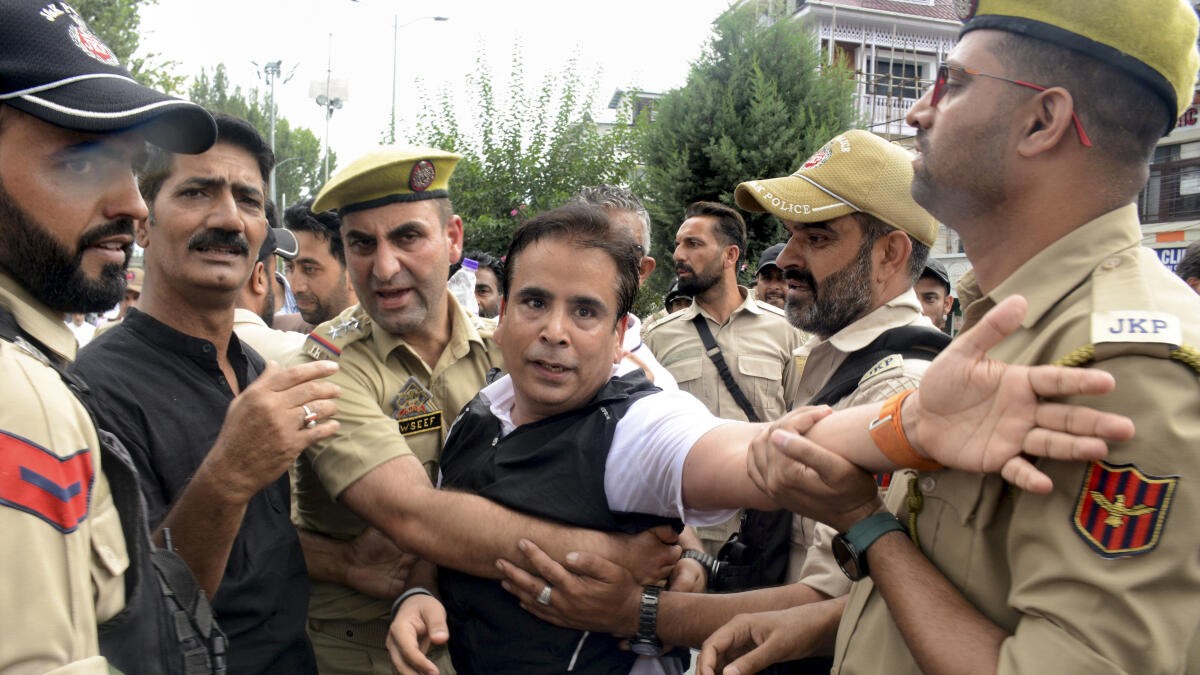
That question quickly became part of the political conversation as National Conference leaders and workers faced police restrictions around their planned protest, while the BJP proceeded with its mobilisation towards the Civil Secretariat.
The government and police have a straightforward explanation for such restrictions: preventing rival political workers from confronting one another, maintaining traffic movement and avoiding a breach of peace.
But politics in Jammu and Kashmir rarely ends with the official explanation.
The visible contrast in how the two demonstrations unfolded has prompted questions among NC supporters and political observers over whether the administration’s approach was genuinely neutral or whether the balance of enforcement appeared tilted.
That perception, whether ultimately proved or disproved, matters.
Because in a politically sensitive region, the appearance of unequal treatment can itself become a political issue.
A Tale of Two Protest Routes
The day’s political geography told its own story.
The BJP planned to assemble at Ghanta Ghar in Lal Chowk before marching towards the Civil Secretariat. Its target was the Omar Abdullah government.
The National Conference, meanwhile, announced a counter-protest outside BJP offices in Srinagar and Jammu, seeking to put pressure on the BJP over statehood and other pending demands.
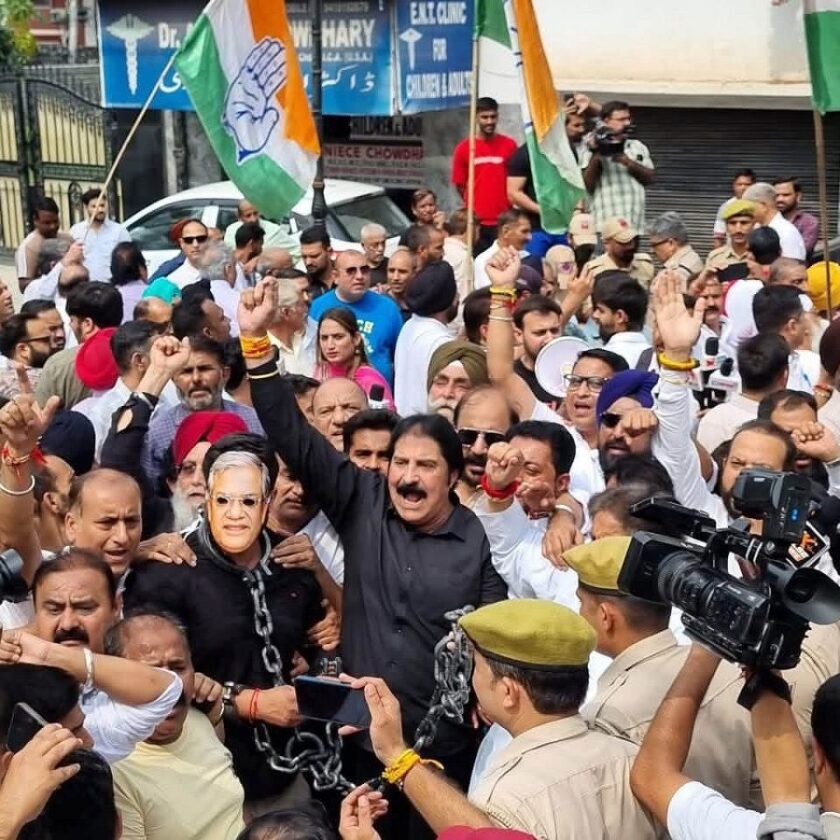
But as NC workers moved towards the BJP office in Jawahar Nagar, police restrictions became increasingly visible.
Roads were blocked.
Vehicles were stopped.
Barricades were erected.
Security personnel were deployed in large numbers around the BJP office and adjoining areas.
The immediate official objective was clear: prevent the two sides from coming face to face.
Yet the political optics were harder to control.
One side appeared to be moving towards the government.
The other was being prevented from reaching the office of its political opponent.
For the NC, that distinction became evidence of what it described as unequal treatment.
For the administration, it was a law-and-order calculation.
The difference between those two interpretations is at the heart of Wednesday’s controversy.
Did Police Facilitate the BJP?
The allegation needs to be treated carefully.
There is a difference between police providing a security corridor for a political programme and police deliberately favouring one political party.
The first can be a legitimate policing requirement.
The second would require evidence.
What can be examined, however, is what happened on the ground.
The BJP’s planned march towards the Civil Secretariat required crowd management along a public route through central Srinagar. The police presence around Lal Chowk and other sensitive locations was therefore part of managing the march.
At the same time, police restricted movement around the BJP headquarters in Jawahar Nagar ahead of the NC protest.
That produced an unmistakable visual contrast.
The BJP’s protest was directed at the elected government.
The NC’s protest was directed at the BJP.
Yet the BJP’s programme was able to proceed as a major public mobilisation, while the NC’s movement towards the BJP office encountered restrictions.
The question is therefore not necessarily whether police “helped” the BJP.
The sharper question is:
Were comparable restrictions imposed on both political formations, at comparable points, for comparable reasons?
That is the standard by which neutrality should ultimately be judged.
The Ground Reality Was More Complicated Than the Slogans
Political speeches tend to reduce complicated situations into simple narratives.
At ground level, Wednesday’s Srinagar confrontation was anything but simple.
Police had to prevent BJP and NC workers from physically confronting one another.
Srinagar’s roads could not simply be allowed to become unrestricted political corridors.
Lal Chowk is one of the busiest and most politically sensitive areas of the city.
Jawahar Nagar houses important government and political establishments.
A march towards the Civil Secretariat carries obvious security implications.
A gathering outside a major political party’s office can equally create the possibility of confrontation.
From a policing perspective, restrictions were therefore predictable.
The problem begins when political parties believe that those restrictions are selective.
Once that perception takes hold, every barricade becomes political.
Every stopped vehicle becomes evidence.
Every cleared road becomes a political statement.
And every police deployment is interpreted through the lens of partisan suspicion.
NC’s Complaint: Why Stop Us at the BJP Office?
For the National Conference, the question was straightforward.
If the BJP was allowed to mobilise against the elected government, why should NC workers be prevented from approaching the BJP office to protest against the Union government’s position on statehood?
The NC’s political argument is particularly pointed because the BJP occupies two different positions in the J&K power structure.
In the J&K Assembly, it is the principal opposition force.
At the national level, it heads the Union government.
That distinction matters enormously in the statehood debate.
The Omar Abdullah government cannot itself restore statehood.
The ultimate decision lies with the Union government.
Therefore, when the NC takes its statehood campaign to a BJP office, it can argue that it is confronting the political party that controls the government at the Centre.
The BJP, on the other hand, argues that Omar Abdullah’s administration must answer for governance issues within J&K.
Both arguments have a constitutional and political basis.
The disagreement is over where accountability should be demanded.
BJP’s Counter-Argument: We Are the Opposition in J&K
The BJP’s response is equally straightforward.
The Omar Abdullah government was elected to govern Jammu and Kashmir.
Employment, recruitment, public services, electricity and administrative performance fall substantially within the sphere of the elected government.
Therefore, the BJP says it has every right to protest against the J&K administration.
This is the central political calculation behind its September 2 march.
Rather than allowing the day’s conversation to revolve exclusively around statehood, the BJP wants voters to ask questions about everyday governance.
The party has raised unemployment, alleged recruitment irregularities, corruption allegations, outsourcing of government work, electricity tariffs and delays in local elections.
These allegations should not be treated as established facts unless backed by official investigations or judicial findings.
But they are politically potent.
Because they move the conversation from constitutional history to household economics.
And Then There Is the Electricity Bill
Perhaps the most tangible issue in the BJP’s campaign is electricity.
The Joint Electricity Regulatory Commission approved an average 6.83 per cent tariff increase for 2026-27, with the revised rates taking effect from September 1.
That means consumers were beginning to see the new tariff structure at precisely the moment political parties were taking their battle onto the streets.
For a political party in opposition, the timing is almost ideal.
Electricity is not an abstract constitutional question.
It arrives every month in a bill.
A household can debate Article 370 for years.
But an increased electricity bill is immediately felt.
The BJP has attempted to turn that economic pressure into a political argument against the NC government.
The NC, meanwhile, has sought to keep the focus on larger questions of statehood and political rights.
The ordinary consumer sits somewhere between the two arguments.
The bill still has to be paid.
The Politics of Barricades
In Kashmir, barricades have acquired a political meaning beyond traffic management.
For years, residents have become accustomed to checkpoints, security cordons, road closures and restrictions around sensitive political occasions.
That makes the psychology of Wednesday’s events important.
When a road is closed, people do not necessarily see only a security arrangement.
They may see a restriction.
When political workers are stopped, their supporters may see suppression.
When another group appears to move forward, supporters may interpret that as preferential treatment.
Whether those perceptions are objectively correct is a separate question.
But they influence public confidence.
And policing ultimately depends not only on enforcement but also on public trust.
The Question of Selective Enforcement
This is where the administration faces its most difficult test.
Neutrality in policing does not necessarily mean treating every protest identically.
Different locations can require different security arrangements.
Different crowd sizes can require different restrictions.
Different routes can carry different risks.
The police can legitimately prevent one gathering from approaching another if there is a credible threat of confrontation.
But neutrality requires a consistent principle.
If one political party is stopped from entering an area on security grounds, the same security rationale must be capable of explaining why another party is allowed to occupy or pass through a comparable public space.
Otherwise, the administration leaves itself vulnerable to the charge of political selectivity.
That is precisely what the NC is now alleging.
The answer cannot simply be that the police were maintaining law and order.
The more important question is:
Whose law-and-order risk was being managed, and how?
Ground Zero: The Public Was Not Asking for Another Political Show
Away from party offices and political speeches, Srinagar’s residents had more immediate concerns.
Traffic disruption.
Road closures.
Delays.
Security checks.
Diversions.
The uncertainty that comes whenever rival political groups take to the streets.
For shopkeepers, political protests can be particularly disruptive.
For commuters, the issue is even simpler.
They need to get from one part of the city to another.
A political party may call its demonstration historic.
A police officer may call the deployment necessary.
A television channel may call the confrontation dramatic.
But for someone trying to reach work, a blocked road is simply a blocked road.
That is the gap between political theatre and ordinary life.
The Missing Question: What Did the Protests Actually Achieve?
Once the crowds disperse, the political parties will claim success.
The BJP can say it demonstrated its strength and highlighted governance failures.
The NC can say it defended statehood and exposed what it considers the Centre’s failure to deliver on commitments.
But what changed?
Did electricity tariffs fall?
Did a recruitment dispute disappear?
Was a new employment policy announced?
Did statehood move closer?
Did the protests produce a new timetable?
Did the Union government give a concrete assurance?
If the answer to these questions is no, then the protests achieved something different.
They achieved political visibility.
And political visibility is not insignificant.
Parties need it.
Opposition parties especially need it.
But visibility should not be confused with governance.
The Real Power Struggle Is Bigger Than NC vs BJP
The confrontation is often presented as a battle between the National Conference and BJP.
But the deeper contest is over who gets to define Jammu and Kashmir’s political agenda.
The NC wants the public conversation to revolve around:
Statehood.
Political rights.
Constitutional safeguards.
Accountability of the Union government.
The BJP wants the conversation to revolve around:
Jobs.
Recruitment.
Electricity.
Corruption allegations.
Administrative performance.
Local democracy.
Both are trying to change the subject on which the other is strongest.
That is sophisticated electoral politics.
And it explains why the confrontation has become so intense.
The Omar Abdullah Government Is Caught in a Difficult Position
For Chief Minister Omar Abdullah, the political equation is particularly complicated.
His party cannot abandon statehood.
It has been one of the National Conference’s principal political demands since the reorganisation of Jammu and Kashmir.
But statehood is not controlled by the J&K government.
At the same time, Omar Abdullah’s government is directly responsible for many of the administrative issues now being raised by the BJP.
That gives the opposition an opportunity.
Whenever the Chief Minister talks about statehood, the BJP can ask about jobs.
Whenever he attacks the Centre, the BJP can ask about governance.
Whenever the government highlights its electoral mandate, the opposition can challenge its performance.
The Chief Minister therefore has to fight on two fronts.
The BJP Has Its Own Accountability Problem
But the BJP cannot escape the other side of the equation.
The party controls the Union government.
The Union government controls the broader constitutional and administrative framework surrounding Jammu and Kashmir.
Statehood remains a central political demand.
The Supreme Court has already called for statehood to be restored at the earliest and as soon as possible.
That leaves the BJP with a difficult question of its own:
If statehood is eventually to be restored, what is the timeline?
Simply saying that it will happen “at an appropriate time” may not satisfy political opponents or the public indefinitely.
The longer the uncertainty continues, the more politically useful the issue becomes for the NC.
Is This Political Theatre?
There is certainly an element of political theatre in the confrontation.
But calling the entire episode theatre would be too easy.
For the BJP, street mobilisation is part of opposition politics.
For the NC, counter-mobilisation is a way to pressure the Centre.
For both parties, demonstrations generate visibility.
But political theatre becomes dangerous when the spectacle begins to substitute for institutional work.
The Assembly exists.
Parliament exists.
Regulatory institutions exist.
Courts exist.
Administrative departments exist.
Political parties have multiple mechanisms through which they can pursue their demands.
Street protests should strengthen democratic accountability, not become the only visible form of political engagement.
The Bigger Concern: Public Trust in Institutions
Perhaps the most serious consequence of Wednesday’s events is not the political argument itself.
It is the question of institutional neutrality.
People may disagree with a government.
They may disagree with a political party.
They may even disagree with a police decision.
But democracy becomes fragile when citizens begin to believe that institutions are working for one political side.
That is why allegations of selective policing should not simply be dismissed as partisan rhetoric.
They should be answered transparently.
If restrictions were imposed on the NC for security reasons, the administration should explain those reasons.
If similar restrictions were imposed on the BJP, that should be made clear as well.
If routes were opened or closed because of specific intelligence inputs, the public may not need sensitive operational details — but the governing principle should be understandable.
Neutrality must not only exist. It must be visible.
What Srinagar Saw on September 2
The political battle in Srinagar ultimately revealed three different realities.
The first was the reality of party politics.
The NC and BJP are preparing for a prolonged confrontation.
The second was the reality of state power.
Police and security forces remain central to how political activity is managed in Jammu and Kashmir.
The third was the reality of ordinary life.
People still had to navigate barricades, traffic restrictions and political mobilisation while going about their daily business.
These three realities rarely align.
And that is where public frustration begins.
Beyond the Barricades
The most important question emerging from the NC-BJP confrontation is therefore not which party held the bigger protest.
It is not even whether one side succeeded in outmanoeuvring the other.
It is whether Jammu and Kashmir’s political system can move beyond perpetual confrontation.
The National Conference has a responsibility to govern effectively while continuing its campaign for statehood.
The BJP has a responsibility to scrutinise the government while answering for the decisions of the Union government it leads.
The police have a responsibility to maintain public order without allowing perceptions of political favouritism to take root.
And the public has a right to ask all three a simple question:
Where does this leave us?
Because when the speeches are over, the barricades are removed and political workers return home, the citizen is still left with the same questions.
Where are the jobs?
When will statehood return?
Why are electricity costs rising?
When will local elections happen?
What is being done about infrastructure?
Who is accountable when recruitment or governance fails?
And, perhaps most importantly:
Can institutions be trusted to treat every political voice by the same rules?
That is the question that Wednesday’s street confrontation has left hanging over Srinagar.
The slogans will fade.
The photographs will disappear from front pages.
The political leaders will move on to their next campaign.
But the credibility of institutions is harder to rebuild once it is lost.
For Jammu and Kashmir, that may be the real story behind the barricades.