J&K Medical Interns’ Stipend Protest: Why MBBS, BDS Doctors Are Demanding ₹30,000 a Month
By: News Desk | 02 September 2026
Srinagar: The protest by MBBS and BDS interns across Jammu & Kashmir has entered its fourth day, bringing a long-pending stipend dispute into sharper focus and drawing support from opposition political parties.
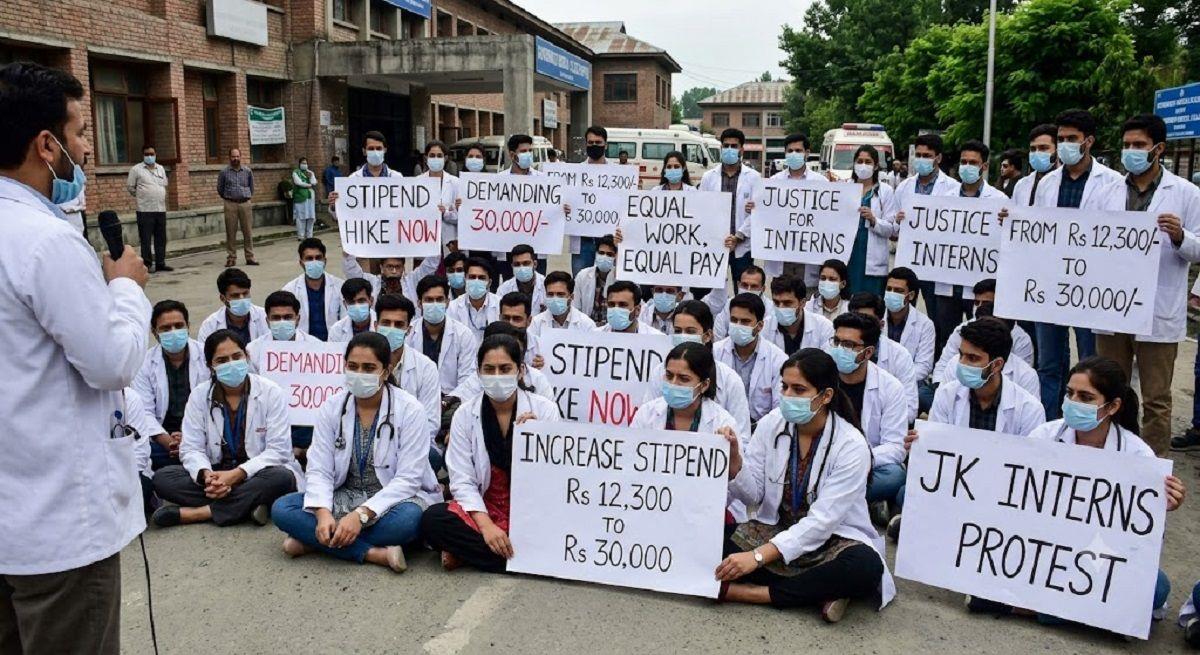
Hundreds of medical interns have suspended routine duties and launched an indefinite strike, demanding that their monthly stipend be increased from the existing ₹12,300 to ₹30,000. The interns say the present amount has remained unchanged for nearly seven years despite rising living costs, long hospital duties and repeated representations to the authorities.
The agitation is being held across government medical institutions, including Government Medical College (GMC) Srinagar, GMC Jammu, GMC Baramulla, GMC Anantnag, GMC Rajouri, GMC Handwara and SKIMS Medical College, Bemina. Interns have also held candlelight demonstrations and overnight vigils as the strike continues.
What began as a demand for a stipend revision has now become a wider conversation about medical training, working conditions and the treatment of young doctors entering Jammu & Kashmir’s public healthcare system.
MBBS, BDS interns demand hike from ₹12,300 to ₹30,000
The central demand is straightforward.
Interns want their monthly stipend increased to ₹30,000.
They currently receive ₹12,300 a month, an amount that protesters say has remained unchanged for almost seven years. At roughly ₹400 a day, interns argue that the stipend no longer reflects either the cost of living or the responsibilities attached to compulsory clinical training.
The interns’ argument is based on the nature of their duties.
During internship, MBBS and BDS graduates work in hospital departments and participate in patient care under the supervision of senior medical professionals. Protesters say their duties include emergency services, outpatient departments, wards, night duties and postings outside major urban centres.
Some interns have reported working shifts extending to 24, 36 and, in some accounts, even longer hours.
For interns posted away from their homes, the stipend also has to cover accommodation, food, transport and other basic expenses.
That has become one of the principal reasons behind the demand for revision.
The protest has spread across Jammu and Kashmir
The agitation is not confined to one medical college.
MBBS and BDS interns have joined the strike across government medical institutions in both Jammu and Kashmir divisions.
Reports from the ground show demonstrations at GMCs and SKIMS institutions, with interns gathering on hospital campuses and outside administrative buildings.
In Srinagar, interns at GMC Srinagar and SKIMS Bemina have held demonstrations and night vigils. In Jammu, interns have staged dharnas and demonstrations near government medical college facilities. Similar protests have been reported from medical colleges in Baramulla, Anantnag, Rajouri and Handwara.
The coordinated nature of the agitation is significant.
Rather than being an isolated college-level dispute, the demand has developed into a Union Territory-wide movement involving both medical and dental interns.
A demand that has been pending for years
The interns’ frustration is rooted in the length of time the issue has remained unresolved.
According to the protesting interns, the existing ₹12,300 stipend has remained unchanged for around seven years.
The issue has also gone through government-level consideration.
Interns have referred to a committee constituted by the Health and Medical Education Department in 2023, which recommended an increase in the stipend. Reports citing the protesters say the recommendation was around ₹25,000 for 2025-26, while a figure of approximately ₹26,300 was subsequently discussed during the 2026 Assembly proceedings.
Another account cited by the Jammu and Kashmir Students Association puts the committee recommendation at ₹26,350.
The different figures reported from the earlier recommendations reflect the evolution of the proposal rather than the interns’ current demand.
The demand now being pressed through the strike is ₹30,000 per month.
The central grievance remains that a proposed revision has not translated into an implemented stipend order.
Why interns say ₹12,300 is no longer adequate
The economic argument is difficult to separate from the working conditions.
A medical internship is a compulsory stage of professional training. It places young doctors inside hospitals at a point when they are acquiring practical experience while also contributing to day-to-day patient services.
Interns say they are routinely involved in emergency departments, OPDs, wards, procedures and other clinical responsibilities.
The workload becomes particularly demanding during night duties and extended shifts.
The interns’ contention is that the present stipend does not adequately compensate for the time spent in hospitals or cover basic expenses associated with their postings.
A doctor quoted during the protests said the current stipend amounts to only about ₹400 a day.
That figure has become a recurring symbol of the protest.
The argument from the interns is not that internship should be treated as a regular salaried medical post. It is that the stipend attached to compulsory clinical training should reflect the economic conditions and responsibilities under which the training is carried out.
Comparison with other states has strengthened the demand
The interns are also pointing to differences in stipend levels across India.
Protesters have said interns in several other states receive substantially higher monthly stipends, with figures in some states reaching ₹25,000 to ₹45,000 depending on the institution and state.
The comparison has become one of the strongest arguments behind the ₹30,000 demand.
Interns performing similar clinical duties across government hospitals want the stipend structure in Jammu & Kashmir to be brought closer to prevailing levels elsewhere.
Their argument has been framed around equal treatment for comparable work and responsibilities.
The disparity has also added urgency to the issue because many of these interns are at the beginning of their professional careers and are already carrying educational and personal financial obligations.
Opposition parties rally behind the protesting interns
The protest has quickly attracted political support.
The PDP has openly backed the interns’ demand.
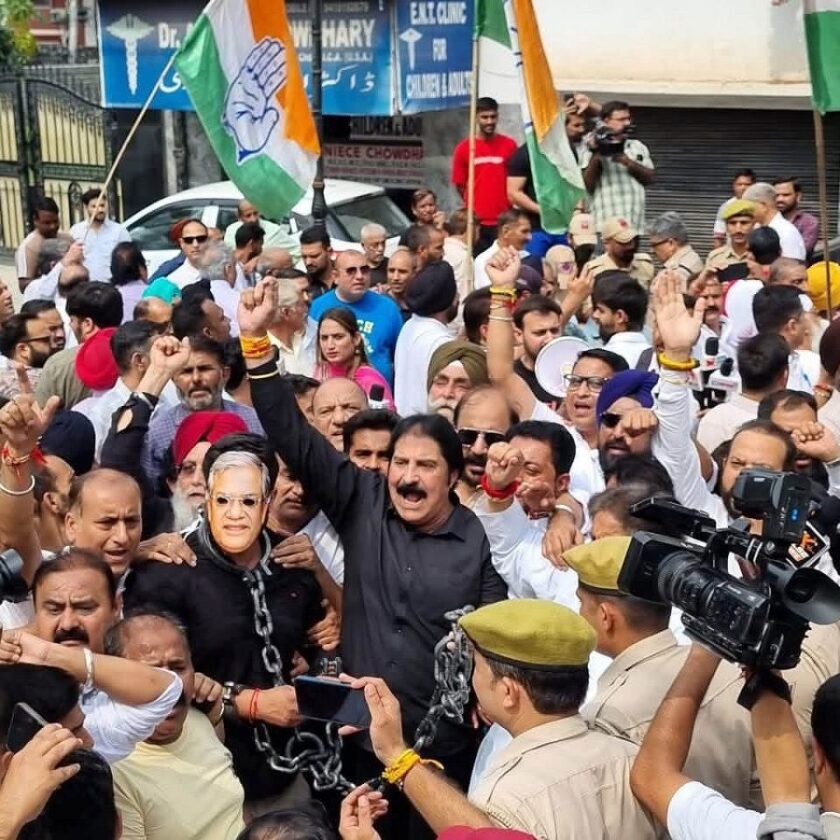
PDP leader Iltija Mufti joined protesting MBBS and BDS interns at GMC Srinagar on September 1 and called for the stipend to be raised from ₹12,300 to ₹30,000. She urged the government to begin a meaningful dialogue with the interns and resolve the issue.
PDP president and former Jammu & Kashmir chief minister Mehbooba Mufti subsequently joined the protesting interns during an overnight vigil at GMC Srinagar.
On September 3, the Indian Express reported that Mehbooba described it as painful to see young medical professionals working extended shifts being forced to protest for what she described as a basic right. She also appealed to Chief Minister Omar Abdullah to meet the interns and address their concerns.
The Apni Party, led by Altaf Bukhari, has also supported the demand.
Bukhari said the interns’ demand for a fair and adequate stipend was justified and urged the government to resolve the matter without further delay. He specifically referred to the services being provided by interns at government medical colleges and SKIMS Bemina.
The political support has consequently broadened the issue from a professional demand into a prominent public policy debate.
Congress has also raised the issue with the government
The demand has not been limited to opposition parties.
Jammu & Kashmir Pradesh Congress Committee chief Tariq Hameed Karra wrote to Chief Minister Omar Abdullah seeking immediate consideration of the interns’ demand.
Karra highlighted the demanding nature of internship duties, including extended shifts, and urged the government to address the issue sympathetically.
This is significant because Congress is part of the ruling arrangement in Jammu & Kashmir.
The stipend dispute has therefore attracted political attention both from opposition leaders and from within the broader governing alliance.
The government is under pressure to resolve a file that has been pending
The interns say the biggest frustration is not simply the amount of money involved.
It is the prolonged administrative delay.
According to statements from protesting interns, the proposed stipend revision has moved between government departments without producing a final order.
Interns have said they were unable to obtain a clear answer about where the proposal stood, with different departments being mentioned during their attempts to seek an update.
That uncertainty has contributed to the decision to launch an indefinite strike.
The protesters are seeking a written assurance, rather than another verbal commitment.
Their position is that the matter has already been discussed for years and requires an implemented government decision.
The strike puts healthcare services under pressure
The protest has an immediate consequence for government hospitals.
Medical interns form part of the hospital workforce, particularly in departments where large patient volumes require continuous assistance.
Their responsibilities vary by institution, but protesters have said they regularly assist in emergency departments, wards, OPDs and other clinical areas.
The suspension of routine duties therefore creates additional pressure on resident doctors, consultants and other healthcare workers.
This is especially relevant in government hospitals, where patient loads can be substantial.
The interns’ demand has consequently created a difficult situation for the administration: resolving the stipend issue while ensuring that patient services remain uninterrupted.
So far, the protest has remained focused on the stipend demand, with demonstrations largely taking place on institutional campuses.
The health sector debate goes beyond the stipend
The dispute has also exposed a broader question about the treatment of young medical professionals in Jammu & Kashmir.
Internship is the transition point between medical education and professional practice.
It is when newly qualified MBBS and BDS graduates begin handling the practical realities of hospitals, including emergencies, patient communication, clinical procedures and the pressures of continuous healthcare delivery.
A prolonged dispute over basic compensation can affect how young professionals perceive the public healthcare system at the beginning of their careers.
The issue therefore has implications for morale as well as money.
Young doctors entering government hospitals need a working environment in which their training is structured, their duties are clearly defined and their financial support reflects the realities of their postings.
Why the ₹30,000 demand has become the focal point
The interns’ demand is not simply an arbitrary increase.
It combines three arguments:
Inflation: The ₹12,300 stipend has remained unchanged for years while the cost of food, accommodation, transport and other necessities has risen.
Workload: Interns say they are performing demanding clinical duties, including extended and night shifts.
Parity: Interns want Jammu & Kashmir’s stipend to be brought closer to what medical interns receive in other parts of India.
Together, these arguments form the basis of the ₹30,000 demand.
The government now has to determine the appropriate stipend based on its own financial and administrative assessment and the recommendations already considered by the Health and Medical Education Department.
The political stakes are growing
The presence of senior political leaders at the protests has changed the visibility of the issue.
For the opposition, the dispute provides a direct way to raise concerns about youth employment, healthcare administration and government responsiveness.
For the government, the issue is more complicated.
A stipend revision would have financial implications across government medical and dental institutions. At the same time, allowing an indefinite protest by medical interns to continue creates pressure on healthcare delivery and risks turning a professional grievance into a larger political confrontation.
The issue has therefore acquired significance well beyond the monthly amount being demanded.
It is now a test of how quickly the administration can respond to a long-pending demand from a professional group working inside the public healthcare system.
What the interns are asking for now
The protesters have made their immediate position clear.
They want:
- The monthly stipend increased from ₹12,300 to ₹30,000.
- Implementation of a revised stipend through a formal government order.
- Resolution of the issue without further administrative delay.
- Recognition of the workload and responsibilities attached to compulsory internship.
- A structured mechanism for future revision of the stipend.
The interns have continued their agitation while political leaders have urged the government to open dialogue.
Reports on September 2 indicated that the strike had entered its third day, with candle marches and demonstrations continuing at government medical institutions.
By September 3, the protest was continuing, with Mehbooba Mufti joining an overnight vigil at GMC Srinagar.
J&K medical interns’ protest is now a test of government response
The MBBS and BDS interns’ agitation has brought an old administrative issue back into public view.
The present stipend of ₹12,300 has remained unchanged for years, according to the protesting interns. A government committee considered a revision in 2023, and higher figures were subsequently discussed, but the proposed increase has not been implemented.
The interns have now moved from representations to an indefinite strike.
Their demand is ₹30,000 a month.
Political parties have joined the discussion, senior opposition leaders have appeared at protest sites and the issue has begun attracting wider public attention.
The central question for the Jammu & Kashmir administration is now straightforward: how quickly can it settle a stipend dispute that has already been under consideration for several years while protecting essential hospital services?
For the interns, the protest is about more than an increase in monthly payment.
It is about whether the public healthcare system recognises the work, time and responsibility expected from young doctors at the very beginning of their professional careers.
And for the government, the resolution will set an important precedent for how long-pending demands in the health sector are handled — through another round of assurances, or through a decision that finally reaches the hospital floor.