Jammu’s Parade Sabzi Mandi Demolition Sparks Trader Anger Over ₹5.88 Crore Redevelopment
By: News Desk | 09 Aug 2026
JAMMU: The demolition of shops at the historic Parade Sabzi Mandi has brought an old question back into sharp focus: when a city modernises its markets, what happens to the people whose livelihoods are built around them?
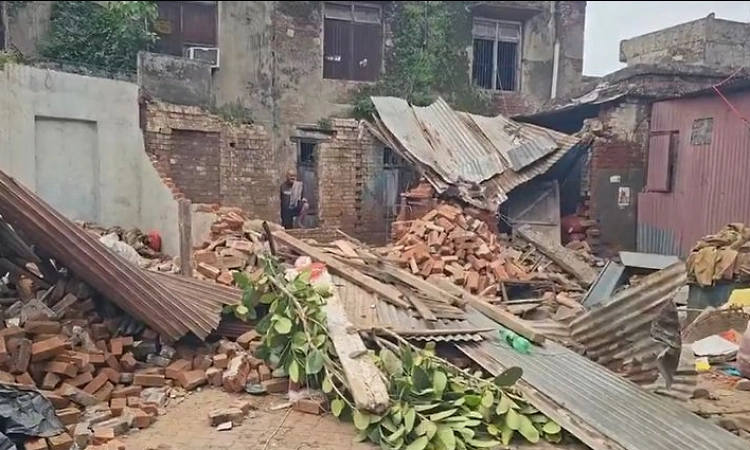
A demolition drive at the Jammu market has triggered anger among traders, who allege that shops were removed without adequate prior notice, rehabilitation arrangements or clarity over their future vending space.
The action comes against the backdrop of a much larger redevelopment plan.
The Jammu Municipal Corporation (JMC), along with the Jammu Smart City framework, is undertaking a ₹5.88-crore redevelopment project designed to transform the traditional vegetable market into a more organised, hygienic and weather-protected commercial space.
The official plan is substantial. It includes a covered Mild Steel shed with 117 vendor platforms, 44 permanent commercial shop blocks, upgraded drainage, new public amenities, improved circulation areas and a redesigned entrance. JMC officially announced the project in June 2026, when its foundation stone was laid in the presence of Jammu East MLA Yudhvir Sethi and JMC Commissioner and Jammu Smart City CEO Dr Devansh Yadav.
But for traders, the question is not only what the market will look like after redevelopment.
It is what happens between demolition and completion.
A Historic Market Caught Between Safety and Livelihood
Parade Sabzi Mandi is more than a collection of vegetable stalls.
It is part of Jammu’s commercial memory.
For generations, residents have visited the market for everyday vegetables and fresh produce, while small traders have depended on its location and established customer base.
That makes redevelopment economically different from constructing a new commercial complex on vacant land.
A market already has an ecosystem.
There are vendors, wholesalers, retailers, loaders, transporters, helpers, customers and suppliers. The physical market may belong to a municipal or public framework, but the economic activity around it represents years—and sometimes generations—of accumulated livelihood.
This is why demolition can have an immediate economic impact even when the long-term redevelopment project is intended to improve the market.
The Immediate Question: Where Do Traders Go?
For a vegetable seller, losing a shop or platform is not simply losing a physical structure.
It can mean losing:
- A fixed customer base
- Storage space
- Daily sales
- Access to suppliers
- Visibility
- Established transport arrangements
- A familiar location built over years
Traders protesting the demolition have alleged that they were not given adequate prior notice and that some shops still contained stock when the action began.
They have also raised concerns over rehabilitation and alternative vending arrangements.
These claims should ultimately be established through official notices, municipal records and any relevant court proceedings. At present, they remain claims made by affected traders, rather than independently verified facts.
What JMC Says the Redevelopment Will Deliver
The redevelopment project itself is not a cosmetic exercise.
According to JMC’s official project announcement, the ₹5.88-crore project is intended to create a cleaner, better-organised and more functional market.
The proposed infrastructure includes a number of major components.
117 Covered Vendor Platforms
The planned Mild Steel covered shed will accommodate 117 vendor platforms, each measuring approximately 1.8 metres by 2.1 metres.
The objective is to provide traders with weather-protected vending space while bringing greater order to the market layout.
The platforms are planned with granite finishes, while the shed area will use Kota stone flooring.
For a market exposed to Jammu’s hot summers and heavy monsoon conditions, weather protection could significantly improve working conditions.
44 Permanent Commercial Shop Blocks
The redevelopment also includes 44 permanent commercial shop blocks, each measuring approximately 2.4 metres by 2.7 metres.
These are intended to accommodate vegetable vendors and allied businesses in a more structured commercial setting.
This element is particularly important because it indicates that the redevelopment plan is not limited to an open vending area.
It envisages a combination of covered platforms and permanent shops.
Drainage and Waterlogging Improvements
One of the less glamorous but economically important parts of the project is drainage.
The existing drainage network is planned to be strengthened and rehabilitated to reduce waterlogging and improve wastewater disposal.
For a vegetable market, drainage is not a minor civic issue.
Water, mud, waste and decaying produce can quickly create hygiene problems and make movement difficult.
A functioning drainage system can therefore improve both public health and the trading environment.
Better Public Amenities
The project also includes separate toilet facilities for men and women and drinking-water cooler units.
The entrance gate is proposed to receive sandstone cladding, while internal circulation areas will use Pavement Quality Concrete designed to withstand pedestrian and light vehicular movement.
These improvements could make the market more accessible to customers while giving traders a more formal working environment.
Why Traders Are Still Unhappy
This is where the redevelopment story becomes complicated.
A modern market can be beneficial in the long run.
But redevelopment can also impose short-term costs on the very people the project is supposed to serve.
Traders say their concerns centre on three issues:
1. Notice and Due Process
Affected shopkeepers have alleged that they were not given sufficient prior notice before demolition.
If established commercial structures are removed, questions naturally arise about the legal and administrative process followed by the civic body.
Were notices served?
Were individual occupants identified?
Were their claims or objections considered?
Were alternative arrangements offered?
Were there court proceedings affecting the demolition?
These are not merely technical questions. They determine whether redevelopment is seen as a participatory civic project or as an exercise imposed on vulnerable small businesses.
2. Rehabilitation
The second concern is more immediate:
Where will the traders operate while the market is being rebuilt?
A construction project can take months.
A vegetable vendor cannot necessarily wait several months for income to return.
This is why rehabilitation should ideally be treated as part of the redevelopment plan—not as an issue to be addressed after demolition.
A temporary vending area close to the original market could help preserve customer access and reduce economic disruption.
3. Allocation of New Spaces
The proposed numbers themselves raise an important question.
The redevelopment plan provides 117 vendor platforms and 44 permanent shop blocks.
But the crucial issue is:
Who will receive them?
Will existing traders receive priority?
What eligibility documents will be required?
How will disputes over ownership, tenancy, occupancy or vending rights be resolved?
Will the new spaces be allotted through a transparent process?
Will rents or licence fees change?
And what happens to traders who do not qualify under the new framework?
These questions matter as much as the physical construction.
The Safety Argument Cannot Be Ignored
There is also a legitimate public-interest argument behind clearing unsafe structures.
JMC officials have maintained that safety concerns are a key consideration, particularly where old or dilapidated structures could pose risks.
The market has faced civic infrastructure problems before.
In December 2024, JMC Commissioner Devansh Yadav inspected the Parade Sabzi Mandi and interacted with vendors, who raised concerns about sanitation, sewerage, high-mast lighting, water coolers and drainage. The commissioner directed officials to address several of these issues.
That earlier inspection is significant.
It shows that the market’s infrastructure problems did not emerge overnight.
A traditional market can carry tremendous cultural and economic value while simultaneously requiring serious structural and civic intervention.
The challenge for authorities is therefore not whether the market should improve.
It is how that improvement should be carried out without unnecessarily destroying livelihoods.
Modernisation Should Not Mean Displacement
There is a broader urban-planning lesson in the Parade market episode.
Cities across India are modernising traditional markets.
Old structures are replaced with organised vending areas, better drainage, wider circulation corridors, covered spaces and improved sanitation.
That process is often necessary.
But successful market redevelopment generally requires more than engineering.
It requires social planning.
A market is an economic ecosystem, not just a building.
If traders are removed and customers are forced to change their shopping habits, the market may lose part of its commercial identity even after a beautiful new structure is built.
The physical infrastructure can be modern while the original trading community disappears.
That would be a very different outcome from genuine redevelopment.
The Six-Foot Passage Debate
Traders have also raised concerns about the proposed width of internal passages, arguing that narrow passages could make it difficult for vehicles carrying bulk vegetables and other produce to move through the market.
This concern deserves technical consideration.
A vegetable market does not function like a conventional shopping mall.
Fresh produce arrives in bulk.
It has to be unloaded, sorted, moved and distributed.
Therefore, market design must account for:
- Loading and unloading
- Small commercial vehicles
- Handcarts
- Customer movement
- Emergency access
- Waste collection
- Fire-safety requirements
- Peak-hour congestion
The final layout should ideally be tested against actual market operations rather than judged only from an architectural drawing.
A passage that looks adequate on paper may become congested when dozens of vendors, customers, carts and delivery vehicles are operating simultaneously.
The Heritage Question
There is also an emotional dimension to the dispute.
Some traders claim that certain shops had been operating for many decades, with family businesses continuing across generations.
Such claims require individual documentary verification, but the larger point is clear:
Old markets carry urban memory.
Their value is not limited to their buildings.
It exists in the relationships between traders and customers, familiar shop locations, informal supply networks and the habits built around them.
When a historic market is redeveloped, preserving that social continuity can be just as important as preserving architectural elements.
The best redevelopment does not simply create a new market.
It carries the old market’s community into the new one.
₹5.88 Crore: What the Investment Could Change
The financial scale of the project is significant.
JMC’s official announcement puts the estimated DPR cost at ₹5.88 crore.
That investment has the potential to address several long-standing problems simultaneously.
A successful project could deliver:
Better hygiene: Improved drainage, flooring and waste management.
Greater safety: More organised structures and circulation.
Weather protection: Covered vending platforms.
Improved customer experience: Better access and organised stalls.
Better working conditions: Permanent or structured vending spaces.
Stronger civic identity: A redesigned market entrance and public facilities.
More efficient land use: Planned allocation rather than ad hoc structures.
In economic terms, the project could improve the productivity of an important urban market.
But that benefit will only be fully realised if existing traders are able to participate in the new market.
Rehabilitation Should Be Treated as Economic Infrastructure
The debate over rehabilitation should not be viewed as a concession to traders.
It should be viewed as part of the economics of the project.
Suppose a vendor loses several months of business because the market is demolished.
That loss affects not only the vendor.
It affects:
- Household income
- Wholesale purchases
- Local transporters
- Daily-wage workers
- Suppliers
- Customers
- Municipal revenue
A temporary market can therefore serve as a bridge between the old and new economies.
Instead of forcing traders to search for customers elsewhere, authorities could consider a planned temporary vending zone, with basic water, sanitation, drainage and waste-management facilities.
That would keep the market’s economic network alive during construction.
Compensation and Stock Loss Need Clarity
Another issue requiring transparency is the treatment of merchandise or business assets affected during demolition.
Traders have alleged that shops contained stock when the demolition began.
Such claims should be documented and examined individually.
If goods were damaged or destroyed during an authorised demolition, the legal position would depend on the nature of the property, notices served, ownership or tenancy status and the applicable municipal and judicial orders.
That is precisely why an inventory and photographic record before demolition can be valuable in sensitive redevelopment exercises.
It protects both sides.
It protects traders from disputed claims.
And it protects the civic administration from allegations that cannot later be independently resolved.
The Bigger Jammu Story
The Parade Sabzi Mandi redevelopment is part of a broader transformation taking place in Jammu’s urban core.
The city needs better roads, drainage, pedestrian infrastructure, sanitation, parking, vending spaces and public amenities.
Traditional markets are among the most difficult places to modernise because they combine old infrastructure with high commercial activity.
The answer cannot be to freeze them in time.
But neither can it be to treat every old market as an encroachment problem.
The objective should be renewal without economic erasure.
What a Trader-Friendly Redevelopment Model Could Look Like
A balanced approach could include several safeguards.
Publish the Rehabilitation Plan
Before major demolition, authorities should publicly disclose where affected vendors will operate and for how long.
Map Existing Traders
A verified list of existing vendors can help reduce disputes over allocation of new spaces.
Give Existing Traders Priority
Where legally and administratively feasible, genuine existing vendors should have a transparent first-right or priority mechanism for new vending spaces.
Create a Temporary Market
A temporary vending zone close to Parade could protect livelihoods and customer access during construction.
Publish the New Layout
The complete plan—including platform sizes, shop dimensions, passages, loading areas and vehicle movement—should be made accessible to traders.
Conduct a Traffic and Logistics Assessment
The market should be tested for real-world movement of produce, carts, customers and delivery vehicles.
Establish a Grievance Mechanism
A designated officer or committee could address trader complaints during construction and allocation.
Preserve the Market’s Identity
Redevelopment should retain elements of Parade’s commercial and historical identity rather than creating a generic shopping complex.
A Modern Market Is Only Successful If Traders Can Afford to Stay
This may be the most important test of the project.
A market can have granite platforms, new drainage, covered sheds, modern toilets and a redesigned entrance.
But if traditional vendors cannot afford the new charges, cannot obtain space or lose their customer base during construction, the project may succeed physically while failing socially.
Urban redevelopment should therefore be measured by two outcomes:
Did the infrastructure improve?
And:
Did the people who depended on the old infrastructure remain part of the new economy?
Both questions matter.
What Happens Next?
The immediate focus is likely to remain on the demolition, construction schedule and the concerns raised by affected traders.
The administration’s challenge will be to demonstrate that redevelopment is not synonymous with displacement.
For traders, the priorities are clear: clarity over notices, legal proceedings, rehabilitation, compensation where applicable, allocation of new spaces and protection of their livelihoods during construction.
For JMC, the project provides an opportunity to fix long-standing infrastructure problems that have affected the market for years.
And for Jammu, the redevelopment offers a chance to demonstrate what modern urban renewal should look like.
The Bottom Line
The ₹5.88-crore Parade Sabzi Mandi redevelopment project is, on paper, a significant attempt to modernise one of Jammu’s important traditional markets. The official plan promises 117 covered vendor platforms, 44 permanent commercial shop blocks, improved drainage, public amenities and better circulation.
But infrastructure alone will not determine whether the project succeeds.
The real test will be whether the city’s traditional traders—many of whom have built their livelihoods around Parade—can make the transition into the new market.
Jammu needs a better Sabzi Mandi. But it also needs a redevelopment process in which the people who made the market matter.
Modernisation should give traders a safer and more dignified workplace—not simply give them a new address after taking away the old one.