Faheem Nazir’s Connaught Place Confrontation Raises Questions About Political Provocation, Viral Videos and the Ground Reality Behind Competing Claims
By: News Desk | Srinagar / Delhi | October 8, 2026
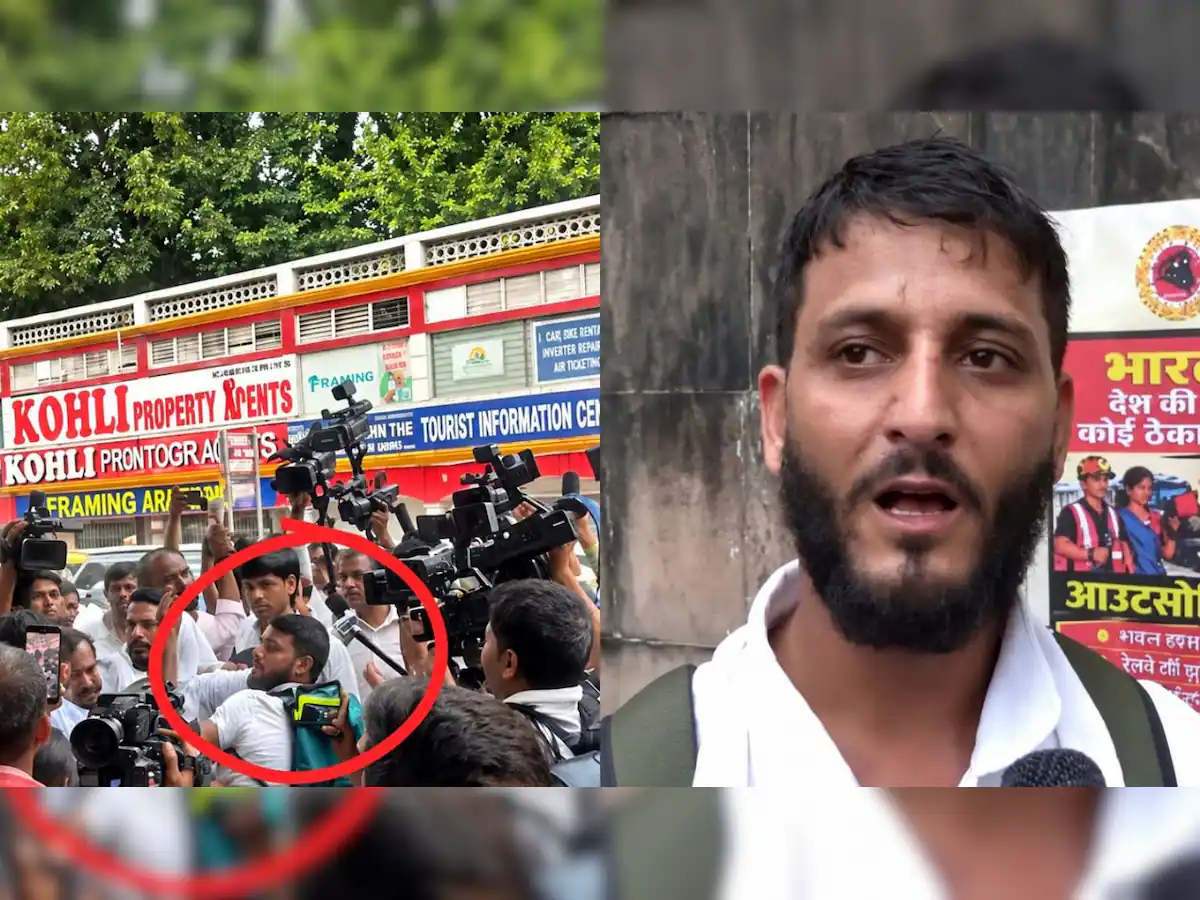
A video showing a young Kashmiri man being surrounded, pushed, dragged and hit by a group of people at Delhi’s Connaught Place has triggered a political controversy at a time when opposition parties are protesting against the Election Commission’s Special Intensive Revision (SIR) of electoral rolls.
The man, identified in media reports as Faheem Nazir, says he supports Prime Minister Narendra Modi and was confronted after questioning opposition leaders over allegations of electoral irregularities and the use of electronic voting machines. Some people at the scene reportedly accused him of verbally abusing Rahul Gandhi, a charge he has denied.
The confrontation has since become a political flashpoint. BJP figures have used the footage to question the opposition’s commitment to democratic dissent, while the immediate circumstances that led to the physical altercation remain disputed.
But the incident raises a larger question: Was this an ordinary confrontation that spiralled out of control, a deliberately provocative intervention at a politically charged gathering, or an episode now being amplified for political publicity?
The available evidence does not establish a definitive answer to the question of motive. It does, however, offer several important clues about the incident, the man at its centre, the protest environment and the political incentives surrounding the video.
What Actually Happened at Connaught Place?
According to reports published on October 8, the confrontation took place at Connaught Place while opposition leaders and MPs were gathering in central Delhi amid protests against the Election Commission and its SIR exercise.
Faheem Nazir, who identified himself as a Srinagar resident and Modi supporter, said he had come to challenge the opposition’s claims about elections and electronic voting machines. Reports say he raised slogans supporting Modi before a confrontation developed with people at the scene.
Footage published by news outlets shows a man surrounded by several people and being physically manhandled. He appears to be pushed, dragged and struck during the altercation.
Nazir subsequently alleged that Congress supporters assaulted him because of his political views. Those present who challenged him reportedly claimed that he had used abusive language against Rahul Gandhi. Nazir denied that allegation.
The distinction between the visible confrontation and the competing explanations for it is important. Video footage can help establish that physical contact occurred, but a short or incomplete clip may not reveal the entire exchange, what was said before recording began, who initiated the confrontation or the precise sequence of events.
The Times of India reported that the allegations surrounding the incident could not be independently verified. India Today reported that Nazir submitted a complaint at the Connaught Place police station and that police were conducting a medical examination and examining the complaint.
At the time covered by those reports, the police process was still under way. A complaint and a medical examination are important investigative steps, but neither by itself establishes the guilt of a particular individual.
The first task, therefore, is to establish the complete sequence of events rather than treating either side’s version as conclusively proved.
The Background: Was Faheem Nazir Already Known as a Modi Supporter?
One of the most significant details in the case predates the current controversy by five years.
In August 2021, NDTV, citing the Press Trust of India, reported that a man identified as Fahim Nazir Shah was walking from Srinagar towards Delhi in the hope of meeting Prime Minister Narendra Modi.
The report described him as a 28-year-old part-time electrician from Srinagar’s Shalimar area. He said he had followed Modi on social media for several years and hoped the journey would attract the Prime Minister’s attention.
The report also recorded his stated interest in discussing youth unemployment and industrial development in Jammu and Kashmir.
A separate report published by Daily Excelsior at the time carried similar details.
The name and biographical details reported in 2021 closely resemble those associated with Faheem Nazir in the October 2026 coverage. This provides a meaningful historical connection, although a complete independent identity verification would still be needed before treating every biographical detail as conclusively established.
What does that background tell us?
First, the claim that the young man admires Modi is not necessarily a political identity created after the Connaught Place incident. Public reporting from 2021 suggests that he had expressed that admiration years earlier.
Second, it complicates the theory that his support for Modi was invented solely to attract attention during the latest controversy.
Third, it does not settle whether his decision to approach the opposition gathering on October 8 was spontaneous, intended as a political intervention or calculated to attract media coverage.
A longstanding political preference and a deliberate publicity strategy can coexist. A person may genuinely support a leader and still choose a highly visible confrontation to draw attention to an issue or to themselves.
The 2021 reports provide evidence of an earlier, publicly expressed political preference. They are not evidence that the 2026 confrontation was staged or that it was not staged.
That distinction is central to a responsible examination of the incident.
Was It a Political Stunt or a Publicity Stunt?
The question is understandable because the confrontation occurred in a politically charged setting, was captured on video and rapidly became a national political talking point.
But the terms “political stunt” and “publicity stunt” imply more than a visible confrontation. They suggest that someone deliberately arranged, provoked or exploited an incident for a particular outcome.
To establish that interpretation, investigators and journalists would need evidence beyond the fact that the incident attracted attention.
That could include a verified timeline of the events, the complete available video footage, statements from independent witnesses, evidence of prior coordination, or reliable documentation showing that participants planned the confrontation.
No such evidence has been established in the reports reviewed here.
There are, nevertheless, several distinct possibilities that should not be confused.
Possibility one: a genuine political disagreement escalated into violence.
Nazir may have approached the gathering to challenge opposition claims, and a verbal confrontation may have escalated. If the investigation establishes that he was assaulted, the political disagreement would not justify the violence.
Possibility two: deliberately provocative behaviour contributed to the confrontation.
A person entering a politically charged gathering to challenge its central message may anticipate a hostile response. If Nazir used provocative language, as some people at the scene reportedly alleged, that could help explain the confrontation. But the allegation remains disputed, and even proven verbal provocation would not automatically justify physical assault.
Possibility three: the incident was deliberately staged or coordinated.
This is a stronger claim. It would require evidence that participants planned the confrontation or knowingly manufactured an incident to generate publicity. The video’s rapid circulation and the political statements that followed do not establish such coordination.
Possibility four: an initially spontaneous incident was subsequently turned into a political publicity campaign.
This is different from staging the original event. Political parties, spokespersons, media outlets and social media users can amplify a genuine incident because it supports their broader arguments. That may happen even when the original confrontation was neither organised nor anticipated.
At present, the available reporting supports scrutiny of the confrontation and its political use. It does not establish which of these explanations fully accounts for what happened.
The most accurate conclusion is that the incident became a political communication event almost immediately, while the question of prior planning remains unanswered.
Why Did the Incident Become Politically Useful So Quickly?
The answer lies partly in the timing.
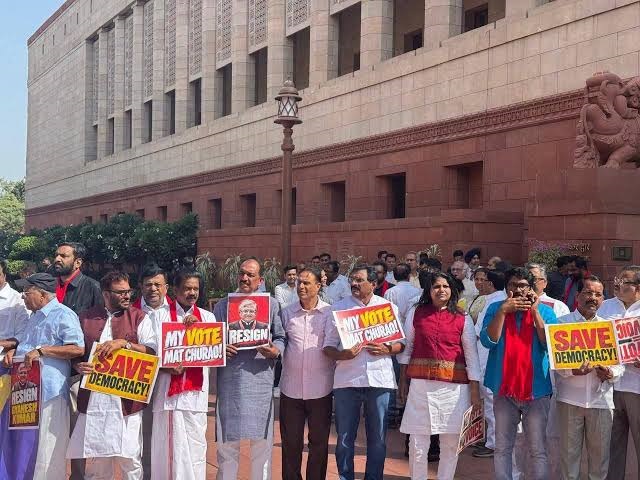
The confrontation occurred during an intense dispute over electoral rolls, the Election Commission and allegations of “vote theft” made by opposition parties.
In the days leading up to October 8, Congress and other INDIA bloc leaders had attempted to demonstrate against Chief Election Commissioner Gyanesh Kumar. Their demands centred on alleged irregularities associated with SIR and calls for the election chief’s resignation.
The Election Commission and the BJP have disputed the opposition’s allegations. The controversy has therefore become part of a broader political argument about electoral integrity and institutional credibility.
Reuters reported on October 6 that police had dismantled a Congress-led sit-in and detained opposition lawmakers during protests seeking the election chief’s resignation. Further demonstrations and detentions followed.
On October 8, the Indian Express reported that Delhi Police had imposed prohibitory orders at Rajghat amid plans for an opposition gathering, while opposition MPs shifted their protest approach after restrictions prevented demonstrations at their intended locations.
Against that backdrop, the Connaught Place confrontation carried political significance beyond the people directly involved.
For BJP supporters, the footage offered a way to argue that opposition protesters were unwilling to tolerate criticism of Rahul Gandhi or challenges to their claims about electoral irregularities.
For the opposition, the central issue remained the dispute over SIR and the Election Commission, rather than the political narrative subsequently attached to the altercation.
The incident therefore entered an already polarised debate in which each side had incentives to frame events in a way that supported its larger argument.
That does not prove that either side organised the confrontation. It explains why the footage was politically valuable once it emerged.
The BJP’s Response: Dissent, Intolerance and Political Messaging
BJP spokesperson Pradeep Bhandari shared the footage and criticised the alleged assault. BJP spokesperson Sajid Yousuf Shah also questioned the opposition’s commitment to freedom of expression.
Their response placed the incident within a broader argument about whether political opponents are prepared to tolerate dissent.
That is a legitimate question to raise when a person appears to be physically attacked during a political confrontation. Political participation cannot depend on whether a person supports the ruling party, the opposition or neither.
However, the political response must be separated from the evidence needed to establish individual responsibility.
A video showing an assault does not automatically prove that every person involved belonged to Congress. Nor does it establish that senior party leaders ordered, approved or knew in advance about the confrontation.
The identity and political affiliation of the people who used violence must be established through evidence, not inferred from the setting alone.
Likewise, the BJP’s use of the incident to criticise Congress is a political response, not independent proof of the motive behind the assault.
The distinction matters because accountability is strongest when it is based on identifiable individuals and verifiable conduct rather than collective blame.
What About the Allegation That Faheem Abused Rahul Gandhi?
This is one of the central unresolved issues.
Some people at the scene reportedly accused Nazir of verbally abusing Rahul Gandhi. Nazir denied the allegation and challenged those making it to produce evidence of his alleged abusive language.
If the complete video or credible witness accounts establish what was said before the physical confrontation, that evidence could help explain how tensions escalated.
But even if abusive language were established, it would not justify a group assault.
Political leaders are routinely criticised, challenged and subjected to harsh language. The appropriate response to offensive speech is not a beating. Depending on the circumstances, speech may be challenged, condemned or addressed through lawful means.
At the same time, the accusation should not be dismissed merely because Nazir denies it. It must be tested against the available evidence.
A responsible investigation would establish whether the alleged words were spoken, who heard them, whether recordings captured the exchange and how the confrontation developed immediately afterwards.
Until then, the allegation should remain an allegation.
The Kashmir Dimension: Why the Man’s Identity Matters
The description of Nazir as a Kashmiri Muslim and Modi supporter has become a prominent part of the story.
That combination attracts attention because political narratives about Kashmir often treat public opinion in the region as though it were uniform. In reality, Kashmiris hold diverse political views, including support for the BJP, support for regional parties, support for national opposition parties, independence-oriented views and political positions that do not fit neatly into party categories.
Nazir’s reported support for Modi is one individual’s political position. It should not be treated as representative of all Kashmiris or used to make sweeping claims about political attitudes in the Valley.
Equally, the possibility that a Kashmiri man supporting the Prime Minister was assaulted should not be minimised because his views differ from those of the people surrounding him.
If the evidence establishes that he was attacked for expressing his political beliefs, the incident would raise a serious question about equal protection and political freedom.
But it would be equally misleading to use one confrontation to claim that an entire political party, community or region is uniformly intolerant.
The incident must be examined at the level where responsibility can be established: the conduct of the individuals involved, the circumstances of the confrontation and the response of the authorities.
What the Video Can Prove, and What It Cannot
Viral videos have become central to political reporting because they can provide direct visual evidence of events that might otherwise be disputed.
But footage is not self-interpreting. Its evidentiary value depends on what it captures, whether it is complete and whether it can be independently verified.
In this case, the published footage appears to show a man being surrounded and physically manhandled. That is a substantial basis for investigating the conduct visible in the recording.
The footage alone does not necessarily establish:
- What was said before recording began.
- Whether the man had been involved in an earlier verbal exchange.
- The identities and political affiliations of everyone involved.
- Whether any participant planned the confrontation.
- Whether an individual or organisation instructed anyone to act.
- The full sequence of events before and after the recorded segment.
These questions require the original footage, additional recordings, witness accounts and police findings.
The speed with which a clip spreads online should not be confused with the speed at which all the relevant facts have been established.
What Does the Police Complaint Mean?
According to India Today, Nazir submitted a complaint at the Connaught Place police station after the incident. Police were examining the complaint and conducting a medical examination.
The distinction between a complaint, an FIR and a completed investigation is important.
A complaint records a person’s account and requests action. An FIR, where registered, formally records information about a cognisable offence and initiates the relevant investigative process. Neither step, by itself, establishes guilt.
Investigators would need to identify those involved, collect available recordings, interview witnesses, establish the nature of any injuries and determine whether the evidence supports criminal charges.
The outcome of that process should be reported when authorities provide verified information.
It would be premature to declare specific individuals guilty before the facts are established. It would also be premature to dismiss the allegation as fabricated without examining the evidence.
The appropriate standard is the same regardless of political affiliation: investigate the alleged violence, identify those responsible and apply the law on the basis of evidence.
The Larger Issue: Can Political Dissent Be Protected When It Is Unwelcome?
The incident raises a question that extends beyond BJP and Congress.
Can someone enter a political gathering and challenge its claims without being physically attacked? The answer should not depend on whether the person supports the government, opposes it or expresses an unpopular position.
Political demonstrations are places for collective expression and public pressure. They can also become tense when opposing viewpoints collide. That makes restraint, security arrangements and respect for individual safety especially important.
There is a distinction between confronting someone verbally and using violence against them. A protester may reject an argument, demand that a person leave a gathering or challenge a claim. Physical assault is not a legitimate substitute for political debate.
The same principle applies in reverse. A person who enters a protest to challenge its message should not assume that the gathering is a stage on which any provocation will go unanswered. Participants remain responsible for their own conduct, and unlawful behaviour should be dealt with through lawful procedures.
The wider political climate also matters. When each side treats every confrontation as proof of the other side’s character, public debate becomes more polarised and the factual questions become harder to resolve.
The Ground Reality: What Is Established and What Remains Unknown?
The available reporting allows several conclusions to be separated clearly.
Established by published reporting: A confrontation occurred at Connaught Place on October 8. Video footage showed a man being surrounded and physically manhandled. The man identified himself as Faheem Nazir, a Srinagar resident and supporter of Narendra Modi. He alleged that he was attacked after expressing his political views.
Supported by earlier reporting: In 2021, a man identified as Fahim Nazir Shah was reported walking from Srinagar to Delhi in the hope of meeting Modi. This supports the existence of a longstanding, publicly expressed admiration for the Prime Minister, although the identity link should be independently confirmed.
Disputed: Whether Nazir verbally abused Rahul Gandhi before the confrontation. Nazir denied doing so, while some people at the scene reportedly alleged that he had.
Not established by the reports reviewed: That all the people involved were Congress workers; that the confrontation was planned in advance; that a political party directed it; or that Nazir deliberately staged the event for publicity.
Still requiring investigative confirmation: The complete sequence of events, the identity of the individuals who used violence, the precise circumstances of the assault and the final outcome of the police investigation.
This distinction prevents two opposite mistakes: treating every allegation made by the alleged victim as a proven fact, or dismissing the visible violence because the incident has become politically controversial.
Political Publicity May Follow an Incident Without Proving It Was Staged
The episode demonstrates how quickly a street confrontation can become a national political story.
Once a video circulates, political figures can use it to reinforce existing narratives, news outlets can report the competing claims, and social media users can interpret the footage through their own political loyalties.
That process can create publicity for the people involved, even if none of them planned the original confrontation.
It is therefore useful to distinguish three questions: Did the confrontation occur? What caused it? Who subsequently benefited from the publicity?
The available footage and reporting support the need to investigate the first question. The second remains partly unresolved. The third can be examined by tracking the political responses and circulation of the video, but political benefit alone does not prove prior coordination.
A person may benefit from an event without having arranged it. A political party may exploit an event without having caused it. And a genuine incident can be amplified in ways that simplify or distort the underlying facts.
These distinctions are essential to assessing the allegation of a political or publicity stunt.
Conclusion: Evidence Before Political Verdicts
The Connaught Place incident deserves scrutiny not because it proves one party’s claims about another, but because it raises questions about political tolerance, public safety and the treatment of dissent.
The footage reported by multiple outlets appears to show a man being physically manhandled. His allegation that he was attacked for supporting Modi warrants investigation. The counter-allegation that he abused Rahul Gandhi also needs to be assessed against evidence rather than accepted or rejected automatically.
The historical reporting about Fahim Nazir Shah’s 2021 journey to meet Modi suggests that his admiration for the Prime Minister predates this incident. It does not prove that the latest confrontation was coordinated, staged or entirely spontaneous.
The ground reality, on the evidence currently available, is that a physical confrontation occurred, the accounts of what triggered it remain disputed, and the claim that it was deliberately staged has not been substantiated.
The next decisive evidence should come from the complete video record, credible witness accounts, identification of those involved and the outcome of the police investigation.
Until then, calling the episode a political stunt is an interpretation, not an established fact. The more important test is whether the authorities establish what happened and hold anyone responsible for unlawful violence to account, regardless of political affiliation.