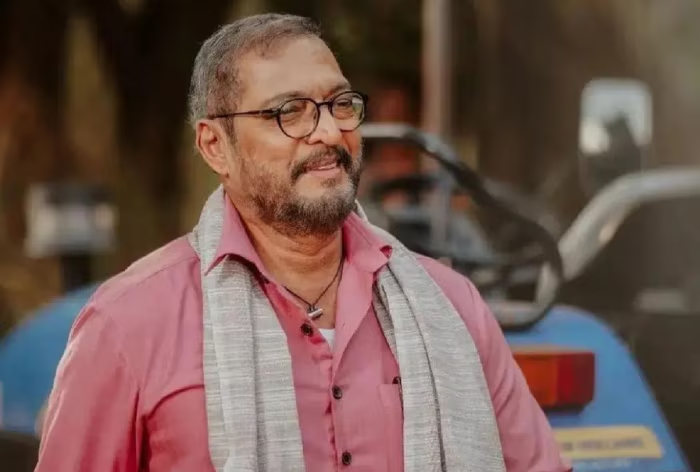
Indian cinema loses an actor who never needed to shout to be heard
By: News Desk | 08 October 2026
Mumbai/Goa: Indian cinema has lost one of its most distinctive voices.
Veteran actor Nana Patekar died on Thursday, October 8, 2026, at the age of 75, after suffering a cardiac arrest at his residence in Dona Paula, Goa. He was taken to Manipal Hospital after being found unconscious, but doctors could not revive him. Hospital officials said CPR was administered for around 45 minutes before he was declared dead at approximately 5:20 a.m.
The actor’s son, Malhar Patekar, confirmed his death. A medico-legal case has been registered and a post-mortem is being conducted, meaning some details surrounding the precise medical circumstances remain subject to the official examination.
But while Thursday’s news is about death, Nana Patekar’s career is ultimately a story about presence.
For almost five decades, he inhabited characters rather than merely performing them. He could be frightening without raising his voice, vulnerable without becoming sentimental and funny without losing the edge that defined him.
From the gangster world of Parinda to the angry idealism of Krantiveer, the troubled soldier in Prahaar, the obsessive husband in Agni Sakshi, the police officer of Ab Tak Chhappan, and the wildly comic Uday Shetty in Welcome, Patekar built a filmography that resisted easy classification.
He was, at once, an actor of parallel cinema, mainstream Bollywood, Marathi theatre and popular comedy.
And he made every one of those worlds feel like his own.
The final hours in Goa
Patekar was found unconscious at his home in Dona Paula in the early hours of Thursday and was taken to Manipal Hospital.
According to hospital information reported by The Indian Express, Dr Shekhar Salkar of Manipal Hospital said that doctors attempted continuous CPR for approximately 45 minutes but were unable to revive him. He was declared dead at around 5:20 a.m.
Reuters, citing hospital information, also reported that cardiac arrest was confirmed, while noting that the specific trigger remained unknown.
That distinction is worth preserving amid the flood of early reports. Cardiac arrest and a heart attack are not medically identical terms: cardiac arrest refers to the heart suddenly stopping effective pumping, while a heart attack generally involves blocked blood flow to the heart muscle. The initial reports have used both expressions, but the post-mortem and medical documentation will establish the fuller picture.
The death came suddenly and at an age when Patekar was still an active presence in Indian entertainment.
His passing therefore landed with particular force across Mumbai’s film industry and Maharashtra’s cultural community.
Nana Patekar: The making of an unconventional star
Born Vishwanath Patekar on January 1, 1951, in Maharashtra, Nana Patekar did not emerge from the traditional mould of a Hindi-film leading man.
His roots were in theatre, and that background remained visible in his work throughout his career.
He made his film debut with Muzaffar Ali’s Gaman in 1978, beginning a journey that would eventually take him across Marathi and Hindi cinema.
The early years were marked by supporting and character roles. But Patekar’s screen presence was difficult to ignore.
He brought an unusual combination of physical stillness, controlled aggression, distinctive speech and emotional unpredictability. His characters frequently appeared to be carrying an entire history beneath the surface.
That quality became one of his trademarks.
He did not always have to be the protagonist.
Sometimes, he only needed a few scenes.
Parinda: The performance that changed everything
If there was one film that announced Nana Patekar as a major force, it was Vidhu Vinod Chopra’s Parinda.
Released in 1989, the film placed him in the role of Anna, a violent and psychologically unstable underworld figure.
Patekar’s performance was terrifying precisely because it was not built around conventional cinematic villainy. There was volatility in the character, but also calculation. A pause could become threatening. A quiet sentence could carry more menace than a conventional outburst.
The performance earned him the National Film Award for Best Supporting Actor.
It was the first of three National Film Awards that would define an extraordinary acting career.
Parinda also helped establish a larger pattern in Patekar’s career: he could make morally complicated characters compelling without asking the audience to excuse them.
Krantiveer: When Nana Patekar became the voice of anger
Five years later came the film that cemented Patekar as a leading man.
In Mehul Kumar’s Krantiveer (1994), he played Pratap Narayan Tilak, a troubled and disillusioned man who eventually turns his anger against corruption and injustice.
The role was explosive, emotional and intensely political in its dramatic vocabulary.
Patekar won the National Film Award for Best Actor for the performance.
But the film’s enduring impact went beyond the award.
Patekar’s performance became synonymous with the kind of emotionally charged cinema in which an ordinary individual’s frustration becomes a larger social statement.
It also demonstrated something important about his acting style.
He could be theatrical without seeming artificial.
He could be loud without becoming empty.
And when the material demanded silence, he could make silence threatening.
Agni Sakshi completed an extraordinary National Award hat-trick
In 1996, Patekar delivered another acclaimed performance in Agni Sakshi.
The film explored an abusive and obsessive marriage, with Patekar playing a psychologically complex character.
His work earned him his third National Film Award, again for Best Supporting Actor.
The three National Awards came for three very different performances:
- Best Supporting Actor — Parinda (1989)
- Best Actor — Krantiveer (1994)
- Best Supporting Actor — Agni Sakshi (1996)
That record remains one of the clearest indicators of his range.
Patekar was not simply rewarded for playing the same kind of intense character repeatedly.
His strongest performances came from radically different emotional spaces.
From Prahaar to Natsamrat: An actor who crossed generations
Patekar’s contribution to cinema was not confined to acting.
He also stepped behind the camera, making his directorial debut with ** Prahaar: The Final Attack**, a film centred on soldiers and military life. He also starred in the film.
His filmography subsequently moved across genres and generations.
There was the patriotic action drama of Tirangaa. The romantic-comedy world of Raju Ban Gaya Gentleman. The crime and political intensity of Angaar. The psychological weight of Khamoshi: The Musical. The hard-edged police drama Ab Tak Chhappan.
And then came a completely different Nana Patekar.
Uday Shetty showed the world another Nana Patekar
For younger audiences, particularly those who encountered him through mainstream Bollywood, Uday Shetty in Welcome became one of Patekar’s most recognisable characters.
The irony was striking.
An actor celebrated for some of Indian cinema’s darkest and most emotionally demanding roles was suddenly making audiences laugh through comic timing, deadpan delivery and the chemistry between Uday Shetty and Majnu Bhai, played by Anil Kapoor.
The performance demonstrated that Patekar’s intensity was not the whole story.
He understood comedy.
He understood rhythm.
And perhaps most importantly, he understood that a character becomes funny when the actor playing him takes the character completely seriously.
That ability helped Patekar remain relevant across generations.
Marathi cinema gave him another language of expression
While Hindi cinema made Nana Patekar a national name, Marathi cinema remained an important part of his artistic identity.
His performance in ** Natsamrat**, the 2016 Marathi film based on the celebrated play by V. V. Shirwadkar, offered another reminder of the actor’s theatrical roots.
The role of Ganpatrao Belwalkar—a celebrated stage actor confronting the loneliness and losses of old age—was almost tailor-made for Patekar.
It brought together theatre, memory, ego, ageing and family relationships.
For an actor whose career had often been associated with rage and confrontation, Natsamrat revealed a different kind of intensity: vulnerability.
That breadth is one reason his death is being felt not only in Bollywood but across the Marathi theatre and film community.
Three National Awards and the Padma Shri
Patekar’s awards cabinet reflects the scale of his contribution.
He won three National Film Awards, an unusually distinguished record for a performer. He was also honoured with the Padma Shri in 2013 for his contribution to cinema and the arts.
But awards alone do not explain his place in popular culture.
There are actors whose careers can be measured through trophies.
Patekar’s is better measured through characters people still quote, imitate and remember decades after the films were released.
His dialogue delivery became a cultural signature.
His pauses became recognisable.
His face could shift from tenderness to menace within seconds.
That was the Nana Patekar effect.
Beyond cinema: The farmer who turned celebrity into social work
Away from the film sets, Patekar increasingly became associated with social causes, particularly the plight of farmers in drought-hit Maharashtra.
In 2015, Patekar and actor Makarand Anaspure spearheaded the NAAM Foundation, responding to severe drought conditions, farmer distress and rural water problems in Maharashtra.
According to the foundation’s own account, its work has focused on water conservation, restoration of canals and abandoned water projects, farmer education and development of drought-affected villages.
This part of Patekar’s life is important because it was not simply an extension of his celebrity image.
The foundation developed into a continuing organisation with projects aimed at rural communities.
For many admirers, that work became another defining part of his public legacy.
The actor who had spent decades playing angry men, policemen, soldiers, gangsters and outsiders was also increasingly seen as someone willing to engage with rural hardship away from the glare of the film industry.
Tributes pour in as India remembers Nana Patekar
The reaction to his death has stretched from Bollywood to politics and the wider cultural world.
Prime Minister Narendra Modi paid tribute to Patekar, describing his acting as possessing a rare intensity, individuality and unmistakable presence. Modi also praised his versatility and creativity and said the characters he created would be remembered for generations.
Union ministers, Maharashtra leaders and actors also expressed grief.
Union Minister Nitin Gadkari remembered Patekar not only for his acting but also for his social sensitivity and work connected with rural Maharashtra.
The Maharashtra government has announced that Patekar will receive a state funeral, citing his contribution to Marathi theatre and both Marathi and Hindi cinema. Cultural Affairs Minister Ashish Shelar announced the decision on Thursday.
The response illustrates how Patekar’s public identity extended beyond the conventional boundaries of a film star.
He belonged simultaneously to cinema, theatre and social activism.
Why Nana Patekar’s acting still matters
There is a particular kind of actor who disappears into a role.
Then there is another kind who makes the role carry his personality.
Nana Patekar managed something more difficult: he brought his own unmistakable presence to a character while still making that character feel complete and independent.
That is why Anna from Parinda did not feel like Pratap from Krantiveer.
Why Pratap did not resemble the troubled characters of Agni Sakshi.
Why the police officer in Ab Tak Chhappan felt different from Uday Shetty.
And why Ganpatrao Belwalkar in Natsamrat seemed to belong to an entirely different emotional universe.
The common thread was not the character.
It was the actor’s ability to locate the emotional truth inside the character.
The voice, the pauses and the unmistakable Nana Patekar style
Indian cinema has produced many powerful performers.
Few have possessed Patekar’s combination of voice, eyes, physical restraint and verbal rhythm.
He could stretch a sentence until it became uncomfortable.
He could make a simple line sound like a threat.
He could turn a comic exchange into something memorable simply by refusing to overplay it.
His dialogue delivery became so distinctive that audiences could sometimes identify the actor before seeing his face.
That is a rare achievement.
And it explains why his performances survived beyond the films themselves.
A career that refused to fit into one box
Nana Patekar’s legacy cannot comfortably be described as that of a “Bollywood star.”
He was a theatre actor who entered cinema.
A Marathi performer who became a Hindi-film icon.
A National Award-winning dramatic actor who became a mainstream comedy favourite.
A director who continued to act.
And eventually, a film celebrity whose public identity became closely connected with rural social work.
That combination made him difficult to categorise—and impossible to easily replace.
Nana Patekar’s enduring legacy
With Nana Patekar’s death, Indian cinema loses an actor whose greatest strength was perhaps his refusal to behave like a conventional star.
He rarely seemed interested in polish for its own sake.
His performances were often rough-edged, uncomfortable and unpredictable.
That was precisely their power.
He brought ordinary human flaws—anger, insecurity, ego, fear, loneliness and desperation—to the screen without softening them.
And when the script allowed humour, he could be just as effective on the other side of the emotional spectrum.
His three National Film Awards, Padma Shri and decades of acclaimed performances provide the formal record.
But the deeper legacy lives elsewhere: in Anna, Pratap Tilak, Uday Shetty, Ganpatrao Belwalkar and dozens of other characters that remain lodged in the memory of Indian audiences.
Nana Patekar is gone.
The characters are not.
And perhaps that is the most fitting measure of an actor’s life.
Some performers leave behind films. Nana Patekar leaves behind performances that continue to live.