Delhi Opposition Rally: Can INDIA Bloc Turn SIR Controversy Into a Nationwide Political Movement?
Ramlila Maidan becomes the centre of a major Opposition mobilisation as Rahul Gandhi, Mallikarjun Kharge and leaders from regional parties rally against electoral roll revisions
By: Javid Amin | 01 November 2026
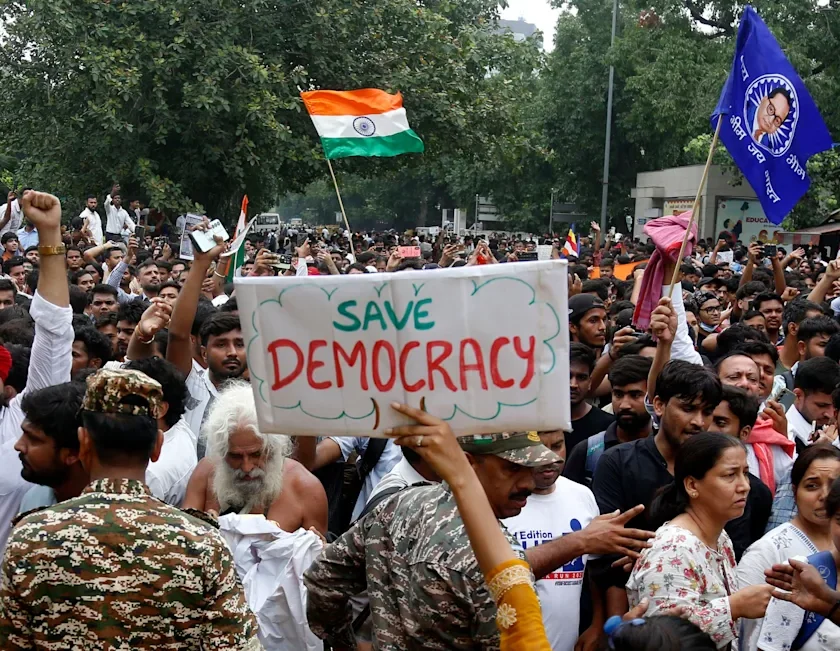
New Delhi: Delhi’s political landscape witnessed a major Opposition mobilisation on Sunday as parties belonging to the INDIA bloc came together for the ‘Chalo Dilli, Vote Bachao, Desh Bachao’ campaign, bringing their protest against the Election Commission’s Special Intensive Revision (SIR) of electoral rolls to the national capital.
The rally at Ramlila Maidan, accompanied by a planned march from the Minto Road-Connaught Place junction, has emerged as a significant political demonstration against Chief Election Commissioner Gyanesh Kumar. The Opposition is demanding his resignation, alleging that the electoral roll revision process has raised serious questions about voter inclusion, transparency and the independence of constitutional institutions.
What makes Sunday’s gathering politically important is not simply the scale of the mobilisation. It is the effort to bring together parties with different regional interests, political priorities and electoral ambitions under a common campaign centred on the right to vote.
The Congress, Samajwadi Party, Trinamool Congress, Rashtriya Janata Dal, Jharkhand Mukti Morcha, Left parties, National Conference and other Opposition formations have been part of the mobilisation.
For the INDIA bloc, the immediate objective is to challenge the SIR exercise. The larger political ambition appears to be turning electoral integrity into a sustained national campaign.
INDIA bloc march from Minto Road to Ramlila Maidan
The day’s programme was designed around two major political events: a march through central Delhi and a large public meeting at Ramlila Maidan.
According to reports from the ground, INDIA bloc MPs assembled at the Constitution Club before proceeding towards the Minto Road-Connaught Place junction. Senior leaders travelled in an open-top bus before joining the march towards Ramlila Maidan through the Ajmeri Gate route.
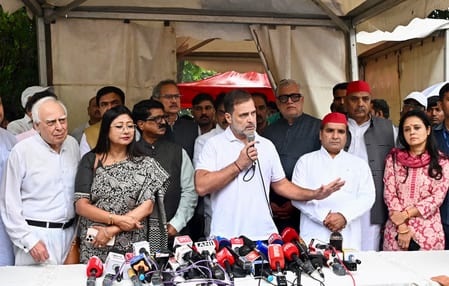
The New Indian Express reported that the march was joined by Rahul Gandhi, Priyanka Gandhi Vadra, Akhilesh Yadav, Mamata Banerjee, Tejashwi Yadav, Farooq Abdullah and Supriya Sule, among others.
The march was more than a symbolic procession. It offered regional parties an opportunity to demonstrate that the electoral roll controversy was not confined to Congress or a handful of states.
For the Congress, it was an opportunity to put Rahul Gandhi at the centre of a broader Opposition campaign. For regional parties, it was a platform to raise concerns about electoral representation while retaining their own political identities.
The presence of leaders from Uttar Pradesh, West Bengal, Bihar, Jharkhand, Telangana and Jammu and Kashmir also gave the mobilisation a national character.
A gathering that brought together the Opposition’s regional heavyweights
The leadership participation was among the most important aspects of Sunday’s mobilisation.
Several prominent political figures from across the country were reported at the march and rally.
Congress: Rahul Gandhi and Kharge lead the mobilisation
The Congress leadership provided the organisational and political centre of the mobilisation. Rahul Gandhi has repeatedly framed the SIR controversy as a question of protecting democratic representation, while Kharge has led the party’s institutional challenge to the Chief Election Commissioner.
Priyanka Gandhi Vadra was among the senior Congress leaders participating in the march. K.C. Venugopal was also involved in the mobilisation and described the protest as a strong political warning to the ruling establishment.
Regional parties: A national opposition presence
West Bengal Chief Minister Mamata Banerjee and TMC national general secretary Abhishek Banerjee were among the prominent participants. Their presence underlined the importance of the voter-roll controversy for the party, particularly in a state where electoral politics remains intensely competitive.
Akhilesh Yadav brought the political weight of Uttar Pradesh, India’s largest state in terms of parliamentary representation.
Tejashwi Yadav represented the RJD, while images of party patriarch Lalu Prasad Yadav featured prominently in the mobilisation.
Jharkhand Chief Minister Hemant Soren and Telangana Chief Minister Revanth Reddy added the participation of two important state governments.
National Conference president Farooq Abdullah was also among the leaders seen arriving at Connaught Place. His participation brought Jammu and Kashmir’s political perspective into the national mobilisation.
NCP (Sharadchandra Pawar) MP Supriya Sule was also present. The broader Opposition mobilisation included Left parties and other INDIA bloc constituents.
The verified reporting establishes participation by these prominent figures. However, every name circulating in preliminary attendance lists should not automatically be treated as a confirmed attendee. In particular, individual participation by Sonia Gandhi, Shashi Tharoor, Salman Khurshid, Siddaramaiah and some other leaders requires separate confirmation.
Crowd strength: 10 lakh claim versus police estimate of 50,000
Crowd size has become another talking point surrounding the rally.
The organisers projected a turnout of up to 10 lakh people, while Delhi Police’s estimate was approximately 50,000. These are very different figures and should be understood as competing projections, not confirmed attendance numbers.
According to preparations reported by The Tribune, Ramlila Maidan can accommodate approximately 45,000 to 50,000 people when empty. With chairs, enclosures and designated movement corridors installed, the effective capacity was estimated at around 30,000 to 40,000.
This distinction matters. A crowd of several thousand gathering outside the venue, along the approach roads and at the march starting point can create the impression of a much larger gathering without representing the number inside the ground.
The political significance of the gathering, therefore, cannot be measured by the organisers’ maximum projection alone. The number of parties represented, the seniority of their leaders and their ability to sustain joint action will be more meaningful indicators of its political impact.
Heavy security across central Delhi
The rally prompted an extensive security deployment across central Delhi.
More than 4,000 personnel were deployed around Ramlila Maidan and the march route, while wider arrangements covering the INDIA bloc gathering and a separate BJP mobilisation brought the overall deployment of police and paramilitary personnel across Central and New Delhi to nearly 10,000, according to reporting by the Financial Express.
The arrangements included:
-
Multi-layered barricading along sensitive stretches.
-
More than 200 CCTV cameras, with some reports putting the figure at 200 to 250.
-
Drone and other surveillance arrangements.
-
Deployment of Central Armed Police Forces, CRPF and Rapid Action Force personnel.
-
Crowd-management arrangements around Connaught Place, Minto Bridge, Ajmeri Gate and Ramlila Maidan.
DCP (Central) Rohit Rajbir Singh confirmed the extensive CCTV coverage and coordination with the rally organisers.
There was also an important administrative distinction. Delhi Police had granted permission for the Ramlila Maidan rally, but police officials had said that permission had not been sought for the proposed march from Connaught Place. The distinction between the authorised venue and the proposed route was reported before the event.
As of the early afternoon reporting, there were no confirmed reports of a major law-and-order breakdown at the main rally.
Why the SIR exercise has become a national political controversy
At the heart of Sunday’s protest is the Election Commission’s Special Intensive Revision of electoral rolls, an exercise intended to update and verify the country’s voter lists.
The issue has developed into a major political confrontation because of the scale of names removed from draft electoral rolls and concerns about whether eligible voters have been given adequate opportunities to establish their eligibility.
The Opposition argues that the exercise risks excluding genuine voters, particularly people who migrate for work, economically disadvantaged families, minorities and citizens who may struggle to produce the required documentation.
The 13.37-crore figure and what it actually means
One of the most frequently cited figures in the controversy is the removal of approximately 13.37 crore names from draft electoral rolls across the three phases of SIR.
According to an analysis published by The Indian Express on September 1, 2026, the figure represented approximately 14.1 per cent of the pre-SIR electorate covered by the exercise.
Delhi recorded a particularly significant reduction. Its electorate fell from approximately 1.45 crore before the revision to 97.53 lakh in the draft electoral roll, representing a reduction of around 32.8 per cent.
Maharashtra also recorded a substantial decline, with its draft electorate falling from approximately 9.78 crore to 7.71 crore.
However, there is an important distinction between names missing from draft rolls and confirmed permanent deletion of eligible voters.
The Election Commission has maintained that the figures include people classified as deceased, permanently shifted, absent or having duplicate registrations. It argues that these categories should not automatically be interpreted as eligible voters being deliberately removed.
The Commission has also pointed to the claims-and-objections process, through which eligible citizens can seek inclusion or correction before final electoral rolls are published.
This is precisely where the political disagreement lies.
The Opposition wants stronger guarantees that no genuine voter will be excluded. The Election Commission maintains that comprehensive verification is necessary to maintain accurate electoral rolls.
The Election Commission’s position and the Supreme Court dimension
The controversy is not simply about the number of names removed. It also concerns the constitutional authority of the Election Commission and the safeguards available to voters during revision.
The Election Commission argues that intensive revision is part of its responsibility to maintain accurate electoral rolls. Its stated objective is to remove ineligible entries while ensuring that eligible Indian citizens remain registered.
The Union government has also defended the process, pointing to safeguards such as door-to-door verification, publication of draft rolls, opportunities to submit claims and objections, and appellate remedies.
An important legal development came on May 27, 2026, when the Supreme Court, in Association for Democratic Reforms and Others versus Election Commission of India and Others, upheld the Election Commission’s statutory authority to conduct SIR under the Representation of the People Act, 1950, and its constitutional responsibilities under Article 324.
That judgment gives the exercise an important legal foundation. However, it does not mean that every individual deletion or administrative decision is beyond scrutiny. Questions about implementation, procedural fairness and the exclusion of eligible voters remain significant.
The distinction is important for understanding Sunday’s demonstration. The Opposition is challenging not only the consequences of the exercise but also the functioning and accountability of the institution conducting it.
Why the Opposition is demanding Gyanesh Kumar’s resignation
The demand for the resignation of Chief Election Commissioner Gyanesh Kumar has become a central political message of the INDIA bloc’s campaign.
The Opposition alleges that the Election Commission has not adequately addressed concerns about electoral roll irregularities and has questioned whether the institution is functioning independently of the Union government.
Rahul Gandhi has repeatedly linked the voter-roll issue with what he describes as the protection of democratic rights. Congress president Mallikarjun Kharge has also pursued the matter through political and institutional channels.
On Saturday, October 31, INDIA bloc leaders held a symbolic public impeachment exercise against the CEC at Kharge’s residence. Former Lok Sabha Speaker Meira Kumar presided over the proceedings, while Kharge presented a resolution listing the Opposition’s allegations.
This was a political demonstration, not a constitutional impeachment proceeding or a legally binding removal process. The distinction matters because the constitutional removal procedure for a Chief Election Commissioner is specific and cannot be replaced by a political resolution.
The Opposition has also approached President Droupadi Murmu and the Supreme Court over the broader electoral concerns.
The Election Commission and the government, meanwhile, have rejected the broader allegations of politically motivated manipulation and defended the revision process.
The dispute therefore raises a larger question: how can public confidence in an independent election authority be maintained when the institution itself becomes the centre of a political confrontation?
BJP’s counter-mobilisation and the political controversy over November 1
Sunday’s political mobilisation was not taking place in isolation.
The BJP organised a separate march in West Delhi to commemorate those killed during the 1984 anti-Sikh violence, creating an unusual situation in which the ruling party and the Opposition were mobilising supporters in different parts of the capital on the same day.
Union Minister Hardeep Singh Puri had criticised the INDIA bloc’s decision to hold its rally on November 1, pointing to the anniversary of the violence that followed former Prime Minister Indira Gandhi’s assassination.
The BJP argued that the timing was insensitive, particularly given the historical association of the Congress with the period surrounding the 1984 violence.
The Opposition’s stated reason for choosing the date was its previously announced campaign against SIR and the Election Commission.
The competing programmes turned November 1 into more than a demonstration over voter registration. They also brought competing historical and political narratives into the public debate.
This is an important political complication for the Congress. While the party wants the national conversation to focus on electoral integrity, the BJP has sought to draw attention to the historical legacy of the Congress.
Both developments illustrate how political mobilisation in India frequently involves competing interpretations of democratic accountability and historical responsibility.
Why this rally matters for the future of the INDIA bloc
The INDIA bloc was formed in 2023 with the primary objective of presenting a united Opposition challenge to the BJP-led National Democratic Alliance.
However, keeping such a broad political coalition together has never been easy.
Its constituents have different electoral interests, regional ambitions and political priorities. In several states, parties that cooperate nationally are also direct competitors locally.
Congress and the Samajwadi Party, for instance, have to balance their national partnership with their respective political calculations in Uttar Pradesh.
The Congress and Trinamool Congress have their own competing ambitions in West Bengal. In Bihar, the Congress and RJD must maintain their alliance while negotiating questions of political leadership and electoral representation.
The Left parties also have their own ideological and electoral priorities.
This makes the participation of leaders such as Mamata Banerjee, Akhilesh Yadav, Tejashwi Yadav, Hemant Soren, Revanth Reddy and Farooq Abdullah politically significant.
It demonstrates that the parties can still identify an issue around which they are prepared to coordinate.
But a common protest platform does not automatically translate into a common electoral strategy.
Can voter rights become the Opposition’s unifying issue?
The INDIA bloc appears to be attempting to build its campaign around a relatively straightforward political message: the right to vote must be protected, and electoral institutions must remain accountable.
This approach has several advantages.
First, it moves the Opposition’s campaign beyond individual state-level political disputes.
Second, it allows regional parties to participate without surrendering their independent political identities.
Third, it creates an opportunity to engage civil society groups, students, youth organisations and ordinary voters who may not necessarily identify with a particular political party.
The issue also has a practical dimension. Electoral registration determines whether citizens can exercise their voting rights. Any confusion, administrative error or failure to restore an eligible voter’s name can have direct consequences.
For the Opposition, this makes SIR an issue with the potential to connect constitutional debate with everyday democratic participation.
The real test, however, will be whether the alliance can convert its political messaging into sustained public engagement and verifiable complaints about electoral administration.
Salman Khurshid’s warning and the possibility of a longer campaign
One of the themes emerging from the Opposition’s mobilisation is the possibility of continuing the agitation beyond Sunday’s gathering.
Congress leader Salman Khurshid has been associated with the broader Opposition campaign. The summary supplied for this article attributes to him the statement that the protest would not end with one rally.
However, an independently verifiable transcript of that exact quotation was not available in the reporting reviewed. It should therefore not be presented as a confirmed direct quote.
The broader strategy is nevertheless visible in the Congress’s previously announced programme.
The party had planned to take its campaign to district and village levels, including outreach to people whose names were missing from electoral rolls and assistance with re-enrolment.
The Indian Express also reported that the next phase of the campaign would involve six yatras from locations near the national capital, expected to reach Delhi from November 25-26 onwards.
This suggests that the November 1 gathering is intended to form part of a wider political mobilisation rather than remain an isolated event.
If sustained, the campaign could create a more organised Opposition movement around voter registration, electoral transparency and institutional accountability.
What the rally means for Jammu and Kashmir
The participation of National Conference president Farooq Abdullah adds another political dimension to the gathering.
Jammu and Kashmir has its own complicated experience with constitutional rights, electoral representation and political participation. Although the Union Territory was not included in the ongoing SIR phase covered by the May 2026 Election Commission announcement, the broader debate about electoral institutions remains relevant to its political environment.
The Election Commission had specifically indicated that the SIR schedule for Jammu and Kashmir, Ladakh and Himachal Pradesh would be announced separately, taking into account the Census exercise and weather conditions in the upper reaches.
For the National Conference, participating in the national Opposition campaign offers an opportunity to remain engaged with broader debates about democratic institutions and constitutional accountability.
Farooq Abdullah’s presence also reinforces the INDIA bloc’s effort to demonstrate that its political platform extends beyond mainland state politics.
However, the National Conference will ultimately be judged in Jammu and Kashmir on its own governance, development commitments and ability to address regional concerns.
National political unity and local political performance remain two different tests.
The larger democratic question: Clean voter lists or the risk of exclusion?
Beyond the political confrontation, the SIR controversy raises an important institutional question.
Every democracy needs accurate electoral rolls. Duplicate entries, deceased voters, permanently shifted residents and ineligible registrations can undermine the integrity of elections.
But the process of correcting electoral rolls must also protect the rights of eligible citizens.
A person who has migrated for employment, changed residence or lacks easily accessible documentation should not lose the opportunity to vote because of administrative difficulties.
The Election Commission has outlined mechanisms for verification, claims and appeals. The challenge is ensuring that these safeguards work effectively on the ground.
Human Rights Watch has also raised concerns about the potential consequences of large-scale electoral roll revisions for marginalised communities and questioned whether the process could affect the fairness of future elections.
The larger issue is therefore not whether electoral rolls should be revised. They should be.
The real question is whether the revision is transparent, accessible, properly supervised and fair to every eligible voter.
That is a question that cannot be settled by political slogans alone. It requires reliable data, independent scrutiny, accessible grievance mechanisms and public confidence in the final electoral rolls.
Delhi rally: What happens after November 1?
The immediate political impact of Sunday’s demonstration will depend on what the INDIA bloc does next.
Three developments will be particularly important.
1. Whether the Opposition maintains its unity
The presence of several senior regional leaders is encouraging for the alliance. But the real test will come when parties have to coordinate on future programmes, public statements and electoral strategies.
2. Whether the campaign reaches affected voters
The Opposition will need to move beyond large rallies and document specific cases of eligible voters facing exclusion. It will also need to help citizens use the official claims and correction mechanisms.
3. Whether the Election Commission responds convincingly
The Commission’s credibility depends not only on defending its procedures but also on addressing genuine complaints transparently. Clear explanations, accessible data and effective grievance redressal can help reduce mistrust.
These developments will determine whether the rally becomes a turning point in the Opposition’s campaign or another large demonstration that gradually loses momentum.
The real political message from Ramlila Maidan
Sunday’s ‘Chalo Dilli, Vote Bachao, Desh Bachao’ mobilisation has brought together a broad section of India’s Opposition at a time when the country’s electoral institutions are facing intense political scrutiny.
The gathering is significant because parties with different regional ambitions and competing political interests have found common ground on the question of electoral integrity.
But the numbers alone will not determine its importance.
Nor will the presence of prominent leaders automatically translate into a stronger Opposition.
The real measure will be whether the INDIA bloc can sustain its coordination, establish credible evidence behind its allegations, engage voters at the grassroots and secure meaningful responses from the institutions it is questioning.
For the Congress, the rally offers an opportunity to strengthen its leadership role within the alliance. For regional parties, it provides a national platform without requiring them to abandon their state-level political priorities.
For the Election Commission, it presents another test of public confidence in the electoral process.
And for Indian democracy, the central question remains straightforward: how can the country ensure that every eligible citizen retains the right to vote while maintaining accurate and trustworthy electoral rolls?
Ramlila Maidan has witnessed many defining political gatherings in India’s history. Whether November 1, 2026, becomes another such moment will depend less on the size of Sunday’s crowd and more on what the political parties, the Election Commission and the government do after the demonstration ends.