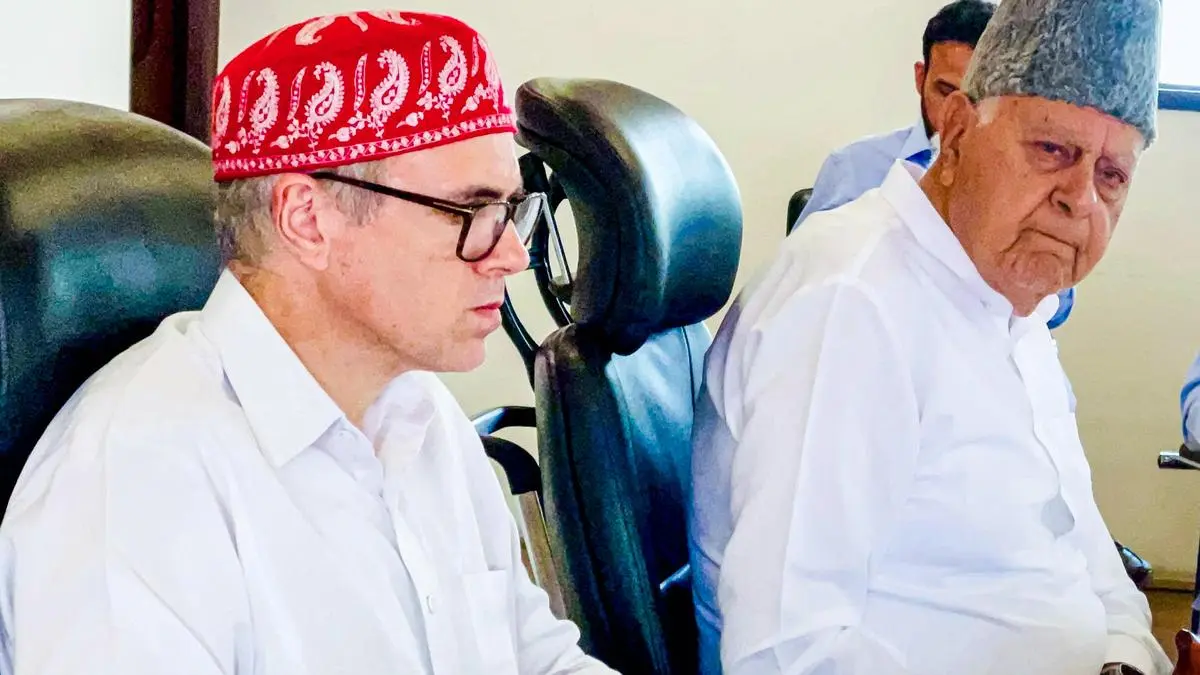
A closed-door meeting involving 17 National Conference legislators and an Independent MLA has taken the cabinet reshuffle controversy to a new level, with demands for an end to unilateral decisions, greater consultation and accountability within the ruling party.
By: Javid Amin | 30 October 2026
The growing discontent within Jammu and Kashmir’s ruling National Conference (NC) has entered a more serious phase, with 17 party legislators reportedly issuing a 15-day ultimatum to party president Farooq Abdullah and Chief Minister Omar Abdullah to address what they describe as an unhealthy culture of centralised decision-making and excessive influence of a small inner circle.
The development follows a four-hour closed-door meeting in Srinagar on Friday, October 30, attended by 17 NC MLAs and one Independent legislator supporting the ruling alliance. The legislators reportedly passed a joint resolution calling for changes in the party’s functioning, an end to unilateral decisions and greater involvement of elected representatives in political and organisational matters.
The meeting was held at the residence of Lolab MLA Qaiser Jamsheed Lone in Srinagar’s Friends Colony, with senior party leaders, including Mubarak Gul, Nazir Ahmad Gurezi and Abdul Majeed Larmi, among those attending. Independent MLA Muzaffar Iqbal Khan, representing Thanamandi, also participated.
What makes the development particularly significant is the nature of the demands.
The legislators are not simply asking why certain leaders were excluded from the cabinet. Their reported objections concern how decisions are made, who influences the Chief Minister, why elected representatives were not consulted before the cabinet expansion and whether the party’s organisational structure is becoming increasingly disconnected from its legislative wing.
The phrase “coterie culture” has consequently become the defining expression of the latest confrontation.
The legislators’ message, as reported by The Hindu, is that the National Conference must function through collective consultation rather than decisions shaped by a small group around its top leadership. One participant described the proposed intervention as a rebellion in favour of the party, rather than an attempt to break it.
For Omar Abdullah, the controversy represents a more complicated political challenge than the disappointment surrounding ministerial appointments. It is now a question of leadership, internal democracy and the relationship between elected representatives and the political establishment surrounding the Chief Minister.
The 15-Day Ultimatum: What Happened Behind Closed Doors?
The meeting on October 30 reportedly began around 3 pm and continued until approximately 6 pm.
According to The Hindu, a legislator who attended the gathering confirmed that a joint resolution had been passed and would be shared with Farooq Abdullah and Omar Abdullah, giving the leadership 15 days to address the concerns.
The resolution reportedly centres on several interconnected grievances:
-
An end to what legislators describe as a kitchen-cabinet system.
-
Greater consultation with elected MLAs before important political decisions.
-
An end to unilateral decision-making.
-
A review of the cabinet’s composition and distribution of portfolios.
-
Greater respect for senior legislators and grassroots party workers.
-
Changes in the organisational functioning of the National Conference.
The participation of senior legislators is particularly noteworthy.
Mubarak Gul, Nazir Ahmad Gurezi and Abdul Majeed Larmi are not peripheral figures in the party. Their presence gives the gathering additional political weight, especially because their names had figured prominently in the resentment following the October 27 cabinet expansion.
The meeting also included Qaiser Jamsheed Lone, who hosted the gathering, and Independent MLA Muzaffar Iqbal Khan.
The available reporting establishes that the resolution and ultimatum were communicated through participants and sources. A publicly authenticated copy of the resolution has not been independently established here. Its specific demands should therefore be attributed to the reporting rather than presented as an independently examined official document.
Nevertheless, the reported 15-day deadline marks an important escalation.
Earlier, dissatisfied legislators were largely expressing disappointment over ministerial appointments. They are now attempting to place their grievances before the party’s highest leadership through a collective political initiative.
That is a substantial shift.
‘Coterie Culture’: The Real Issue Behind the Revolt
The strongest language emerging from the meeting concerns the alleged concentration of political influence around a small group of individuals.
In political terminology, a coterie refers to a relatively small circle of people who exercise influence over important decisions, often without the wider participation of an organisation’s members.
The dissatisfied NC legislators reportedly believe that a similar pattern has developed within the party and government.
Their objection is that elected representatives are not receiving adequate opportunities to participate in decisions that affect the organisation, the administration and their constituencies.
One participant, quoted by The Hindu, argued that the kitchen-cabinet system and coterie culture must end, adding that there had been no formal or informal consultation with elected legislators before the cabinet expansion.
This allegation raises a fundamental question about the functioning of a ruling political party.
An MLA is not simply a representative who participates in Assembly proceedings. The position also carries political responsibility towards constituents, party workers and local organisational networks.
When a government takes decisions involving ministerial appointments, portfolio allocations or major administrative priorities, legislators naturally expect some level of consultation.
This expectation becomes stronger when the party has spent years seeking public support and rebuilding its organisation.
The disagreement, therefore, appears to involve more than access to the Chief Minister. It concerns whether the party’s elected representatives feel they have a meaningful role in shaping its political and administrative priorities.
For the NC leadership, dismissing the issue as disappointment over cabinet berths may no longer be sufficient.
Cabinet Reshuffle: The Trigger That Brought the Discontent Into the Open
The immediate trigger for the latest confrontation was the cabinet expansion carried out by Omar Abdullah on October 27.
Four National Conference legislators were inducted into the government:
-
Ali Mohammad Sagar
-
Shamima Firdous
-
Mir Saifullah
-
Altaf Ahmad Wani, popularly known as Altaf Kaloo.
Independent minister Satish Sharma was dropped from the Council of Ministers. The expansion increased the cabinet’s strength from six to nine, reaching the maximum permitted under the Jammu and Kashmir Reorganisation Act, 2019.
The decision was expected to address vacancies that had remained unfilled since the government was formed in October 2024.
Instead, it triggered resentment among legislators who believed they had a legitimate claim to ministerial representation.
The disappointment was not limited to those who had openly expressed interest in joining the government. It also involved senior leaders who believed that their electoral contribution, organisational experience and years of association with the party deserved greater recognition.
Reports also indicated that around a dozen NC legislators stayed away from a dinner hosted by Farooq Abdullah following the cabinet expansion, adding another visible sign of dissatisfaction.
The timing of the meeting is important.
It took place only three days after the reshuffle, suggesting that the legislators were unwilling to allow the controversy to fade through routine political consultations.
However, the cabinet expansion should be understood as the trigger, not necessarily the entire cause.
The language of the resolution indicates that the disagreement has expanded into a broader demand for changes in the party’s functioning.
The Demand to Replace Four Ministers: A More Direct Challenge to Omar Abdullah
One of the more consequential demands emerging from the dissenting group concerns the performance and tenure of existing ministers.
According to Rising Kashmir, participants in the meeting reached a consensus that the four ministers who had been part of the government since its formation in October 2024 should make way for fresh faces after completing two years in office.
The demand is politically significant because it moves the disagreement beyond the selection of newly inducted ministers.
It effectively calls for a review of the existing cabinet.
There are two dimensions to this argument.
First, performance and accountability. Some legislators reportedly believe that ministers who have completed two years should be evaluated on their performance rather than automatically retaining their positions.
Second, political accommodation. Replacing existing ministers would create opportunities for other legislators who believe they have been overlooked.
However, the demand raises an important question: should ministerial changes be based on a fixed political rotation, or should they depend on individual performance and the Chief Minister’s assessment of administrative requirements?
There is no automatic constitutional requirement for ministers to leave office after two years. The reported demand is a political proposal from dissatisfied legislators, not an established rule governing the Council of Ministers.
It is also important to distinguish between a demand for a cabinet review and an agreed decision by the leadership to remove existing ministers.
No such decision had been publicly confirmed by October 31.
The issue nevertheless places Omar Abdullah in a difficult position. Accommodating the demand could mean upsetting ministers who have only recently received important portfolios. Rejecting it could further alienate a sizeable section of his legislative party.
The Nasir Aslam Wani and Shammi Oberoi Controversy
According to The Hindu, some legislators accused Omar Abdullah’s adviser Nasir Aslam Wani and Member of Parliament Shammi Oberoi of insulating the Chief Minister from elected representatives and influencing decisions affecting party members.
These allegations should be treated as the views of the dissenting legislators, not as independently established findings.
Nevertheless, the issue has political importance.
The relationship between an elected leader and his advisers is always sensitive in a parliamentary democracy. Advisers can provide political and administrative assistance, coordinate communication and help manage complex government responsibilities.
But elected representatives expect their concerns to reach the Chief Minister without unnecessary barriers.
When MLAs believe that a small group controls access to the leadership, the problem can become institutional rather than personal.
The criticism, therefore, is about the perceived structure of influence around Omar Abdullah.
It also explains why the latest dissent is more serious than a conventional cabinet dispute. The legislators are reportedly questioning not only the decisions being taken but also the process through which those decisions are reached.
The Portfolio Distribution Dispute: Why the Deputy Chief Minister Has Entered the Debate
Another reported grievance concerns the allocation of portfolios after the reshuffle.
According to the account published by The Hindu, some dissatisfied legislators questioned the distribution of important departments and raised objections concerning Deputy Chief Minister Surinder Kumar Choudhary.
This introduces another political dimension.
Portfolio allocation determines the administrative influence of individual ministers. Departments such as finance, power, public works, education, revenue and rural development carry substantial importance for the government’s policy priorities and constituency-level politics.
For legislators, the distribution of these responsibilities can also signal which leaders enjoy the confidence of the Chief Minister.
The dissenting MLAs reportedly questioned whether the distribution reflected performance and merit.
Some also argued that ministers who had not delivered sufficiently during their initial two years should not automatically receive important responsibilities in the reshuffled government.
These are serious political criticisms, but they remain allegations and opinions attributed to the legislators. No independent performance audit or verified finding of wrongdoing has been established by the reporting cited here.
The leadership will ultimately have to decide whether the complaints warrant an internal review or whether they reflect disagreements over political preferences.
Ruhullah’s November 3 Deadline Adds to the Leadership’s Problems
His confrontation with the NC leadership centres on Article 370, political commitments, statehood and what he regards as the government’s failure to adequately represent the aspirations of its voters.
The internal confrontation has become more complicated because it coincides with the continuing disagreement between the NC leadership and Srinagar MP Aga Syed Ruhullah Mehdi.
Ruhullah has maintained that he intends to resign from both the National Conference and the Lok Sabha on November 3.
His objections are fundamentally different from those of the 17 MLAs.
While the legislators are demanding changes in the party’s organisational structure and decision-making process, Ruhullah has questioned the leadership’s political direction and its commitment to the promises made during the 2024 Assembly elections.
He has been particularly vocal about Article 370, the restoration of statehood and the protection of Jammu and Kashmir’s political rights.
On October 31, his planned departure remained an announced intention rather than a completed resignation. His proposed public address in central Kashmir is expected to provide greater clarity about his future political course.
The two developments should not be confused as one coordinated rebellion.
There is no established evidence that the 17 legislators and Ruhullah are operating under a common political arrangement.
However, both developments expose different forms of dissatisfaction with the current leadership.
One concerns internal consultation and organisational authority. The other concerns political credibility and ideological commitments.
Together, they create a difficult situation for the Abdullah leadership.
Is the Government Under Threat? The Numbers Tell a Different Story
The National Conference’s internal crisis is politically significant, but it does not automatically translate into a threat to the government’s survival.
The NC won 42 seats in the 90-member Jammu and Kashmir Legislative Assembly in the 2024 elections. According to The Hindu, the NC-led government currently has the support of 50 legislators.
The reported dissenting group of 17 NC MLAs represents a substantial portion of the party’s legislative strength.
However, there is an important difference between legislators demanding internal reforms and legislators withdrawing support from the government.
The participants have reportedly ruled out an immediate attempt to split the party.
That distinction matters for three reasons:
-
The legislators’ stated demands are directed towards the party leadership.
-
There has been no confirmed collective withdrawal of support from the government.
-
The group appears to be seeking organisational and cabinet-level changes rather than announcing a separate political formation.
The government therefore faces a serious internal management challenge, but there is no verified basis to describe it as facing an immediate collapse.
The political arithmetic may be relatively comfortable. The organisational arithmetic is considerably more complicated.
Jammu Representation: Another Unresolved Question
The cabinet reshuffle has also intensified criticism over regional representation.
All four newly inducted ministers represent constituencies in Kashmir Valley. The departure of Independent minister Satish Sharma, who represented Chhamb in Jammu district, has strengthened criticism that the Jammu region has lost an important voice in the Council of Ministers.
Jammu division has 43 Assembly constituencies, compared with Kashmir’s 47.
The distinction is not simply numerical. Jammu has its own political, economic and administrative concerns, ranging from border-area development and employment to infrastructure, education and public services.
The opposition BJP has used the reshuffle to question the government’s regional balance.
For the National Conference, this presents a wider political challenge. The party needs to demonstrate that its government represents the entire Union Territory, including constituencies where it has limited electoral influence.
It is important, however, not to confuse the regional representation controversy with the specific demands of the 17 MLAs. The available reporting does not establish that every participant in the closed-door meeting adopted regional representation as a central demand.
The two issues nevertheless overlap in the larger debate about inclusiveness and the distribution of political influence.
Farooq Abdullah’s Intervention Could Decide the Next Phase
At this stage, he remains one of the few figures within the National Conference who can potentially bring together dissatisfied senior legislators, the Chief Minister and competing organisational interests.
His role is important because the present dispute involves two different levels of party leadership.
Omar Abdullah heads the elected government and exercises executive authority as Chief Minister. Farooq Abdullah, as party president, carries organisational responsibility and remains a central figure in the NC’s political structure.
A successful intervention would require more than reassuring legislators that their concerns have been heard.
The leadership would need to address the substance of their complaints.
That could involve:
-
Establishing a more regular consultation mechanism between the Chief Minister and NC legislators.
-
Reviewing how major political and organisational decisions are communicated.
-
Assessing ministers’ performance through clearly defined administrative benchmarks.
-
Clarifying the responsibilities of political advisers and party functionaries.
-
Strengthening communication between the party leadership, legislators and grassroots workers.
These are possible avenues for resolving the dispute, not decisions that the party has announced.
The leadership must also be careful not to create the impression that the 15-day ultimatum has forced it into a compromise that undermines the authority of the elected government.
The challenge is to accommodate legitimate internal concerns without allowing competing political demands to paralyse governance.
Ground Assessment: What the Next 15 Days Could Mean for NC
The coming fortnight will be an important test of the National Conference’s ability to manage internal dissent.
The situation can develop along three broad lines.
1. Dialogue and organisational correction
Farooq Abdullah and Omar Abdullah could initiate consultations with the dissatisfied legislators, examine their grievances and introduce changes in the party’s consultation mechanisms.
This would be the least disruptive outcome.
It would allow the leadership to retain control while giving legislators a greater sense of participation.
2. A prolonged cabinet and leadership confrontation
If the leadership rejects the demand for a cabinet review or fails to address allegations concerning decision-making, the group could continue pressing for changes.
This may result in further meetings, public statements and pressure over ministerial performance and portfolio allocation.
Even without defections, sustained internal disagreement could affect the government’s political functioning.
3. Organisational restructuring and a wider political realignment
If the disagreement continues beyond the 15-day deadline, the NC leadership could face pressure to restructure party responsibilities, change internal communication channels or reconsider the role of advisers.
The situation could become more complicated if Ruhullah proceeds with his announced November 3 resignation and the political debate over the party’s commitments intensifies.
This remains a possibility, not an established outcome.
The decisive factor will be whether the leadership treats the ultimatum as an opportunity to correct organisational weaknesses or simply as another episode of dissatisfaction following a cabinet reshuffle.
The Bigger Question: Who Really Has a Voice Inside the National Conference?
The National Conference has survived political upheavals, periods outside government and major changes in Jammu and Kashmir’s constitutional and administrative structure.
Its return to power in 2024 was a significant political achievement.
But governing presents a different set of challenges from winning elections.
A political party can campaign around collective aspirations, promise inclusive development and seek the support of different regions and constituencies. Once in government, it must translate those promises into administrative decisions while balancing competing political interests.
The present crisis suggests that this balance is becoming difficult within the NC itself.
The 17 MLAs are reportedly demanding greater consultation and an end to what they describe as coterie culture. The cabinet reshuffle has exposed dissatisfaction among senior legislators. Ruhullah’s planned departure has reopened questions about the party’s ideological direction.
These developments should not be treated as proof that the National Conference is on the verge of a split.
But neither should they be dismissed as routine political disagreements.
The most important test for the Abdullah leadership will be whether it can restore confidence among its own elected representatives without compromising the government’s ability to function.
The National Conference is no longer dealing with a simple dispute over ministerial positions. It is facing a direct question about internal democracy, political accountability and the distribution of influence within the party.
The 15-day ultimatum has put a deadline on that question.
What happens before it expires may determine whether the current unrest becomes a turning point in the party’s internal functioning or another disagreement temporarily contained by its established leadership.