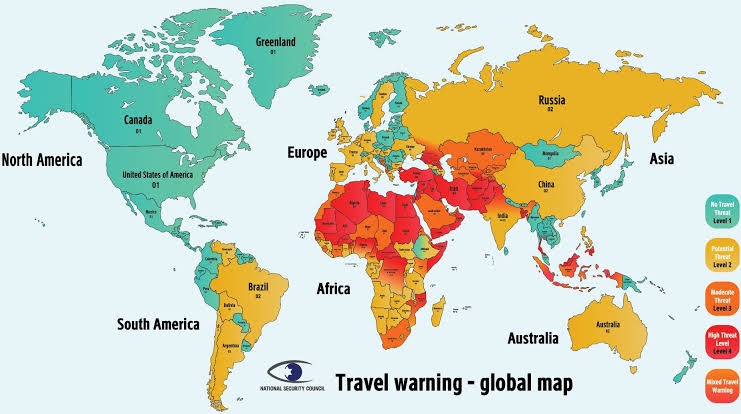
Middle East tensions, missile and drone threats, and risks to aviation and shipping have prompted renewed travel warnings. But do the advisories point to an imminent global crisis?
By: Javid Amin | 29 October 2026
New Delhi, October 30: A series of travel warnings and security advisories issued by governments across the world has drawn attention to the deteriorating security environment in parts of the Middle East, triggering speculation on social media about the possibility of a major geopolitical escalation.
The warnings have raised questions among travellers and observers about whether governments are preparing their citizens for another phase of conflict involving the United States, Iran and regional actors.
The concern is not entirely without foundation. Official advisories describe an unpredictable security environment, the possibility of further military and retaliatory attacks, threats from missiles and drones, and potential disruptions to commercial flights and maritime traffic.
However, there is an important distinction between heightened security warnings and confirmation of an impending military operation.
As of October 30, there is no publicly confirmed announcement from major governments or international organisations establishing that a specific large-scale global event or worldwide conflict is imminent. The available evidence points instead to elevated regional risks, particularly in the Middle East, and growing concern about their possible international consequences.
Travel advisories issued by several governments have highlighted growing security concerns in the Middle East, including missile and drone threats, aviation risks and maritime disruption. But do these warnings signal an imminent global crisis, or are governments preparing citizens for an increasingly unpredictable regional situation?
Why Are Governments Issuing Travel Advisories?
Travel advisories are an established part of international security and diplomatic practice. Governments use them to inform citizens about risks in foreign countries, help travellers make decisions and provide guidance to nationals already living or travelling abroad.
These warnings are generally based on a combination of intelligence assessments, diplomatic reporting, security developments, local conditions and information shared by partner governments.
They can be updated when circumstances change, including when military activity increases, diplomatic facilities face threats, airspace restrictions are introduced or the safety of commercial transport becomes uncertain.
The latest regional warnings reflect several overlapping concerns:
- The possibility of further military escalation and retaliatory attacks.
- Missile and drone threats affecting parts of the Middle East.
- Security risks around military installations and critical infrastructure.
- Potential airspace restrictions, flight cancellations and diversions.
- Maritime security concerns around strategically important shipping routes.
Importantly, a travel advisory does not necessarily mean that an attack is expected within hours or days. Governments may issue precautionary warnings because the consequences of failing to prepare could be serious.
Middle East at the Centre of Security Concerns
The Middle East remains the principal focus of the current travel and security warnings.
The continuing confrontation involving the United States and Iran, together with attacks and retaliatory actions involving regional actors, has created an unpredictable environment for several countries.
The risk is not limited to the territory where military activity takes place. Missile and drone threats can affect neighbouring countries, while military operations may lead to temporary airspace closures, changes in flight routes and restrictions around sensitive locations.
The US Department of State’s October 23 advisory for the United Arab Emirates, for instance, carries a Level 3 rating, advising Americans to reconsider travel because of terrorism and armed-conflict risks. The advisory also refers to potential attacks by Iranian-supported Houthi forces and security concerns involving US interests in the region.
The United Kingdom’s travel advice for the UAE similarly warns British nationals about regional tensions, possible further attacks and the risk of flight cancellations or airspace closures.
Australia has also issued region-specific guidance. Its Smartraveller service continues to describe the Middle East security environment as unpredictable, warning that conflict could disrupt travel even for people whose final destination is outside the region.
These advisories demonstrate genuine security concerns, but they should not be interpreted as evidence that all the countries issuing them possess information about one confirmed, imminent international event.
Missile and Drone Threats: Why Governments Are Concerned
Modern conflicts increasingly involve drones, ballistic missiles, cruise missiles and other long-range weapons.
Such weapons can create risks beyond the immediate battlefield. A missile or drone attack may lead to emergency airspace restrictions, airport disruption, temporary suspension of flights and heightened security around energy facilities, military installations and diplomatic premises.
New Zealand’s current travel advice for the United Arab Emirates specifically identifies the threat of drone and missile attacks as a security concern. It also advises against maritime travel in the vicinity of the Strait of Hormuz and other sensitive areas because shipping incidents can occur with little warning.
This is significant because the Gulf region is central to international energy transportation and commercial shipping.
Even when an attack does not directly involve a commercial vessel or passenger aircraft, the surrounding security situation can affect insurance costs, shipping schedules, airline operations and the movement of goods.
Aviation Risks: Why International Flights Could Be Affected
Commercial aviation is particularly sensitive to military escalation.
Airlines must consider the safety of aircraft, passengers and crew when operating near areas where missiles, drones or military aircraft may be active. If the security situation deteriorates, airlines may avoid certain air corridors, reroute flights or suspend services temporarily.
Airspace restrictions can also be imposed by national authorities, sometimes at short notice.
The consequences can extend well beyond the conflict zone. A flight connecting Europe and Asia, for example, may need to take a longer route if an important corridor becomes unsafe or unavailable.
Passengers may consequently face:
- Flight delays and cancellations.
- Longer travel times because of diversions.
- Changes in connecting flights.
- Temporary disruption at major transit airports.
- Higher operating costs that may eventually affect ticket prices.
Australia’s travel guidance warns that flights can be delayed, cancelled or diverted suddenly during periods of regional instability. It also advises travellers to check the security situation at both their destination and transit points.
For international passengers, the practical lesson is clear: checking the final destination alone may not be enough. The security conditions in transit countries and the air corridors used by airlines also matter.
Strait of Hormuz: A Strategic Concern for the Global Economy
One of the most important geographical points in the current security situation is the Strait of Hormuz.
The narrow waterway connects the Persian Gulf with the Gulf of Oman and the Arabian Sea. It is one of the world’s most important routes for oil and gas shipments.
Any serious disruption could affect energy supplies, shipping costs and international markets.
The impact would not be confined to countries directly involved in the confrontation. Major energy-importing economies, including India, would also be exposed to higher oil prices, increased freight costs and uncertainty in supply chains.
The risks extend beyond crude oil. Disruptions to shipping can affect liquefied natural gas, petroleum products and other commodities transported through the region.
For this reason, maritime security warnings deserve close attention. They indicate concern about the safety of commercial movement through strategically important waters, although they do not automatically mean that a complete blockade or prolonged closure is imminent.
What Do the Different Countries’ Warnings Actually Say?
The advisories issued by different governments are not identical. They reflect each country’s assessment of the risks facing its citizens in specific destinations.
The United States, for example, has maintained a worldwide caution notice highlighting the possibility of security risks linked to Middle East tensions. Its October 23 advisory for the UAE specifically advises reconsidering travel.
The United Kingdom’s advice for the UAE warns of regional instability, possible further attacks and travel disruption.
Australia’s Smartraveller service has issued varying advice levels across the Middle East. Its October 22 regional update warned that conflict could continue to affect international travel, including journeys that do not have a Middle Eastern destination.
New Zealand’s advice for the UAE identifies the risk of drone and missile attacks and highlights maritime dangers around the Strait of Hormuz.
Japan’s Ministry of Foreign Affairs has also published regional security information, including warnings concerning Saudi Arabia and attacks attributed to Houthi forces.
The differences matter. A warning against all travel to one country is not the same as advice to exercise increased caution in another. Nor does a government updating a destination advisory necessarily indicate that it has received intelligence about an imminent attack.
Travellers should therefore read the actual advisory and its latest update rather than relying on screenshots, headlines or social media summaries.
Social Media Speculation and the Risk of Misinformation
The circulation of travel warnings has also fuelled speculation online.
Some posts have described the advisories as evidence that governments are preparing citizens for a major war. Others have suggested that intelligence agencies may know about an impending event that has not yet been publicly announced.
Such claims require careful scrutiny.
Travel advisories are public documents. They are designed to communicate risks and practical safety guidance, not necessarily to signal secret military developments.
A government may raise its advisory level because of a pattern of attacks, threats to diplomatic facilities or a deteriorating regional security environment. That decision does not establish that a new military operation has been authorised.
The distinction between a credible security concern and an unverified prediction is particularly important during periods of geopolitical tension.
Sensational claims can create unnecessary anxiety, influence travel decisions and spread misinformation. Official government notices, airline updates and statements from recognised international organisations remain more reliable sources of information.
What Should Travellers Do?
People planning international travel should treat official advisories seriously without assuming that every warning signals an approaching global emergency.
Travellers heading to or transiting through the Middle East should:
- Check the latest travel advice issued by their own government.
- Monitor airline notifications and confirm flight status before leaving for the airport.
- Review the security conditions in transit countries as well as the final destination.
- Understand the cancellation, rescheduling and disruption provisions in their travel insurance.
- Keep emergency contact details and important travel documents accessible.
- Follow instructions issued by local authorities and their country’s embassy or consulate.
People already in areas affected by military activity should follow local emergency instructions and avoid sensitive locations, including military installations and critical infrastructure.
What Developments Should the World Watch?
The security situation could change quickly. Several developments may help indicate whether regional tensions are stabilising or worsening.
Official military and diplomatic statements: Announcements from Washington, Tehran and regional capitals may provide important signals about the direction of the confrontation.
Airspace restrictions: New or expanded restrictions, particularly around major aviation corridors, could indicate rising operational risks.
Maritime security alerts: Further incidents involving commercial vessels or warnings around the Strait of Hormuz and Red Sea would deserve close attention.
Military deployments: Confirmed changes in military posture may help assess the level of regional preparedness, although deployments alone do not prove that an attack is imminent.
International diplomatic activity: Emergency consultations or initiatives involving the United Nations and regional governments may indicate efforts to contain tensions.
Energy markets: Sudden changes in oil prices, shipping costs and insurance premiums can reflect concerns about supply disruptions. However, market movements are not, by themselves, proof of an impending conflict.
Why India Has Reason to Pay Attention
For India, developments in the Middle East have direct economic and strategic significance.
The region is important for India’s energy imports, trade, investment and the welfare of a large Indian expatriate population. Any prolonged disruption could affect crude oil prices, shipping costs, remittances and the movement of Indian nationals.
Flight disruptions could also affect passengers travelling between India, the Gulf and destinations in Europe or North America.
A major escalation could place additional pressure on India’s diplomatic relationships with countries across the region. New Delhi has strong interests in maintaining stable ties with Gulf states, Iran, Israel and the United States.
The safety of Indian citizens abroad would remain a central concern in any serious deterioration of the security situation.
For these reasons, India has a direct interest in developments around regional airspace, maritime routes and diplomatic efforts to prevent further escalation.
The Bottom Line: Heightened Vigilance, Not Proof of a Global Emergency
The latest travel warnings reflect a serious and evolving security environment, particularly in parts of the Middle East. Missile and drone threats, military retaliation, risks to commercial aviation and concerns around strategic shipping routes are legitimate reasons for governments to advise caution.
But the evidence currently available does not establish that countries are issuing a coordinated warning about a specific global event or that a worldwide conflict is inevitable.
The most responsible reading is that governments are preparing their citizens for uncertainty in a region where security conditions can deteriorate quickly and where local conflict can have international consequences.
For travellers, the priority should be to follow official guidance and remain alert to changes in flight and security conditions. For the wider public, the priority should be to distinguish verified developments from speculation.
The world is facing heightened geopolitical risk. That deserves attention, but it should not be confused with confirmation of a global crisis.