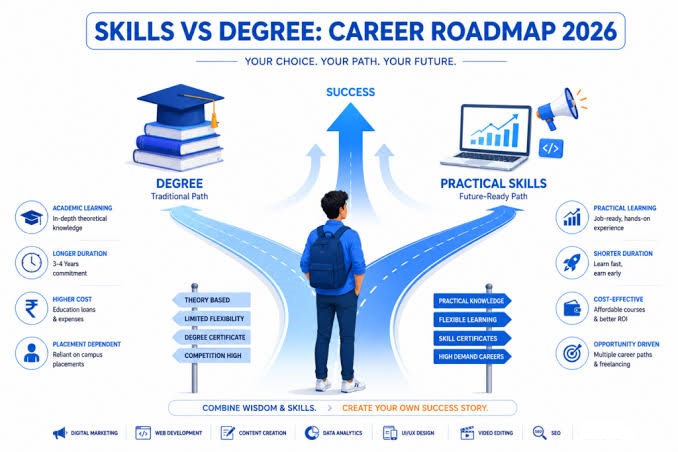
From Degree to Skill: The New Rule of Success in 2026
How Digital Skills, Freelancing, Remote Jobs and AI Are Reshaping Career Opportunities for India’s Graduates — Including Young Professionals in Kashmir
By: Javid Amin | 29 October 2026
The Degree Is in Your Hand. What Comes Next?
For generations, the formula for career success appeared straightforward: complete your education, earn a degree, apply for jobs and work your way towards a stable future.
In 2026, that formula still matters, but it is no longer sufficient on its own.
Thousands of young people complete graduation every year with hopes of securing a good job. Yet many discover that academic qualifications alone may not prepare them for the practical demands of the workplace. Employers want candidates who can contribute to real projects, use relevant tools, communicate clearly and adapt to changing technology.
At the same time, another group of young professionals is exploring a different route. They are learning software development, digital marketing, UI/UX design, video editing, cybersecurity and AI automation. Instead of depending exclusively on local vacancies, they are building portfolios, approaching clients online and applying for remote positions with companies outside their cities and countries.
Some succeed in securing international projects. Others begin with internships, small assignments or local clients before gradually expanding their work.
The important difference is not that every freelancer earns more than a graduate with a conventional job. It is that skills can create additional routes to employment, income and professional growth.
This shift is particularly relevant for young people in regions such as Kashmir, where access to a wider range of local employers may be limited in some fields. With suitable skills, reliable internet access and the ability to work professionally online, a person’s potential client base can extend well beyond their immediate surroundings.
The new career question is therefore no longer simply, “Which degree should I pursue?”
It is also, “What can I learn to do, how can I demonstrate that ability, and who needs the work I can deliver?”
1. The 2026 Reality: Employers Need More Than Qualifications
A degree remains valuable. It can provide subject knowledge, foundational understanding, professional credibility and access to careers that require formal qualifications.
However, the transition from education to employment can be difficult when classroom learning does not translate into workplace readiness.
A graduate may understand marketing concepts but have little experience running a campaign. A computer science student may know programming fundamentals but struggle to build and deploy a complete application. A design student may understand visual principles without having a portfolio that demonstrates how those principles solve business problems.
This gap between knowledge and practical execution is one reason skills development has become a central career issue.
Mercer | Mettl’s India’s Graduate Skill Index 2025 reported that 42.6% of Indian graduates assessed in its study were considered employable overall. The result reflects the report’s assessment methodology and should not be interpreted as meaning that the remaining graduates can never find work. It nevertheless highlights the challenge of matching graduate capabilities with employer expectations. https://www.mercer.com/insights/talent-and-transformation/talent-assessment/indias-graduate-skill-index-2025/
More recent research points in the same broad direction. The India Skills Report 2026, listed by the Confederation of Indian Industry, examines how AI-enabled work, freelancing, remote employment and other changing work models are influencing the skills landscape
Together, these findings point towards a practical lesson: education and skills development should complement each other.
Degree versus skill: Is it really a competition?
The debate is often presented as a choice between formal education and practical training. That is an oversimplification.
A more useful comparison is how each contributes to career readiness.
| Traditional education | Practical skill development |
|---|---|
| Builds subject knowledge and theoretical foundations | Builds the ability to perform specific tasks |
| Provides a recognised academic qualification | Produces work samples and demonstrable experience |
| Can be essential for regulated professions | Can strengthen employability across many industries |
| Usually follows a structured curriculum | Can be adapted to current tools and market needs |
| Helps establish credibility and eligibility | Helps show employers or clients what you can deliver |
For many careers, the strongest combination is a degree, relevant practical skills and evidence of work.
For example, a graduate with a marketing degree who can research an audience, develop a content strategy, manage advertising campaigns and interpret performance data may be better prepared for a digital marketing role than someone who knows only marketing theory.
Likewise, a computer science graduate who has built, tested and documented working applications can demonstrate capabilities that a list of completed subjects may not fully reveal.
The objective is not to abandon education. It is to turn education into capability.
2. Why Digital Skills Are Opening New Career Routes
Digital technology has changed how organisations develop products, reach customers, protect information and manage daily operations.
A small business may need a website without employing a full-time developer. A local retailer may need someone to manage online campaigns. An international creator may need a video editor. A startup may require a designer for a new application, while a growing organisation may need help automating repetitive administrative work.
These needs create opportunities for employees, contractors, freelancers and small digital service businesses.
The most useful skills are not necessarily the trendiest ones. They are the skills that solve identifiable problems for people and organisations.
Consider six career paths that students and early-career professionals can explore in 2026.
3. UI/UX Design: Turning Digital Products Into Better Experiences
Every time someone books a hotel, orders a product, completes an online payment or uses a mobile application, they interact with a digital experience.
If that experience is confusing, slow or difficult to navigate, users may abandon it. UI/UX professionals help businesses make digital products clearer, more usable and more effective.
UI, or User Interface design, focuses on the visual and interactive elements of a product: screens, buttons, layouts, typography, colours and visual consistency.
UX, or User Experience design, looks more broadly at the user’s journey. It involves understanding user needs, identifying problems, organising information, testing designs and reducing friction.
What does a UI/UX designer actually do?
Typical responsibilities include:
- Researching user needs and behaviour.
- Creating user journeys, wireframes and prototypes.
- Designing website and mobile application interfaces.
- Developing reusable design systems.
- Testing interfaces and incorporating feedback.
- Collaborating with developers, product managers and clients.
- Improving accessibility, clarity and usability.
Skills worth learning
Start with design fundamentals, including spacing, typography, colour, hierarchy and visual consistency. Learn how to structure information and understand user behaviour.
Tools such as Figma are useful for creating layouts, prototypes and design systems. Depending on the role, knowledge of accessibility, usability testing, responsive design and basic HTML/CSS can also be valuable.
AI tools can assist with early concepts, research synthesis and repetitive design tasks. However, understanding users, making sound design decisions and explaining why a particular solution works remain important.
How can a beginner build a portfolio?
Instead of collecting certificates without practical work, create three detailed case studies.
For example:
- Redesign the booking journey for a small hotel.
- Develop a mobile shopping experience for a local handicraft store.
- Create a website for a tourism operator or local service business.
Explain the problem, your research, the design decisions and the final prototype. If you can test the design with real users and document the feedback, your case study becomes more credible.
Be honest about whether a project was commissioned, self-initiated or hypothetical.
Career opportunities
Potential roles include UI designer, UX designer, product designer, interaction designer, design systems specialist and UX researcher.
Freelance work may include landing pages, website redesigns, mobile application screens and prototype development.
For a beginner in Kashmir, a practical starting point could be redesigning a local business website or creating a booking interface for a tourism service. The resulting work can become a portfolio piece and, where the business agrees, a real-world case study.
4. Digital Marketing: Helping Businesses Find Customers Online
A business can have a good product and still struggle to attract customers. Digital marketing helps organisations reach audiences, communicate value and measure whether their marketing activities are working.
It can be a useful option for graduates from commerce, management, media, English, journalism and other backgrounds, although people from any discipline can learn it.
Unlike some technical professions, digital marketing offers several possible entry points. A beginner might start with content writing, social media management or search engine optimisation before specialising in analytics, paid advertising or broader marketing strategy.
What does a digital marketer do?
Depending on the role, responsibilities may include:
- Researching customer needs and search behaviour.
- Planning content for websites and social media.
- Improving website visibility through SEO.
- Managing paid advertising campaigns.
- Developing email marketing strategies.
- Tracking traffic, leads and conversions.
- Analysing campaign performance and improving results.
- Coordinating with designers, writers and sales teams.
Skills to prioritise
Learn keyword research, search intent, content strategy, basic website management, on-page SEO, analytics and conversion principles.
For paid campaigns, understand targeting, budgets, tracking and campaign measurement before spending money. Familiarity with tools such as Google Analytics, Google Search Console and advertising platforms can help, depending on the specialisation.
AI can assist with research, idea generation, drafting and analysis. But effective marketing still requires fact-checking, original thinking, customer understanding and a clear grasp of business goals.
How to build a portfolio
Choose a business or product and develop a small marketing project.
For example:
- Audit a website and recommend SEO improvements.
- Prepare a 30-day content calendar.
- Research relevant search terms and create a content plan.
- Design a campaign with a defined target audience.
- Create a report explaining how you would measure performance.
If you work with an actual business, establish the scope and obtain permission before publishing results or using private data.
Career opportunities
Possible roles include SEO executive, digital marketing executive, content strategist, social media manager, performance marketer, email marketing specialist and marketing analyst.
Freelancers can offer services to ecommerce stores, tourism companies, restaurants, education providers, agencies and small businesses.
For someone working from Kashmir, tourism and handicrafts can provide useful practice areas because businesses in these sectors often need websites, content, search visibility and digital customer communication. That does not mean every business will have a budget or that every campaign will succeed; it means there are concrete problems worth learning to solve.
5. Software Development: Building Products, Websites and Applications
Software development remains a major route into technology work, but beginners should understand that learning to code is only the beginning.
Employers and clients need people who can understand requirements, write maintainable code, test their work, fix problems and collaborate with others.
A developer’s value is not measured simply by how many programming languages appear on a résumé. It is measured more meaningfully by the quality and usefulness of the systems they can build.
What can a software developer work on?
Potential projects include:
- Business websites and ecommerce stores.
- Web applications and customer portals.
- Mobile applications.
- Internal business tools.
- APIs and backend systems.
- Database-driven applications.
- Integrations between software platforms.
- Automated testing and deployment workflows.
Which skills should beginners learn?
A web development pathway could begin with HTML, CSS and JavaScript, followed by a modern frontend framework and backend fundamentals.
Python can be a useful entry point for automation, backend development and data-related work. Students interested in systems programming or certain performance-sensitive applications may later explore languages such as C++ or Rust.
Regardless of language, learn Git, debugging, databases, APIs, security fundamentals and testing. Build an understanding of how applications are deployed and maintained.
Portfolio projects that demonstrate ability
Create a small but functional application, such as:
- A booking system for a guesthouse.
- An inventory tracker for a local retailer.
- A service website with a working enquiry form.
- A dashboard that presents useful business information.
- An appointment management tool for a small organisation.
Document the features, technologies used, limitations and improvements you would make next. Publish source code where appropriate, and ensure you do not expose passwords, API keys or private information.
Career opportunities
Possible roles include frontend developer, backend developer, full-stack developer, mobile developer, QA automation engineer and junior software engineer.
Developers can apply for salaried positions, internships, contract assignments or freelance projects. However, remote employers may still require technical interviews, relevant experience, overlapping working hours or specific qualifications.
The most effective strategy is to build projects that demonstrate reliable execution rather than attempting to learn every programming language at once.
6. Cybersecurity: Protecting Businesses in a Digital World
As organisations move more of their operations online, they must protect systems, data, networks and users from misuse and attack.
Cybersecurity is therefore more than a trend. It is an operational requirement for businesses that depend on digital infrastructure.
The Data Security Council of India’s Indian Cyber Security Skilling Landscape 2025–2026 reported substantial difficulties among surveyed organisations in finding candidates with practical cybersecurity skills. Its findings also highlighted growing interest in AI and generative AI security capabilities.
These findings suggest opportunities for well-prepared candidates, but cybersecurity is not a shortcut to an easy job. It requires technical foundations, disciplined practice, ethical judgement and continuous learning.
What do cybersecurity professionals do?
Depending on their specialisation, they may:
- Monitor systems for suspicious activity.
- Investigate security alerts.
- Help secure networks, applications and cloud systems.
- Assess vulnerabilities and recommend fixes.
- Support incident response and recovery.
- Improve identity and access controls.
- Help organisations meet security and compliance requirements.
- Educate employees about phishing and other threats.
Skills for an entry-level pathway
Begin with computer networking, operating systems, Linux fundamentals, basic scripting and security principles.
Learn how authentication, permissions, encryption, logs and common vulnerabilities work. Practice using legal training labs and systems you own or have explicit permission to test.
Entry-level certifications can provide structure, but they do not replace hands-on knowledge. A portfolio might include a documented home lab, a sample incident report, a defensive monitoring exercise or a security assessment conducted in an authorised environment.
Career opportunities
Potential roles include junior security analyst, SOC analyst, security support specialist, vulnerability management analyst and security operations associate. More specialised roles may require substantial experience.
Cybersecurity can be a promising career for people who enjoy investigating problems, understanding systems and working carefully under pressure.
Important: Never test a real website, server or network without permission. Curiosity is useful; unauthorised access is not professional experience.
7. Video Editing: A Digital Skill Built Around Communication
Video is widely used in education, entertainment, marketing, product demonstrations and social media. Businesses and creators need people who can turn raw footage into clear, engaging and well-paced content.
Video editing can appeal to people with an interest in storytelling, visual communication and creative production. It can also offer an entry point for learners who prefer practical, project-based work.
What does a video editor do?
Typical work includes:
- Selecting and arranging footage.
- Improving pacing and storytelling.
- Cleaning and balancing audio.
- Adding titles, subtitles and graphics.
- Matching colour and maintaining visual consistency.
- Preparing videos for different platforms.
- Incorporating feedback and delivering final files correctly.
Some editors specialise in short-form social media content, while others focus on YouTube videos, advertisements, interviews, documentaries, educational content or corporate communications.
Skills and tools to learn
Start with editing fundamentals: cuts, transitions, rhythm, audio levels, colour correction, captions and export settings.
Tools may include DaVinci Resolve, Adobe Premiere Pro or other suitable editing software. The best starting tool depends on your device, budget and the type of work you want to produce.
AI-assisted tools can speed up transcription, captioning, rough cuts and some repetitive tasks. Yet the editor still needs to understand storytelling, audience expectations, pacing, accuracy and copyright.
How to build a portfolio
Prepare a small collection of different projects:
- A short promotional video.
- A talking-head video with captions.
- A product demonstration.
- A longer video edited into several short clips.
- A tourism or destination video using footage you own or are licensed to use.
Show the final work and briefly explain your role. Use properly licensed music, footage, fonts and graphics.
Career opportunities
Potential roles include video editor, short-form content editor, post-production assistant, social video producer and motion graphics editor.
Freelance clients may include creators, marketing agencies, ecommerce businesses, educators and production teams.
A beginner should avoid competing only on the promise of fast or cheap editing. Reliability, clear communication, good audio, consistent quality and on-time delivery can help establish a stronger professional reputation.
8. AI Automation: Helping Businesses Work Smarter
AI automation is attracting attention because organisations are exploring ways to reduce repetitive work and connect digital tools more effectively.
The opportunity is not simply to learn how to write prompts. It is to understand a workflow, identify a genuine problem, select appropriate tools and build a solution that works reliably.
For example, a business might need to organise incoming enquiries, classify support requests, prepare reports, move information between applications or generate a first draft for human review.
A well-designed automation can reduce manual effort. A poorly designed one can introduce errors, expose data or create extra work.
What does an AI automation specialist do?
Depending on the role, the work may include:
- Mapping an existing business process.
- Identifying repetitive or error-prone tasks.
- Connecting applications through APIs and integrations.
- Building workflows using automation platforms.
- Using AI models for classification, extraction or drafting.
- Adding human approval steps for sensitive actions.
- Testing reliability and monitoring failures.
- Documenting the system for future maintenance.
Skills to learn
Start with process mapping and basic automation concepts. Learn how data moves between applications, how APIs work, and how to handle authentication and errors.
Depending on the type of work, useful tools may include no-code or low-code automation platforms, spreadsheets, databases, webhooks and Python. Learn about AI model limitations, privacy, permissions and the need to verify outputs.
You do not need to master every platform. Choose a small set of tools that suit the problems you want to solve.
Portfolio projects with practical value
Build examples such as:
- A workflow that organises website enquiries and sends them to the correct team.
- A system that drafts responses to common questions for human review.
- An automated report that collects permitted data and summarises changes.
- A workflow that extracts information from approved documents and flags uncertain results.
- A customer-support assistant that answers from a defined knowledge base and escalates questions it cannot answer reliably.
Use sample or authorised data, and explain the limits of each project.
Career opportunities
Possible roles include automation specialist, workflow consultant, AI implementation associate, business process automation developer and AI solutions support specialist.
Some roles are technical and require programming; others focus more on process analysis, integration and business operations.
The strongest candidates combine tool knowledge with an understanding of how organisations actually work. AI automation is not a guaranteed high-income shortcut, and the market will continue to change as software becomes easier to use.
9. Which Career Should You Choose? Match the Skill to Your Strengths
A popular career is not automatically the right career for every learner. Before committing months to training, consider your interests, starting point, access to equipment and the type of work you enjoy.
| Career path | Best suited to people who enjoy | A practical first project |
|---|---|---|
| UI/UX design | Visual problem-solving and understanding users | Prototype a mobile app or website |
| Digital marketing | Research, writing, business and audience growth | Create a measurable content and SEO plan |
| Software development | Logic, building systems and debugging | Build and publish a working web app |
| Cybersecurity | Investigation, systems and risk reduction | Complete an authorised security lab |
| Video editing | Storytelling, visuals and pacing | Produce a polished promotional video |
| AI automation | Workflows, problem-solving and integrations | Automate a repetitive task with safeguards |
The time required to become job-ready varies considerably. It depends on prior knowledge, available study time, the complexity of the role and the standard of work employers or clients expect.
Do not select a path solely because someone on social media claims it pays exceptionally well. Look at real job descriptions, speak with practitioners, test the work and decide whether you can see yourself developing the skill over time.
10. Freelancing: From Learning a Skill to Finding Paying Clients
Freelancing allows individuals to offer services to clients without necessarily becoming permanent employees of those organisations.
A freelancer may work with several clients, complete a defined project or provide ongoing services under a contract. Some freelancers operate independently; others work through agencies or digital platforms.
This model can create flexibility, but it also transfers responsibility to the freelancer. Finding clients, agreeing on scope, managing deadlines, handling revisions, issuing invoices and tracking income become part of the job.
Why freelancing appeals to graduates
Freelancing may offer several advantages:
- The ability to work with clients beyond the local area.
- Opportunities to build experience through smaller projects.
- Flexibility in selecting a specialisation.
- A portfolio that demonstrates practical results.
- The possibility of combining freelance work with further study or a conventional job, subject to contractual restrictions.
However, freelancers can experience irregular income, intense competition, delayed payments and periods without projects. Platform fees, payment processing, taxes, software costs and unpaid time also affect earnings.
A successful freelancer is not simply someone who knows a tool. They must identify a client problem, communicate a solution, deliver dependable work and earn enough to sustain the business.
A beginner’s freelancing roadmap
Step 1: Choose one clear service.
Avoid presenting yourself as an expert in everything. Start with a service you can learn and demonstrate, such as short-form video editing, website development, SEO audits or workflow automation.
Step 2: Build proof before making big promises.
Prepare two or three strong projects. Show what you did, why you did it and what the finished work can accomplish. Clearly label practice projects rather than presenting them as paid client work.
Step 3: Create a professional presence.
Build a portfolio website or use a suitable portfolio platform. Add a concise description of your services, relevant samples, contact details and a professional profile.
Step 4: Approach potential clients thoughtfully.
Research businesses that could benefit from your service. Send personalised messages explaining a specific problem you noticed and how you could help. Avoid generic messages sent to hundreds of people.
Step 5: Agree on the work in writing.
Define the deliverables, deadlines, revision limits, price, payment schedule, ownership rights and responsibilities of both parties. For larger projects, consider a deposit or milestone-based payments where appropriate.
Step 6: Deliver reliably.
Respond professionally, communicate delays early, protect client information and test the final work before delivery. Ask for honest feedback and permission to display suitable work in your portfolio.
Step 7: Improve your offer.
As experience grows, review which services clients value, where your process can improve and which projects are worth pursuing. Do not increase prices or claim expertise without considering your results, costs and market position.
11. Remote Jobs: Working for an Employer Without Relocating
Freelancing and remote employment are related but different.
A remote employee generally works for one organisation under an employment arrangement. A freelancer usually provides services independently under project or service agreements.
Remote work can allow someone to apply for opportunities in another city or country without relocating. But remote vacancies are not necessarily available worldwide. Some employers restrict hiring to particular countries because of employment law, payroll, tax, security or working-hour requirements.
Where can job seekers look?
Useful starting points include:
- LinkedIn Jobs: Search by role and use the remote work filter. LinkedIn also supports job alerts and more descriptive searches. https://www.linkedin.com/help/lms/answer/a508610
- Company career pages: Apply directly when an employer publishes a suitable vacancy.
- Specialist job boards: Explore reputable boards that focus on remote work or particular professions.
- Professional communities: Participate in industry groups where employers and practitioners share legitimate opportunities.
- Freelance platforms: Explore project-based work where your service matches the client’s needs.
Check each listing’s location restrictions, employment type, required experience, working hours and application process.
Remote work requires more than technical ability
Employers often need remote workers who can communicate clearly, document their work, manage time and solve problems without constant supervision.
A developer may need to explain a technical issue in writing. A designer may need to present decisions and respond to feedback. A marketing specialist may need to report performance across different time zones.
For international work, written English can be particularly useful, though the level required depends on the role and client. Clear, professional communication matters more than trying to sound complicated.
Remote work also requires a realistic assessment of your working environment. A dependable internet connection, a suitable device, secure accounts, regular backups and a quiet place for meetings can make a meaningful difference.
12. LinkedIn: Turn Your Profile Into a Professional Opportunity Page
LinkedIn is more than a digital résumé. It can help job seekers discover vacancies, demonstrate their skills, connect with professionals and learn how employers describe the work they need.
The platform cannot guarantee a job or a client, but a clear and credible profile can make it easier for relevant people to understand what you offer.
How to build a stronger LinkedIn profile
1. Write a specific headline.
Avoid relying only on labels such as “Graduate,” “Job Seeker” or “Looking for an Opportunity.”
A more useful headline identifies your direction and skills. For example:
Junior UI/UX Designer | Figma | Wireframes, Prototypes and Responsive Design
Use this only if it accurately reflects your capabilities.
2. Write an evidence-led About section.
Explain the problems you enjoy solving, the tools you use, the projects you have completed and the kind of role or work you are pursuing.
If you are a beginner, say so honestly. A focused profile with a few credible projects is better than exaggerated claims.
3. Add projects and portfolio links.
Include working demos, design case studies, code repositories, video samples or campaign reports where relevant. Explain your individual contribution and avoid publishing confidential client material.
4. Add skills that match your target roles.
Review current job descriptions and identify recurring requirements. Add relevant skills only when you can reasonably demonstrate them.
5. Connect with professionals in your field.
Follow companies, engage thoughtfully with industry discussions and connect with people whose work interests you. Ask specific questions rather than immediately requesting a job from every new connection.
6. Search strategically.
Try searches such as:
- “Junior UI/UX Designer — Remote”
- “Entry-Level Digital Marketing — Remote”
- “Junior Frontend Developer — Remote”
- “Video Editor — Contract”
- “AI Automation Specialist — Remote”
- “Cybersecurity Analyst — Graduate”
Adjust the wording to match your skills and experience. Create job alerts and review the eligibility requirements before applying.
What should you post?
You do not need to become an influencer. Share useful evidence of your progress.
You could publish a short case study, explain a problem you solved, show a design prototype, discuss a coding project or demonstrate an automation workflow. Describe what you learned and acknowledge limitations.
Consistent, relevant work can help people understand your capabilities more clearly than frequent generic motivational posts.
13. From Kashmir to the World: Building a Career Beyond Geography
For young people in Kashmir, digital work can create an additional route to opportunity. It allows skills to be presented to organisations and clients beyond the local employment market, without requiring immediate relocation in every case.
A designer in Srinagar can create a website prototype for a business in another city. A video editor can work with a creator in a different time zone. A developer can contribute to a distributed software team, subject to the employer’s hiring requirements. A digital marketer can support a business that needs content, SEO or campaign analysis.
These are realistic examples of how digital services can cross geographic boundaries. They are possibilities, not guarantees that a client or remote position will be available.
Start with the advantages you can build locally
Kashmir’s tourism, hospitality, handicraft, food and retail businesses can provide useful settings for practical learning and portfolio development.
For example:
- Design a booking page for a guesthouse.
- Create a product catalogue for a handicraft seller.
- Develop a website for a local service provider.
- Edit a short destination video using licensed footage.
- Prepare an SEO plan for a small business.
- Automate a simple enquiry-management workflow.
Where a real business agrees to collaborate, the work may become a practical project. Where it does not, you can create a clearly labelled demonstration project using sample information.
This approach helps learners connect digital skills with real business needs rather than building unrelated sample projects indefinitely.
What does a remote-ready workspace require?
Before applying for international work, assess the essentials:
- A computer suitable for your chosen skill.
- Reliable internet access, with a backup option where practical.
- Appropriate software and secure account access.
- A professional email address and online portfolio.
- A plan for calls across time zones.
- A secure way to store and transfer work.
- A reliable invoicing and payment process.
- An understanding of relevant tax and contractual responsibilities.
Some careers require more powerful hardware than others. Video editing, design and software development may have different equipment needs, while cybersecurity work may require a dedicated and carefully configured practice environment.
Plan your learning around the equipment and resources you actually have. Start with suitable tools and upgrade when your work genuinely requires it.
International clients require international standards
Working across borders means understanding professional expectations, not just using global platforms.
Clients may expect agreed deadlines, clear progress updates, properly documented deliverables and prompt communication. They may also have requirements regarding privacy, intellectual property, confidentiality and data protection.
Before accepting international work, confirm the client’s identity, project scope, payment terms, currency, fees and applicable contractual arrangements. Understand the relevant Indian tax and reporting obligations for your circumstances; seek qualified advice when needed.
A global opportunity is most valuable when the arrangement is legitimate, sustainable and professionally managed.
14. The Dark Side of Online Work: Beware of Fake Jobs and Freelancing Scams
The promise of earning from home has also attracted fraudsters who target students, unemployed graduates and inexperienced freelancers.
Some advertisements promise unusually high earnings for very simple tasks. Others demand registration fees, training payments, security deposits or money to unlock supposed earnings.
The Indian Cyber Crime Coordination Centre has specifically warned about fake CAPTCHA-filling job schemes that demand upfront payments or personal information and then withhold remuneration. Its advisory recommends reporting cyber fraud promptly through the national cybercrime reporting system or helpline 1930.
Red flags to recognise
- A supposed employer asks you to pay to secure a job.
- The income promised is unrealistic for the work involved.
- The recruiter pressures you to act immediately.
- The company identity, website or contact details cannot be verified.
- You are asked to share sensitive information unnecessarily.
- A client sends an unexplained overpayment and asks you to return part of it.
- You are asked to install suspicious software or give remote access to your device.
- A freelance client requests extensive unpaid work unrelated to a reasonable selection test.
Not every unpaid trial or platform fee is automatically fraudulent, but the terms should be transparent, proportionate and independently verifiable.
Never share passwords, one-time passcodes or banking credentials with a supposed recruiter. Verify the organisation through independently obtained contact information, not merely through links supplied in an unsolicited message.
If you experience financial cyber fraud, contact your bank or payment provider promptly and report the incident through India’s official cybercrime channels.
Remember: legitimate digital work is built on skills, contracts and trust—not registration fees or guaranteed-income promises.
15. How to Start From Zero: A Practical 90-Day Skill-Building Plan
You do not need to learn all six career paths. Choose one primary skill, build a foundation and test your ability to complete useful work.
The following plan is a starting framework. Adapt it to your existing knowledge, available time and chosen specialisation.
Days 1–15: Explore and choose
Review job descriptions and freelance projects in two or three fields that interest you.
Identify common skills, typical deliverables and entry requirements. Watch introductory lessons, try beginner exercises and choose one primary direction.
By the end of this stage, you should be able to explain what your chosen professional does and name a small project you can realistically build.
Days 16–30: Learn the foundations
Follow a structured learning path rather than jumping between unrelated tutorials.
Practise regularly. Keep notes, complete exercises and reproduce examples before attempting to modify them.
Learn the basic professional tools for your field, but focus on understanding the work rather than collecting software names.
Days 31–60: Build real projects
Create at least two projects that demonstrate different aspects of your skill.
For example, a digital marketer might prepare an SEO audit and a content strategy. A developer might build a functional website and a small application. A video editor might produce a short advertisement and a longer interview edit.
Review your work, correct errors and document your decisions.
Days 61–75: Prepare your portfolio and profile
Organise your strongest work into a portfolio. Write concise descriptions of each project, including the problem, process, tools and result.
Update your CV and LinkedIn profile. Ask a knowledgeable person to review your work and identify gaps.
If a project is fictional or self-initiated, label it accordingly. Do not invent client results or testimonials.
Days 76–90: Start approaching the market
Apply for relevant internships and entry-level jobs. Contact potential clients with specific, professional proposals. Participate in appropriate communities and request feedback from practitioners.
Track applications, responses, interviews and the quality of feedback you receive. If the same weakness repeatedly appears, address it before sending more applications.
The 90-day objective is not guaranteed employment. It is to move from passive learning towards demonstrable capability and a repeatable process for finding opportunities.
16. The 12-Month Roadmap: From Beginner to Emerging Professional
After the first three months, the focus should shift from completing projects to improving quality, gaining experience and understanding the market.
| Period | Main objective | What to work towards |
|---|---|---|
| Months 1–3 | Foundation | Learn one skill and build initial portfolio projects |
| Months 4–6 | Practical experience | Improve projects, seek internships or complete small legitimate assignments |
| Months 7–9 | Specialisation | Develop deeper expertise and learn relevant industry workflows |
| Months 10–12 | Career development | Apply strategically, strengthen professional relationships and pursue repeat work |
Progress will vary. Someone with prior experience may advance faster, while a learner balancing study, employment or limited equipment may need more time.
The important principle is consistency. Regular practice, feedback and completed work are more useful than repeatedly restarting a course whenever a new technology becomes popular.
17. How to Measure Progress Without Chasing Certificates
Certificates can help demonstrate structured learning, particularly in fields where recognised credentials are relevant. But they are not a complete measure of professional ability.
Use a broader checklist to evaluate your progress.
Technical ability
- Can you complete the core task without copying every step from a tutorial?
- Can you identify and correct common errors?
- Can you explain why you chose a particular approach?
Portfolio quality
- Does your work solve a clear problem?
- Can another person understand your process?
- Have you tested the result and corrected obvious issues?
Professional readiness
- Can you estimate the time required for a task?
- Can you communicate progress and ask useful questions?
- Can you respond constructively to feedback?
- Can you deliver files or systems in an organised, usable form?
Market readiness
- Do you understand the roles or services you are targeting?
- Can you explain your value without exaggerating?
- Have you sought feedback from employers, clients or experienced practitioners?
When you can demonstrate these capabilities, your applications and conversations become more specific and credible.
18. Common Mistakes That Slow Down Career Growth
Learning too many skills at once
A learner may study SEO one week, web development the next and AI automation after that. The result can be broad familiarity without enough depth to complete paid work.
A better approach: Choose one main skill and one complementary skill. Add more when you understand the fundamentals.
Depending entirely on certificates
Certificates can structure learning, but they do not always demonstrate the ability to solve a practical problem.
A better approach: Pair relevant courses with projects, documentation and feedback.
Copying projects without understanding them
A portfolio full of copied templates may look attractive but fail under questioning.
A better approach: Modify projects, explain your decisions and demonstrate that you understand how the work functions.
Expecting immediate income
Freelancing is often presented as a quick route to financial independence. In reality, finding clients and building a reliable reputation can take time.
A better approach: Treat early work as a period of learning and market testing. Maintain realistic financial expectations.
Applying without tailoring your profile
Sending the same generic application to every employer makes it difficult to show why you fit a particular role.
A better approach: Match your application to the job description and include the most relevant examples of your work.
Ignoring communication
A technically capable person can still lose opportunities through unclear proposals, missed deadlines or poor client updates.
A better approach: Practise writing concise messages, documenting decisions and managing expectations.
Treating AI as a substitute for understanding
AI tools can accelerate some tasks, but they can also generate inaccurate code, flawed advice, weak content or insecure workflows.
A better approach: Use AI to assist your work, then verify the output, understand its limitations and take responsibility for what you deliver.
19. The Most Valuable Combination: Technical Skills Plus Human Skills
Technology skills can help someone qualify for an opportunity, but they rarely operate in isolation.
A digital marketer needs to understand customers. A designer must listen to users and explain design choices. A developer needs to interpret requirements. A video editor must understand the story. A cybersecurity professional needs judgement and discipline. An automation specialist must recognise when a process should not be automated.
Across these careers, several complementary capabilities matter:
- Communication: Explaining ideas clearly to colleagues and clients.
- Problem-solving: Breaking complex tasks into manageable steps.
- Critical thinking: Checking assumptions and identifying errors.
- Adaptability: Learning new tools without abandoning core principles.
- Time management: Estimating work and meeting deadlines.
- Professional ethics: Protecting information and respecting intellectual property.
- Business understanding: Connecting technical work to the needs of an organisation.
These capabilities are particularly important in remote work, where teams may not share an office or time zone.
A strong professional is not simply someone who can operate a tool. It is someone who understands when to use it, how to use it responsibly and how to judge whether the result is good enough.
20. The Future of Work: Build Adaptable Skills, Not Just Trendy Ones
Technology will continue to change the tasks people perform. Some activities will become easier to automate, while other roles will evolve to include new tools and responsibilities.
That makes it risky to treat any current career as permanently secure or to assume that one course guarantees a stable future.
A more durable strategy is to build transferable foundations.
For digital marketing, this may mean understanding customers, analytics and communication in addition to AI-assisted content tools.
For software development, it may mean mastering programming fundamentals, testing, system design and security rather than relying exclusively on one framework.
For video editing, it may mean developing storytelling, visual judgement and production discipline alongside automated editing features.
For cybersecurity, it may mean understanding systems and risk while continually learning about new threats.
For UI/UX design, it may mean combining design principles, research and usability testing with AI-assisted workflows.
For AI automation, it may mean understanding business processes, integrations, privacy and reliability rather than relying on a single platform.
The tools will change. The ability to learn, solve problems and deliver useful work can help professionals adapt.
Conclusion: Your Degree Is a Foundation. Your Skills Show What You Can Build.
The world of work in 2026 offers more ways to develop a career than the traditional model of graduating and applying only to nearby employers. Digital skills can help people explore remote employment, freelance projects, internships and opportunities with organisations beyond their immediate geography.
But access to these opportunities is not automatic. Competition remains real. Employers have requirements. Clients expect reliable delivery. Freelancers must manage uncertainty, and remote workers must demonstrate that they can contribute effectively.
The practical response is to start small, learn deliberately and produce evidence of your ability.
Choose one skill. Complete meaningful projects. Build a credible portfolio. Improve your communication. Learn how to identify legitimate opportunities. Apply consistently, ask for feedback and keep updating your knowledge.
For a student or graduate in Kashmir, this can mean using a local business problem as the starting point for a portfolio project, then taking that work to a wider professional audience. For someone elsewhere in India, the same principle applies: begin with what you can learn and demonstrate, then expand your reach.
A degree still has value. Experience still matters. Formal qualifications remain essential in many professions.
But in a competitive, technology-driven economy, the ability to turn knowledge into useful work can make a significant difference.
In 2026, do not stop at asking what your degree qualifies you for. Ask what you can build, improve, protect, design or deliver with the skills you are developing.
That is where education begins to translate into opportunity.
Note: Employment figures and research findings cited in this feature are based on the linked reports and their stated methodologies. Career outcomes depend on individual preparation, market conditions and employer or client requirements. No job, income level or freelance success is guaranteed.