Farooq Abdullah appoints veteran Eidgah MLA to a key organisational post after four ministers are inducted into Omar Abdullah’s Cabinet; discontent among senior leaders exposes the challenge of balancing political aspirations and regional representation.
By: News Desk | 27 October 2026
Srinagar: Jammu and Kashmir Chief Minister Omar Abdullah’s long-awaited Cabinet expansion has triggered visible resentment within the ruling National Conference (NC), with several senior legislators expressing disappointment over their exclusion from ministerial positions and supporters of veteran leader Mubarak Gul staging a protest at the party headquarters.
The political fallout followed the induction of four legislators as ministers on October 27, completing the Council of Ministers’ expansion to its maximum permissible strength of nine, including the Chief Minister. The new ministers are Ali Mohammad Sagar, Shamim Firdous, Mir Saifullah and Altaf Ahmad Wani, popularly known as Altaf Kaloo. Independent MLA Satish Sharma, who was part of the previous Cabinet, was dropped.
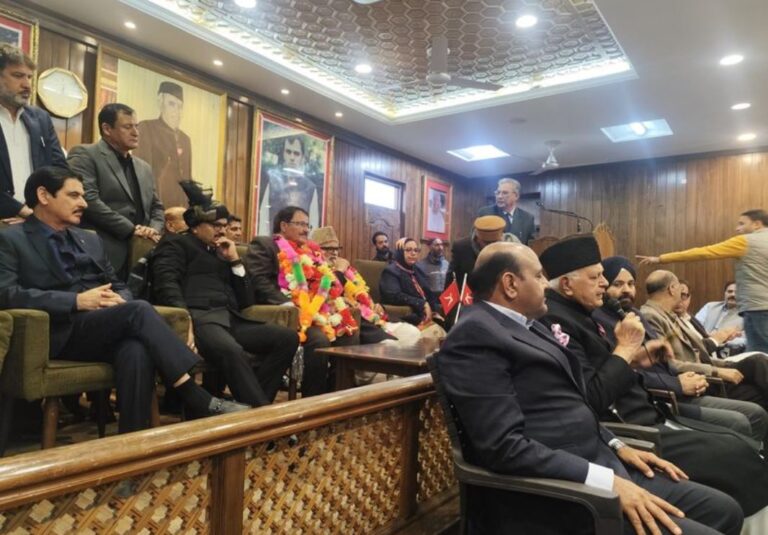
Within hours of the swearing-in ceremony, National Conference president Farooq Abdullah appointed Mubarak Gul, the six-time MLA from Eidgah, as the party’s new general secretary. The appointment came after Gul publicly expressed disappointment over being left out of the Cabinet, in a move widely seen as an effort to address the growing discontent within the party.
The developments have brought the internal challenges facing the National Conference into sharper focus as Omar Abdullah’s government seeks to balance seniority, experience, regional representation and the expectations of legislators who have long worked with the party.
Mubarak Gul’s exclusion sparks protest
Gul’s omission from the expanded Cabinet became one of the most visible sources of discontent following the swearing-in ceremony at Lok Bhavan in Srinagar.
A veteran National Conference leader and former Speaker of the Jammu and Kashmir Legislative Assembly, Gul has represented Eidgah in Srinagar across six Assembly elections. His supporters argued that his political experience and longstanding association with the party warranted a place in the government.
The resentment spilled onto the streets outside the National Conference headquarters at Nawa-i-Subah, where supporters raised slogans against the decision to leave him out. Some questioned why a senior legislator with decades of political experience had been overlooked while other party members were inducted into the Cabinet.
Gul himself expressed disappointment over his repeated exclusion from ministerial positions. Speaking to reporters, he recalled attending numerous oath-taking ceremonies without being inducted into the government.
Farooq Abdullah subsequently reached out to Gul and appointed him general secretary of the party. The decision placed Gul in a senior organisational role as the leadership faced pressure to respond to the concerns of his supporters.
The appointment, however, did not immediately end the protest. Reports published after the announcement said some supporters continued to demand a ministerial berth and questioned whether the organisational position adequately recognised Gul’s seniority. Daily Excelsior reported on October 28 that Gul had yet to accept the new post.
Four new ministers, a full-strength Cabinet
The Cabinet expansion brought Ali Mohammad Sagar, Shamim Firdous, Mir Saifullah and Altaf Ahmad Wani into the government.
Sagar is a senior National Conference legislator from Khanyar, while Firdous represents Habba Kadal. Mir Saifullah represents Trehgam in Kupwara district, and Altaf Kaloo is the MLA from Pahalgam. Sagar and Mir Saifullah have held ministerial positions in earlier governments, while Firdous has previously held a senior public position through the Jammu and Kashmir State Commission for Women.
The induction of four ministers filled the available vacancies and brought the Council of Ministers to its maximum permitted strength of nine, including the Chief Minister. The limit is central to understanding the resentment: the leadership had more aspirants for ministerial positions than available berths.
A report by The Indian Express before the expansion noted that Omar Abdullah was facing competing demands from senior and younger leaders, different sub-regions and communities. It also highlighted the limited room for accommodating additional legislators under the Union Territory’s current framework.
The expansion has therefore resolved the question of who would fill the vacant ministerial positions while leaving unresolved the expectations of several leaders who were not selected.
Abdul Majeed Larmi voices disappointment
Gul was not the only senior legislator to express disappointment.
Abdul Majeed Bhat Larmi, a three-time MLA from south Kashmir, became emotional after being left out of the Cabinet. According to Daily Excelsior, Larmi said he believed his seniority and experience made him a strong contender for a ministerial berth and that he had understood his name was being considered before the final list was settled.
Larmi also questioned the choice of Altaf Kaloo, arguing that he had greater seniority. Despite his disappointment, he reaffirmed his loyalty to the National Conference and said he would work to pacify his supporters.
His reaction illustrates the difficulty of managing expectations within a party whose senior legislators have spent years building political constituencies and seeking opportunities to serve in government.
For leaders such as Larmi, a ministerial appointment represents more than a personal elevation. It also carries political significance for their constituencies, supporters and local party networks. Exclusion can therefore produce frustration beyond the individual legislator.
Gurezi’s absence adds to the pressure
Another senior National Conference leader, Nazir Ahmad Khan, popularly known as Gurezi, did not attend the swearing-in ceremony after being left out of the Cabinet, according to Daily Excelsior.
The report said newly inducted ministers Mir Saifullah and Altaf Kaloo later visited Gurezi’s residence as efforts began to address the disappointment among leaders who had expected ministerial positions.
Gurezi’s absence added to the signs of unease within the party. His political standing and constituency in north Kashmir make his response relevant to the leadership’s broader effort to maintain cohesion across the region.
The developments also underline the challenge of balancing individual aspirations against the political demands of different constituencies. A Cabinet decision can have implications for a legislator’s standing among supporters, even when the leader continues to profess loyalty to the party.
Regional and community representation under scrutiny
The Cabinet expansion has also renewed debate over the distribution of ministerial positions between Jammu and Kashmir and among different sub-regions and communities.
All four newly inducted ministers represent constituencies in the Kashmir Valley. With the reshuffle, seven members of the nine-member Council of Ministers are from Kashmir, while Deputy Chief Minister Surinder Choudhary and Minister Javed Rana represent the Jammu region’s Pir Panjal belt. Independent MLA Satish Sharma, who represented Chhamb in Jammu, was dropped.
The regional balance has become a subject of political discussion because Jammu and Kashmir’s electoral geography includes distinct sub-regions, including the Pir Panjal and Chenab Valley, as well as communities with their own political expectations.
The Indian Express reported before the expansion that the Chenab Valley and the Pahari community lacked representation in the existing Cabinet. It also described the competing demands facing Omar Abdullah as he sought to accommodate regional, sub-regional and ethnic considerations.
These concerns have gained renewed attention following the final selection of ministers. The Cabinet’s composition does not by itself establish how government resources or administrative attention will be distributed, but representation remains a significant political issue for elected leaders and their constituents.
Farooq Abdullah’s organisational response
The appointment of Gul as general secretary came at a critical moment for the National Conference. The party leadership faced public expressions of disappointment from senior legislators and protests by supporters who believed their leaders had been overlooked.
The appointment was announced by National Conference spokesperson Imran Nabi Dar. Gul replaced Ali Mohammad Sagar in the organisational role after Sagar entered the Cabinet.
The move gives Gul a senior position within the party organisation, while Sagar assumes ministerial responsibilities. It also places an experienced legislator in a role that involves party organisation at a time when the leadership must manage competing expectations among its elected representatives and workers.
The appointment has been interpreted as an effort to contain resentment following the Cabinet decision. The public response, however, indicates that some supporters continue to regard a ministerial berth as the recognition Gul deserved.
The extent to which the new role eases the discontent will depend on how Gul responds to the appointment and how the party leadership engages with the concerns raised by his supporters.
Omar Abdullah’s challenge after the reshuffle
For Omar Abdullah, the Cabinet expansion marks the completion of a long-awaited reshuffle but also brings the challenge of managing its political consequences.
The Chief Minister had to make choices within a strict limit on the number of ministers while responding to demands from senior legislators, younger party members and different regions. As The Indian Express reported before the expansion, the limited size of the Council of Ministers meant that several aspirants would inevitably remain outside the government.
The reactions following the swearing-in show that the consequences extend beyond those who received ministerial positions. Leaders who were excluded have constituencies to answer to, while their supporters expect the party leadership to acknowledge their contribution and political standing.
The government must now move from the selection of ministers to the allocation of portfolios and the delivery of its policy agenda. At the same time, the party organisation must address concerns among its workers and legislators without allowing disagreements over appointments to overshadow its wider political commitments.
A test of party unity
The National Conference’s Cabinet expansion has brought an internal balancing act into public view. The induction of four ministers has completed the Council of Ministers, but the exclusion of several senior leaders has exposed the competing expectations within the ruling party.
Mubarak Gul’s appointment as general secretary represents the leadership’s organisational response to one prominent case of discontent. The reactions of Gul’s supporters, Abdul Majeed Larmi and Nazir Ahmad Khan Gurezi show that dissatisfaction extends beyond a single appointment.
The coming weeks will indicate whether the party can accommodate these concerns through organisational responsibilities, political engagement and the functioning of the government.
For Omar Abdullah and the National Conference leadership, the task is now to maintain cohesion while ensuring that ministerial decisions translate into effective governance. The Cabinet has reached its full strength; the wider challenge of keeping the party united remains.