Netanyahu vs Eisenkot: Israel Faces Coalition Deadlock After Election
By: Javid Amin | 28 October 2026
Jerusalem: Israel’s parliamentary election has produced a result that may keep Benjamin Netanyahu politically relevant without giving him the numbers needed to govern comfortably. With around 85% of ballots counted, the bloc led by the Israeli prime minister is projected to win 53 seats, compared with 48 for the opposition bloc led by former military chief Gadi Eisenkot. Arab-led parties are on course to secure 19 seats, their strongest showing in the current electoral contest. Neither main bloc has reached the 61 seats required for a majority in the 120-member Knesset.
The figures tell a more complicated story than a straightforward Netanyahu victory or defeat. His Likud party remains the largest individual party, but his wider coalition has lost the parliamentary majority needed to govern independently. Eisenkot’s opponents have gained ground, yet they also face a formidable obstacle: assembling a government from parties with conflicting positions on national security, Palestinian issues and cooperation with Arab political representatives.
The strongest immediate message from the electorate is therefore uncertainty. Israel has not clearly endorsed a new government, but it has made the formation of the next administration more difficult.
The result also carries consequences beyond domestic politics. Netanyahu has used the election-night address to reaffirm his determination to confront Iran, while the regional conflict remains unresolved. Whether Israel’s next government will be able to pursue that policy with the same political freedom is now an important question for Washington, Tehran and neighbouring countries.
Israel election results: What the latest count reveals
Partial parliamentary projection · October 28, 2026
Netanyahu-led bloc
53
Seats projected
Eisenkot-led bloc
48
Seats projected
Arab-led parties
19
Seats projected
Seats needed for a majority
61 of 120
Figures reported by The Times of Israel and other outlets while counting remained incomplete. They are not final certified results.
The Times of Israel+1
These numbers also explain why some early headlines and projections differed. Exit polls released on election night had placed the Netanyahu bloc at around 52 seats, while another broadcaster initially projected a much closer race. As the count progressed, the distribution changed. Exit polls, partial official counts and final certified results are different stages of the electoral process and should not be treated as interchangeable.
The distinction matters for the political narrative. Netanyahu has a clear lead over Eisenkot’s bloc in the latest projection, but a lead is not the same as a parliamentary majority. His opponents, meanwhile, cannot assume that adding their projected seats to those of the Arab-led parties automatically produces a viable government.
Netanyahu remains the strongest individual contender, but his coalition has a problem
Netanyahu’s Likud remains the largest party, with projections suggesting approximately 27 seats, compared with around 20 for Eisenkot’s Yashar party. That gives Netanyahu a stronger individual position than the opposition leader, but the wider coalition arithmetic remains unfavourable.
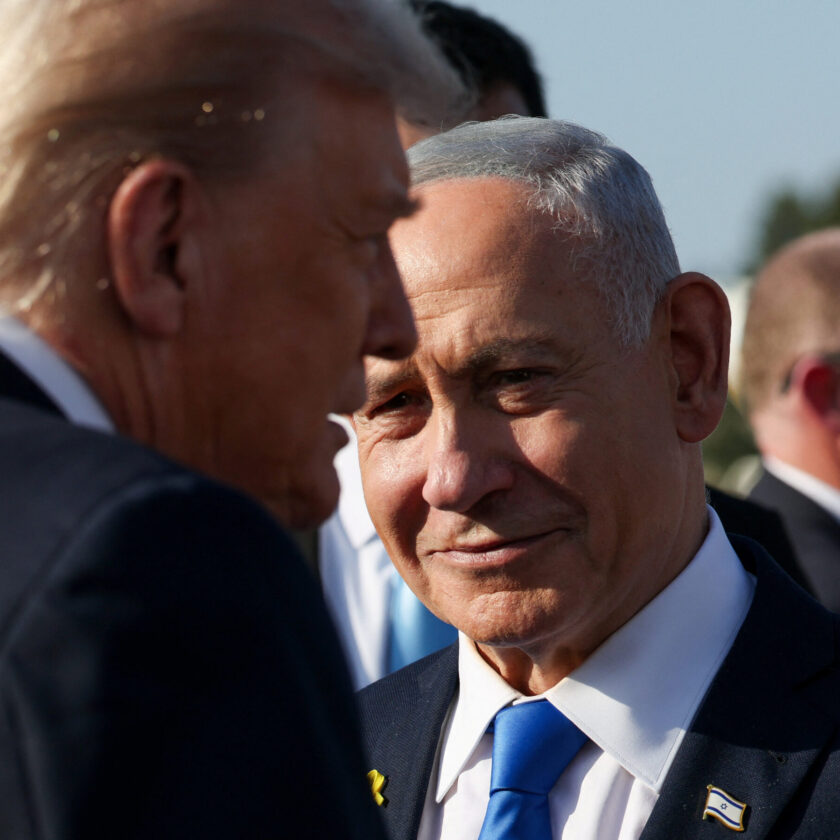
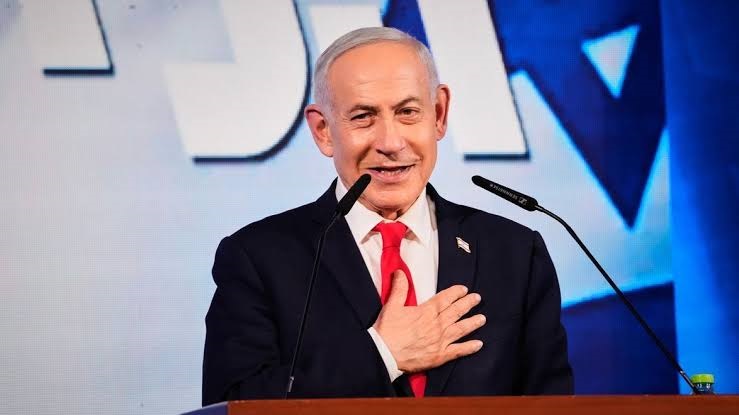
In his election-night remarks, Netanyahu called for a “strong, right-wing national government” and highlighted Israel’s military achievements. He also described the country as having a historic opportunity, alongside US President Donald Trump, to remove what he called the existential threat posed by Iran.
His political opponents interpret the result differently. Eisenkot argued that voters had rejected the current government and called on Netanyahu to step aside. He also warned senior security officials against allowing national security to be used for political purposes.
These competing claims reflect the central contradiction in the election. Netanyahu’s bloc appears to have outperformed the opposition, yet it has not secured the numbers needed to govern alone. The opposition can argue that the prime minister has lost his majority, but it has not demonstrated that it can assemble a stable replacement.
For Netanyahu, the immediate objective is to retain the support of right-wing and ultra-Orthodox partners while exploring whether additional support can be secured. For Eisenkot, the challenge is to turn opposition to Netanyahu into a workable governing arrangement rather than a temporary parliamentary alignment.
Neither task is straightforward.
Arab-led parties emerge as the election’s biggest power brokers
The most consequential development may be the performance of Israel’s Arab-led parties, which are projected to win 19 seats collectively. The figure would give them an unprecedented level of representation in the Knesset and make them central to discussions about the next government.
For Arab citizens of Israel, the result reflects several overlapping concerns: political representation, rising violent crime in Arab communities, discrimination, the war in Gaza and opposition to Netanyahu’s governing coalition.
Turnout reached 77.7%, the highest level in more than two decades, according to Reuters. Arab participation was particularly significant, as community leaders had urged voters to use the election to influence government formation.
But electoral gains do not automatically translate into cabinet positions or governing influence.
Netanyahu has rejected forming a government dependent on Arab-led parties. Eisenkot and several other opposition figures have also faced political constraints over whether to cooperate with them. The opposition’s arithmetic becomes much more favourable if Arab parties support a government, but securing that support could require political compromises that some of its prospective partners are reluctant to make.
That leaves Arab political leaders with a difficult choice: seek direct participation in government, support an alternative administration from outside the coalition, or use their parliamentary strength to negotiate specific policy concessions.
Ra’am leader Mansour Abbas has expressed willingness to help facilitate a change of government, while Joint List representatives have also indicated they want to prevent Netanyahu’s coalition from continuing. Their approaches and conditions are not necessarily identical, however, and the parties should not be treated as a single political organisation simply because they share an interest in opposing the incumbent government.
The election has given these parties greater leverage. Whether they can convert that leverage into lasting political influence remains an open question.
Why forming a government will be harder than counting the seats
Israel’s parliamentary system requires a governing coalition to command the support of at least 61 members of the 120-seat Knesset.
On paper, the opposition bloc’s projected 48 seats and the Arab-led parties’ 19 seats would add up to 67. That is enough to cross the majority threshold.
In practice, the calculation is less straightforward.
Several opposition parties campaigned against relying on Arab-led parties to form a government. Their differences extend beyond political personalities to questions of national identity, military policy, relations with Palestinians and the role of Arab representatives in national decision-making.
At the same time, Netanyahu’s bloc is also short of a majority. His established right-wing and religious partners may be reluctant to support a broader unity government if doing so means compromising on issues central to their political programmes.
The election has therefore produced a majority against Netanyahu’s current coalition in numerical terms, but not necessarily a unified majority ready to govern.
Four possible outcomes
1. An opposition-led government
Eisenkot could seek to assemble a coalition with centrist and other opposition parties, potentially relying on Arab-led parties for support. This route has the parliamentary numbers in principle, but it requires overcoming campaign commitments and ideological divisions.
Netanyahu could try to secure backing from smaller parties or individual lawmakers. Yet his projected 53 seats leave him eight short of a majority, and there is no guarantee that enough potential partners will agree to join him.
A broader agreement between major political camps could reduce the immediate risk of another election. But Netanyahu and Eisenkot have publicly staked out opposing positions, and a unity government would need agreement on leadership, security policy and the distribution of power.
If no candidate can assemble a workable coalition, Netanyahu’s government can remain in a caretaker capacity while political consultations continue. If the process ultimately fails, Israel could return to the polls.
Israeli President Isaac Herzog has urged parties to approach negotiations with an open mind and do everything possible to avoid another election. He is expected to begin formal consultations with party representatives after receiving the official results. The candidate selected to form a government then has a limited period to assemble a coalition.
The immediate next step is therefore not another public declaration of victory. It is the formal coalition process, where the arithmetic of the Knesset must be translated into a functioning government.
Israel election and Iran war: Why the result matters beyond Jerusalem
The political uncertainty comes at a sensitive time for the wider Middle East.
In his election-night speech, Netanyahu said Israel had a historic opportunity to confront Iran alongside Trump. His remarks reinforce the possibility that military pressure on Tehran will remain a priority if he continues to lead the government.
However, it would be premature to conclude that the election result automatically makes renewed strikes more likely.
A caretaker government remains responsible for state administration and security, but the absence of a stable parliamentary majority could complicate decisions with substantial military, diplomatic or economic consequences. The extent of those constraints would depend on the circumstances and the nature of any proposed operation.
The American political calendar adds another variable. Trump faces US midterm elections on November 3, and previous reporting has described preparations for possible renewed US-Israeli attacks on Iran after that date. Such reporting indicates that military options are being considered, not that a final order to attack has been confirmed.
Three issues will be especially important in the days ahead:
-
Military coordination: Whether Washington and Jerusalem continue to align their objectives and timetables.
-
Diplomatic negotiations: Whether the parties can make progress on sanctions, maritime security and Iran’s nuclear programme.
-
Regional stability: Whether Gulf shipping, energy infrastructure and neighbouring countries face renewed attacks or restrictions.
The outcome of Israel’s coalition talks will help determine who exercises political authority. It will not, by itself, resolve the strategic dispute with Iran.
Economic warning signs: Markets are watching the political uncertainty
The election has also affected financial markets.
Reuters reported that the shekel weakened by around 1.6% against the US dollar on October 28, while Israel’s main stock-market indexes fell by more than 3%. The market reaction reflected concerns about the possibility of a prolonged caretaker government and uncertainty over the next administration.
A single trading session does not establish a long-term economic trend, and markets can move for several reasons. Nevertheless, political uncertainty matters when a country is already dealing with the financial and security costs of prolonged conflict.
Businesses need clarity on fiscal policy, public spending, investment and the future direction of security policy. A lengthy coalition negotiation could delay important decisions and deepen uncertainty, particularly if it coincides with renewed military escalation.
The broader economic implications could extend beyond Israel. Further conflict involving Iran and the Strait of Hormuz could put pressure on oil prices, shipping costs and regional trade, affecting energy-importing economies such as India.
What the election says about Israeli society
The result cannot be reduced to a contest between Netanyahu and Eisenkot.
The high turnout, the strong performance of Arab-led parties and the continuing strength of Likud reveal a society divided over how to respond to years of conflict and political turmoil.
Netanyahu retains substantial support, particularly among Jewish voters who credit his government with pursuing an aggressive security strategy. At the same time, the loss of a clear coalition majority demonstrates that support for the prime minister does not automatically translate into sufficient parliamentary backing for his existing government.
The opposition’s challenge is equally revealing. It has attracted enough support to deny Netanyahu a clear majority, but it has not yet demonstrated that it can reconcile its internal differences and form a stable alternative.
For Arab-led parties, the election offers a rare opportunity to influence government formation. Yet their ability to exercise that influence will depend on whether Jewish-majority parties are willing to cooperate with them and what political conditions they attach to their support.
These are questions about representation and the nature of Israeli democracy, not simply about the identity of the next prime minister.
Conclusion: Netanyahu leads, but the political battle is far from over
Israel’s October 27 election has given Netanyahu a lead in the latest partial projections, but it has not delivered the decisive parliamentary victory his bloc needs to govern alone.
With approximately 53 seats projected for his bloc, 48 for Eisenkot’s opposition and 19 for Arab-led parties, the next government will depend on negotiations, compromises and decisions that have yet to be made.
The strongest immediate conclusion is that Netanyahu remains a central contender, but his political future is not settled. The opposition has a potential numerical route to power, but its reluctance to rely on Arab parties makes that route difficult. A unity government remains possible, while prolonged negotiations and another election cannot be ruled out.
For the wider Middle East, the implications are significant. Netanyahu’s stated intention to continue confronting Iran suggests that the security agenda will remain prominent. But the election does not establish whether renewed military action will take place, when it might happen or whether diplomacy can still prevent another escalation.
Israel has voted. The harder task now is to turn the result into a government capable of making decisions at a time when domestic politics and regional security are increasingly intertwined.