NC’s Limited Presence at Delhi Protests Raises Questions Over INDIA Bloc Coordination
By: News Desk | Srinagar | October 8, 2026
Ruhullah, PDP, People’s Conference and AIP leaders also absent from Delhi mobilisation as regional parties navigate electoral-roll concerns, internal differences and competing political priorities
The National Conference’s limited participation in the Congress-led protests in New Delhi against Chief Election Commissioner Gyanesh Kumar has triggered fresh questions about coordination within the opposition INDIA bloc, particularly over how far Kashmir-based parties are prepared to participate in a sustained, nationally coordinated campaign.
The National Conference (NC), which governs Jammu and Kashmir under Chief Minister Omar Abdullah and remains part of the INDIA bloc, was represented during the opening phase of the Delhi agitation by Rajya Sabha MP Chowdhary Muhammad Ramzan. However, according to Greater Kashmir, the party’s participation did not continue at the same visible level over the following days, while several other prominent political figures from Jammu and Kashmir also remained absent from the Delhi demonstrations.
These included NC MPs Main Altaf and Aga Syed Ruhullah Mehdi, Rajya Sabha members Gurwinder Singh Oberoi and Sajad Kitchloo, Peoples Democratic Party (PDP) president Mehbooba Mufti, Peoples Conference chairman Sajad Gani Lone and representatives of the Awami Ittehad Party (AIP), led by jailed MP Abdul Rashid Sheikh, popularly known as Engineer Rashid.
The absences have prompted discussion about whether the national opposition’s campaign has secured sufficiently broad participation from regional parties, even as those parties have raised concerns about electoral-roll revisions and the Election Commission’s functioning.
However, the picture is more complicated than a simple divide between participation and withdrawal. NC and PDP leaders, along with other opposition representatives, also took part in a joint protest in Jammu on October 7, indicating that their absence from the Delhi mobilisation did not necessarily mean they had abandoned the broader campaign against alleged electoral irregularities. citeturn224465search8turn224465search9
Chowdhary Muhammad Ramzan Represents NC on Day One
The National Conference’s presence at the Delhi protest was largely confined to its parliamentary representation during the opening day.
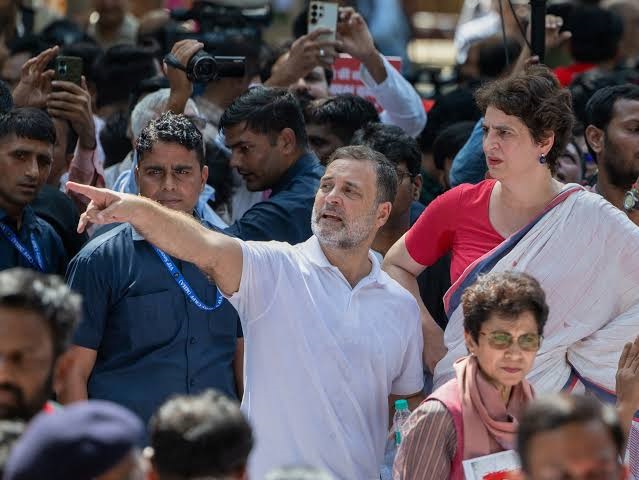
Chowdhary Muhammad Ramzan, a Rajya Sabha MP and parliamentary party leader, joined opposition leaders, including Congress president Mallikarjun Kharge and Rahul Gandhi, during the march towards the Election Commission headquarters.
Ramzan said he was representing the National Conference through its parliamentary wing, according to the report in Greater Kashmir.
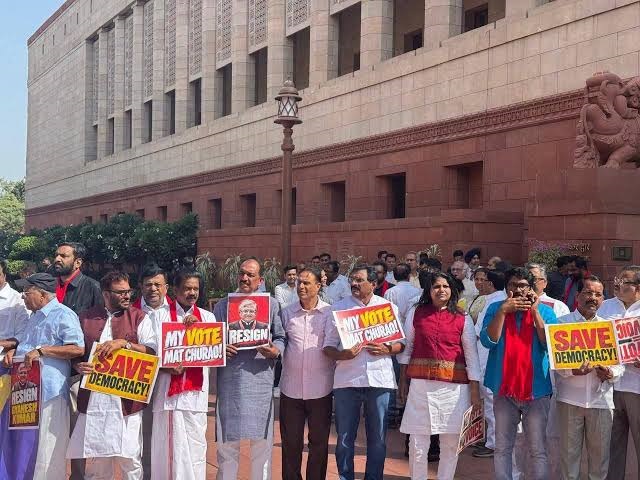
The march was part of the INDIA bloc’s campaign demanding accountability from the Election Commission over the Special Intensive Revision (SIR) of electoral rolls. The opposition has alleged that the exercise risks excluding eligible voters and has called for Chief Election Commissioner Gyanesh Kumar’s resignation.
The Delhi mobilisation escalated on October 6, when Rahul Gandhi, Priyanka Gandhi Vadra and other opposition leaders staged a prolonged sit-in at Akashvani Bhawan after police stopped their march. Several leaders were detained and later released. Subsequent demonstrations continued, including a protest at Jantar Mantar on October 7 and a gathering at Rajghat on October 8. citeturn224465search1turn224465search3turn224465search4
The limited visibility of NC leaders after the first day became a point of political discussion because the party is both a regional governing force and a constituent of the national opposition alliance.
Why the Absences Matter
The INDIA bloc was formed to coordinate opposition parties against the BJP-led Union government. Its members, however, retain their own organisational structures, regional priorities and political strategies.
For the National Conference, participation in a national protest involves balancing its relationship with Congress and other opposition parties against the political questions that dominate its own constituency in Jammu and Kashmir.
The NC has criticised aspects of the electoral-roll revision process and has raised concerns about the Election Commission. Yet participation in a sustained Delhi protest is a separate political decision from agreeing with the broad objective of electoral transparency.
That distinction matters when assessing the party’s conduct.
The absence of several NC parliamentarians could reflect differences in political strategy, individual decisions or other considerations that have not been publicly established. Without an explicit explanation from the party or the absent leaders, it would be premature to interpret non-attendance as a formal withdrawal from the INDIA bloc.
The episode nevertheless raises a practical question for the alliance: how effectively can it coordinate a national campaign when constituent parties have different priorities, political pressures and preferred venues for protest?
Ruhullah’s Absence Adds Another Dimension
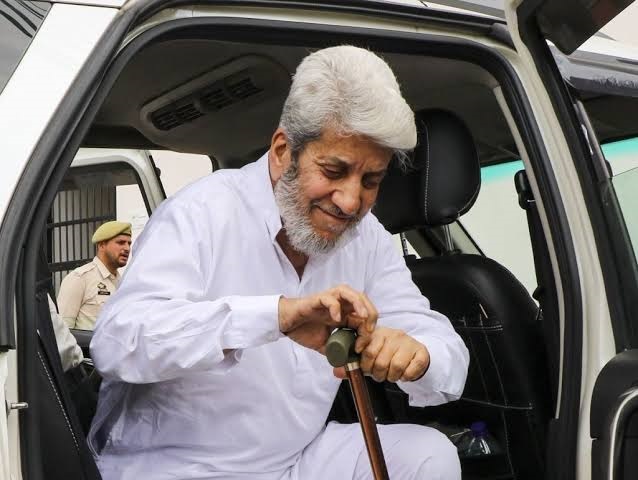
The absence of Aga Syed Ruhullah Mehdi has attracted particular attention because of his increasingly public differences with the NC leadership.
The Srinagar MP has criticised his party over what he sees as a failure to pursue its commitments on Jammu and Kashmir’s constitutional status with sufficient consistency. His disagreements have extended to the NC’s emphasis on statehood and its approach to the political commitments associated with the 2024 Assembly election.
Ruhullah’s position has often reflected a demand for a broader campaign around constitutional rights rather than a narrower focus on restoring statehood alone. His political differences with the NC leadership have therefore become part of the wider discussion about the party’s direction and internal cohesion. citeturn757236search13turn757236search7
His absence from the Delhi protest is relevant in that context, but it does not independently establish his reasons for staying away.
Nor should his decision automatically be treated as an indication that he disagrees with every aspect of the protest’s stated objective. A politician may share concerns about electoral processes while differing over the leadership, format or political messaging of a particular mobilisation.
For the NC, the episode adds to the challenge of managing internal disagreements while maintaining its position within a broader opposition alliance.
PDP, People’s Conference and AIP Also Stay Away From Delhi
The absence of the PDP, People’s Conference and AIP further illustrates the difficulty of converting shared concerns into uniform political participation.
The PDP, led by Mehbooba Mufti, has frequently criticised the Centre’s approach to Jammu and Kashmir and has raised concerns about political and constitutional rights. The People’s Conference, led by Sajad Gani Lone, has also maintained its own positions on the region’s political future.
The AIP, associated with Engineer Rashid, has pursued a distinct political line, with its leadership and supporters raising issues concerning representation, political rights and the treatment of people in Jammu and Kashmir.
Despite their differences, these parties have expressed concerns about the electoral process or the functioning of the Election Commission. Their absence from the Delhi protests, as reported by Greater Kashmir, therefore raises questions about the extent to which those concerns translate into participation in a common national campaign.
But absence from one protest should not be confused with a blanket rejection of the issue. Political parties can oppose a process, support demands for accountability and still differ over how, where and with whom they choose to protest.
Jammu Protest Shows the Picture Is Not One-Dimensional
An important counterpoint to the Delhi absences came on October 7, when INDIA bloc parties organised a joint “Save Democracy” march in Jammu.
Leaders and supporters of the Congress, National Conference, PDP, CPI(M) and other opposition groups participated in the regional demonstration. They called for action against Chief Election Commissioner Gyanesh Kumar and alleged large-scale deletion of names from electoral rolls.
NC provincial president Jammu Rattan Lal Gupta and leaders from the Congress and PDP were among those associated with the mobilisation. The parties demanded accountability and questioned the consequences of the SIR process for eligible voters. These were opposition allegations, not judicial findings that the Election Commission had manipulated the electoral rolls. citeturn224465search8turn224465search9
The Jammu demonstration is significant because it shows that opposition coordination continued at the regional level even as participation in Delhi remained uneven.
It also highlights the difference between a national campaign centred on the Congress leadership and a locally organised protest involving parties with their own political bases and priorities.
The distinction is important for interpreting the INDIA bloc’s position in Jammu and Kashmir. Participation may vary by venue and political context without necessarily indicating that a party has abandoned the broader cause.
SIR and the Dispute Over Electoral Rolls
The immediate issue uniting the opposition campaign is the Special Intensive Revision of electoral rolls.
Opposition parties have questioned whether the process could lead to eligible voters being removed from electoral lists and have sought greater transparency about how revisions are being conducted. They have also demanded the resignation of Gyanesh Kumar.
The Election Commission and the BJP have rejected the opposition’s characterisation of the exercise. The Commission has maintained that electoral-roll revision is part of its statutory responsibilities, while the BJP has accused the opposition of politicising the process.
The controversy has also reached the Supreme Court. On October 5, the Court declined to suspend the CEC at the interim stage but sought responses from the Election Commission, the Centre and other respondents over allegations concerning SIR-related decisions. The Court’s decision to seek responses does not establish that the allegations are true; the issues remain subject to legal scrutiny. citeturn224465news31turn224465search0
For regional parties in Jammu and Kashmir, the issue intersects with a longer history of political debate about representation, electoral credibility and the relationship between the region’s political institutions and the Union government.
That context may help explain why parties can share concerns about electoral processes while adopting different approaches to a national protest.
INDIA Bloc Unity: Shared Objectives, Different Strategies
The INDIA bloc’s challenge is not simply to assemble parties under a common banner. It must also coordinate actions among organisations that have different electoral constituencies, leadership structures and political priorities.
The National Conference is responsible for running the elected government in Jammu and Kashmir, while the Congress and other alliance partners operate within their own national and regional political calculations.
The PDP, People’s Conference and AIP have additional reasons to maintain separate political identities, particularly when competing over questions of constitutional status, regional representation and the performance of the NC government.
These differences do not automatically make coordination impossible. But they can affect the form it takes: one party may prioritise a Delhi demonstration, another a regional march, and another parliamentary or legal intervention.
The NC’s limited participation in the Delhi agitation therefore presents a question about the practical depth of coordination within the alliance, rather than definitive evidence of a split.
Whether the parties can sustain cooperation beyond individual demonstrations will depend on their subsequent actions, public statements and willingness to coordinate future initiatives.
The National Conference’s Political Balancing Act
For the NC, the issue is particularly sensitive because it occupies two positions simultaneously: it is the governing party in Jammu and Kashmir and a participant in a national opposition alliance.
As the governing party, it faces questions about employment, public services, political commitments and its working relationship with the Union government. As an INDIA bloc constituent, it is also expected to coordinate with opposition parties on national issues.
These roles can overlap, but they are not identical.
A protest against the Election Commission may provide common ground for the NC and Congress, yet the two parties can still have different priorities on regional governance or the political demands they want to foreground.
The NC’s limited presence in Delhi, combined with its participation in the Jammu mobilisation, illustrates how political coordination can differ between the national and regional levels.
The question for the party is not merely whether it attends a particular demonstration, but how clearly it communicates its position on electoral transparency and how consistently it coordinates with its alliance partners.
What to Watch Next
Several developments will help clarify whether the Delhi episode was a temporary difference in protest strategy or part of a broader change in alliance coordination.
First, any public explanation from the NC leadership or the absent MPs could clarify why the party’s participation in Delhi remained limited.
Second, the participation of the NC, Congress, PDP and other parties in future protests will show whether the Jammu mobilisation can be followed by sustained cooperation.
Third, developments in the Supreme Court proceedings and any documentary responses from the Election Commission may shape how the opposition frames its campaign.
Finally, the relationship between the NC leadership and Aga Syed Ruhullah Mehdi will remain relevant to understanding the party’s internal political dynamics, although his absence from one protest should not be treated as proof of a particular motive.
Conclusion: A Question of Coordination, Not Yet a Confirmed Split
The National Conference’s limited participation in the Delhi protests has raised questions about its engagement with the INDIA bloc at a time when the opposition is seeking a coordinated response to concerns about electoral-roll revision.
The absence of Ruhullah, the PDP, the People’s Conference and the AIP has added to the discussion about how much support the campaign commands among Kashmir-based political forces.
Yet the joint “Save Democracy” march in Jammu demonstrates that regional opposition coordination has not disappeared altogether.
The more defensible conclusion is that participation in the campaign has been uneven, with national and regional mobilisation taking different forms. Whether that pattern reflects temporary tactical choices or deeper differences within the opposition alliance will become clearer through subsequent actions and public explanations.
For now, the episode highlights a central challenge for the INDIA bloc: translating shared concerns about electoral transparency into sustained political coordination among parties whose regional priorities and strategies do not always align.