National Conference backs opposition campaign over SIR as Rahul Gandhi and other INDIA bloc leaders face detention during march to Election Commission
By: Javid Amin | 06 October 2026
New Delhi/Srinagar: The political confrontation over the Election Commission’s Special Intensive Revision (SIR) of electoral rolls intensified on Tuesday as National Conference (NC) joined the INDIA bloc’s protest in New Delhi, backing the opposition’s demand for the resignation of Chief Election Commissioner Gyanesh Kumar.
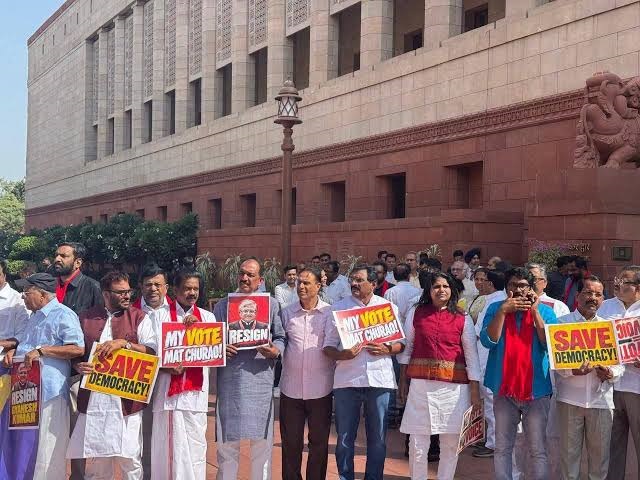
The protest brought together leaders from several opposition parties, including the Congress, Samajwadi Party, Trinamool Congress, National Conference, NCP (SP), RJD and Left parties. They marched from Parliament towards the Election Commission headquarters, alleging irregularities in the electoral-roll revision exercise and using the phrase “vote chori” to describe what they claim are wrongful exclusions from voter lists.
The Election Commission and the BJP have rejected the opposition’s characterisation of the exercise, maintaining that electoral-roll revision is intended to identify and correct inaccurate entries.
The confrontation escalated during the march, with Rahul Gandhi, Priyanka Gandhi Vadra and several other opposition leaders detained after a prolonged sit-in near Akashvani Bhavan, close to the Election Commission’s headquarters. They were subsequently released.
For the NC, participation in the agitation gives the SIR controversy a direct Jammu and Kashmir dimension. The party heads the elected government in J&K, while its vice-president and Chief Minister Omar Abdullah has also participated in the INDIA bloc’s discussions on the campaign.
NC Joins a Wider Opposition Campaign
The National Conference’s participation did not emerge in isolation.
The INDIA bloc had already finalised a coordinated action plan at its September 30 meeting in New Delhi. The plan included public meetings, district-level demonstrations, “Save Democracy” marches and a march by opposition MPs to the Election Commission on October 6.
Omar Abdullah was among the leaders present at that strategy meeting. Other participants included Congress president Mallikarjun Kharge, Rahul Gandhi, Sonia Gandhi, TMC chief Mamata Banerjee, RJD leader Tejashwi Yadav, NCP (SP) leader Supriya Sule and PDP president Mehbooba Mufti.
The bloc subsequently moved ahead with its October 6 programme.
The protest’s immediate demands included the resignation of Gyanesh Kumar and an end to the SIR exercise. The opposition has also called for judicial scrutiny of pending cases concerning the electoral-roll revision and wider examination of the Election Commission’s functioning.
The NC’s participation therefore places the party within a broader national opposition campaign rather than treating the protest as a separate Jammu and Kashmir-specific initiative.
Rahul Gandhi, Priyanka Gandhi Among Leaders Detained
Tuesday’s demonstration became particularly significant after the opposition march was stopped by police near the Election Commission’s office.
Rahul Gandhi and other INDIA bloc MPs attempted to proceed towards the poll panel’s headquarters but were stopped by barricades. Gandhi climbed onto a barricade while holding the national flag before being taken into custody. He and Priyanka Gandhi Vadra subsequently entered the Akashvani Bhavan premises, where opposition leaders staged a prolonged sit-in.
Among those who participated were Samajwadi Party chief Akhilesh Yadav, TMC leaders Abhishek Banerjee and Derek O’Brien, NCP (SP)’s Supriya Sule and CPI(M)’s John Brittas.
The protest continued for several hours before police detained the leaders. They were later released.
According to The Indian Express, the demonstrations came amid an intensifying dispute over alleged differences within the Election Commission and a report that Election Commissioners Sukhbir Singh Sandhu and Vivek Joshi had formally objected on 14 occasions over a 10-month period to various decisions taken under the CEC. Those reports have become an important part of the opposition’s argument against the functioning of the commission.
The allegations concerning internal disagreements within the Commission, however, are separate from proof of deliberate voter manipulation. They should therefore not automatically be treated as evidence that electoral rolls were unlawfully altered.
What Is the SIR Dispute About?
The immediate controversy centres on the Special Intensive Revision of electoral rolls.
The opposition has argued that the exercise could result in legitimate voters being removed from electoral lists and has questioned the procedures used to verify voters.
The phrase “vote theft” has consequently become a major political slogan of the campaign.
The opposition’s argument is that even if electoral rolls need correction, the process must ensure that genuine voters are not inadvertently excluded and that citizens have meaningful opportunities to challenge deletions.
The Election Commission’s position is different. It maintains that electoral-roll revision is part of the statutory process of keeping voter lists accurate and dealing with entries that may be duplicated, shifted, deceased or otherwise ineligible.
That distinction is central to understanding the controversy.
A voter being removed from a roll during a revision exercise is not, by itself, proof of electoral fraud. The question is whether the person was legitimately removed, whether due process was followed and whether an eligible voter can effectively challenge an incorrect deletion.
This is where the political dispute has increasingly moved from the technical question of electoral rolls to the broader issue of institutional trust.
NC’s J&K Connection Makes the Protest More Significant
The NC’s involvement carries particular significance because the party is not merely an opposition organisation at the national level.
It leads the government in Jammu and Kashmir.
That creates a more complicated political position for the party. The NC participates in a national opposition campaign against a constitutional institution while simultaneously functioning as the ruling party in a Union Territory whose own electoral and political processes have been shaped by major constitutional changes since 2019.
The party has consistently emphasised the importance of democratic representation and political rights in Jammu and Kashmir.
Its participation in the SIR protest therefore allows the NC to connect a national question about electoral rolls with its wider political argument concerning representation and institutional accountability.
At the same time, the NC’s involvement should not be interpreted as evidence that the Jammu and Kashmir government has independently established wrongdoing by the Election Commission.
That remains a political allegation made by opposition parties.
Omar Abdullah Had Already Backed the Campaign
Jammu and Kashmir Chief Minister Omar Abdullah had already publicly supported the INDIA bloc’s agitation before Tuesday’s march.
Speaking in Srinagar on October 6, Omar said the bloc had prepared a calendar of action beginning with the march to the Election Commission and indicated that the campaign would continue.
He also welcomed the Supreme Court’s questions concerning voter-list deletions and said it remained to be seen how far the court would go in addressing the issue.
Omar’s comments are significant because they show that the NC leadership’s position is not limited to participation in a Delhi protest.
The party is increasingly associating itself with the INDIA bloc’s broader campaign over electoral-roll revision and the functioning of the Election Commission.
Farooq Abdullah’s Intervention Adds Another Layer
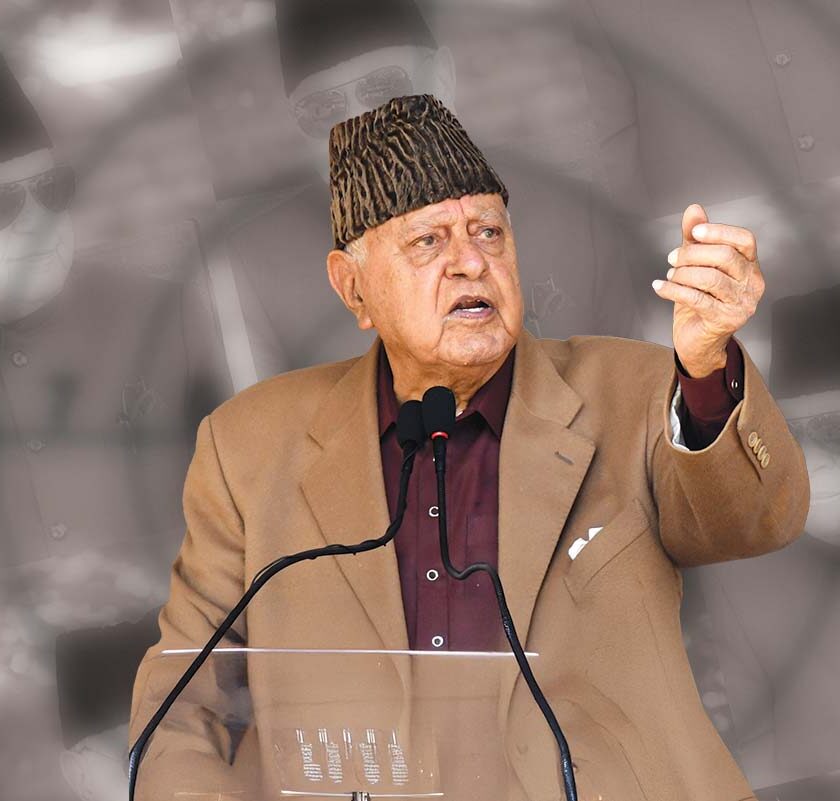
NC president Farooq Abdullah has also criticised alleged voter deletions and questioned whether citizens could be deprived of their voting rights.
At the fifth Halla Bolle Conclave in Srinagar, Abdullah said people were beginning to show courage and argued that “change is on the way”, referring to protests against the SIR exercise and the Chief Election Commissioner.
He also called for a more autonomous Election Commission and questioned the existing system for selecting the CEC.
His intervention places the issue within the NC’s broader political narrative around democratic institutions and electoral rights.
But, as with other opposition leaders, Abdullah’s assertions about wrongful or politically motivated voter deletions remain political claims unless independently established through individual cases, official records or judicial findings.
The October 6 March Was Bigger Than the NC
Although the NC’s participation is important for Jammu and Kashmir, the October 6 demonstration was fundamentally a multi-party national mobilisation.
Nearly 20 opposition parties were reported to have participated in the protest, including the Congress, SP, TMC, RJD, NCP (SP), Shiv Sena (UBT), Left parties, NC, PDP and JMM.
The Biju Janata Dal also sent representatives to the protest despite not being a formal INDIA bloc constituent, adding another political dimension to the mobilisation.
At the same time, the absence of some INDIA bloc parties, including the DMK and AAP from Tuesday’s protest, showed that the opposition campaign is not completely uniform. The Indian Express also reported differences among INDIA bloc allies over how the day’s protest was handled.
That matters because the SIR controversy is creating both cooperation and internal tensions within the wider opposition.
BJP Rejects Opposition’s “Vote Theft” Narrative
The BJP has strongly rejected the opposition’s allegations.
Union ministers and BJP leaders have accused the Congress and its allies of attempting to undermine the Election Commission and said the opposition was using electoral complaints to explain political setbacks.
The BJP has also questioned why opposition parties challenge the electoral system when they lose elections but accept the same system when they win.
These arguments form the principal political counter-narrative to the INDIA bloc’s campaign.
The Election Commission has also defended its procedures.
After opposition MPs sought to meet the poll panel during Tuesday’s confrontation, the Commission said the request was unusual and did not follow its established procedure for such meetings. According to the Commission, meetings with political parties are ordinarily held at its own premises, and it offered to send a senior official to receive a memorandum.
Thus, the confrontation is not simply between protesters and the government. It increasingly involves competing claims about institutional procedure, transparency and the credibility of electoral administration.
The Political Stakes for Jammu and Kashmir
For Jammu and Kashmir, the development has several political implications.
The first is the closer alignment between the NC and the national opposition campaign.
The second is the possibility that electoral-roll issues could become part of the wider political conversation in J&K, where questions of representation and democratic participation already carry considerable political weight.
The third concerns the relationship between the NC and its INDIA bloc partners.
The alliance has demonstrated unity at the national level over the SIR issue, but differences among its constituent parties have also surfaced on other political questions. Reports have indicated tensions between the NC and PDP ahead of the alliance’s October 7 Jammu mobilisation.
The national campaign therefore brings both coordination and new political pressures for the J&K parties involved.
Jammu and Kashmir Prepares for Its Own Mobilisation
The INDIA bloc’s campaign is also moving into Jammu and Kashmir.
A joint protest and “Save Democracy” march has been planned in Jammu on October 7, with leaders from the Congress, NC, PDP, RJD and Left parties expected to participate.
A separate mobilisation announced in Kathua is also scheduled as part of the wider October 2-8 campaign, with organisers planning to raise allegations concerning voter deletions and the SIR process.
This gives the national dispute a local political expression.
For the NC, it also means that the party will have to balance its role as the ruling party in J&K with its participation in an opposition-led campaign against the national election machinery.
What Happens Next Could Matter More Than the Slogans
The political language surrounding the controversy has become increasingly sharp.
“Vote theft”, “democracy”, “CEC resignation” and “electoral manipulation” have become central phrases in the opposition campaign, while the BJP has accused the protesters of attacking constitutional institutions.
But beyond the slogans, the substantive questions remain administrative and legal.
Were eligible voters wrongly excluded?
Were proper notices and opportunities for correction provided?
Can citizens easily verify their electoral status?
How are disputed deletions reviewed?
How independently and transparently is the Election Commission operating?
And, separately, what evidence supports the broader political allegations being made by the competing sides?
These questions require documentary evidence, official responses and, where necessary, judicial scrutiny.
A National Issue With a J&K Political Echo
The NC’s participation in the October 6 INDIA bloc protest marks a further step in the party’s engagement with the national opposition campaign over SIR and the Election Commission.
It also shows how quickly an electoral-roll exercise has moved beyond administrative circles and become a national political confrontation.
For the opposition, the campaign is about protecting voting rights and demanding greater accountability from the election machinery.
For the Election Commission and the BJP, the SIR exercise is being defended as part of the process of maintaining electoral rolls and ensuring their accuracy.
The difference between these positions is now being tested in political protests, official exchanges and the courts.
For Jammu and Kashmir, the debate carries an additional layer because the NC is both a participant in the national opposition campaign and the party heading the elected government in the Union Territory.
As the INDIA bloc’s campaign continues and protests spread to Jammu and other parts of the country, the SIR controversy is likely to remain a major test of how political parties, election authorities and the judiciary address competing claims about voter rights, electoral integrity and institutional independence.