IIM Jammu Modi Birthday Event Row: ₹500 Fine Notice Sparks Questions Over Campus Autonomy
By: News Desk | 19 September 2026
A disputed Students’ Council notice, a political backlash from Congress and the institute’s denial have turned a campus lamp-lighting ceremony into a wider debate over institutional autonomy, student choice and the place of political symbolism inside India’s premier educational institutions.
What began as a lamp-lighting ceremony at the Indian Institute of Management (IIM) Jammu has quickly become a political and institutional controversy.
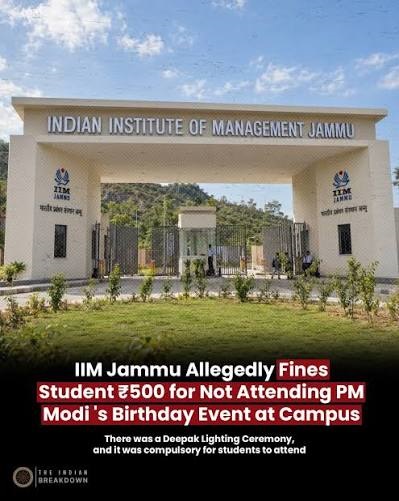
On September 17, 2026, IIM Jammu hosted a Deepak Lighting Ceremony to mark Prime Minister Narendra Modi’s 76th birthday. The event was held on the institute campus and was attended by BJP MLA Yudhvir Sethi, while IIM Jammu Director Professor B.S. Sahay presided over the programme. The institute described the occasion as part of a broader reflection on India’s development journey towards Viksit Bharat 2047.
The controversy emerged after a communication purportedly issued by the IIM Jammu Students’ Council told students who had missed the event to explain their absence. The communication described attendance as mandatory and warned that students who failed to submit an explanation could face a ₹500 fine.
Congress seized on the notice, questioning why attendance at a Prime Minister’s birthday programme should be compulsory at a management institute.
But there is another side to the story.
IIM Jammu has rejected the suggestion that it actually fined students. An institute official said no student had been penalised and described participation in such activities as part of the institute’s approach to holistic student development. The institute also said the communication being cited originated with the Students’ Council rather than the administration.
That distinction — between a notice threatening a fine and an actual fine being imposed — is central to understanding the controversy.
What Actually Happened at IIM Jammu?
The September 17 programme was not a routine academic lecture or classroom activity.
It was a ceremonial event organised to mark Prime Minister Narendra Modi’s birthday. IIM Jammu publicly acknowledged the lamp-lighting ceremony and described it in the context of India’s development journey.
The presence of BJP MLA Yudhvir Sethi added an overt political dimension to an otherwise institutional campus programme. The BJP legislator congratulated the Prime Minister and spoke about his leadership and the role of institutions such as IIM Jammu, IIT Jammu and AIIMS Jammu in Jammu and Kashmir’s development.
The subsequent Students’ Council communication is what transformed the event into a controversy.
According to reports, students who had been marked absent were asked to provide written explanations. The communication reportedly said that exemptions would be considered only on medical grounds and required supporting documentation.
It further warned that students who did not respond would face a ₹500 fine.
Congress MP and party in-charge for Jammu and Kashmir, Syed Naseer Hussain, shared the purported communication publicly and questioned whether attendance at a Prime Minister’s birthday celebration should be treated as an academic responsibility.
His argument was broader than the amount of the alleged fine.
For Congress, the episode represented a question of institutional neutrality and student choice.
For IIM Jammu, however, the institute’s response has been that the incident has been misrepresented and politicised, and that no student was actually fined.
The ₹500 Detail Matters
The initial description of the controversy as a ₹4,000 fine is not supported by the current reporting.
The figure repeatedly appearing in the purported notice and subsequent reports is ₹500.
More importantly, available reporting does not establish that students actually paid the ₹500 fine.
The institute has specifically said that no student was fined.
That does not make the notice irrelevant. It raises a different question: why was a fine mentioned at all, and under what authority was the communication issued?
That is where IIM Jammu’s existing student rules become significant.
IIM Jammu Already Has Rules on Mandatory Institutional Activities
The controversy cannot be examined entirely outside the institute’s existing disciplinary framework.
IIM Jammu’s published MBA handbook states that students are required to attend institutional activities, including events, guest lectures and compulsory batch meetings. The handbook provides for a ₹2,000 fine for absentees, subject to the prescribed approval and exemption process. It also provides for medical exemptions under specified conditions.
The institute’s published IPM handbook contains a similar attendance provision, also referring to mandatory participation in institutional activities and a ₹2,000 fine for absences.
That means the existence of a penalty for missing an institutional event is not, by itself, a new policy created for the Prime Minister’s birthday programme.
The more difficult question is whether a political leader’s birthday ceremony properly falls within the category of an institutional activity for which compulsory attendance can legitimately be expected.
That distinction has not been fully resolved in the public statements surrounding the controversy.
And it is precisely here that the campus-autonomy debate begins.
Where Does Institutional Autonomy Begin?
IIM Jammu is not an ordinary college.
It is an Institute of National Importance under the Indian Institutes of Management Act, 2017. The legislation was designed to provide IIMs with significant institutional autonomy alongside accountability. IIM Jammu itself describes its status as an Institute of National Importance.
The autonomy framework matters because management institutes are expected to create environments in which students can question assumptions, debate competing ideas and make independent judgments.
That does not necessarily mean campuses must be politically sterile.
Universities and management schools routinely host political leaders, ministers, policymakers, diplomats, civil servants and public intellectuals. Political discussion can be a legitimate part of higher education.
The issue is different when participation rather than discussion becomes the point of contention.
A student attending a political leader’s address voluntarily is one thing.
A student being academically or financially penalised for not attending such an event raises a different institutional question.
The IIM Jammu episode has therefore brought two principles into contact: institutional participation on one side and individual choice on the other.
Congress Sees a Larger Politicisation Question
Congress has used the controversy to argue that educational institutions should remain spaces where students are encouraged to think independently rather than participate compulsorily in political celebrations.
Syed Naseer Hussain questioned whether a Prime Minister’s birthday event should become an obligatory campus activity and argued that premier educational institutions should nurture independent minds.
That is a political interpretation of the episode, rather than an established finding that IIM Jammu has become politically controlled.
The distinction matters.
The available evidence establishes that the institute hosted the ceremony, that a Students’ Council communication regarding absenteeism circulated, and that the communication mentioned a ₹500 fine.
It does not establish that IIM Jammu imposed a political loyalty requirement on students or that students were ultimately fined for refusing to celebrate the Prime Minister.
The institute has explicitly rejected that characterization.
The Students’ Council Question
Another important detail is the role of the Students’ Council.
IIM Jammu’s own website describes the Students’ Council as an elected student body responsible for student-related activities and says it plays a role in maintaining discipline and addressing student concerns.
Therefore, the origin of the disputed communication matters.
If the notice was issued by the Students’ Council under existing institutional rules, the episode is partly a question of how student governance operates and what powers the council exercises.
If the communication was issued or authorised by the administration, the institutional accountability question would be different.
IIM Jammu has said the communication cited by Congress originated from the Students’ Council rather than the institute administration.
That distinction deserves greater scrutiny before the controversy is reduced to a simple claim that an IIM directly fined students for missing a political celebration.
Why the Incident Has Resonated Beyond Jammu
The controversy is taking place against a much longer history of political contestation inside Indian educational institutions.
Indian campuses have rarely been completely separated from politics.
Student movements played a major role in the political mobilisation surrounding the Emergency in the 1970s. The Mandal Commission protests transformed university campuses into major arenas of debate over reservation and social justice. More recently, controversies at JNU, Jamia Millia Islamia, Banaras Hindu University, Aligarh Muslim University, IITs and other institutions have brought questions of free speech, identity, social justice, policing and institutional autonomy into public debate.
But these episodes are not identical.
Each arose from different circumstances and involved different institutions, laws and political questions.
The common thread is that campuses often become a reflection of wider social tensions.
JNU: Free Speech and the Limits of Dissent
The 2016 JNU controversy became one of India’s most politically charged campus disputes after an event on the university campus and allegations surrounding slogans described by authorities and political groups as anti-national.
Students were arrested and sedition provisions became part of the subsequent legal and political debate.
The controversy eventually became much larger than the original campus event.
It raised fundamental questions about where legitimate dissent ends, how universities should respond to controversial political expression and whether criminal law should enter campus disputes.
The JNU episode demonstrated how quickly a university dispute can become a national political argument.
Jamia: Campus, Protest and State Power
The protests at Jamia Millia Islamia during the 2019–20 Citizenship Amendment Act agitation produced another major confrontation between campus politics and state authority.
Students participated in protests against the legislation. Police entered the university campus amid clashes and violence outside, leading to widespread criticism and competing accounts about what happened.
The episode triggered national arguments about protest rights, policing and the treatment of students.
Like the JNU controversy, Jamia showed that the relationship between universities and politics is rarely straightforward.
BHU: Gender, Safety and Student Protest
At Banaras Hindu University, women students’ protests in 2017 focused on allegations of harassment and demands for better security.
The police response became another source of controversy.
Here the political issue was not a party celebration but the question of how an institution responds when students challenge its administration over safety and gender-related concerns.
It demonstrated another dimension of campus politics: student mobilisation can arise from institutional grievances rather than ideological allegiance.
Mandal: Reservation and Social Justice
The Mandal Commission protests of 1990 remain one of the most consequential examples of student politics in modern India.
Opposition to the implementation of recommendations concerning OBC reservations produced widespread protests, including self-immolations and violent clashes.
The debate fundamentally changed the political vocabulary around caste, representation and affirmative action.
Unlike the current IIM Jammu controversy, Mandal was about public policy on a scale that affected the structure of Indian society.
But the campus again served as the place where a national political question became intensely personal for students.
Hijab Controversy: Religion and Institutional Rules
The Karnataka hijab controversy brought religious expression directly into classrooms.
The central dispute concerned whether students could wear the hijab in educational institutions governed by prescribed uniform rules.
The issue eventually moved through the courts and became part of a larger national conversation about religious freedom, institutional regulations and individual identity.
It also demonstrated that questions that appear administrative — dress codes, attendance rules or campus regulations — can acquire major political and constitutional dimensions.
IIT Bombay and the Darshan Solanki Case
The user’s original timeline places the IIT Bombay caste-discrimination controversy in 2024. The major incident, however, occurred in February 2023, when first-year chemical engineering student Darshan Solanki died after falling from a hostel building.
Allegations of caste discrimination followed, including claims from his family and others.
An IIT Bombay internal committee’s interim report said it found no specific evidence of direct caste-based discrimination other than a statement from Solanki’s sister, while separate demands for investigation and concerns over caste discrimination continued.
The incident prompted student protests and renewed discussion around caste discrimination, mental-health support and institutional mechanisms for marginalised students.
Again, the facts and allegations need to be kept separate.
A Pattern, But Not One Single Story
It is tempting to place every campus controversy into one broad narrative of political interference.
The historical record is more complicated.
Indian campuses have witnessed:
- political mobilisation by students;
- government intervention;
- protests against government policy;
- caste and reservation conflicts;
- religious identity disputes;
- gender and safety protests;
- disagreements over free speech;
- clashes between student bodies and administrations;
- and controversies involving political parties.
Sometimes the state has been accused of suppressing dissent.
At other times, institutions have faced criticism for failing to control violence, discrimination or disruptive protests.
In still other cases, student organisations themselves have become political actors.
The important question is therefore not simply whether politics exists on campus. It plainly does.
The deeper question is what kind of political participation an educational institution should encourage, and where compulsory institutional discipline should stop.
The IIM Jammu Controversy Is About More Than ₹500
The ₹500 figure is almost incidental.
The real issue is whether participation in a political leader’s birthday event can reasonably be treated as an institutional obligation.
IIM Jammu’s existing rules show that compulsory attendance and financial penalties for institutional activities are already part of its student framework.
The institute’s position is that the particular event was not compulsory and that no student was fined.
The disputed Students’ Council communication, however, reportedly used the word “mandatory” and referred to a ₹500 penalty for students who failed to respond.
Those two positions leave an obvious question:
Was the communication an incorrect or overzealous application of an existing attendance rule, or did the event itself fall within an institutional category that students were expected to attend?
That is a question the institute and the Students’ Council can answer more clearly than political commentary can.
What Should Happen Next?
The controversy would benefit from documentation rather than competing political narratives.
Several basic facts could settle much of the dispute:
Who authorised the notice?
Under which specific student rule was it issued?
Was the September 17 ceremony officially classified as a compulsory institutional activity?
Were any students actually fined?
If no fine was imposed, was the ₹500 warning subsequently withdrawn?
Did the administration approve the Students’ Council communication?
And perhaps most importantly:
Does IIM Jammu distinguish between compulsory academic/institutional activities and voluntary participation in events connected to political personalities?
Clear answers to those questions would establish whether this was a routine application of campus rules, an administrative communication that went beyond its intended purpose, or a misunderstanding that acquired political significance.
India’s Campuses Will Continue to Reflect India’s Politics
There is no realistic way to remove politics entirely from Indian higher education.
Students are citizens. Professors are citizens. Institutions operate within society. National debates inevitably enter classrooms, hostels, student elections and public discussions.
The challenge is maintaining a distinction between exposure to political ideas and compulsory participation in political symbolism.
An institute can invite a Prime Minister, Chief Minister, opposition leader or minister and allow students to engage with them.
It can organise discussions on public policy, development, constitutional questions and governance.
But institutional credibility ultimately depends on transparent rules being applied consistently, with clear distinctions between academic obligations, institutional activities and voluntary political participation.
That is why the IIM Jammu episode deserves attention beyond the immediate Congress-versus-BJP argument.
The question is not simply who celebrated a birthday or who criticised the celebration.
It is whether premier educational institutions can preserve an environment where students are free to participate, question, disagree or abstain — while still following legitimate and clearly defined institutional rules.
For IIM Jammu, the immediate controversy may concern one lamp-lighting ceremony.
The larger issue is the boundary between campus discipline and individual choice.
And that is a debate far bigger than ₹500.