J&K Reservation Row: Iltija Mufti Targets NC Government Over Jobs and Pending Quota Report
By: Javid Amin | 19 September 2026
Srinagar: Jammu and Kashmir’s long-running debate over reservation has returned to the centre of political attention, this time with Peoples Democratic Party leader Iltija Mufti accusing the National Conference-led government of failing to address the concerns of open-merit aspirants.
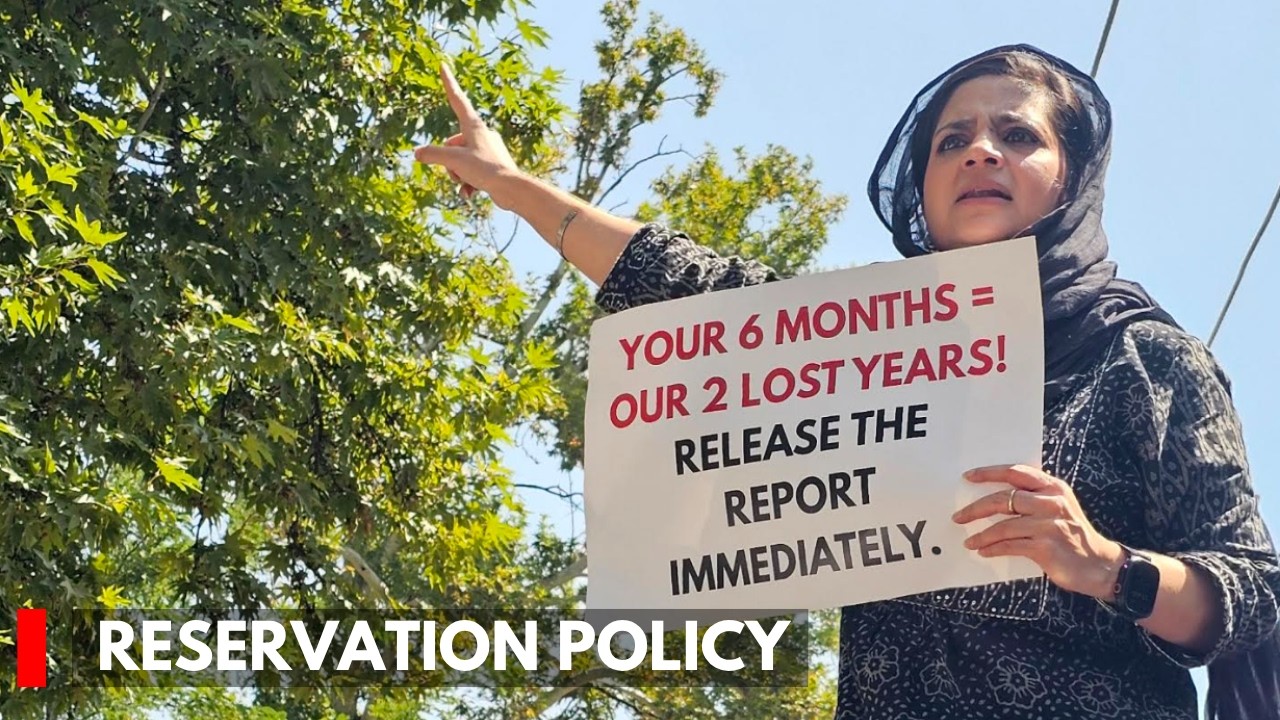
At a protest in Srinagar on Saturday, Mufti demanded that the Jammu and Kashmir government make public the report of the Cabinet Sub-Committee constituted to examine and rationalise the reservation policy, arguing that students and job seekers have been left waiting for clarity.
She went further, accusing the administration of what she described as “institutional apartheid” and alleging that Kashmiri youth were being pushed out of government examinations and recruitment opportunities.
Those are political allegations, not established findings of any government inquiry. But they come against the backdrop of a genuine and unresolved policy dispute.
Since changes to J&K’s reservation framework in 2024 expanded the reserved share to around 70 percent, open-merit candidates have argued that their opportunities have narrowed dramatically. The Omar Abdullah government subsequently formed a Cabinet sub-committee to examine the grievances and recommend rationalisation.
The committee submitted its report, but the recommendations have not yet translated into a publicly implemented revised policy. In a written Assembly response in March, the government said the report was before the competent authority and that there was no specific timeline for implementation.
That gap between the submission of the report and its public implementation is now becoming a political fault line.
Iltija Mufti turns reservation into a wider jobs debate
Mufti’s criticism goes beyond the technical question of quota percentages.
Addressing protesters outside the PDP headquarters, she argued that open-merit students had been promised that their concerns would be examined and that the reservation issue would be addressed within six months.
“Two years have passed,” she said, demanding that the government disclose the committee’s findings.
She also referred to the difficulties faced by families who spend years financing competitive-exam preparation, saying some parents have mortgaged or sold land to educate their children.
The political message was clear: the reservation controversy, in the PDP’s framing, is no longer simply about percentages on a government notification. It is about whether an educated young person who competes in the open category has a reasonable opportunity to secure a government job.
Mufti also raised concerns over outsourcing, recruitment procedures, examination rules and age limits, linking the reservation dispute to the larger problem of unemployment.
Her most forceful allegation was that the recruitment system was systematically disadvantaging Kashmiris. She simultaneously stressed that her criticism was not directed against any particular community but at what she described as an unfair policy structure.
That distinction is important in a debate that involves multiple communities and competing claims of historical disadvantage.
The 70% reservation figure is at the heart of the controversy
The immediate source of the dispute lies in changes introduced in 2024.
Before those changes, the reservation structure was significantly lower than it is today. Amendments following the expansion of the Scheduled Tribe framework and changes involving Other Backward Classes pushed the overall reserved share to approximately 70 percent.
That left approximately 30 percent for open merit in the commonly cited vertical reservation structure.
For open-merit aspirants, the arithmetic became the central grievance.
If seven out of every ten positions are occupied through reserved categories, candidates competing in the general/open category face a much smaller pool of seats, even though reserved-category candidates who meet the general merit threshold can also compete in open merit under the applicable rules.
The issue is therefore more complicated than saying that “70 percent of jobs are unavailable to general-category candidates.” Reservation operates through category-wise rosters and rules, and open-merit selection is not simply a closed category from which reserved candidates are excluded.
But the political effect of the 70:30 headline has been substantial.
It has become shorthand for a wider argument that merit-based competition has been squeezed.
Why the reservation structure changed
The 2024 changes were not introduced by the Omar Abdullah government.
They followed constitutional and legislative changes expanding the Scheduled Tribe framework in J&K and subsequent amendments to the Union Territory’s reservation rules.
The ST share was increased from 10 percent to 20 percent, with the new structure distinguishing between ST-I and ST-II categories. The OBC list was also expanded and the OBC reservation share increased.
This distinction matters politically.
The present NC government inherited much of the framework that triggered the open-merit protests.
Its problem is that it subsequently became responsible for responding to the protests.
That is why the Cabinet Sub-Committee became politically important.
The government could not simply ignore the concerns of general-category students, but neither could it casually dismantle protections that had been created through constitutional and statutory changes.
It therefore sought a mechanism to examine the overall reservation architecture.
The Cabinet panel was created after protests
The Omar Abdullah Cabinet constituted the reservation review sub-committee in December 2024 following growing protests and representations from open-merit aspirants.
The committee was headed by Social Welfare and Education Minister Sakeena Itoo, with other members of the Council of Ministers.
Its mandate was to examine the reservation structure and recommend ways of rationalising it.
The committee eventually submitted its report in June 2025. The report then went through further examination before being considered by the government.
This chronology complicates the political claim that the committee itself had been sitting on the matter for two years.
The stronger and better-supported criticism is different: more than a year after the committee submitted its report, the recommendations had still not resulted in a publicly implemented new reservation framework.
The government itself acknowledged in March 2026 that the report was pending before the competent authority and that no specific implementation timeline had been fixed.
That is the unresolved administrative question now being exploited politically by the PDP.
What happened to the proposed open-merit increase?
The committee’s recommendations have been the subject of considerable political interest because reports indicated that the government was considering increasing the open-merit share.
Reports in late 2025 said the Cabinet approved a proposal under which open merit could rise from the existing 30 percent to around 50 percent, while another account of the proposal indicated a target of 40 percent depending on the categories and mechanism being considered.
The exact proposal has become difficult for the public to assess because the full report has not been placed in the public domain.
This lack of transparency is itself part of the controversy.
According to reporting, the proposed changes focused on categories that the administration could alter without directly reducing constitutionally protected ST and SC allocations. RBA and EWS quotas were among the areas discussed in reports on the proposed rationalisation.
The political challenge is obvious.
Every percentage point shifted toward open merit affects another category.
Reducing one quota can trigger opposition from the communities that currently benefit from it.
Leaving the existing structure untouched keeps open-merit aspirants dissatisfied.
The government therefore faces a balancing exercise between competing claims of representation.
Why open-merit candidates say the system has become unfair
For an aspirant preparing for a competitive examination, the debate is not abstract.
A student can spend several years completing a degree, preparing for examinations and paying application fees, coaching costs and living expenses.
Age limits make the process more time-sensitive.
Each examination cycle therefore carries significant financial and emotional consequences.
Iltija Mufti has used precisely this argument in her campaign.
She said economically weaker families cannot afford to keep financing examination attempts indefinitely, particularly when recruitment cycles are delayed or the number of open-merit vacancies appears limited.
This is also why reservation has become closely connected to the wider unemployment debate.
J&K has a large population of educated young people competing for a relatively limited number of government posts. Government employment carries particular significance because of the relative stability and social status associated with public-sector work.
When recruitment becomes delayed or highly competitive, frustration quickly becomes political.
But the reservation debate is not simply “merit versus quota”
That framing risks oversimplifying the policy question.
Reservation exists precisely because policymakers and courts have recognised that formally equal competition does not necessarily produce equal opportunity for historically disadvantaged groups.
The legal framework governing reservations has evolved through legislation, executive rules and judicial decisions.
J&K’s reservation system has included protections for Scheduled Castes, Scheduled Tribes, socially and educationally backward groups, residents of backward areas, people living near the Line of Actual Control and International Border, Economically Weaker Sections and other categories.
The question is therefore not whether reservation should exist at all.
The current political dispute is about how much reservation is appropriate, which groups should receive it, how those groups should be identified and whether the overall structure remains proportionate and legally sustainable.
That is a much more complex question than the slogans heard at political demonstrations.
The regional dimension makes the debate even more sensitive
Reservation in J&K has always had a strong regional dimension.
The Union Territory contains communities with very different geographical, social and economic conditions.
The challenges faced by people in remote mountain districts are not necessarily identical to those faced by students in Srinagar, Jammu or other urban centres.
This makes any quota reform politically delicate.
If a category was originally created to address geographical or social disadvantage, reducing it can be portrayed as withdrawing protection from vulnerable communities.
At the same time, open-merit aspirants argue that excessive fragmentation of vacancies leaves too little space for candidates who compete outside reserved categories.
The government therefore has to answer two questions simultaneously:
Are disadvantaged groups adequately represented?
And:
Is the remaining open-merit pool large enough to preserve meaningful competition?
The Cabinet report was supposed to help answer precisely that question.
The “Kashmiri youth” allegation needs evidence
Mufti’s most politically charged allegation is that Kashmiri youth are being systematically excluded from jobs and examinations.
That claim should be distinguished from the broader and documented controversy over reservation.
A reservation system based on legally defined categories does not automatically constitute discrimination against people from a particular region.
To establish systematic regional discrimination, one would need recruitment-wise data showing the domicile, category, selection rate, examination participation and final representation of candidates from different regions, along with the rules under which each selection was made.
Such data would allow the public to distinguish between three separate possibilities:
- the effect of the reservation formula itself;
- differences in the number of candidates competing from different regions;
- and any separate administrative or recruitment practices that might affect regional representation.
Without that granular evidence, the allegation remains a political claim rather than an established finding.
That distinction is particularly important because reservation policy is designed around social and constitutional categories, not simply a Jammu-versus-Kashmir allocation.
The pending report has become the political battleground
The government has already acknowledged that the report exists.
That has changed the nature of the dispute.
The question is no longer whether a review was undertaken.
It is why its recommendations have not been publicly implemented.
In March, the government told the Assembly that the report had been submitted to the Council of Ministers and was under consideration before the competent authority. It also said the existing reservation policy would continue in the meantime.
For the PDP, this provides an obvious political opening.
Iltija Mufti can argue that the government promised action, created a committee and received its recommendations, yet students are still waiting.
For the NC government, the issue is more complicated.
It has to balance the demand for greater open merit against the interests of communities whose reservations were expanded or protected through legal and constitutional changes.
Any reduction in a particular category is likely to produce a new political dispute.
Why the issue matters beyond government recruitment
The controversy is not confined to government jobs.
The reservation structure also affects admissions to professional and educational institutions.
That makes the debate particularly sensitive among students preparing for medical, engineering and other competitive examinations.
Earlier disputes over postgraduate medical admissions illustrated how quickly reservation questions can become intertwined with professional education and career prospects. In 2024, the PDP itself had raised concerns about the impact of the new reservation structure on postgraduate medical admissions.
For families investing heavily in education, the distinction between securing a degree and securing a career has become increasingly important.
A reservation policy therefore has consequences long before a candidate submits a government-job application.
The political competition is widening
The PDP is not alone in challenging aspects of J&K’s reservation structure.
The controversy has previously generated criticism from within the wider political spectrum, including voices associated with the National Conference itself.
That is significant because it shows that the issue cannot be reduced entirely to a PDP-versus-NC confrontation.
Open-merit concerns cut across party lines.
At the same time, parties representing reserved communities are likely to resist any change that they believe weakens constitutional protections or reduces representation.
The political battlefield therefore contains several constituencies rather than two.
What happens next?
The immediate question is whether the government will make the Cabinet Sub-Committee’s recommendations public.
If it does, the debate is likely to move from allegations about secrecy to a detailed examination of the proposed quota structure.
Political parties, student groups and community organisations would then be able to examine which categories gain, which lose and how the new formula would affect government recruitment and professional admissions.
If the report remains unpublished, the political pressure is likely to continue.
The upcoming Assembly proceedings could provide another platform for the opposition to demand disclosure and for the government to explain the delay.
The administration could also face a difficult choice over whether to implement the recommendations substantially as proposed, modify them, or seek further legal and constitutional advice.
The larger question: what does “merit” mean in J&K?
At the centre of the controversy is a word repeatedly used by both politicians and students: merit.
For open-merit aspirants, merit often means the ability to compete without category-based reservation.
For supporters of reservation, merit cannot be separated from unequal starting conditions. A student from a historically disadvantaged community may have faced barriers that are invisible in a single examination score.
That philosophical disagreement cannot be resolved by changing one percentage point.
It requires reliable data.
How many candidates apply under each category?
How many qualify?
How many are finally selected?
What is the representation of different communities in government services?
Which categories remain under-represented?
How many posts are filled through open merit?
And how does the system compare with the population and socio-economic indicators it is designed to address?
Those are the questions that a transparent reservation review should answer.
J&K’s reservation debate enters a decisive phase
Iltija Mufti’s Srinagar protest has brought the reservation controversy back into the political spotlight, but the underlying dispute is much larger than one PDP demonstration.
The 2024 changes dramatically altered J&K’s reservation arithmetic. The subsequent Cabinet review acknowledged that the system required examination. The committee submitted its report. Yet the government has not publicly implemented a revised framework, and its own Assembly response confirms that the recommendations remain under consideration.
That uncertainty has created political space for the PDP to attack the NC government on transparency, employment and merit.
But the eventual solution will have to go beyond political slogans.
It will have to reconcile competing constitutional obligations, protect legally recognised disadvantaged groups, address genuine concerns among open-merit aspirants and withstand judicial scrutiny.
For J&K’s young job seekers, the stakes are immediate.
Every delayed recruitment cycle means another examination, another fee, another year of preparation and, for many families, another financial burden.
For the government, the challenge is equally clear: a reservation policy cannot retain public legitimacy if those affected by it do not understand how it works, why the percentages were chosen and what evidence supports them.
The pending report therefore matters not simply because it contains recommendations.
It matters because its publication could finally move J&K’s reservation debate from political accusation towards a public examination of the numbers, the law and the consequences.
Until that happens, the 70-percent reservation figure and the 30-percent open-merit figure will continue to dominate the political conversation, while thousands of students remain caught between competing claims of social justice and open competition.