Khwaja Digar: When Centuries of Kashmir’s Sufi Heritage Come Alive in Srinagar
By: Javid Amin | 16 Aug 2026
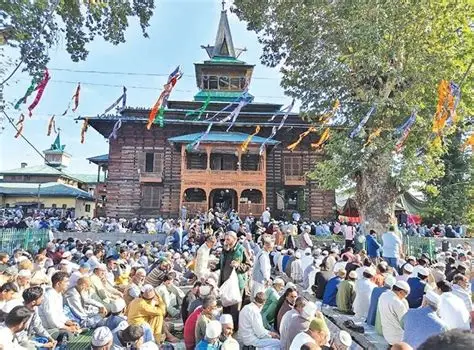
Srinagar: Every year, as devotees make their way towards Khwaja Bazar in Srinagar’s Nowhatta, the narrow lanes around the historic Naqshband Sahib shrine take on a distinctly spiritual character.
Prayer mats appear outside the shrine.
Devotees arrive from different parts of the Valley.
Religious scholars speak about the life and teachings of Hazrat Khwaja Baha-ud-Din Naqshband.
And, at the heart of the observance, thousands gather for the traditional congregational prayer known as Khwaja Digar.
More than a single religious ceremony, Khwaja Digar represents a living connection between Kashmir’s present and a Sufi tradition that has survived for centuries.
The annual gathering at Ziyarat Naqshband Sahib is deeply associated with the Naqshbandi spiritual order and the religious history of Srinagar’s old city. Recent coverage of the observance has recorded thousands of devotees gathering for the special congregational prayers and religious programmes.
The tradition has endured through generations, carrying with it not only religious teachings but also memories of Kashmir’s changing social and cultural landscape.
What Is Khwaja Digar?
Khwaja Digar is a traditional congregational prayer associated with the annual observance at the Naqshband Sahib shrine in Khwaja Bazar, Nowhatta.
The observance is linked to the Urs of Hazrat Khwaja Baha-ud-Din Naqshband, the Central Asian spiritual master associated with the Naqshbandi Sufi order.
Contemporary Kashmiri accounts describe Khwaja Digar as a special congregational prayer offered after Asr, accompanied by religious recitations and teachings about the saint and the Naqshbandi tradition.
The annual event traditionally falls on the 3rd of Rabi-ul-Awwal, according to local accounts and reporting.
A date clarification for 2026
There is a calendar discrepancy worth noting.
Several Hijri calendars place 3 Rabi-ul-Awwal 1448 on Sunday, August 16, 2026, while August 17 falls on 4 Rabi-ul-Awwal.
Islamic dates can differ depending on local moon-sighting and religious authority, so the date announced by the shrine or local religious authorities should take precedence for the actual observance.
For that reason, the 17 August 2026 programme should be described as the scheduled observance only if confirmed by the shrine authorities, rather than automatically equating the Gregorian date with 3 Rabi-ul-Awwal.
The Naqshbandi Order: A Spiritual Tradition From Central Asia
To understand Khwaja Digar, it is necessary to understand the Naqshbandi tradition itself.
The Naqshbandi order traces its spiritual lineage to Hazrat Baha-ud-Din Naqshband Bukhari, who lived in Central Asia in the 14th century.
Born near Bukhara, in present-day Uzbekistan, he became associated with a spiritual tradition that placed strong emphasis on inner purification, remembrance of God and adherence to Islamic teachings.
The Naqshbandi path eventually spread well beyond Central Asia.
Its influence reached South Asia, including the Mughal-era cultural and religious networks that connected Kashmir with wider Central Asian and Indian Islamic traditions.
In Kashmir, the Naqshbandi tradition became deeply connected with the region’s religious history.
How the Naqshbandi Tradition Reached Kashmir
The development of the Naqshbandi order in Kashmir is associated with spiritual figures and families who established khanqahs and religious networks in Srinagar.
The shrine at Khwaja Bazar is closely associated with Khwaja Khawand Mahmood Naqshbandi, whose presence and lineage helped establish the Naqshbandi tradition as an important part of Kashmir’s religious landscape.
Historical accounts place the establishment of the shrine complex in the 17th century, with 1633 commonly cited for the construction of the present shrine structure.
Some Kashmiri accounts trace the wider tradition at the shrine to the period around 1608, associated with Khwaja Khawand Mahmood.
These dates refer to different stages in the development of the institution and tradition, rather than necessarily contradicting one another.
What is clear is that the shrine has been part of Srinagar’s religious landscape for centuries.
Why the Area Is Called Khwaja Bazar
The neighbourhood surrounding the shrine is known as Khwaja Bazar.
The name itself reflects the shrine’s historical importance.
As religious institutions grew around the old city, the surrounding commercial and residential areas became closely identified with the spiritual centre.
Today, Khwaja Bazar remains one of the recognisable neighbourhoods of downtown Srinagar.
On the day of Khwaja Digar, its identity changes once again.
The marketplace and adjoining streets become part of a much larger religious gathering.
Recent reports have described long queues of vehicles and large crowds across surrounding areas during the annual observance.
The Spiritual Meaning of Khwaja Digar
For devotees, Khwaja Digar is not simply a large prayer gathering.
It is a day of remembrance.
The event allows worshippers to reconnect with the spiritual legacy associated with Hazrat Khwaja Naqshband and the generations of Kashmiri scholars, saints and families who preserved the tradition.
The prayer also carries an important communal dimension.
People who may live in different towns and districts of Kashmir converge at one place.
Older devotees return to a tradition they have followed since childhood.
Parents bring their children.
Grandparents pass the practice to younger generations.
In this way, the tradition becomes a form of living religious memory.
The Central Role of Congregational Asr Prayer
The defining public ritual of Khwaja Digar is the congregational prayer offered after Asr.
This is why the observance is sometimes described in local accounts as a special mass prayer.
Historical and contemporary reports consistently identify the congregational prayer as the central feature of the annual gathering.
As the time approaches, devotees spread prayer mats through the shrine compound and surrounding spaces.
When the congregation begins, the ordinary rhythm of the old city briefly gives way to a shared act of worship.
For many participants, that collective experience is the heart of Khwaja Digar.
Qur’anic Recitation, Teachings and Religious Sermons
The prayer is accompanied by religious programmes in which scholars discuss the life, teachings and spiritual legacy of Khwaja Baha-ud-Din Naqshband.
Recent observances have included religious scholars speaking about the saint’s teachings and the history of the Naqshbandi tradition.
In 2025, Mirwaiz-e-Kashmir Dr Moulvi Muhammad Umar Farooq delivered a sermon at the shrine during Khwaja Digar after a prolonged period during which he had been unable to address the gathering there. His sermon focused on faith, compassion, humanitarian responsibility and environmental concerns.
That episode demonstrated how the shrine can function simultaneously as a place of worship, religious learning and community reflection.
The Naqshbandi Emphasis on Inner Remembrance
One of the distinctive features associated with the Naqshbandi spiritual path is its emphasis on quiet or inward remembrance of God, commonly described as silent dhikr.
The tradition places importance on remembering God while maintaining awareness of everyday responsibilities.
This gives Naqshbandi spirituality a distinctive character.
The outward gathering at Khwaja Digar may involve thousands of people, but the spiritual ideal at its centre places considerable emphasis on inward discipline and remembrance.
That contrast is part of what makes the tradition distinctive:
a massive public gathering built around a deeply inward spiritual philosophy.
The Shrine and the Sacred Relic of Prophet Muhammad
The Naqshband Sahib shrine also occupies an unusual place in Kashmir’s sacred history because of its association with the holy relic of Prophet Muhammad (PBUH).
Historical accounts state that when a strand of the Prophet’s hair was brought to Kashmir in 1699, it was initially kept at the Naqshband Sahib shrine.
As the number of devotees seeking to see the relic grew, the authorities sought a larger site.
The relic was subsequently moved to the location that developed into the present Hazratbal Shrine.
Hazratbal would eventually become one of Kashmir’s most important Muslim shrines.
The episode nevertheless left an enduring historical connection between the two sacred sites.
It is another reason why Naqshband Sahib occupies such an important position in Kashmir’s religious geography.
A Shrine That Also Carries Kashmir’s Architectural Memory
The spiritual importance of Naqshband Sahib is complemented by its architecture.
The shrine is recognised for traditional Kashmiri wooden craftsmanship, including intricate latticework and khatamband ceilings.
The use of wood, decorative panels and traditional craftsmanship reflects an architectural language found across historic religious buildings in Kashmir.
This makes the shrine valuable not only as a place of worship but also as part of the Valley’s built heritage.
In Kashmir, spirituality and architecture have often evolved together.
Shrines, mosques and khanqahs became places where religious devotion was expressed through local artistic traditions.
Naqshband Sahib is an important example of that relationship.
Khwaja Digar Is Also a Story of Generations
Perhaps the strongest reason the tradition has survived is simple:
people keep passing it on.
A child who accompanies a parent to Khwaja Digar may eventually return decades later with children of their own.
That cycle turns a religious observance into a family tradition.
Recent reporting has captured precisely this generational connection, with devotees describing how they first came to Khwaja Digar with their parents and later brought their own children and grandchildren.
This is how cultural traditions survive.
Not only through books.
Not only through institutions.
But through memory and participation.
Thousands Gather, Turning Old Srinagar Into a Spiritual Centre
Khwaja Digar is among the occasions when the religious geography of Srinagar becomes especially visible.
Devotees travel from different parts of the Valley.
The shrine compound fills.
Nearby streets become crowded.
Traffic arrangements become necessary.
And the old neighbourhood around Nowhatta becomes part of a much larger congregation.
In 2024, reports described thousands of devotees participating in the traditional prayers, with traffic congestion extending through several areas of downtown Srinagar.
A similar large gathering was reported in 2025.
The scale demonstrates that Khwaja Digar is not a small shrine ritual.
It is a major annual religious gathering in Kashmir.
More Than a Religious Event: Khwaja Digar and Kashmiri Identity
Kashmir’s Sufi heritage has long been discussed as an important part of the region’s cultural identity.
Shrines associated with different Sufi orders became centres not only of worship but also of social interaction, learning and community life.
Khwaja Digar belongs to this wider heritage.
Its continued observance demonstrates that Kashmir’s Sufi traditions are not merely historical memories preserved for visitors.
They remain active practices.
People still gather.
They still pray.
They still listen to religious teachings.
And they continue to associate these practices with their families and communities.
That makes Khwaja Digar a particularly important example of living heritage.
Khwaja Digar Through Kashmir’s Changing History
The tradition has survived periods of political upheaval, social transformation and changes in religious practice.
The shrine itself has also experienced periods when access to religious gatherings was restricted.
In 2025, local reports highlighted that the Mirwaiz delivered his sermon at the shrine after six years of restrictions.
The return of a major public religious gathering after such interruptions demonstrated the emotional importance of the tradition to devotees.
It also showed how religious spaces can become repositories of collective memory.
A gathering like Khwaja Digar is therefore experienced not only through theology but also through memory:
who was present, who could not attend, what happened in previous years, and what the tradition means to families.
Why Khwaja Digar Still Matters in 2026
In an era of rapid urbanisation, social-media culture and changing lifestyles, traditional religious gatherings face the challenge of remaining relevant to younger generations.
Khwaja Digar appears to have retained its appeal precisely because it is participatory.
It is not simply something people watch.
They attend.
They pray.
They listen.
They meet relatives and neighbours.
They carry the experience home.
That physical participation gives the tradition a resilience that digital culture cannot easily replace.
Khwaja Digar 2026: What Devotees Should Know
For readers planning to attend, the most important details are:
Location
Ziyarat Naqshband Sahib, Khwaja Bazar, Nowhatta, Srinagar.
The shrine lies in the historic downtown area, close to the traditional religious and commercial quarters of old Srinagar.
Traditional date
Khwaja Digar is traditionally associated with the 3rd of Rabi-ul-Awwal.
2026 calendar note
Several published Hijri calendars place 3 Rabi-ul-Awwal 1448 on August 16, 2026, with August 17 falling on 4 Rabi-ul-Awwal. Local moon-sighting and shrine announcements may differ, so devotees should follow the official local schedule.
Main prayer
The defining public ritual is the Khwaja Digar congregational prayer after Asr.
Crowd expectations
Large gatherings are normal. Previous observances have drawn thousands of devotees from across Kashmir.
What Makes Khwaja Digar Different?
Kashmir has many celebrated shrines and annual Urs observances.
What makes Khwaja Digar distinctive is the combination of:
- a centuries-old Naqshbandi lineage;
- a major congregational prayer;
- the historic Naqshband Sahib shrine;
- strong participation from Srinagar’s old-city communities;
- intergenerational family participation;
- religious scholarship and sermons;
- traditional remembrance practices; and
- a large-scale gathering that turns a historic neighbourhood into a centre of collective devotion.
It is this combination that has allowed the tradition to remain culturally significant.
The Deeper Message of Khwaja Digar
At its deepest level, Khwaja Digar is about continuity.
The saint being remembered lived centuries ago.
The shrine itself has witnessed generations of Kashmiris.
The prayer has continued across changing political and social circumstances.
And families continue to bring younger generations to the gathering.
That continuity is perhaps the most powerful aspect of the tradition.
Khwaja Digar demonstrates that heritage does not survive simply because a building survives.
It survives when people continue to give it meaning.
Conclusion: A Living Tradition at the Heart of Old Srinagar
Khwaja Digar is much more than an annual prayer at a historic shrine.
It is a meeting point between faith and memory, spirituality and community, history and everyday life.
At Naqshband Sahib in Khwaja Bazar, generations of Kashmiris have gathered to remember Hazrat Khwaja Baha-ud-Din Naqshband, listen to religious teachings and participate in a collective act of worship.
The tradition’s endurance offers a glimpse into the deeper cultural landscape of Kashmir — one in which Sufi shrines continue to serve as places of prayer, remembrance, learning and community connection.
As devotees once again gather around the historic shrine, the significance of Khwaja Digar lies not simply in its age.
It lies in the fact that it is still being lived.
Centuries after the Naqshbandi tradition took root in Kashmir, the prayer continues to bring people together.
And in a rapidly changing Valley, that continuity remains one of the clearest expressions of Kashmir’s living spiritual heritage.