‘Used by Everyone, Represented by None’: Why Kashmiri Pandits Say They Have Become Political Orphans
By: News Desk | 10 Aug 2026
Jammu: For a community that has spent more than three decades away from its ancestral homes, the question is no longer simply whether Kashmiri Pandits will return to the Valley.
Increasingly, community leaders are asking a second, equally consequential question:
Who speaks for them politically?
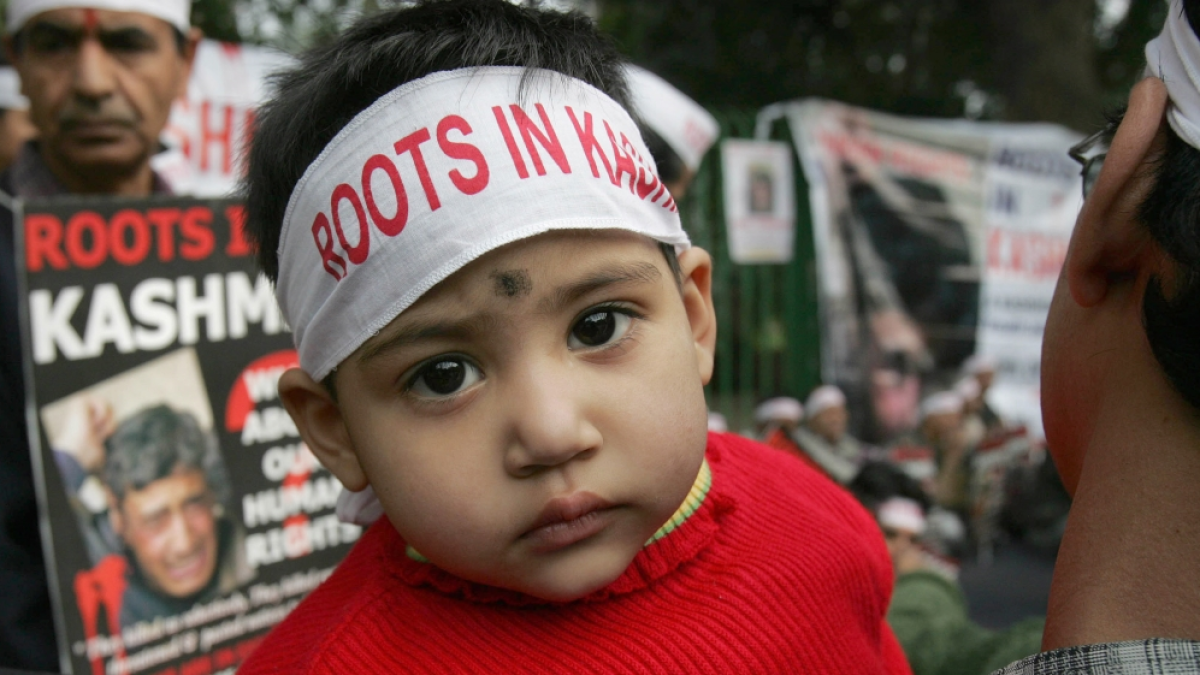
At Jagti township and other migrant settlements, Kashmiri Pandit representatives have revived a familiar but increasingly pointed description of their political condition: “political orphans.”
The phrase captures a sense of accumulated frustration. Community leaders argue that successive elections have brought promises of return, rehabilitation, security and justice, but that these commitments have rarely translated into a comprehensive, time-bound political roadmap.
Their criticism extends across the political spectrum. Leaders of the displaced community accuse mainstream parties of invoking the Pandit question during elections but failing to maintain sustained political pressure once electoral campaigns end.
The result, they argue, is a community that remains highly visible whenever Kashmir’s displacement is discussed, but comparatively weak when decisions about Kashmir’s political future are actually negotiated.
That distinction — between being politically relevant as an issue and being politically represented as a community — lies at the heart of the latest grievance.
Why the ‘Political Orphan’ Description Has Returned
The expression is not new.
The idea of Kashmiri Pandits as “political orphans” has appeared in discussions of the community’s displacement and loss of political agency for years. Academic literature has also examined the concept in the context of the Pandit exodus and the community’s struggle to regain political influence.
What has changed is the political context.
Three decades after the mass displacement of Kashmiri Pandits in the early 1990s, a large section of the community remains outside the Valley. Families have established lives in Jammu, Delhi and elsewhere, while questions surrounding ancestral property, security, employment, political representation and the possibility of return remain unresolved.
For many displaced families, exile has consequently evolved from what was initially perceived as a temporary displacement into a multigenerational reality.
That has produced a difficult political paradox.
The community remains emotionally and culturally connected to Kashmir, yet many of its members live their daily lives outside the Valley.
Their political demands, meanwhile, continue to be closely tied to their homeland.
Elections Bring Promises — But Community Leaders Want a Roadmap
The central complaint from Pandit representatives is not simply that political parties discuss their return.
It is that the discussion often stops at the level of promises.
Community leaders say successive election campaigns have featured commitments concerning the safe return and rehabilitation of Kashmiri Pandits. But they argue that such promises need to be converted into measurable policy objectives.
For a displaced family, “return” is not a single administrative decision.
It involves a chain of questions:
- Where will the family live?
- What happens to ancestral property?
- How will property disputes be resolved?
- What security arrangements will exist?
- What employment opportunities will be available?
- What schools and healthcare facilities will support returning families?
- How will communities be reintegrated?
- What political representation will displaced residents have?
- What happens to those who have spent decades building lives outside Kashmir?
Without answers to these questions, community representatives argue, the word “return” remains a political slogan rather than a rehabilitation policy.
This is why the demand for a time-bound roadmap has become central to the community’s current discourse.
The Electoral Question: Are Kashmiri Migrants Actually Disenfranchised?
This is one area where the political narrative requires careful examination.
Kashmiri migrant voters have historically remained linked to the parliamentary constituencies they originated from in the Valley. But that does not mean they are simply unable to vote.
The Election Commission of India has maintained a special voting arrangement for Kashmiri migrants.
For the 2024 Lok Sabha election, migrant electors from the three Valley parliamentary constituencies — Baramulla, Srinagar and Anantnag-Rajouri — could vote through designated special polling stations or postal ballots. The Election Commission also modified the procedure in 2024 to make voting easier for migrants living in Jammu and Udhampur.
For migrants residing in Jammu and Udhampur, the requirement to fill Form M for voting at designated special polling stations was removed. Migrants living elsewhere could continue using the prescribed mechanism, including postal voting arrangements.
Therefore, the more precise grievance is not that Kashmiri migrants are categorically denied the right to vote.
The deeper issue raised by community leaders is political agency.
A person living permanently in Jammu, Delhi or another part of India may continue to vote in relation to a constituency in the Valley from which their family originated. That preserves the formal connection to the homeland, but it also creates questions about whether the existing electoral structure adequately reflects the community’s present-day residential reality.
This is where the debate over representation becomes more complicated.
1.13 Lakh Kashmiri Migrant Electors Were Registered in 2024
The scale of the electoral constituency is significant.
According to election officials cited in 2024, 1,13,873 Kashmiri migrant electors were registered across the Srinagar, Baramulla and Anantnag parliamentary constituencies.
The figure comprised 56,290 men, 57,582 women and one transgender elector.
For the Srinagar parliamentary constituency alone, 52,100 Kashmiri migrant voters were eligible to participate in the 2024 election.
The Election Commission established 26 special polling stations for migrant voters, including 21 in Jammu, four in Delhi and one in Udhampur.
These figures demonstrate two things simultaneously.
First, the displaced community remains an important electoral constituency.
Second, the community’s electoral arrangements are structurally different from those of voters who live within the constituencies where they are registered.
That distinction fuels the argument over political representation.
The Election Commission Has Tried to Make Voting Easier
The electoral system for Kashmiri migrants has not remained static.
In April 2024, the Election Commission announced changes intended to reduce procedural difficulties for displaced voters.
For migrants living in Jammu and Udhampur, Form M was eliminated for voting at special polling stations, with electors in different camps and zones mapped to designated polling stations. For migrants outside Jammu and Udhampur, self-attestation replaced the earlier requirement for gazetted-officer attestation of the relevant certificate.
The Commission’s position is therefore important to the debate.
The system has recognised the unusual circumstances of Kashmiri migrant voters and created special mechanisms to facilitate participation.
The community’s criticism is about something broader: whether voting alone amounts to meaningful political representation.
‘Used by Everyone, Represented by None’
This sentiment has become a recurring theme in the community’s political discourse.
Kashmiri Pandit representatives argue that different parties have approached the community from different ideological positions, but that the result has often been the same: promises during election periods followed by insufficient follow-through.
The allegation is political, not a finding independently established against every party.
Still, it points to a larger problem.
The Pandit issue is frequently discussed through the language of security, migration and return. Much less attention is paid to the institutional question of how displaced Pandits should participate in political decision-making concerning Kashmir.
That is particularly significant because displacement has changed the community’s demographic geography.
A family may have roots in Srinagar, Anantnag, Baramulla or another part of the Valley while its children and grandchildren have grown up in Jammu, Delhi or elsewhere.
The political system must therefore deal with two realities at once:
the community’s connection to its ancestral homeland and its present-day life outside it.
Jagti: From Emergency Shelter to a Symbol of Prolonged Displacement
Jagti township near Nagrota in Jammu has become one of the most recognisable settlements associated with displaced Kashmiri Pandits.
For many residents, however, the township represents more than physical shelter.
It is a reminder of how temporary arrangements can become permanent when displacement lasts for decades.
The problems raised by community representatives include ageing infrastructure, maintenance concerns, employment challenges, social pressures and uncertainty about long-term rehabilitation.
The passage of time has created another complication: a generation that was born outside Kashmir has now become adults.
For them, exile is not a memory from their own childhood.
It is the environment in which they grew up.
This makes the question of rehabilitation increasingly urgent.
A return policy designed around the realities of the 1990s cannot necessarily address the needs of families living in 2026.
The Property Question Cannot Be Separated From Return
Any serious discussion about the return of Kashmiri Pandits eventually reaches the issue of property.
For displaced families, ancestral houses and land are not simply financial assets.
They can represent family history, neighbourhood relationships, religious traditions and a physical connection with Kashmir.
At the same time, decades have passed.
Properties may have changed hands, deteriorated, been encroached upon, been disputed or become subject to complex legal and administrative circumstances.
A credible return policy therefore requires more than announcements.
It requires:
Property verification
Families need transparent mechanisms to establish ownership and document claims.
Dispute resolution
Cases involving contested properties need time-bound legal and administrative processes.
Restoration and compensation
Where physical restoration is impossible, appropriate compensation mechanisms would need to be clearly defined.
Security guarantees
Returning families need credible assurances that their physical safety and property will be protected.
Without resolving these interconnected issues, a mass return programme would remain difficult to implement.
Panun Kashmir’s Demand Goes Beyond Rehabilitation
Not all Kashmiri Pandit organisations have the same political vision.
One of the most prominent examples is Panun Kashmir, which has historically advocated a separate homeland for Kashmiri Pandits.
Community leader Tito Ganju has reiterated the organisation’s demand for a separate homeland with Union Territory status, envisaged in areas east and north of the Jhelum.
This is a distinct political demand and should not be presented as the unanimous position of every displaced Kashmiri Pandit.
The broader community includes people with differing views on return, rehabilitation, political integration and the future constitutional arrangement of Kashmir.
What unites many of these positions, however, is a demand for greater political agency.
The disagreement is often over what form that agency should take.
The ‘Custodians of Civilisational Memory’ Argument
Another dimension of the debate concerns identity.
Community leaders increasingly describe Kashmiri Pandits not merely as a displaced population but as an integral component of Kashmir’s historical and cultural inheritance.
The argument is rooted in the community’s long association with Kashmiri language, literature, scholarship, temples, rituals and intellectual traditions.
From this perspective, rehabilitation is not simply about resettling families.
It is also about restoring a community’s ability to participate in the cultural life of the place it considers home.
This argument gives the political debate a wider dimension.
The question becomes not merely:
How many families can return?
But:
What place will Kashmiri Pandits occupy in the social, cultural and political future of Kashmir?
Representation Is the Missing Piece of the Return Debate
The most difficult issue may ultimately be representation.
A return policy can theoretically address housing.
A rehabilitation policy can address employment.
A security policy can address physical safety.
But none of these automatically answers the political question.
Who represents displaced Kashmiri Pandits?
How should their interests be reflected in legislatures?
Should there be dedicated representation mechanisms?
Should migrant constituencies have a formal political voice?
Should displaced residents receive representation where they currently live?
These are constitutional and electoral questions that require careful consideration rather than political slogans.
The issue becomes particularly relevant in the post-2019 political structure of Jammu and Kashmir, where the Union Territory has moved through significant institutional changes.
The community’s demand for political agency therefore intersects with a larger debate about how displaced populations can retain meaningful democratic representation.
A Community Divided by Time as Much as Geography
Three decades of displacement have created internal generational differences.
Older members remember homes, neighbourhoods, temples and communities in the Valley through direct experience.
Younger generations may know the same places through family stories, photographs, literature and occasional visits.
That difference matters.
For the first generation, return can mean going home.
For younger generations, it may mean discovering a home they never fully experienced.
A successful rehabilitation strategy would have to acknowledge both realities.
It would need to create conditions in which returning is not simply physically possible but economically viable, socially sustainable and psychologically meaningful.
What a Credible Return and Rehabilitation Roadmap Could Include
If political parties want to move beyond electoral promises, community representatives argue that a roadmap should contain measurable milestones.
1. Security
A clearly defined security framework for returning families, including rapid-response mechanisms and protection of vulnerable settlements.
2. Housing
A transparent housing programme linked to individual family circumstances rather than a one-size-fits-all model.
3. Property rights
Digitisation, verification and fast-track resolution of property claims and disputes.
4. Employment
Dedicated livelihood programmes covering government employment, entrepreneurship, professional services and private-sector opportunities.
5. Education
Schools and higher-education opportunities for children and young adults returning to the Valley.
6. Healthcare
Accessible medical facilities, particularly for elderly members of the displaced population.
7. Political representation
A structured mechanism through which displaced Pandits can participate in political decision-making concerning their community and homeland.
8. Cultural restoration
Support for temples, cultural institutions, archives, language preservation and community traditions.
9. Monitoring
An independent mechanism to publish periodic progress reports rather than relying solely on political announcements.
10. Inter-community reconciliation
Any sustainable return programme would ultimately require rebuilding social trust and coexistence at the local level.
The Political Parties Face a Difficult Test
For mainstream political parties, the Pandit question presents an unusually difficult challenge.
The community wants recognition of its suffering and displacement, but it also wants concrete policy.
It wants security, but also normal civic life.
It wants the possibility of return, but not a return without dignity.
And increasingly, it wants representation rather than simply symbolic recognition.
For the parties, the test is whether the Kashmiri Pandit issue can be taken beyond election-time rhetoric.
A serious policy would require continuity across governments and political cycles.
That is particularly important because rehabilitation is inherently a long-term process.
A five-year electoral cycle is short compared with a 36-year displacement.
Why the Phrase ‘Political Orphans’ Resonates
The power of the phrase lies in its simplicity.
A community can be visible and still be politically marginal.
It can vote and still question whether it is adequately represented.
It can receive government schemes and still feel that its larger political aspirations remain unanswered.
It can remain emotionally connected to its homeland while building a new life elsewhere.
That is the contradiction behind the phrase “political orphans.”
It is not a claim that Kashmiri Pandits have no political allies.
It is a claim that they do not believe any political structure has adequately restored their collective agency.
The Way Forward: From Symbolism to Measurable Commitments
The debate around Kashmiri Pandits has lasted long enough that another round of promises is unlikely to satisfy the community.
What is increasingly demanded is a measurable framework.
A meaningful political roadmap would need to answer four fundamental questions:
When can families return?
Under what security and property conditions?
How will they rebuild sustainable livelihoods?
How will their political voice be protected?
Until those questions receive credible answers, the word “rehabilitation” will continue to carry different meanings for policymakers and displaced families.
For the community, rehabilitation is not simply a government package.
It is about restoring security, dignity, identity, livelihood and political agency.
The Bigger Kashmir Question
The Kashmiri Pandit issue cannot be separated from the broader question of Kashmir’s future.
Any long-term political settlement or social reconstruction in the region will have to address the experiences of communities affected by decades of conflict and displacement.
For Kashmiri Pandits, that means confronting the legacy of the early 1990s while also looking toward a future in which they can participate meaningfully in Kashmir’s civic and cultural life.
The challenge is enormous.
But so is the cost of allowing the issue to remain permanently trapped between election manifestos and commemorative speeches.
The demand emerging from Jagti and other migrant settlements is therefore broader than a request for housing or compensation.
It is a demand to be treated as stakeholders rather than electoral symbols.
Conclusion: From Political Orphans to Political Stakeholders
The phrase “political orphans” captures the frustration of a community that believes it has spent decades waiting for its political voice to be restored.
The Election Commission has taken steps to facilitate migrant voting, including special polling arrangements and procedural reforms. But electoral access is only one part of the larger representation question.
The harder challenge lies in creating a political framework that addresses return, rehabilitation, property, livelihoods, security, cultural preservation and representation together.
For Kashmiri Pandit families, the demand is increasingly clear:
Do not ask them only for their vote. Give them a meaningful voice in the future being shaped in their name.
Whether that voice takes the form of new representation mechanisms, stronger rehabilitation institutions, a separate political arrangement or another model will remain a matter of political debate.
But one principle is difficult to dispute:
After more than three decades of displacement, a sustainable solution cannot be built on promises alone. It requires a roadmap, measurable commitments and a political system in which displaced Kashmiri Pandits are not merely remembered, but represented.